Showing posts with label folklore. Show all posts

Thursday, March 3, 2022

A nice letter about the Black Madonna (Vierge Noire) Phenomenon

I got this in my email a few days back.  Not knowing for which it was intended, I just made it a post unto itself.  I don't endorse all the ideas of the author, nor the links, at least not until I've actually explored them.  But so far, it's interesting stuff and I look forward to reading it all more fully....

Hello Steven,  I was trying to post a comment on Laws of Silence about this, but no success. Said I must be a team member  [I've just changed that]. Anyway, the attached is what I wanted to post, plus a Dropbox link and some stuff about the Chapel of Plaincouault.

Chouette. The Black Madonna is something I have looked into considerably over last couple of years. Here are my notes. The serpent is also a good subject particularly in the context of Jung's writings. He was King of Kings on this. What does it all mean for practical purposes? Well what it all drives towards is the probability that Christianity was a cult developed and used by Philip K. Dick's "Empire (that) Never Ended". Further it was probably an Essene cult initially who like many current indigenous populations (see Cosmic Serpent by Jeremy Narby) used Entheogens as a means to achieve higher conscious state(s) in order to move into that other world many are increasingly discovering and finding out that Patriarchy is rapidly (in an eternal sense outside time) moving back towards matriarchy and of extreme necessity. Hekate, Mother Earth, call it what you will. VALIS Vast Active Living Information System. Of a complexity and potential power beyond imagination and then more. In a "fifth dimension". Threaded through 4-D space-time continuum.  "Gallowglaich", Belgique. https://www.dropbox.com/s/897sc45ealryx0a/Black%20Madonna.docx?dl=0Then there is this: Les Champignons de Plaincourault:
Sam Woolfe (2013), “The Psychedelic Origin of Christianity”, 17th April 2013.www.samwoolfe.com/2013/04/the-sacred-mushroom-and-cross-by-john.html
History of Yesterday (2021), How Psychedelics Probably Fuelled the Spread of Christianity”, 15th January 2021.historyofyesterday.com/how-psychedelics-probably-fuelled-the-spread-of-christianity-8d9f22401ac0
"Gallowglaich"

Monday, February 16, 2015

Noon Blue Apples


If you don't know the story of Rennes-le-Château (RLC), let me try and break it down for you.

In the late 19th century a priest named Bérenger Saunière was appointed as the village priest of RLC.  He found his church and presbytery in a sorry state, reflecting the overall poverty of this small village, remote and isolated atop a large hill.

At some point Saunière came into a large amount of money, the origin of which is unknown, but which at least in part came from trafficking masses.  Ads placed in various Catholic newspapers throughout Europe, as well as his own account books, attest to this fact.  But the amount of money this previously impoverished priest spent is the equivalent of millions of euros in today's money, so it is possible there were other sources.  Having been punished for preaching Royalist views from the pulpit, it's possible that some moneyed Royalists furnished him with cash, but this is speculation.  Fact is, we simply don't know where all the money came from.

Saunière refurbished his church quite elaborately and built himself an impressive villa complete with large gardens he stocked with exotic animals such as peacocks and llamas.  He also built an orangery and a personal library in the form a small castle with a crenelated tower.  This was stocked with rare and expensive volumes.  Indeed, Saunière lived well, and his accounting ledgers show an impressive collection of fine wines and spirits, gourmet foods and other small luxuries.  His largess extended to the village as well, for it was he who paid for its electrification.  He also had a road built, winding upside the hill from the village of Couiza.  Though his early renovation angered the villagers -- his work had displaced their family tombs -- his generosity eventually won their loyalty.  After being called into account over his lavish ways by his Bishop at Carcassonne, Saunière went; once.  After that he simply refused to go, eventually being suspended, then replaced.  But when his replacement arrived, the villagers didn't go to mass at the church, but to the masses held by Saunière in his private chapel!

After his death in 1917, he was survived by his servant and confidant, some have said mistress, Marie Dénarnaud.  The money had pretty much dried up at this point and Marie found it difficult to maintain the property, so it was bequeathed to one Noël Corbu in 1946.  Corbu claimed that Marie had told him the real story of Saunière's wealth and promised to reveal the location of an extensive treasure in exchange for room and board until the end of her days; however, when she died in 1953, she hadn't revealed the secret.  In 1955 Corbu opened a hotel and restaurant on the property and in 1956 gave a serialized interview in a regional newspaper, claiming Marie had told him that Saunière had found the treasure of Blanche de Castile, accumulated to pay the ransom of Saint Louis, most of which was still hidden in the area.  He also claimed Saunière found some mysterious parchments which were of enormous value.

Now this of course could all be true.  It's also possible Marie invented it all in order to scam her way into a secure retirement.  It's also possible that Corbu, a published novelist, made it all up to promote  his hotel and business.  Corbu was pretty much correct in assuming a story of hidden treasure would attract visitors.  Today the place attracts thousands of visitors a year for nothing more than a lovely view, a small but admittedly interesting church -- and an intriguing enigma.  It has attracted treasure-hunters from the start, obliging the town to pass a law in 1965 specifically prohibiting excavations in the commune.  By that time Corbu had sold the property and died soon after in 1968 in an auto accident (which adds a little something to the mystery).

In 1966 Pierre Plantard and/or Philippe de Chérisey published a book which linked the treasure to the Merovingians, based upon an earlier book that had quoted Corbu extensively.  This book was credited to St. Anthony the Hermit.  These two in fact created a whole host of documents that later cropped up in Gérard de Sède’s 1967 book, L'Or de Rennes.
The central claim in L'Or de Rennes was that Saunière found parchments proving that the lineage of the "last" Merovingian king, Dagobert II, assassinated on 23 December 679, did not die with him as had previously been thought. His son was presumed to have escaped the massacre and took refuge at Rennes-le-Château, where he founded a line of descent before being buried in 758 in the church crypt. These genealogical documents implicated to an exceptional degree the Priory of Sion, a secret organisation working behind the scenes ever since the Carolingian and Capetian usurpations for the recognition of the legitimacy of the Merovingian line of descent to the throne of France. Pierre Plantard claimed to be descended from Dagobert II. 
Their motivations are obscure.  Plantard was a royalist who had been involved in various right-wing secret societies and who supported a Merovingian restoration.  He may have actually believed he was the rightful heir to the throne, as he claimed.  There is some indication they felt some financial gain might be made from it.  De Chérisey was a self-described satirist who had been involved in various surrealist-inspired groups such as Oulipo and the College of Pataphysics.  It was he who forged the parchments upon which de Sède and later authors have based many of their claims.  Both he and Plantard have admitted the forgery, and the current holder of the parchments has had them tested and determined that they are only a few decades old.  De Chérisey was an artistic man; perhaps the whole thing was for him an amusing intellectual game, from encrypting the documents to weaving an alternate reality.  In this latter regard he was, like Corbu, a stunning success.  Like Corbu, he never seemed to have made any money from it.  De Sède, Plantard and De Chérisey all fell out with one another over time for reasons which involved, among other things, royalties and other monies.

In 1969, Henry Lincoln read de Sède's book while on holiday in France.  Intrigued, he convinced his bosses at the BBC it would a great subject for a documentary.  In 1982, Lincoln, Michael Baigent and Richard Leigh published The Holy Blood and the Holy Grail.  The book elaborated upon all the elements heretofore present, but brought in a whole host of other mysteries.

The Holy Blood and the Holy Grail claimed many things, but the centerpiece was that the Priory was guarding a secret, namely, that the Holy Grail -- the "Sangreal" -- was really the "sang real", the Royal Blood evoked in the title.  This royal blood was the bloodline of Jesus Christ, which had survived and become the Merovingian Dynasty.  The Priory was dedicated to protecting and restoring the dynasty.  Now, the idea of a royal bloodline was not unique to this trio of authors; indeed, they supported many of their claims by bringing in pre-existing French legends.  That Mary Magdalene ended her days in Provence, for example had been a widespread belief in Medieval France.  But the book has since had a tremendous impact on our culture and contemporary spirituality.

One great book -- Foucault's Pendulum -- satirized its methods and conclusions and one absolute ball of shit -- The Da Vinci Code -- borrowed freely from its ideas and became an international publishing phenomenon, selling millions of copies and igniting dozens of copy-cat books, documentaries, a Hollywood adaptation and a number of sequels.  Dan Brown became a very rich man.  Today the corpus of books studying the phenomenon of a Jesus bloodline are legion, as are books about Rennes-le-Château, becoming a genre of its own in the world of esoteric literature.

I think that as a sociological phenomenon, it's actually an important story.  First of all, the hoax itself is extensive.  It consists of just enough fact to make it credible and all the right elements -- such as secret societies, encrypted documents and hidden treasure -- to make it irresistible.  But how this hoax and story mixed with history in order to produce such a complex web of beliefs is amazing, for today it encompasses a whole range of what could be termed New Age ideas:  numerology, mystical toponymy, UFO's, whatever.  If you can think of a connection someone else probably already has too -- and published a book about it.

The parchments forged by De Chérissey contain secret messages.  The first reads:

"À Dagobert II Roi et à Sion est ce trésor et il est là mort." 

"To Dagobert II King, and to Sion belongs this treasure and he is there dead."

The second has another equally cryptic phrase:

"Bergere pas de tentation que Poussin Tenniers gardent la clef pax DCLXXXI par le croix et ce cheval de dieu j’achieve ce daemon de gardien a midi pommes bleues"

"Shepherdess, no temptation. That Poussin, Tenniers hold the key: peace 681. By the cross and this horse of God. I complete (or destroy) this daemon of the guardian at noon blue apples"

The encryption that reveals this nonsensical phrase is very complicated, you can read about it here.  In order to make the encryption work, it was necessary to use up all the extra letters.  This is why the phrase "blue apples" appears.

You will recall that Plantard and de Chérisey's first book was attributed to Saint Anthony the Hermit.  On his feast day, January 17th, it has become tradition to visit RLC in order to witness the noon blue apples.  Basically, at noon light shines through a stained-glass window and casts blue blobs of light onto the sculpture of Christ on the pulpit.

I set out this year for RLC with my brother-in-law, jazz crooner Alfredo Buendia.  Alfredo has just returned from Rio, where he spent the last few years busking and selling his CDs, playing for weddings and events.  It was a clear if frigid day, and we made good time, stopping just after Fanjeaux to pick up some bread, cheese, ham, chocolate and a couple of beers.  A bit later, in Mirepoix, we had lovely croissants and cafés au lait under the bastide.  If I'd had my head about me, I'd have realized we were going the wrong way -- Mirepoix is not on the road to Limoux from Fanjeaux, and Limoux was the next point on the map we didn't have, before heading the last few kilometers down to Couiza and then up to RLC.  So we plunkered along various routes until I realized something was amiss.  We lost a good half-hour getting back to Mirepoix until I feared we'd miss noon.  But we made it with about 15 minutes to spare.  This meant that upon arrival, there was nowhere in the village to park.  This also meant we didn't have to stand around uselessly waiting for it to happen.

There were a lot of people in the church, but it wasn't jammed.  We found a place pretty easily and fortunately, we're both pretty tall.  There were a lot of English voices in the crowd, which was unsurprising, but there were a smattering of Dutch voices as well.  In Summer, a lot of Dutch head this way, so it's not surprising there'd be some in Winter as well.  While we waited, I surveyed the crowd.  A lot of men wore mustaches and wore fedoras (including myself!)  There were few women in woolen scarfs and dresses of a style that looked to me like what older hippies or Wiccans would wear.  Not saying all Wiccans dress alike!  But there was a certain vibe, something akin to gaydar I guess, which would all be perfectly natural in this place, on this day, at this time.

One guy handed me a tract and said a few things that were hard to follow.  Some mystical shit.


This tract is in French with unusual spelling.  The content is rather strange, railing against consumerism and hypocrisy of the French in the wake of the Charlie Hebdo murders.  The man implies that he is in fact the "true king."  It's filled with puns, at one point saying we're all hostages to the 14th letter: "N".   Alfredo and I were talking about this guy over sandwiches and a lady next to us said that he'd removed "l'N" from his writings, that is to say, "la haine," or hate.

Later, this guy, apparently named René and the leader of some sort of local commune, something of a notorious eccentric, tried to climb up into the pulpit but was shouted down by the crowd.  He continued his discourse outside the church, standing atop a low wall before the crucifix, his arms outstretched and wearing a crown upon his head.

As noon rolled around the wan blobs of blue light did creep across the pulpit and surround the head of the Jesus carved there.  No one seemed overwhelmed, but there was lots of discussion and photograph taking.  Some guy mentioned that the light wasn't bright enough because of a tree branch that had grown across the front of the window and that the mairie had promised to cut it back for next year.

There are many sites across the globe where architecture has been designed so that the sun would shine one a certain spot or through a certain window on a specific date, but to me, this seemed more coincidence than anything else.  Unless something more spectacular happens when the light is stronger, it's pretty much a non-event.  It's quite possible De Chérisey had noticed this and included noon blue apples in his text as a reference, having already chosen this Saint as the pseudo-author of his first book with Plantard.  Or he may have merely chosen the phrase and someone else then noticed the blobs of light, connecting the two.  It's not as if this phenomenon is especially striking.  First of all, the same lights will appear on days before and after the 17th; they won't be in a much different a position than they are on that day.  Secondly, on that very day there were other places where blue circles were cast on the walls that were much clearer and distinct than those on the pulpit and no one seemed to be making a hubbub over them.

The 17th is pretty much a non-event where nothing out of the ordinary happens.  Except for the fact that several dozen carloads of people make their way here to observe the phenomenon, look for an audience or simply get together.  I'll bet most of these people just use it as an excuse to come here.  Of course there must be a smattering of true believers, but I'll bet they're not the majority.  There are people like me, curious to see for myself and mainly, to observe the people.  I didn't come to observe the event as so much the event around it. And why not?  It's a lovely drive and the village is charming.  I always leave feeling good, charged up.

After RLC, we went to Rennes-les-Bains and had more great coffee and went up and down the main thoroughfare of the village in search of local oddities.  We scoped out some things in the village cemetery and, as you can see in the video, took a short hike to the rock formation known as the "Devil's Armchair" and the "Trembling Rock".   Because of RLC, everything around here is invested with esoteric meaning.

I'd passed through these parts a few years ago with my kids, it's always a great visit.  I'm a skeptic, but an open-minded one.  Nothing I've seen yet has convinced me of anything especially mystical about this place, but the reputation does precede it and lends it an air of mystery another place might be lacking.  But all that aside, it's a lovely place to pass a day or two and I would like to make Noon Blue Apples Day an annual event.  Check back next January to see how it turns out.

Thursday, September 11, 2014

El Mano de Dios

I've already written directly about Gauchito Gil and San La Muerte, two of the more popular Argentine folk saints.  Both have widespread and fervent cults, with thousands of devotees, roadside shrines ranging in size from small altars to sculpture gardens and even centers of pilgrimage:  holy cities, so to speak; despite all this, despite the many attestations of miracles, the Catholic Church does not recognize these saints.

San La Muerte and Caspar, the dead baby.
This may be understandable, at least in the case of San La Muerte, aka Saint Death or Holy Death.  An imposing figure, a skeleton, often robed and wielding a scythe, sometimes leaning forward in his throne, he is basically a sainted Grim Reaper.  Although some pray to him as one would with any other saint, for matters of love (red), money (gold) or other worldly powers and concerns, he is suspected to be the patron of more sinister worshipers, and nefarious deeds have been discovered and ascribed to his influence.  His cult is strongest in northeast Argentina, especially in Corrientes.  Some speculate the cult is a product of the encounter between Guaraní ancestor worship, which included the veneration of bones, and the influence of Jesuit missionaries in the 1760's; but fact is, nobody know exactly when or how it started.

A similar figure is, unsurprisingly, also worshiped in Mexico.  I say unsurprisingly because death, skulls and skeletons are a common Mexican artistic motif and Todos Santos (All Saint's Day), or the Day of the Dead, is one of Mexico's most rambunctious and widely-celebrated religious traditions.  Death is mourned and celebrated with drink, fireworks and feasting at the local cemetery.   The image of the mother is also an important motif in Mexican culture and the national patroness is La Virgen de Guadalupe, an image ubiquitous in Mexico and wherever Mexicans live.  She is the heart and soul of Catholic Mexico.  Not surprising that death is, unlike in Argentina, a woman:  La Santisima Muerte.  This would be an interesting area of study; the respective gender of "Saint Death" in Mexico and Argentina and why such a similar figure appeared in both countries.  I wonder if it could be something as secular as the fact that both countries are the largest producers of cultural products in Latin America:  music, television, literature and especially cinema.  Not sure why this would be, but for some reason the possibility came to mind.

Anyway, pictured above is my red San La Muerte.  I had actually first purchased a flashier gold statuette, but my mother-in-law knocked it off a table while tidying up, and it broke into pieces.  She's a psychoanalyst and my wife is as well; my wife is always trying to tell me that many of my accidents are not that at all, but unconscious reflections of inner desires or aversions.  So it's ironic that her mother, who disapproves of these things, "accidentally" broke it.  The iconoclastic mother-in-law.

In writing this I learned that Guatemala also has a skeletal death saint, El Rey San Pascual, who seems to be pretty much the same as Argentina's San La Muerte.  The three death saints I've discussed are believed to have their origins in pre-Colombian religion; indeed, the syncretism between non-Christian religious beliefs and Catholicism is a Latin American-wide phenomenon.  African traditions have blended with Christianity to produce Candomblé (Brazil), Voudon (Haiti) and Santería (Cuba) to name but a few.  In countries with a fewer African Americans, such as Guatemala and Mexico, this process took place with Native American beliefs.  The Catholic Church has always been tolerant of the syncretism, up to a point.  Indeed, allowing the use of "pagan" traditions was first applied to European Christianization and even has a name:  Interpretatio Christiana.  This has become a point of contention in countries once dominated by Catholicism but now rife with various Protestant and Evangelical sects, which seek to eliminate pagan traditions from Christian belief and practice.  In Guatemala, this has led to riots on several occasions; one notorious brawl took place of the steps of the cathedral in Chichicastengo.  

"Chichi" has a very strong syncretic religious culture.  I witnessed a ritual in nearby Utatlán, at the end of a long, incense-filled, tunnel-like cave under a Mayan temple complex.  I also saw what was clearly a fertility ritual before a stone idol called Pascual Abaj; this sits atop a hill closer to Chichi than Utatlán.  I photographed this ritual at the friendly urging of the man performing it, and made extensive notes on the precise actions he performed.  One day I'll dig up this notebook and photos to share here on LoS.  I was also personally blessed by a curandero in Nebaj, a bit farther north, at a shrine hidden in a cornfield.  It involved lots of prayers and the burning of various materials we picked up at the local market.  What bound all three of these rituals was the free intermingling of the names of recognizable Catholic saints with Mayan gods.  Syncretism in action.  There was also a Day of the Dead in the Guatemalan town of Todos Santos; this was an emotional experience for me, having not long prior lost my father, and I danced and drank all night with a family who must have sensed my grief, as I was welcomed into the kitchen periodically throughout the night to warm up, rest and drink bowls of a delicious gruel that kept me going and helped absorb the copious amounts of alcohol I imbibed -- which in this town, is a big part of the ritual observance.  I feel privileged to have witnessed and participated in these rituals so I am eager to meet some practitioners of Afro-Catholic religions.  My only concern is to avoid becoming a gawking tourist; I need to participate, but I do not want to contribute to the "touristification" of these rituals.

I used to say that my only further use of psychedelics would be to try ayahuasca with a shaman to guide me, but ritual ingestion of ayahuasca, aka yagé, has unfortunately become a kind of drug tourism, the Quechua and Aymara-speaking regions treated like some kind of New Age Amsterdam, a New World Kathmandu.  William Burroughs and Allen Ginsberg wrote an excellent book on their search for the drug, entitled The Yagé Letters.  A detailed and often hilarious account, it doesn't get into folk saints, but it does  describe a serious series of psychic and spiritual investigations.  It has also undoubtedly helped spawn the kind of zonked-out pilgrimage to the hinterlands I used to undertake without understanding the potential deleterious effects this can have on a spiritually rich but financially impoverished people.  Some will end up selling their religion to the highest bidder and others will become hucksters, with either no real knowledge of the shamanic role or just jiving the gullible and saving the real traditions for themselves.  This is, not in the specific context of spiritual tourism but tourism in general, why I turned a bit cold towards traveling in parts of Mexico and Guatemala, not for lack of "authentic" experience, but for contributing to the kind of human interactions that reduces everything to an exchange of goods and services for cash.  I realize tourism can be an important economic boost for a country, and if anyone needs a boost it's Mexico and Guatemala, but I'm kind of leery of the whole "Gringo Trail" these days.  I'd still like to experience the Afro-Latin-American traditions though.


But back to my collection of figurines, next pictured is Gauchito Gil.  I've discussed his story before, but it's worth repeating that before his murder, he'd enlisted in the war against Paraguay to escape the wrath of a local police chief, jealous of his affair with a wealthy widow.  After his return, he refused to fight in the Argentine Civil War and fled from the authorities into the pampa, more or less forced into the role of a bandit.  Gil was eventually captured and killed by the police, but not before he informed the gendarme who was about to cut his throat that his dying son would recover; he did, and the grateful policeman spread Gauchito's cult as thanks and penance.  Gil's roadside shrines are painted red and red banners hang from them or fly overhead.  His cult, like that of San La Muerte, is strongest in the north, in Corrientes, but it has spread throughout Argentina and into neighboring Brazil, Paraguay, Uruguay and Chile.  He even has a Facebook page.  But who doesn't?  Even San La Muerte is social media savvy.

Before Gil's throat was cut, he was hung upside down on a tree typical of the pampa.  This recollects Old World sources such as the crucifixion of Jesus (not to mention Mithras and Osiris) and also the self-sacrifice of Odin, who hung upside down on the Norse axis mundi named Yggdrasil, an ash tree to Gil's algarrobos.  Argentina has strong connection to Italy, so it's more likely that the upside down Gil was inspired by Italian pitture infamanti, portraits of criminals hung by their heels upon a tree, a way to humiliate condemned men, especially those deemed traitorous.  When the Roman populace rose up against them, Mussolini and mistress Clara Petacci were dragged from their home, hung by their heels by an angry mob and beaten to death.  The hanging by the heels part always intrigued me; perhaps I jump too quickly to conclusions in seeing a connection.  But this practice was almost surely based on the Roman predilection for crucifying the condemned upside down if an extra dose of humiliation was required.  The pitture infimati in turn became the model for the The Hanged Man, the 12th card of the Tarot's Major Arcana.  In the Tarot, the hanged man is usually hung from either a tree, or a leafy tree-like Tau, the man's body cross-like, his face serene, seemingly out of place in a less than serene predicament.  He also has a nimbus around his head, like a saint or a martyr.  This may be because the crucifixion is a prelude to illumination, as in Odin's case, or resurrection, as in the case of Jesus.  For that matter, in Gil's case as well, for while the man died on the tree, his cult was also born; the man became the saint, his power to intercede on behalf of the powerless announced.  Tarot-designer A.E. Waite doesn't see The Hanged Man as a martyr and it's not generally interpreted in this light, but the cardcould easily have formed the basis of Gil's iconography.  A position usually reserved for reviled criminals but who was, in Gil's case, a saint.

I mention the bit about Gil refusing to fight and the story about being drafted because this element also plays into the story of La Difunta Correa.  Legend is that circa 1840 a woman named Correa set off to rejoin her husband, who'd been drafted to fight in the Argentine Civil War.  (Other versions of the tale have her fleeing into the pampa because she had her child out of wedlock, while others yet have her fleeing the sexual advances of corrupt officials -- a common element in the "virgin martyr" category of saint; there are dozens of examples in the "official" canon).  She died of thirst on the way and, when some gauchos came across the body four days later, her baby was still able to suckle at her breast.  The gauchos buried her and saved the baby.  So both Saints' tales involve the gaucho, still a powerful symbol of freedom, men who live beyond the confines, and law, of the city, in the wide and wild pampa, with their own code of justice, symbolized by the gaucho's knife.  The tango, another symbol of Argentine society and a powerful erotic dance, is said to have been born in the brothels, evolving from the milongas which were first danced by pairs of men, imitating the movements and gestures of a knife fight.  Both stories also attest to the heavy weight these Civil Wars put on people's hearts, as brother fought brother and tore the people apart.  Some versions of Correa's story also involve unjust officials whose actions set in motion the Saint's martrydom.  So we have two massively popular cults, very death-centered, plus the worship of death itself, all three of which seem to have grown most rapidly in the years following the Falklands/Malvinas War.  This war is a big part of contemporary Argentine consciousness, the outline of the islands instantly recognizable on signs in countless cities reading "Las Malvinas son Argentinas!"  The Malvinas are Argentinian!  This war also brought down a brutaldictatorship and with its exit came countless revelations of a long reign of terror effectuated by the police and the military:  kidnappings, murder, horrifying detention centers, theft of children, the stuff of nightmares.  It's a scar on every family, and my own is no exception.

Below is the latest addition to my collection.  La Difunta Correa's cult is centered in Vallecito and was first spread by cattle drivers -- gauchos -- and now more by truckers.  Roadside shrines are apparent because devotees leave bottles of water to represent her "eternal" thirst.

There is a Catholic antecedent to this story, by the way.  There is a story in Jacobus da Vorigine's Golden Legend about a barren couple, a Roman Governor and his wife, who had their prayer for a child granted to them by Christ, via Mary Magdalene's intercession.  The governor and pregnant wife then set sail for Rome to meet St. Peter, but the wife died en route, during childbirth.  Making land, the governor found he could not bury the body, so he covered it with his cloak and left the doomed baby by her breast.  He returned two years later, shocked to find his child still alive, having suckled at his mother's breast the whole time, her body incorrupt.  Mary Magdalene, who'd accompanied him, then resurrected the wife!

La Difunta Correa
I don't have a figurine for this last saint, but my mother-in-law, the iconoclast, told me about him when she gave me La Difunta Correa:  Miguel Ángel Gaitán.  Miguel was a baby who died in 1967.  In 1973 a violent storm unearthed his coffin and his corpse was found to be incorrupt.  This is a pretty common first step towards sainthood.  A saint specific to the Toulouse region, Germaine of Pibrac, is such a saint.  And of course the incorrupt body of the Roman Governor's wife precedes the story of Gaitán and La Difunta Correa. The locals made four attempts to shelter the coffin but each time a tomb was erected, it was later found demolished.  This is actually quite a common motif in legends surrounding miraculous images of the Virgin.  It was then decided simply to place the coffin in a chapel, but even then, the lid was found to have been removed; after this went on for a while the boy's mother decided to put a glass lid on the coffin and today, the little mummy receives thousands of visitors yearly and answers prayers.  This too is not unheard of in "official" Catholic saints.  I've seen plenty of saints in glass coffins; in Cortona, Italy, where I stayed for 3 months back in 1990, the dried cadaver of an obscure local saint, Saint Margaret of Cortona, was placed upon the parish church's altar.

A bit out of place, but it just occurred to me that the story of Correa is also a strong symbol of a mother's love for her child, which recalls what I said about the role of the mother in Mexico, but also the role of the Virgin.  The incorruptibility of the body is an indication of spiritual purity, itself linked to sexual purity.  For the Virgin is free from original sin, an innocent not corrupted by the carnal pleasures responsible for the Fall and thus, the aging and infirmity-prone corporal bodies from which Adam and Eve were originally free.  Makes the Christian Science concept of sin as a kind of disease seem a bit less innovative; the incorrupt bodies of the pure are the other side of the doctrine that sin causes corporeal corruption....

So none of these miracles or stories, and even their specific details, are out of place among the enormous roster of Catholic saints, many so local that most people haven't even heard of them, even Catholics from the same country.  St. Fris, anyone?

People are hungry for religion, especially receptive to the idea that prayer and offerings can result in miracles; where poverty is endemic, sickness, education, money and success are concerns with more hopelessness attached to them than in much richer countries.  And in the last few decades, Argentina has slipped deeper and deeper into poverty and all its accompanying woes.  It is a country dominated by a profound sense of insecurity, for the future, for the hope of economic recovery and an end to corruption, the explosive growth of shanty towns and above all, crime.  This in a country already wounded by a recent war and a brutal dictatorship, many of whose criminal perpetrators are still alive.  I would only expect these cults and others like them to grow.  Everybody's looking for a miracle, to be touched by the Hand of God.  Or at least one of his deputies.

With folk saints, all the familiar elements of official Catholic saints are recycled and put into a more contemporary and familiar context -- not, for example, Roman Gaul, but contemporary Argentina.  And this will continue to happen, whether officially recognized or not.  In France, the current most popular "official" saints date largely from the 19th century; long enough ago that the historicity of the accounts is not an issue, but close enough in time and within familiar enough events to reassure the devoted that their saint knows exactly what they might going through.  As the times continue to change, we can expect periodic updates to the legends of existing folk saints, as well as the development of entirely new ones.  The age of miracles isn't over.  Evangelicals will speak in tongues and be slain in the Spirit like the apostles, the logical conclusion of the Protestant devaluation of the role of the priest as an intermediary, the belief that each man and woman can read the Bible for themselves and develop a special relationship with the Christ.  Catholics, still valuing the role of the priest, will continue to look towards even holier intermediaries, and if the old ones are found lacking -- because inevitably, poor people will remain poor, sick people will not recover and the sterile will remain childless -- new ones are just waiting to be found.

Friday, June 27, 2014

Saturday Night Fever

Here’s a little coincidence I found interesting.  A couple years ago I went to a clandestine restaurant, an occasional dinner an acquaintance puts on for friends and strangers in his amazing medieval-era cellar.  25 Euros for the entrée, main dish, dessert, digestif and all you care to drink in beer and wine.

And you can smoke -- for a cellar it's well-ventilated!

The cuisine was Haitian creole and as part of the fun, guests were asked to dress up according to a "Voodoo" theme.  (I use the less academic but popular spelling throughout this post).  I decided to dress up as Baron Samedi.  Baron Samedi is a Loa, or spirit, a kind of  "leader" of the Ghede family of Loa.  The Ghede are a boisterous bunch:  hard-drinking, foul-mouthed and lusty, they govern matters of fertility, and death.  There are other Barons (La Croix, Cimitière, Kriminel), but it's sometimes unclear if they are separate incarnations or merely aspects of Samedi.  Peu importe.  Samedi is the best-known and clearly the most important.

The Baron is usually depicted dressed in a black tuxedo and top hat, dark glasses and cotton plugs in his nose.  He often carries a cane.  Basically the dress of a 19th-century aristocrat....or corpse; his face is often skeletal, if not an outright skull.

For my costume, I dressed up in a black suit and decorated a black cane with a crucifix and pair of small antlers, then painted my face and hands to have a skeletal appearance.

But for the hat, all I could produce was my brown fedora.  So, imagine my surprise when I turned to Wikipedia while waiting for my wife to get ready.

More recently an unknown, light-skinned, dark-haired young man has been associated with Baron Samedi. Holding true to tradition he is seen only on Saturday after the sun has set, wearing a fitted dark suit. He sticks to the party lifestyle of drinking, smoking, dancing and sex, affiliated with the Baron.  The only real difference seen in this new adaptation is that instead of his usual top hat, he is never seen without a fedora.

I’m a light-skinned young man, it was Saturday night, I was dressed in a fitted black suit, wore a fedora and I was off for a dinner which would include lots of drinking and smoking, possible dancing and hopefully, sex.

I was amused and to be honest, not flipped out, but a little puzzled.  Given the circumstances, this was meaningful.  I didn't expect a description that justified my departure from the standard iconography.  What finally flipped me out was that when I finally got around to recounting this little anecdote -- two years later -- I went back to Wicker-podium and was surprised to see that the reference no longer was there!  The young man in dark suit and fedora was gone.

Luckily, Wicked-pantaloons keeps a record of an article's entire history.  I had to convince myself I hadn't imagined the whole thing.  What follows is a brief summary of the citation.  It began on March 5th, 2012, when an unknown user wrote

More recently the image of a dark haired young man has been associated with Baron Samedi.

This evolved into the longer description quoted above within a few minutes.

On March 15th, the description was calibrated a bit, but the essence was the same.  Like on the 5th, the user was anonymous; the IP address was different and might have been a different person tidying up some grammar.  Maybe it was the same person.  For both users, the only contributions were to the Baron Samedi article.

But a short time later, May 5th, the text was removed with the comment “somebody’s idea of a joke”.

On June 27th, a third (or second, or the same) anonymous user whose only contributions are to Baron Samedi, wrote

However more recently he has been portrayed rather differently. Now the the image of a dark-haired, light-skinned young man is seen as Baron Samedi. This new adaptation stays true to tradition wearing a fitted dark suit, but there are differences. The dark glasses, nasal voice and cotton plugs have been removed. Replaced with slight facial hair and and earring on his left ear. The most notable change, Baron Samedi seems to have traded in his top hat for a fedora.

(This isn’t the version I noticed, and I have neither slight facial hair nor an earring).

On July 25th this was removed in turn: “removed removed newer portrayal because there is no citation for this image of the Baron”

On July 28th the same text was added back in. (A 4th anonymous IP dealing only with Samedi).

On the 30th another user removed it, saying “Revert when you have a source for this nonsense”

It was again added on August 9th by a 5th anonymous user.  Again, the user’s only concern on Wikipedia was Baron Samedi.

Finally, it was removed on September 1st with the comment “there is no material available to suggest the addition is factual. if you wish to read it, cite a source."

OK, so this is all a fascinating look at a minor revert war.  What’s interesting (to me) is that it seemed to describe me pretty well and I happened upon it during the few months it appeared.  Not so strange I suppose, given my interest in Voodoo and a few months is a pretty large window.  That said, the version I saw, which didn’t include details that would have made it less descriptive of me at that moment, was only online for part of that period.  I also found it amusing that a person (or persons) found it important enough to keep re-adding their own description over a period of 6 months, apparently vigilant enough to notice it had been removed within a few days to a month afterwards.

Writing this out and reading back over it, it all seems so trifling.  It was a mere coincidence; but given the association with Voodoo, it had some resonance and stuck in my memory.  If this had happened to a more impressionable soul, a better poet maybe, it might have been a magickal sign, an invitation to ride the snake, a personal Loa revealed....

Another part of this story is that three months prior to this dinner, drinking with cousins, we joked about how I was the Baron of Fondemenge and, for a brief time, including during this period, these cousins would write to me as “Baron”….

Tuesday, June 3, 2014

Aucamville Project 13: Accursed Houses

Aucamville has been around a long time.  Bronze coins found here attest to a Gallo-Roman presence.  I'm not sure exactly if this is early or late Gallo-Roman, but if we just leave it in the air we can still safely say the village is between 1500 and 2000 years old!

Who know what weird things have gone down in these past two millennia?  Is it at all surprising that the village features at least one haunted house?  What surprises me is that there aren't more legends of hauntings and weird happenings.


The house isn't actually tilted, the spirits have fuggered the image!
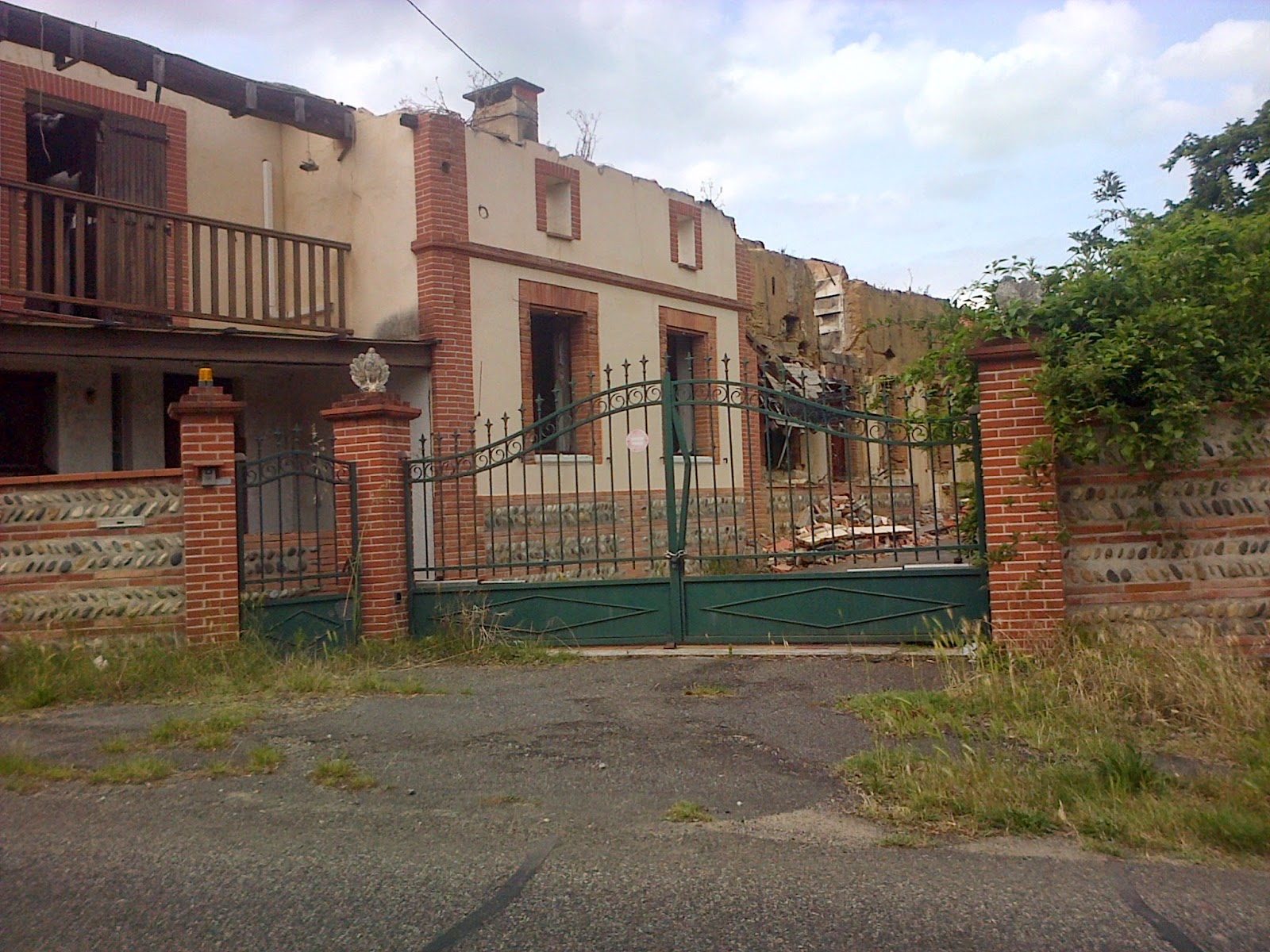
This house was apparently used as a barracks by the German Army during the occupation.  It's a grand house and now in a total state of decay.  It's quite dangerous and threatens to collapse into its large basement any time now.  I'm surprised I hadn't heard of this until just the other day, but apparently villagers swear it's haunted.  No apparitions or cold gusts of wind, though.  Just the sound of boots, dead German soldiers, tramping through the ruins.  I've cruised by this place in the dead of night, three sheets to the wind and haven't heard any tramping boots.  Just one latched shutter somehow got open and hasn't budged since.  But rest assured!  I'm on the case, Egon.

And there is another house, which isn't said to be haunted....but to my mind it is.  Just across the road from where I live there is a handsome house which has been empty since I moved here in 2007.  It's progressively fallen into greater disrepair; in 2005 there was a fire and for a short while some people seemed to be actively dismantling it, although that seems to have ceased.  It used to be a rather elegant tavern named the "auberge de Tail"  but people now call it the "Auberge Rouge" or "Red Tavern."  "Red" as in "Blood"....

L'Auberge Rouge
The full story is a bit hazy, but for an unknown period of time a homeless guy by the name of Georges Haurdine lived and worked at the auberge.  Proprietor Altobella Capelleri had lured him to the auberge with promises of work, room, and board, but neglected to mention the regular beatings.  Described as "slow", Haurdine was exploited by Capelleri, and through a combination of intimidation and violence she was able to keep him like a slave.  Apparently a "family friend" was filmed raping him on several occasions and there were even rumors of sadistic parties involving public officials, but that seems par for the course in France.  Not the parties, but the rumors.  Not so surprising when you consider that this is the country which gave us Gilles de Rais and the Marquis de Sade.  Unlike Gilles de Rais, however, these tales were (probably) either deliberately fabricated to smear the political class or got mixed up in the popular imagination with the "Affaire Alègre" in which Toulousain serial killer Patrice Alègre claimed he organised S+M orgies for public officials and killed on their instructions to cover things up.  Eyes Wide Shut, wot?

Mr Haurdin's body was never found.  As the story goes he was beaten and left for dead by Capelleri herself.  She then had her husband and son bring the body to the pigs, then afterward to a well, where it lay rotting for 6 months.  Unhappy with the progress of decomposition, they retrieved the body, burnt it in the tavern's kitchen chimney and then disposed of the ashes in various trashcans throughout Toulouse.

Maybe the house isn't haunted....but I certainly am....

An earlier article with a few remarks on the Capelleri story.

Thursday, July 25, 2013

Val d'Aure to the Val d'Aran: On the Trail of the Black Madonna

There have have been three successive waves of misfortune over the ages that have diminished the number of so-called “Vierges Noires” (Black Virgins or Black Madonnas) in France.  The most recent has also made surviving examples difficult to get a look at.

The first wave of destruction came at the hands of the Huguenots, who, in their iconoclastic fury, sent countless icons to the bonfires during the bloody years of the Wars of Religion (1562-1598).

In the French Revolution (1789-1799) we see the same fury and more icons were destroyed, chapels razed and sold off for their bricks and blocks, religious art "appropriated".  At least two chapels and one grand monastery within a few kilometers of my house suffered this fate.

The third wave has been theft. The two Black Virgins I could have seen during my stay in the Aure Valley were impossible to see for this last reason.  The example in Comminges was also locked away.

The route one travels from the mouth of the Aure valley over the Pyrenees into Spain dates back to a Roman road, and most likely even back to a prehistoric hunting/trading trail.  During the Middle Ages it was one of the important branches of the "Milky Way", a colorful name for the Road to Santiago de Compstela.  Aure is another word for or, or gold, recalling my own handle here on LoS:  Daurade, meaning "gilded/gilt" or "golden".  (It also means "gilt-head breem.")  How it got this name my be due to its historical importance as a trading corridor.

The Aure Valley is a zone dense with Black Virgins; to the North one finds Notre Dame de Polignan in Montrejeau.  By some accounts there's another at Saint-Bertrand-de-Comminges. To the south, in Spain, Huesca is home to almost ten examples. To the west, a Black Madonna can be found in Héas; to the east, we find them in Oust, vic d'Oust, Belesta, Aspet and St Béat. One would think it would be easy to catch a glimpse of one, but I passed Bourisp, Aragnouet, Sopeira (Spain) and Montrejeau and only saw Nuestra Señora de la O in Sopeira.  And she's not even black.  Ean Begg's list of Black Madonnas often gets me chasing after these "White Black Virgins". 

Notre Dame de Sescas

ND de Sescas
The Black Virgin at Bourisp was stolen in the night of 21st November, 1982. She was quite tall, 150 cm, her black dress decorated with red flowers, seated on a gold throne.

Legend has it that the statue was found c. 1200 CE by a bull in a muddy area near a spring.  She was brought to the local church. But, according to Saillens, she "refused the hospitality of the church and ended up settling on a nearby high point, near another spring."  Usually this happens three times but in this case it took four times before the villagers decided to erect Her chapel where She wanted.

According to this excellent page, legend has it that an unknown architect appeared and made the plan, oversaw the work and then mysteriously disappeared once the work was completed.  This element figures in other legends; I first heard this kind of story at the Loretto Chapel in Santa Fe, New Mexico, about a miraculous staircase.  It obviously came from Spain and is probably as ubiquitous as tales about the "Devil's Bridge".

ND de Sescas is also known to have helped previously infertile couples have children.  One mother, whose previous nine children had died, prayed fervently before the icon and her tenth child outlived her.

Something related, as I see it, is that she was also known to bring an end to drought.

All of these are classic Black Virgin elements: found by a bull, the presence of a spring and subsequent role in fertility, the decision of where to be worshipped, a high place. Nothing unusual in the typology.  Like many of the Pyrenean Black Madonnas, there is also a link to the Saracen invasions.  The author of this brief text makes the excellent point that these legends are valuable historical records because they indicate the approximate dates that the Saracen invasions stopped; Madonnas that had been hidden for decades or perhaps even centuries were then (re)discovered.  This is an important feature of the legend of La Virgen de Montserrat, patroness of Catalonia.

Saillens also points out that nearby at Cadéac, there are thermal springs where Cybele was once worshipped. Cybele was the Phrygian mother of the gods worshipped by the Romans as the Magna Mater in the form of a black stone. Her holy day was the 25th of May, and this black stone was bathed in the river Almo. As I said earlier, today’s road dates back to antiquity, a Roman road linking Zaragosa to points north for both military and commercial purposes.  Ideal conditions for the transmission of her cult.

A pale reflection of the original
The original Virgin may be gone, but her memory is quite strong. A copy has been made; when I remarked that it is quite “white”, the women monitoring the church replied, almost indignantly, “No, look.” She waddled over to the copy and used her cane to pull back Her dress. Okay, the body was quite dark. On the floor, a second copy, black as pitch seemed to overlook the scene, somewhat Asiatic in features. A photograph of the stolen icon completed the scene.  So, secondary images retain the darkness which is, at least for the monitor, an important element of the Madonna of Sescas.

Vaguely Asiatic Black Madonna near the Sescas altar
Perhaps the most visible sign of the historical importance of her cult were the frescoes that decorated the church from floor up to and including the vault, from apse to nave to portico. Great stuff. Scenes from the life of Jesus, portraits of the patriarchs, the last judgement, the seven deadly sins, scenes of the early Christian martyrs. There were also two medallions with the Phoenix and the Pelican, so labelled, which are some of the symbols cherished by the Rosicrucians. The style of these were Renaissance, so it’s quite possible. In any event, a lovely place, well-preserved and obviously quite cherished, with old frescoes, early-20th century ex-votos and a thorough and tasteful contemporary renovation.

Your standard icon of Mary doesn’t evoke such devotion--there are broken and neglected statues of the Virgin all over France.  A Black Virgin, however, even a stolen one, is another story.

Frescos on the vault; hard to see, but these depict the Phoenix and the Pelican feeding its children with itw own blood, a Rosicrucian and masonic symbol of Christ's sacrifice

The Throne of Wisdom -- Aragnouet

The second Black Virgin I wanted to see was about 11k closer towards Spain in the small village of Aragnouet. All I know is that she is known as the Throne of Wisdom and was stolen 30+ years ago from a Templar Church to the southwest of the village. The church is perched aside a steep gorge as the river Neste roars below. Perfect setting for a mystical film à la Polanski’s 9th Gate. But this church is being renovated and when I peeped through the fence inside, all I saw were scaffolds.

Apparently this Virgen is related stylistically to Notre Dame de Belloc in the Catalan village of Dorres, which can be seen in this flickr set.   Notre Dame de Dorres seems to have a lively cult and is first mentioned c. 1260 CE, about the same time as ND de Sescas.  I also wonder if Dorres is etymologically related to "or" which is also Catalan for gold.  Golden in Catalan is "daurat" however, so it may just be a "false friend".

Back in the village, I passed the parish church church where I saw an older bloke with a killer mustache cutting the grass with a scythe. I called ou to him and he came over. I asked him if the church could be visited and he said no, it’s always closed and besides, it’s not very exceptional. I told him what I was after and he told me that the Vierge Noire wasn’t in this church, it was in a locked box. She’d been stolen about 20 years back and found in Paris at an auction house. The village actually had to buy her back!

Bastards, I thought, whoever’d steal a cult object is a real sonofabitch. I said as much and my informant agreed. They’d robbed Bourisp, Guchen, Aragnouet, etc. etc., all up and down the valley in the light of day. We’d be stupid to put it back on display he said. It would just get stolen again and we wouldn’t have much sympathy. Maybe when the Templar Church is finished they could put it back, with a guard? Well, volunteers are hard to come by these days! How many people live in this village? 250. Yeah, I can see how that could pose a problem!

So, this is Vierge Noire country, but if you can actually see one, good luck. Robbers have made them difficult to access, their guardians are understandably cagey and even a few kilometers can take a long time to travel! 

Nuestra Señora de la O, or de Alaón

On to Spain, we wound our way down to Barbastos and headed back to France via the Val d'Aran, the only place in the world where a form of Occitan, the Aranese dialect, is the official language (along with Castellano and Catalan).  On the road to the Val d'Aran, I had a chance to stop at Sopeira, a village of considerable charm in a truly majestic setting, the aquamarine mountain lake, the sheer mountains rising up in a multitude of brown and ochre hues, vultures sailing about.  One of those rare unforgettable places we stumble across from time to time.

The village is home to what began as a Cluniac Abbey, later to become a Benedictine property.  The Benedictines are often associated with Black Madonnas and this place is no exception.  The abbey dates to the late-11th/early-12 c. but there is a Visigothic crypt below the altar that dates to the 9th c.  Both the Benedictine and Visigoth history of the abbey are not inconsistent with other Black Madonna sites I've visited.

Thing is, despite Ean Begg's inclusion of "de la O" in his list of Black Virgins, the statue, though lovely, is white.  Begg has this to say about her:

The monastery of San Pedro contained various relics left there by the Goths....A document of 12 Feb. 845 of Charles the Bald, King of France, grants privileges to Na Sra de Alaón.  The 'O' is the cry of parturition [childbirth] celebrated in the Great O antiphons of longing sung at Vespers from 17-23 Dec.  The first line of the hymn at Lauds in the Office of Our Lady is 'O Gloriosa Domina'.

An alternate and probably more spurious reason for the "O" given by the guardian of the place was that people prayed to Nuestra Señora de Alaón o [or] de Sescas o La Morenita, etc.  This sound like straight-up folk etymology to me, but it would help explain, perhaps, why she is associated with Black Madonna....they're all one and the same as an intercessor.  The guardian didn't seem to think the suggestion that she was a Black Madonna was odd.  When I told her about Begg's designation she simply explained why.  Still, I didn't see any other indications in writing she is a Black Madonna.  

I can't find anything about her origins, but I would be unsurprised to find she was found by a bull or near a spring, any number of mythemes associated with the type.

Notre Dame de Polignan 

Upon our return to France and before jumping back on the autoroute, I took a short detour to Gourdan-Polignan, just next to Montrejeau, to see if I could get inside the chapel of ND de Polignan, having been denied the opportunity on a previous visit years ago.  Like so many chapels in the area, the chapel was locked tight, no doubt as a result if the robberies previously mentioned.  

Notre Dame de Polignan is a 14th c. statue said to have been found by a bull.  She also had the power to teleport, if you will, having at one point been stolen by the nearby village of Huos, who chained her up.  To no avail, she broke her own chains to return to the site of the present chapel.  For this, perhaps, one of her specialties is freeing prisoners, which is not a unique attribute.

Other than that, I can't find much about her other than that her primary day of pilgrimage is the 8th of September, the Nativity of the Virgin.  This also the day of a very old cheese festival; on that day her blessing is sought by pilgrims from all over the Comminges.  Not a trifling matter if your livelihood depends on this delectable dairy product.  Also, given the association of the Virgin with fertility and childbirth, an association with milk is pretty logical.

****
So, all in all I visited four chapels and only managed to see one, cream-colored exemplar of a "Black" Virgin.  Still, the journey being the destination and all that, it was a rewarding experience.  I talked to some nice people eager to share their knowledge, which wasn't so vast, but it was agreeable nonetheless.  I also got to see some beautiful architecture and frescos.  I regret not getting more images, both due to my sucky camera and the locked doors, but I did get some useful data.  The similarities in these legends, especially the assocations with water and bulls, the miraculous indication of where the statue wanted to be worshipped, does indeed support the idea of a distinct genre of Marian cult, something I'm prone to vacillate about.

Anyway, this has turned out longer than expected, so I'm stopping.

****

As with this and all of my posts about the Black Madonna, I consulted the following books.  For those who speak French, Cassagnes-Brouquet presents a solid, academic overview of the subject.  Saillens, also in French, has a lot of valuable anecdotes and a kind of region-by-region guide to where many Black Madonnas can be found.  His work is a bit more speculative; the version linked to below is cost-prohibitive for most of us.  Begg's book is a Jungian free-for-all, as he readily admits.  You have to be careful with his speculations, but the book is jam-packed with fascinating bits of folklore and insights.  The Gazetteer makes up half the book--it is an invaluable list; Begg accompanies me on every journey I make in Spain and France.

****