Showing posts with label penis. Show all posts

Wednesday, June 8, 2011

Unscrupulous Masonic braumeisters in cahoots with Lego: a twisted plot targeting children to get them hooked on beer

Okay, now that I've got your attention with a ridiculous title I can regale you with some more of what one recent reader referred to as "ludicrous nonsense".  We would add "incoherent" to that as well.

Fumer tue

I've always liked the logo for Camel cigarettes.  A chilled out camel in front of some pyramids, facing East, a cluster of palm trees in the background.  Classic.

But every urban folklorist knows that there's another "subliminal" image in the camel's front flank.  One need not even squint to distinguish the form of a man who appears to be holding his schlong, having a wee perhaps....although I've seen it somewhere that it's actually Mae West.  Others assure us that it's Manneken Pis--"Little Man Pee"--a famous sculpture fountain in Brussels.

(The origin of this little piss-ant is cloaked in legend, some involving a lost little boy found the spot, others involving the boy squelching a house fire with his pee or even saving the city by peeing on the fuse of an explosive charge laid by enemies, or again, a little boy pissing on enemies from a tree.)

Flash forward to 1987.  Camel re-brands itself and updates the Camel into a hip dude, shades and baseball cap, cigarette perpetually dangling from the side of his snout.  Joe Camel.  The subliminal messages continue.  Many swear that the snout depicts nothing less than a cock and generous balls.  Others say it's the base of a wang inserted deeply into a vagina.  I guess that's to be expected when a phallic obsession meets an oral fixation.

What concerns us here, however, are not the alleged sexual images in this logo, but the controversy surrounding the use of a cartoon character for marketing cigarettes.  After years of criticism, lawsuits and government pressure, RJ Reynolds stopped the campaign in 1997, denying all the while that they were not targeting children.  However, 

Internal documents produced to the court in Mangini v. R. J. Reynolds Tobacco Company, San Francisco Superior Court No. 959516, demonstrated the industry's interest in targeting children as future smokers.  The importance of the youth market was illustrated in a 1974 presentation by RJR's Vice-President of Marketing who explained that the "young adult market . . . represent[s] tomorrow's cigarette business. As this 14-24 age group matures, they will account for a key share of the total cigarette volume - for at least the next 25 years."  A 1974 memo by the R. J. Reynolds Research Department points out that capturing the young adult market is vital because "virtually all [smokers] start by the age of 25" and "most smokers begin smoking regularly and select a usual brand at or before the age of 18."

Boire avec moderation

So, if cigarette companies do it, why not breweries?  And what better way to get into a kid's head than with toys? (See alcopop).

Dig, if you will, the following photograph of a Lego chevalier I purchased recently for my son:

Sir Drinks-a-Lot

Now take a gander at the Kronenbourg beer logo:

http://www.blogger.com/goog_303970181
 
Kronenbourg (whose name could translate into "Crown Town" if one wanted to play loose with the etymology) is a pale lager produced by the Kronenbourg brewery based in Strasbourg, founded way back in 1664 by Geronimus Hatt.  Despite the fact that it's almost universally denigrated by people I know, everyone seems to drink it.  Personally, I find a frosty 25cl bottle goes down especially well and when I open my first of the day I gulp it down like Bukowski, tilting my head back and downing it in one long swallow.  Then I crack another.

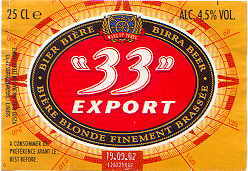
A bit lower on the respectability scale is "33 Export".  Now, I'm not saying that because the number 33 is present we're looking at Masonic symbolism.  Fact is, however, there are 32 + 1 degrees in the Scottish Rite, so a link exists, if only by "passive" association (meaning I can't help it that Freemasonry pops to mind everytime I see the number 32 or 33).  I thought the name might have something to do with the compass rose sometimes pictured in the logo, but the compass rose only has 32 points.

http://www.pichelbruder.de/Home_deutsch_/Die_Biere/Frankreich/33_Export/33_export-c50.jpg

It occurs to me now that the Sol de Mayo on the Argentine flag also has 32 points and in this bears a resemblance to the compass rose, perhaps suggesting the radiation of its revolutionary ideas in all directions...32 export.  Maybe 33 refers to a mysterious unknown direction?  But seriously, that the sun represent a compass is reinforced by taking a look at the Uruguayan version, which features 16 rays, the four cardinal directions decidedly compass-like.  A compass rose is often depicted in a simplified 16 (or 8) point form.


http://fr.wikipedia.org/wiki/Fichier:Sol_de_Mayo-Bandera_de_Uruguay.svg


16-point compass rose:  Tossa del Mar, Catalonia.
Actually, French Wikipedia informs us that the number comes from something more prosaic--the original size of the bottles, 33cl.  Rats, foiled again.

http://en.wikipedia.org/wiki/File:Original_Rolling_Rock_Bottle.jpg
Now, this 33 reminds me of another beer, Rolling Rock.  One mystery of this beer is why "33" is present on the label.  Does it have to do with temperature, the number of words in the little text on the label....or is there something else.  Jesus' age perhaps....or the number of Scottish Rite degrees?  More than a coincidence that early Freemasons met in bars and taverns?

Of course not.  But it is funny.
 
And none of these things really have anything to do with the other.

Thursday, August 5, 2010

The Found Symbol

 
In a comment following our Staff of Life post, the Gid pointed out the similarities between the iconography of Saints Agatha and Lucia, one holding a platter of eyes (Lucia) and the other, of breasts (Agatha). I responded that "....a circle with a dot in the middle could be an eye....or a breast....", proposing that perhaps there was a visual metaphor at play here.

But Gid, ever clever, responded with an entire post (Eye Nipples: What is This) and a comment on that post with a very good link to an article about the origin of the eye/breast association (Before the Milk of the Word: Nipple-Eyes). It's a good survey and has very interesting pictures, all the more fun to look at cuz, well: boobs.

The circle with a dot in the center, however, has also appeared on LoS in the past, a fact I forgot at the time. It was first mentioned in a post about the Voortrekker Monument in South Africa (Hier staan ons voor die Heilige God van hemel en aarde) as a solar symbol, that of Ra. I then stumbled across the same symbol upon the grave of Scouting's founder Lord Baden-Powell (not the Brazilian musician!). In traditional Scouting trail signs it means that the trail has ended and the Scout has gone home; a meaning BP used to mean his own death.

The symbol, it seems, kept....keeps....popping up. I've just received Terry Melanson's book on the Bavarian Illuminati, Perfectibilists (so far, so good, btw) and in the prologue what do I see but the very same symbol. Apparently the Illuminati chose it perhaps because of this very solar connection: power--Illuminating power--radiating outward from a very definite center.* This solar symbolism can be found in a variety of revolutionary contexts--a sun graces the flags of Uruguay and Argentina, for example. It goes without saying Freemasons played an integral part in the independence movements of both countries.

It occurs to me this symbol is also the origin of such Masonic, Revolutionary and other Enlightenment-era symbols as the Eye of Providence (here seen as a nipple!) and the radiating triangle, earlier defined on LoS:
"....as is most usual in the Masonic symbol, the rays emanate from the center of the Triangle, and, as it were, enshroud it in their brilliancy, it is symbolic of the Divine Light. The perverted ideas of the Pagans referred these rays of light to their sun-god and their Sabian worship.

But the true Masonic idea of this Glory is, that it symbolizes that Eternal Light of Wisdom which surrounds the Supreme Architect as a Sea of Glory, and from Him as a common center emanates to the universe of His creation."

So, aside from being an Egyptian (and ancient Chinese?) solar symbol, the "circled dot", or circumpunct, has a variety of other meanings, many from the mystic arts. (It is also Dan Brown's Lost Symbol). Apparently, according to Wikipedia, Freemasons themselves use it to symbolize control over the passions, although I've never seen it used in this context.

I consulted my copy of Mackey's Encylopedia of Freemasonry (a tattered, two-volume deal) and it makes no such claim about passions and the control thereof. What it does describe in the Masonic context is more startling because it refers back to the idea of double pillars and serpents, two other obsessions from past LoS posts, but not before outlining what "we may collect from the true history of its connection with the phallus of the Ancient Mysteries".

Copied/pasted from our pal Dave Lettelier at Phoenix Masonry, here's Mackey's take on the Point Within a Circle:
  
"....it is useless to multiply examples of the prevalence of this symbol among the ancients. Now let us apply this knowledge to the Masonic symbol.

We have seen that the phallus and the point within a circle come from the same source, and must have been identical in signification. But the phallus was the symbol of fecundity, or the male generative principle, which by the ancients was supposed to be the sun, they looking to the creature and not to the Creator, because by the sun's heat and light the earth is made prolific, and its productions are brought to maturity. The point within the circle was then originally the symbol of the sun; and as the lingam of India stood in the center of the lunette, so it stands within the center of the Universe, typified by the circle, impregnating and vivifying it with its heat. And thus the astronomers have been led to adopt the same figure as their symbol of the sun.

Now it is admitted that the Lodge represents the world or the universe, and the Master and Wardens within it represent the sun in three positions. Thus we arrive at the true interpretation of the Masonic symbolism of the point within the circle. It is the same thing, but under a different form, as the Master and Wardens of a Lodge. The Master and Wardens are symbols of the sun, the Lodge of the universe, or world, just as the point is the symbol of the same sun, and the surrounding circle of the universe.

An addition to the above may be given, by referring to one of the oldest symbols among the Egyptians, and found upon their monuments, which was a circle centered by an AUM, supported by two erect parallel serpents; the circle being expressive of the collective people of the world, protected by the parallel attributes, the Power and Wisdom of the Creator. The Alpha and Omega, or the Will representing the Egyptian omnipotent God, surrounded by His creation, having for a boundary no other limit than what may come within his boundless scope, his Wisdom and Power. At times this circle is representedby the Ananta (a Sanskrit word meaning eternity), a serpent with its tail in its mouth. The parallel serpents were of the cobra species.


It has been suggestively said that the Masonic symbol refers to the circuits or circumambulation of the initiate about the sacred Altar, which supports the three Great Lights as a central point, while the Brethren stand in two parallel lines."

 As for those Parallel Lines, Mackey writes: 

"In every well-regulated Lodge there is found a point within a circle, which circle is imboridered by two perpendicular parallel lines. These lines are representative of Saint John the Baptist and Saint John the Evangelist, the two great patrons of Freemasonry to whom our Lodges are dedicated, and who are said to have been "perfect parallels in Christianity as well as Freemasonry" In those English Lodges which have adopted the Union System established by the Grand Lodge of England in 1813. and where the dedication is "to God ad his service," the lines parallel represent Moses and Solomon. As a symbol, the parallel lines are not o be found in the earlier instructions of Freemasonry. Though Oliver defines the symbol on the authority of what he calls the Old Lectures, it is not to be found , any anterior to Preston, and even he only refers to ne parallelism of the two Saints John."

So, I apologize for not extrapolating on this in a convoluted essay, but I'm in the first third of three of my five weeks paid vacation. Vive la France!

Notes: A post script....

* I mentioned this reference to the circumpunct to Terry in a private email and he had this to say (quoted with his permission, natch): 

"I only mentioned the circumpunct a few times in the book - twice I think. Later on though, I write a bit about Weishaupt's philosophic debt to Leibniz. The latter was a bit obsessed with the symbol, which he called the Hieroglyphic Monad....Weishaupt, as a philosopher, would have been alluding to the Monad more than anything."

A further email: 

"Also, Einige Originalschriften is online for the first time; scanned and posted at Scribd. It includes copious examples of [the circled-dot's] use in the wild. The square too was used in their communications, to symbolize a Masonic Lodge."

A few days later....

You will recall that I referred to my copy of Mackey's Encyclopedia (Revised 1917 version) as "tattered". An old pair of volumes, they are bound in embossed leather; trouble is, the leather on the spines, still tenuously clinging to the binding when I got them, has since fallen off in several pieces (I bought them to use, not to look at on the shelf!) This is why I failed to notice that the circumpunct, with the two parallel lines, is embossed on the leather of the spine. Fortunately I still have those scraps of leather lying about.

One must only assume that Mackey, or at least his publisher, found that this symbol was worth using to represent the entire book at a glance as it sat on the shelf. The front cover, incidentally, features the square and compasses with an Eye of Providence in place of a "G", the sun and the moon, a hand bell and a Delta. Funny thing is, this is the first time I've ever remarked upon the circumpunct as a Masonic symbol (there are so many, after all), triggered by reading about the Illuminati.

Sunday, January 24, 2010

Detachable Arms

I've been reading Thomas Mann's "The Magic Mountain". In the "Research" section (of Chapter V), the narrator describes a curious creature that I cannot identify:

In others [i.e., other animals] the male parent reached with his arm down the gullet of the female to deposit the semen within her; after which, bitten off and spat out, it ran away by itself upon its fingers, to the confusion of scientists, who for long had given it Greek and Latin names as an independent form of life.

Now, it's possible that this is just a flight of Mann's fancy, but I'm inclined to think that Mann was describing something that was actually being reported by scientists of the day; of course it also possible that the science of the time was wrong.

Nonetheless, I am curious and would like to learn what animal this is.

Googling for it, I came across an interesting article on BBC entitled Animal Sex that covers some of the same ground as "Research"; both writings, for example, describe the anglerfish's strange mating practices.

The BBC piece also describes some strange cephalopod practices that sound remarkably like the animal that Mann described. Some octopus species have an arm (3rd on the right) that doubles as a penis; they only mate once, and lose that arm in the process--it often remains stuffed inside the female. Some cuttlefish actually have a penis-arm that detaches itself and swims off on its own to empregnate a mate.

Now this all sounds remarkably like what Mann describes except for one key detail: cephalops do not have fingers!

So I ask you: What animal is Mann describing?

Tuesday, August 18, 2009

Weenie roast

Lay where you're laying, don't make a sound
I know they're watching, they're watching
All the commotion, the kiddie like play
Has people talking, talking

You, your sex is on fire

--Kings of Leon: "Sex on Fire"

Sheeyit! Them wimmins is gone plum loco I tellya!

But seriously folks, when we posted about some modern furies a few days ago we never suspected that there were so many other cases of genital arson in recent history.

February 28, 2007. A Montréal woman was sentenced to four years in prison for pouring fondue fuel on her boyfriend's penis and torching it, while he slept.

The man later died of unrelated causes; in the incident he suffered 3rd degree burns and serious psychological trauma.

Attacker Andrée René got four years of prison, mandatory counseling and a court order to stay away from guns and combustibles for ten years. She was 44 years old at the time of sentencing.

August 22, 2007. This couple was divorced, but the high cost of apartments kept them roommates for three years. Apparently fed up with her philandering ex, our frustrated Muscovite set her ex's penis on fire as he sat in front of the TV. Naked. He'd been drinking vodka and fallen asleep.

Police made no predictions about his recovery. Perpetrator "Anna" was 41 years old at the time of her arrest.

December 8, 2008. "I just wanted to burn his penis so it belongs to me and no one else, I didn't mean this to happen." So stated the tad jealous Rajini Narayan, an Australian woman who poured a flammable liquid over her husband's crotch as he slept and then set it alight. Understandably shocked awake, the poor bastard knocked over the bottle of whatever product it was and caused the fire to spread, burning himself more in the process.

The man later died and Narayan was charged on January 6, 2009 with murder, arson and three counts of endangering a life (her kids were in the house it seems). She's also being ordered to have counseling. She was 44 years old at the time of her arrest.

* * * * * * * *

So. There is a lesson to be learned here. If you are a philanderer or even thinking about philandering--and your wife is of a certain age--don't leave anything easily flammable in the house. Hide the spirits, the fondue fuel, sterno cans, lighter fluid, gasoline, whatever! Throw away the candles the matches the tinderbox! Hell, don't watch TV naked, don't hug a friend and whatever you do, for God's sake man, don't go to sleep!!

Monday, August 10, 2009

There is no castration fear

Hell hath no fury

If fury is a blind rage, and a fury is a woman, does that make woman a blind rage?

According to Wikipedia:

In Greek mythology the Erinyes (Ἐρινύες, pl. of Ἐρίνυς Erinys; lit. "the angry ones") or Eumenides (Εὐμενίδες, pl. of Εὐμενής; lit. "the gracious ones") or Furies in Roman mythology were female, chthonic deities of vengeance or supernatural personifications of the anger of the dead.
....
When the Titan Cronus castrated his father Uranus and threw his genitalia into the sea, the Erinyes emerged from the drops of blood, while Aphrodite was born from the seafoam.

Furthermore:

The Erinyes are particularly known for the
persecution of Orestes for the murder of his mother, Clytemnestra.

Cases in point

Glue Stick. July 30. One philanderer found himself held at gunpoint as his wife, two of his mistresses and a sister superglued his penis to his stomach. They had lured them there with a simple ruse in order to exact their revenge....and he found himself in a rather sticky situation.

Flaming Sambuca. August 6. A Greek woman is being hailed as a hero after pouring sambuca on a Englishman's genitals and setting them alight.

By some accounts our drunken limey chose the wrong woman at whom to shake his dick and make sexual advances towards. In Greece, it would seem, revenge is a dish best served hot.

What fellow wouldn't shudder at such a pair of stories? It's not a John Bobbitt de-dicking, but it's still not fun to think about; and if the Copycat Effect is a real phenomenon, we can only warn badly-behaved men to reconsider their ways.

The poetic resonance

This all took place in the Electra bar on the isle of Crete.

Electra is the sister of the aforementioned Orestes, who murdered his mother and her lover to avenge his father's murder. Although the legend is usually about Orestes' revenge and subsequent flight from the avenging Furies, Electra is often depicted as an accomplice. Both Sophocles and Eurip ides named their theatrical version of events after her and she not Orestes is the central character. Indeed, in Euripides' version, when Orestes hesitates to commit matricide, it's Electra who goads him on. She and her brother kill Clytemnestra by making her deep throat a sword.

The so-called "Electra Complex" developed by Freud and given a name by Jung, is said to develop when a young girl discovers she has no penis and becomes sexually attracted to her father, thinking he will impregnate her. He links this to "penis envy" wherein the young girl blames her mother for her "castration." Eventually this resentment goes away when it's trumped by the girl's fear of losing her mother's love. The mother is then internalized and the cycle starts all over again.

But these Electra myths, resonant in their themes of revenge, symbolic castration and death by phallus, are more important as a trigger to evoke the Furies, those vengeful woman who in some versions of the Orestes story transform from vengeful bloodthirsty Erinyes into merciful Eumenides, symbolizing the "good side" of justice. Wikipedia again:

Nonetheless, many scholars believe that when they were originally referred to as the Eumenides, it was not to reference their good sides but as a euphemism to avoid the wrath that would ensue from calling them by their true name.

So remember that the next time you feel like calling a fury, er--a woman--a bitch; just say "yes, dear" instead.

Yeah, sorry; cheap joke. Especially when just a day before the nut roast a turdling by the name George Sodini charged into a health club and killed 3 woman and injured nine others before turning the gun on himself, mainly because he couldn't get laid.

War of the sexes indeed....