I suppose author Terry Melanson could be labeled a "conspiracy theorist", but that would be to lump him into a large sack containing a lot of undesirable company.
I would call Terry a "conspiracy historian." His website (Illuminati Conspiracy Archive) is a rich and well-documented examination of conspiracies: not lizard overlords or any of that, but solid, historically sound researches into not only Illuminism, Freemasonry and various "occult" traditions, but the equally occulted, as in hidden, machinations of the powerful elites bent of maintaining power, wealth and control.
We don't see eye to eye on a lot of stuff, but Terry's a solid guy. He's drawn what is perhaps the inevitable conclusion from my post Try this angle and linked to it on his blog as Triangles and Cronyism. I think the different titles are instructive. Mine is an invitation to try on a pair of lenses and see something from a different angle; he has taken a much more polemic approach. I'm on a fence, he's taken a side. I'm an agnostic, he's a believer. At least I think that is an accurate if a bit glib assessment. Anyway, I hope we're both the richer for the difference.
So yeah, this is a plug, a thanks and a shout-out. Anyone interested in what we examine here on LoS will find his site instructive.

Sunday, January 30, 2011

Saturday, January 29, 2011
The hand is the whole
In A gruesome discovery (Jan. 19) I listed a few literary appearances of the dismembered human hand. I list them again here for quick reference:
The central conflict of Peter Pan between Pan and Captain Hook is instructive. To begin with, Hook is named for the tool that has replaced his missing hand. As you may recall, Pan cut off Hook's hand and fed it to an alligator. This alligator also has a clock in its belly and the mere mention of the beast haunts Hook. Its approach is announced by the ticking of the clock, which I take as an intimation of Hook's mortality. The missing hand is the reason behind Hook's rage and the cause of endless humiliations at the hands of the boy who refuses to grow up.
I see in this the bitterness of the old, who are replaced by the young and who envy what they once were: carefree, virile and exuberant. The old resent the young. In this post-Freudian world, this will obviously be read as a kind of Oedipal conflict and the de-handing a symbolic castration. But I see the severed hand in and of itself as a potent symbol of power and need not necessarily represent a castration. On the other hand, the hand does historically have an association with sexual imagery. Yeah, go ahead and laugh. I'm not talking about Rosy Palm and her five sisters.
In cheiromancy, or palm-reading, the hand is a microcosm of the entire human, so as a metonymy, it's not merely a phallic substitute. It represent the whole entity. Furthermore, according to the cheiromancers, the human is him/herself a microcosm, a mirror of the universe. It is there unsurprising to see that the hand has a history of being used to represent certain gods and in the Western tradition, God Himself.
I see the Pan/Hook conflict repeated in the conflict between Luke Skywalker and Darth Vader in the Star Wars movies. Luke/Pan, the powerful youth, is sought by the Emperor to replace his father, Vader/Hook. (I know that Hook is not Pan's father, but he is usually linked with Wendy's father. This is certainly true in the Disney films and in the play, the same actor ususally plays both Hook and Mr. Darling). Unable to turn Luke to his will, Vader must destroy his son. But he never does. He does render him powerless, however, by cutting off his sword hand. When Luke finally confronts his father again, his severed hand has been replaced, he is again whole and powerful. In the ensuing physical conflict Luke cuts of his father's hand and at end of their struggle, reconverts him to the side of good. Interestingly, we later learn in the prequels that Vader, as a youth, lost his hand in an earlier struggle that precipitated his original turn towards evil.
The hand is a liminal device; it holds keys and opens doors, in this case between a very Manichean good and evil, light and dark. Perhaps this might also be implied in the saying of Jesus referenced above. The hand represent sinful thought and action....it is a point between good and evil; if it can facilitate the passage between a state of sin and a state of grace, removing it can shut the door it has opened.
The monkey's paw in W.W. Jacobs' story is also a kind of tool. It is a magical talisman with great power. In this case, the power of life over death. Tellingly, as the story opens, a father and son are playing chess, the same father and son conflict between light and dark we see in Star Wars. In the story, a family is presented with the monkey's paw, which can grant three wishes. Jokingly, the family wishes for money. As a result, the son dies and the bereaved mother and father receive monetary compensation. The mother then uses the paw, or hand, to wish the boy back to life. As the wind rises up, there comes a banging at the door: the dead son wants to re-enter the world of the living through the front door. As the mother fumbles at the door to let the boy in (a sexual metaphor as well?) the father wisely uses the hand to wish for the revenant son to disappear. Here the father/son conflict and a hand which are critical elements in the transition between states. Life and death in this case, but why not grace and sin, good and evil? "The wages of sin is death" (Romans 6:23).
Might not the monkey's paw in fact be the monkey's pa? Men being the monkey, pa being God the Father? It's worth exploring....
The Hand of Glory was also a magical talisman, made from the severed man of a hanged man. It's powers included the ability to paralyze, but tellingly, it was said to have the power the unlock any door. It was thus used by thieves and figures in a number of macabre tales.
In these literary iterations of the severed hand, I have detected the theme of transition between states and raised the idea of its use as a metonymy. It is used as the latter quite frequently in current idiom. Consider the following examples:
What do the paleontologists tell us set the human a species apart? A fortuitous combination of intelligence, binocular/color vision and opposable thumbs. The importance of these latter two may be expressed in the myths described in the paragraphs to come, in which the hand and the eye are sometimes opposing magical elements.
When I heard about this severed hand in Aucamville, I thought immediately about the hand on Urbain Vitry's tomb. As we have discussed in previous posts, Vitry was influenced by Egyptian precedents. On his tomb there is a Christian version of a most ancient symbol: the hand. At the center of the cross the hand is formed into the gesture of benediction, or blessing, representing the power of Christ invested in priests.

This Carthaginian example may have been the precursor of the hamsa, or hand of Fatima, daughter of the Prophet Muhammed. It is so prevalent in both Arab and Berber culture that it figures in the symbolism of modern Algeria (a distant grandchild of Carthage).
"Hamsa hands often contain an eye symbol. Depictions of the hand, the eye, or the number five in Arabic (and Berber) tradition is related to warding off the evil eye, as exemplified in the saying khamsa fi ainek ("five [fingers] in your eye")" [The expression "a thumb in the eye" is still used in English, to refer to taunting or antagonistic action]
"Archaeological evidence indicates that a downward pointing hamsa used as a protective amulet in the region predates its use by members of the monotheistic faiths. It is thought to have been associated with Tanit, the supreme deity of Carthage (Phoenicia) whose hand (or in some cases vulva) was used to ward off the evil eye."
"The hamsa's path into Jewish culture, and its popularity particularly among the Sephardic Jewish community, can be traced through its use in Phoenicia. Jews sometimes call it the hand of Miriam, referencing the sister of the biblical Moses and Aaron. Five (hamesh in Hebrew) represents the five books of the Torah for Jews. It also symbolizes the fifth letter of the Hebrew alphabet, "Heh", which represents one of God's holy names. Many Jews believe that the five fingers of the hamsa hand remind its wearer to use their five senses to praise God"
Interesting that in this example were looking back to our old friends the Phoenicians, from whom it has found its way into the Abrahamic religions. You will also note that in the votive image above, a raised hand is ensconced between a pair of pillars, which in Egyptian and Phoenician architecture, as well as in Solomon's temple and down to Freemasonry, have been markers of sacred space. If the pillars represent the gate, the hand would seem to represent the key.
But as we can see in the examples of the Hand of Fatima or Miriam, they also represent a power, specifically a power against the eye. Interesting too that it is associated with a woman's hand: Miriam, Fatima, and Carthaginian Tanit, this latter associated with Phoenician Astarte and Egyptian Neith (incidentally, like our recently discussed Dorcas, Neith was associated with weaving--Neith meaning "weaver). The femininity of this hand is interesting in that it serves as a popular folk talisman in decidedly male-dominated spiritual traditions--Judaism and Islam. I find it especially striking that that Tanit's hand could ward of the evil eye....a power sometimes attributed to her vulva. Tanit, Astarte and Neith are all fertility goddesses.
Tanit was symbolized by an ankh-like glyph with a triangular base surmounted by a bar and circle. This in turn was surmounted by a symbol representing a crescent moon which also evokes the eye. In the standard work on the symbol, F.O. Hvidberg-Hansen interprets this symbol as a woman raising her hands.
Bruno Barbatti, in Berber Carpets of Morocco: The Symbols Origin and Meaning, sheds further light on the sexual symbolism hinted at in my look at The Monkey's Paw, with attention being paid to the hamsa's use as a door-knocker. If you recall, the zombie son returns banging at the door, while his mother struggles to let him in. The paw is then used to ward him off.
These two khamsa specimens reflect a combined symbolism: the palm of the hand, decorated with a lozenge....together with the shortened thumb and little finger symbolize the bell-shaped vulva. The three (!) middle long fingers on to which, corresponding to their significance, a snake and daggers have been inlaid, embody the male presence. This is the tongue which makes the bell ring. It is no coincidence that the hand of Fatima is often used as a door-knocker, serving the one who wishes to enter, and at the same time warding of evil.
So here the hand is not only associated with a vagina, but with phallic symbols as well, phallic symbols which in turn are associated with the tongue, the organ of speech. We have already spoken of its use as a way to ward of the evil eye. This conflation of the senses may explain its Jewish symbolism, that is its use as a reminder to praise God with all five senses.
I mentioned Rosy Palms earlier as a slang term for the hand which masturbates....is the hand/eye conflict the origin of of the myth that having a wank will cause a man to go blind?
I should also add that until reading this, I'd forgotten that in France, a disembodied hand is a traditional door-knocker. This may have something to do with its use in the Arab world, a recollection of a pre-Christian diffusion of North African religion spread into Gaul by the Romans. Or maybe not. One knocks on a door with the hand, makes sense to forge a knocker in the shape of one.
If I may add a cruder thought, it occurs to me as in the paw of the monkey, the paws of any creature correspond both to feet and hands. So if we speak of an animal's toes, we are in a sense also speaking of its fingers. I'm thinking here of "camel toe", the slang term for a woman's labia as seen through tightly-fitting pants. Here we have yet another conflation, "labia" are of course "lips", bringing us once again to idea of the mouth. Hey, I'm not the first one to make this point. Ever here of the vagina dentata, or "toothed vagina"? This myth appears in both European and South American mythologies.
One need not look as far as Tanit, Polynesia or Paraguay, however, to find the hand as both symbol of divinity and of human speech. The disembodied Hand of God, or Manus Dei, is a long-standing motif in both Judaic and Christian art. It would be a task in itself to document this motif, but I'd like to note a few aspects of its use which seem most relevant here. The Manus Dei is, above all a metonymy. The Hand represents God Himself.
This motif has its origins in Judaism, in which depictions of God are still considered unacceptable, much like in Islam. This even extends to writing the names of God....you will often see "G-d" written by observant Jews in order to bypass this interdiction. In Western Christian art, images of God both as the Father and the Son have become acceptable and the motif is most prevalent in Medieval art.
According to Wikipedia, "Gertrud Schiller distinguishes three functions of the hand in Christian art: as symbol of either God's presence or the voice of God, or signifying God's acceptance of a sacrifice." This idea that the Hand of God is a stand-in for His voice is particularly intriguing It seems that research has indicated that both words and gestures stimulate the same areas of the brain. So, why not symbolize the Voice of God with His Hand
Of course, it's fairly evident that this hand relates also to the hamsa talisman found in both Islamic and Jewish contexts, and which may originate from Phoenician prototypes.
The hand motif is a varied and complex phenomenon, but I would like to here note its use as a sign of divine approval of earthly power. Examples date back to fourth century, and apparently was most often associated with the crowning of Empresses. Traditional French coronation regalia included a kind of scepter terminating in a hand forming the gesture of benediction and "represents the justice-dispensing power of God as being literally in the hands of the king." (emphasis added) The King, as God's representative on earth, thus is by proxy both His hands and His voice.
Hoo-boy. No doubt I could go on and on, and it would be useful for someone more inclined than I to look at this outside of the North African and European contexts--my passing references to Mudras notwithstanding. Not looking into these should not be seen as an ethnocentric diss. I'm just less versed in other cultures and more focused on Mediterranean cultures at this point in my life. Even in this, I think I've left out a lot in what is sometimes a swift and choppy read, to be sure.
Finally, I hope for friends who read this they've gained some insight into why the severed hand found near my house has exercised such a fascination over me. I mean, aside from the fact a person was either murdered and dismembered in the vicinity of my house or murdered elsewhere and then distributed in the woods nearby. True Crime is powerful stuff; as much for the rational fears about violence as it is for its mythological resonance.
Cut. That's a wrap....
Note from The Gid:
"Based on a quick glance, though, I want to ask: Have you addressed shaking hands? In regards to hands as a gateway or liminal device, it seems like hands powerfully connect us to other people. Not just the handshake, but, well, you know, touching other people ... "touching others" is a metaphor for a transcendental connection with other people (i.e., the hand as the liminal device), maybe, or I'm just drunk and being sloppy in my thought and relaying a "touching" tale. And we can see other people and talk to other people, but you can't just go around touching everyone for crying out loud. Lay your hands on another person, and you'd better be a priest, doctor, or lover."
I should quote this again from an earlier post:
Another inconclusive symbol, found in a round medallion at the center of the cross atop the tomb, is a human hand. By chance we stumbled across another entry in Mackey's Encyclopedia--Hand (p. 317)--illustrated by an engraving of the hand in a nearly identical gesture:
"In Freemasonry, the hand as a symbol holds a high place, because it is the principal seat of the sense of feeling so highly revered by Masons....Horapollo says that among the Egyptians the hand was the symbol of a builder, or one fond of building, because all labor proceeds from the hand." Mackey continues, explaining its use in Christian iconography in a gesture of benediction: "The form of this act of benediction, as adopted by the Roman Church, which seems to have been borrowed from the symbols of the Phrygian and Eleusinian priest or hierophants, who used it in their mystical processions, presents a singular analogy, which will be interesting to Mark Master Masons, who will recognize on it a symbol of their own ritual. In the benediction referred to, as given in the Latin Church, the thumb, index and middle fingers are extended, and the other two bent against the palm. The church explains this position of the extended thumb and two fingers as representing the Trinity; but the older symbol of the Pagan priests, which was precisely of the same form, must have had a different meaning. A writer in the British Magazine (vol.i., p.565) thinks that the hand, which was used in the Mithraic mysteries in this position, was symbolic of the Light emanating not from the sun, but from the Creator, directly as a special manifestation....Certainly, to the Mason, the hand is most important as the symbol of that mystical intelligence by which one Mason knows another "in the dark as well as in the light."
Given that the symbol is used as a sign of benediction, it may not be anything more than a sign of his Catholic faith. But maybe it's a Masonic reference. It's certainly an eye-popper. Given Vitry's passion for Egyptian architecture, by which his tomb was inspired, it may simply be a nod to the use described by Horapollo. It's worth recalling the notion that the Egyptian obelisk is also thought to symbolize a petrified ray of light, much akin to our anonymous British writer's theory that the hand symbol represents the light emanating from the Creator. Again, like the square and compasses, it lead to tantalizing speculation but nothing conclusive. Maybe the hand is simply a brazen variation on the Anahinthan cock's comb.
Back to the present:
Given this post, I think it less likely to be a Masonic reference....
- The Lost Symbol; a severed hand starts the action.
- Star Wars: Luke Skywalker /Darth Vader....Vader is actually referenced in Symbol in what I took as a nod to the severed hand mytheme.
- Peter Pan: Captain Hook. His lost hand drives his fury and thus, the plot.
- The Monkey's Paw revolves around the magical power of a monkey's paw, or hand.
- This guy
has a neat collection about the Hand of Glory "and other gory tales about human hands." The severed hand in The Lost Symbol is in fact a Hand of Glory (explained below). - The Bible: Jesus, according to some translations, said: "If your right hand offends you, cut it off...." (Matthew 5:30; Mark 9:43).
The central conflict of Peter Pan between Pan and Captain Hook is instructive. To begin with, Hook is named for the tool that has replaced his missing hand. As you may recall, Pan cut off Hook's hand and fed it to an alligator. This alligator also has a clock in its belly and the mere mention of the beast haunts Hook. Its approach is announced by the ticking of the clock, which I take as an intimation of Hook's mortality. The missing hand is the reason behind Hook's rage and the cause of endless humiliations at the hands of the boy who refuses to grow up.
I see in this the bitterness of the old, who are replaced by the young and who envy what they once were: carefree, virile and exuberant. The old resent the young. In this post-Freudian world, this will obviously be read as a kind of Oedipal conflict and the de-handing a symbolic castration. But I see the severed hand in and of itself as a potent symbol of power and need not necessarily represent a castration. On the other hand, the hand does historically have an association with sexual imagery. Yeah, go ahead and laugh. I'm not talking about Rosy Palm and her five sisters.
In cheiromancy, or palm-reading, the hand is a microcosm of the entire human, so as a metonymy, it's not merely a phallic substitute. It represent the whole entity. Furthermore, according to the cheiromancers, the human is him/herself a microcosm, a mirror of the universe. It is there unsurprising to see that the hand has a history of being used to represent certain gods and in the Western tradition, God Himself.
I see the Pan/Hook conflict repeated in the conflict between Luke Skywalker and Darth Vader in the Star Wars movies. Luke/Pan, the powerful youth, is sought by the Emperor to replace his father, Vader/Hook. (I know that Hook is not Pan's father, but he is usually linked with Wendy's father. This is certainly true in the Disney films and in the play, the same actor ususally plays both Hook and Mr. Darling). Unable to turn Luke to his will, Vader must destroy his son. But he never does. He does render him powerless, however, by cutting off his sword hand. When Luke finally confronts his father again, his severed hand has been replaced, he is again whole and powerful. In the ensuing physical conflict Luke cuts of his father's hand and at end of their struggle, reconverts him to the side of good. Interestingly, we later learn in the prequels that Vader, as a youth, lost his hand in an earlier struggle that precipitated his original turn towards evil.
The hand is a liminal device; it holds keys and opens doors, in this case between a very Manichean good and evil, light and dark. Perhaps this might also be implied in the saying of Jesus referenced above. The hand represent sinful thought and action....it is a point between good and evil; if it can facilitate the passage between a state of sin and a state of grace, removing it can shut the door it has opened.
The monkey's paw in W.W. Jacobs' story is also a kind of tool. It is a magical talisman with great power. In this case, the power of life over death. Tellingly, as the story opens, a father and son are playing chess, the same father and son conflict between light and dark we see in Star Wars. In the story, a family is presented with the monkey's paw, which can grant three wishes. Jokingly, the family wishes for money. As a result, the son dies and the bereaved mother and father receive monetary compensation. The mother then uses the paw, or hand, to wish the boy back to life. As the wind rises up, there comes a banging at the door: the dead son wants to re-enter the world of the living through the front door. As the mother fumbles at the door to let the boy in (a sexual metaphor as well?) the father wisely uses the hand to wish for the revenant son to disappear. Here the father/son conflict and a hand which
Might not the monkey's paw in fact be the monkey's pa? Men being the monkey, pa being God the Father? It's worth exploring....
The Hand of Glory was also a magical talisman, made from the severed man of a hanged man. It's powers included the ability to paralyze, but tellingly, it was said to have the power the unlock any door. It was thus used by thieves and figures in a number of macabre tales.
In these literary iterations of the severed hand, I have detected the theme of transition between states and raised the idea of its use as a metonymy. It is used as the latter quite frequently in current idiom. Consider the following examples:
- His response was a bit heavy-handed.
- She rules the office with an iron fist.
- The man was strong-armed into signing the contract.
- He can't escape the long arm of the law.
What do the paleontologists tell us set the human a species apart? A fortuitous combination of intelligence, binocular/color vision and opposable thumbs. The importance of these latter two may be expressed in the myths described in the paragraphs to come, in which the hand and the eye are sometimes opposing magical elements.
When I heard about this severed hand in Aucamville, I thought immediately about the hand on Urbain Vitry's tomb. As we have discussed in previous posts, Vitry was influenced by Egyptian precedents. On his tomb there is a Christian version of a most ancient symbol: the hand. At the center of the cross the hand is formed into the gesture of benediction, or blessing, representing the power of Christ invested in priests.

| Tomb of Urbain Vitry, died 1863 |
The use of sacred hand gestures is not limited to Catholic or Christian practice. Hinduism and Buddhism have a highly evolved system of powerful signs called Mudras, and organizations such as Freemasonry and Scouting use hand gestures as salutes, modes of recognition and, like the Hand of Glory, a way to gain entry into restricted spaces.
 | |||
| Tanit Votive Stela, Carthage, 4th c BCE; |
"Hamsa hands often contain an eye symbol. Depictions of the hand, the eye, or the number five in Arabic (and Berber) tradition is related to warding off the evil eye, as exemplified in the saying khamsa fi ainek ("five [fingers] in your eye")" [The expression "a thumb in the eye" is still used in English, to refer to taunting or antagonistic action]
"Archaeological evidence indicates that a downward pointing hamsa used as a protective amulet in the region predates its use by members of the monotheistic faiths. It is thought to have been associated with Tanit, the supreme deity of Carthage (Phoenicia) whose hand (or in some cases vulva) was used to ward off the evil eye."
"The hamsa's path into Jewish culture, and its popularity particularly among the Sephardic Jewish community, can be traced through its use in Phoenicia. Jews sometimes call it the hand of Miriam, referencing the sister of the biblical Moses and Aaron. Five (hamesh in Hebrew) represents the five books of the Torah for Jews. It also symbolizes the fifth letter of the Hebrew alphabet, "Heh", which represents one of God's holy names. Many Jews believe that the five fingers of the hamsa hand remind its wearer to use their five senses to praise God"
Interesting that in this example were looking back to our old friends the Phoenicians, from whom it has found its way into the Abrahamic religions. You will also note that in the votive image above, a raised hand is ensconced between a pair of pillars, which in Egyptian and Phoenician architecture, as well as in Solomon's temple and down to Freemasonry, have been markers of sacred space. If the pillars represent the gate, the hand would seem to represent the key.
But as we can see in the examples of the Hand of Fatima or Miriam, they also represent a power, specifically a power against the eye. Interesting too that it is associated with a woman's hand: Miriam, Fatima, and Carthaginian Tanit, this latter associated with Phoenician Astarte and Egyptian Neith (incidentally, like our recently discussed Dorcas, Neith was associated with weaving--Neith meaning "weaver). The femininity of this hand is interesting in that it serves as a popular folk talisman in decidedly male-dominated spiritual traditions--Judaism and Islam. I find it especially striking that that Tanit's hand could ward of the evil eye....a power sometimes attributed to her vulva. Tanit, Astarte and Neith are all fertility goddesses.
Tanit was symbolized by an ankh-like glyph with a triangular base surmounted by a bar and circle. This in turn was surmounted by a symbol representing a crescent moon which also evokes the eye. In the standard work on the symbol, F.O. Hvidberg-Hansen interprets this symbol as a woman raising her hands.
Bruno Barbatti, in Berber Carpets of Morocco: The Symbols Origin and Meaning, sheds further light on the sexual symbolism hinted at in my look at The Monkey's Paw, with attention being paid to the hamsa's use as a door-knocker. If you recall, the zombie son returns banging at the door, while his mother struggles to let him in. The paw is then used to ward him off.
These two khamsa specimens reflect a combined symbolism: the palm of the hand, decorated with a lozenge....together with the shortened thumb and little finger symbolize the bell-shaped vulva. The three (!) middle long fingers on to which, corresponding to their significance, a snake and daggers have been inlaid, embody the male presence. This is the tongue which makes the bell ring. It is no coincidence that the hand of Fatima is often used as a door-knocker, serving the one who wishes to enter, and at the same time warding of evil.
So here the hand is not only associated with a vagina, but with phallic symbols as well, phallic symbols which in turn are associated with the tongue, the organ of speech. We have already spoken of its use as a way to ward of the evil eye. This conflation of the senses may explain its Jewish symbolism, that is its use as a reminder to praise God with all five senses.
I mentioned Rosy Palms earlier as a slang term for the hand which masturbates....is the hand/eye conflict the origin of of the myth that having a wank will cause a man to go blind?
I should also add that until reading this, I'd forgotten that in France, a disembodied hand is a traditional door-knocker. This may have something to do with its use in the Arab world, a recollection of a pre-Christian diffusion of North African religion spread into Gaul by the Romans. Or maybe not. One knocks on a door with the hand, makes sense to forge a knocker in the shape of one.
If I may add a cruder thought, it occurs to me as in the paw of the monkey, the paws of any creature correspond both to feet and hands. So if we speak of an animal's toes, we are in a sense also speaking of its fingers. I'm thinking here of "camel toe", the slang term for a woman's labia as seen through tightly-fitting pants. Here we have yet another conflation, "labia" are of course "lips", bringing us once again to idea of the mouth. Hey, I'm not the first one to make this point. Ever here of the vagina dentata, or "toothed vagina"? This myth appears in both European and South American mythologies.
One need not look as far as Tanit, Polynesia or Paraguay, however, to find the hand as both symbol of divinity and of human speech. The disembodied Hand of God, or Manus Dei, is a long-standing motif in both Judaic and Christian art. It would be a task in itself to document this motif, but I'd like to note a few aspects of its use which seem most relevant here. The Manus Dei is, above all a metonymy. The Hand represents God Himself.
This motif has its origins in Judaism, in which depictions of God are still considered unacceptable, much like in Islam. This even extends to writing the names of God....you will often see "G-d" written by observant Jews in order to bypass this interdiction. In Western Christian art, images of God both as the Father and the Son have become acceptable and the motif is most prevalent in Medieval art.
According to Wikipedia, "Gertrud Schiller distinguishes three functions of the hand in Christian art: as symbol of either God's presence or the voice of God, or signifying God's acceptance of a sacrifice." This idea that the Hand of God is a stand-in for His voice is particularly intriguing It seems that research has indicated that both words and gestures stimulate the same areas of the brain. So, why not symbolize the Voice of God with His Hand
Of course, it's fairly evident that this hand relates also to the hamsa talisman found in both Islamic and Jewish contexts, and which may originate from Phoenician prototypes.
The hand motif is a varied and complex phenomenon, but I would like to here note its use as a sign of divine approval of earthly power. Examples date back to fourth century, and apparently was most often associated with the crowning of Empresses. Traditional French coronation regalia included a kind of scepter terminating in a hand forming the gesture of benediction and "represents the justice-dispensing power of God as being literally in the hands of the king." (emphasis added) The King, as God's representative on earth, thus is by proxy both His hands and His voice.
Hoo-boy. No doubt I could go on and on, and it would be useful for someone more inclined than I to look at this outside of the North African and European contexts--my passing references to Mudras notwithstanding. Not looking into these should not be seen as an ethnocentric diss. I'm just less versed in other cultures and more focused on Mediterranean cultures at this point in my life. Even in this, I think I've left out a lot in what is sometimes a swift and choppy read, to be sure.
Finally, I hope for friends who read this they've gained some insight into why the severed hand found near my house has exercised such a fascination over me. I mean, aside from the fact a person was either murdered and dismembered in the vicinity of my house or murdered elsewhere and then distributed in the woods nearby. True Crime is powerful stuff; as much for the rational fears about violence as it is for its mythological resonance.
Cut. That's a wrap....
Note from The Gid:
"Based on a quick glance, though, I want to ask: Have you addressed shaking hands? In regards to hands as a gateway or liminal device, it seems like hands powerfully connect us to other people. Not just the handshake, but, well, you know, touching other people ... "touching others" is a metaphor for a transcendental connection with other people (i.e., the hand as the liminal device), maybe, or I'm just drunk and being sloppy in my thought and relaying a "touching" tale. And we can see other people and talk to other people, but you can't just go around touching everyone for crying out loud. Lay your hands on another person, and you'd better be a priest, doctor, or lover."
I should quote this again from an earlier post:
Another inconclusive symbol, found in a round medallion at the center of the cross atop the tomb, is a human hand. By chance we stumbled across another entry in Mackey's Encyclopedia--Hand (p. 317)--illustrated by an engraving of the hand in a nearly identical gesture:
"In Freemasonry, the hand as a symbol holds a high place, because it is the principal seat of the sense of feeling so highly revered by Masons....Horapollo says that among the Egyptians the hand was the symbol of a builder, or one fond of building, because all labor proceeds from the hand." Mackey continues, explaining its use in Christian iconography in a gesture of benediction: "The form of this act of benediction, as adopted by the Roman Church, which seems to have been borrowed from the symbols of the Phrygian and Eleusinian priest or hierophants, who used it in their mystical processions, presents a singular analogy, which will be interesting to Mark Master Masons, who will recognize on it a symbol of their own ritual. In the benediction referred to, as given in the Latin Church, the thumb, index and middle fingers are extended, and the other two bent against the palm. The church explains this position of the extended thumb and two fingers as representing the Trinity; but the older symbol of the Pagan priests, which was precisely of the same form, must have had a different meaning. A writer in the British Magazine (vol.i., p.565) thinks that the hand, which was used in the Mithraic mysteries in this position, was symbolic of the Light emanating not from the sun, but from the Creator, directly as a special manifestation....Certainly, to the Mason, the hand is most important as the symbol of that mystical intelligence by which one Mason knows another "in the dark as well as in the light."
Given that the symbol is used as a sign of benediction, it may not be anything more than a sign of his Catholic faith. But maybe it's a Masonic reference. It's certainly an eye-popper. Given Vitry's passion for Egyptian architecture, by which his tomb was inspired, it may simply be a nod to the use described by Horapollo. It's worth recalling the notion that the Egyptian obelisk is also thought to symbolize a petrified ray of light, much akin to our anonymous British writer's theory that the hand symbol represents the light emanating from the Creator. Again, like the square and compasses, it lead to tantalizing speculation but nothing conclusive. Maybe the hand is simply a brazen variation on the Anahinthan cock's comb.
Back to the present:
Given this post, I think it less likely to be a Masonic reference....
Shotgun Willie
Long as we're going on about pies & tea and whatnot, reckon we might as well share this somewhat overlooked stoner country classic:
Thursday, January 27, 2011
Pies
January 23 was National Pie Day -- not to be confused with National Pi Day (March 14, natch) -- which gave me an opportunity to reflect on one of my favorite subjects: Pie.

And pied, too!

Some of my favorite Americans were great pie (tossing) devotes, including the Three Stooges, Laurel and Hardy, Jackie Gleason, Johnny Carson, Charlie Chaplin, Tyrone Slothrop, Bugs Bunny, Gilligan, the Beastie Boys, Lucille Ball, Dr. Strangelove....
What a strong endorsement! But what, after all, could be more American than apple pie, hotdogs, and mom? (Although we might reconsider the wieners, what with all of the hot dog eating contest controversies -- it's enough to make the Black Sox look clean!) Furthermore, what goes better together than pie and tea? And what's more American these days than considerations of tea?
You think, perhaps, that this is a joke. "Why pie," asks the regular reader of LoS? Consider, however, that the Catholic's Lord's body is baked dough, the very staff of life, as we've previously reported. Consider, too, that the Montpelier Argus and Patriot once wrote that:
So let's step back a bit, peek under the crust, and dig into the pie ... er, rather, dig into the history of the pie.
As far as I can tell (using my google-fu & a bit of guess work), Egyptians are credited with inventing pie, but this accreditation appears to simply stem from their invention (again, as far as I can tell) of a flaky baked crust that they layered with honey -- more like a pastry, I expect, than a pie. The notion spread from the Egyptians to the Greeks to the Roman to Europe at large, where the pie slowly evolved into a method for preserving meats (i.e., meats were spiced, sugared, and encrusted to prevent the growth of bacteria).
I would imagine that the expansion from a pastry-like product was slow going. Consider that Greek spinach pie is--let's face it--not pie at all. It's probably, I would guess, the Romans who really created the first dishes that we might recognize as the modern pie. (Wikipedia disagrees.)
But Rome fell and the Dark Ages descended upon the pie.
Of course they say that the Dark Ages are only dark because we've failed to shine a light upon them. Did the pie survive this age of great European migrations because pie made meat portable? Did local varieties emerge and and take root when Rome fell? We lack, it appears, the historical documents (like "Ye Dark Ages Cookbook") to know.
At any rate, once kingdoms were formed, the wealth and security of nations allowed the pie to flourish. It seems, in fact, that pie creativity may have pinnacled in the 1500s. Cookbooks from the time feature (or so my google-fu tells me) meat pies of all sorts, from turtle to peacock, with bird legs often extruding the crust to form convenient handles. Fruits first entered the fillings around this time, and, incredibly, even living things were encrusted:
This isn't just some make believe tune. Kings had large pocket books and major entertainment needs; their chefs soon had all sorts of living things bursting forth from of pies, from song birds, to human dwarfs, to jugglers who emerged a-juggling.
But if the pie's creative zenith resulted from exorbitant wealth and kingly boredom, it declined with the emergence of democracies and the settlements of frontiers.
America, in fact, took the pie for its own. Someone once asked Answers.com "Did ben franklin like pie?"; the "favorited" answer (provided by Cheese445532) was "yep, if he was normal in that regard".
But to turn to more authoritative sources, there's a great article entitled "The Real American Pie" that I hope you'll read. I've stuck a lot of links into this post, but if you read just one, this should be it. (And if you read two, well, this history of the pie is pretty damn good, too.)
In "The Real American Pie", Cliff Doerksen spins a wonderful yarn of the pie's evolution in America, which I'll try to butcher down into one or two bloody paragraphs. Pie was, for this frontier land, a return to the pie as preserved meat. Mince meat was the pie of the day -- the pie of America, in fact. It was apparently reviled on the one hand as a papist abomination that caused murder-inducing nightmares if not outright death; it was proclaimed as a Darwinian winnowing agent of weak genetic lines on the American frontier and was decried by abolitionists thanks to its alcohol level that was closer to brandy than beer.
On the other hand, it was widely popular. Doerksen seems to consider it the cheeseburger of its day.
Until, Doerksen reports, it was mysteriously supplanted by apple pie, all of sudden-like in the 40s.
Doerksen illuminates, struggles, and leaves us with this paradox of the pie, both hated and loved, popular yet vanishing; we shall, however, forge ahead into contemporary times, well aware of the irony that the past that is closest is murkiest.
Of today we can say safely, at least, that mince meat is a watered-down dish, safe for children and vegetarians, and consumed almost chiefly on Thanksgiving and Christmas (and, hopefully, National Pie Day and National Pi Day, too). It's been replaced by apple pie in popular American culture, where, since the 40s, apple pie has reigned as the American dish; today it feels only natural to declare apple pie so, for we assume it is linked straight back to Johnny Appleseed, a great American mythos, right up there with my home-state's hero, Acrefoot Johnson.
But how appropriate that, as Doerksen exposed, our national pie changed in the 40s -- for the world was a-changin' to.
Here, my friends, I am afraid that I begin to struggle as a writer, finding it difficult to present the Truth within the Narrative -- at least without bending the Truth. I suspect that if you want to challenge me on the Truth of this post, you will challenge the veracity of the next few paragraphs as I try to trace the national mood of the United States through its use of the pie.
But I will try.
Or at least I would like to try. I would like, for example, to describe the thrown pie's arc in terms of the US' transition from the patriot zeal of the World Wars, to the growing distrust of the 60s, and on to the violence of contemporary terrorism. I would like to see "American as apple pie" as a concept in motion, a symbol that evolves over time as revolutionaries grapple for control of the nation. Consider the great prank of "The Pieman" splatting NY's mayor with apple crumb because he's a crumby mayor of the Big Apple: Does this not represent the pie wrestled from its status as a symbol of stolidness and patriotism only to be flung back at the power elite?
Were the elite not brought down to earth, reduced to clowns, just as the pie itself is reduced to clownery?
And from these prankish beginnings, these counter-cultural flings, can we further describe the changing national character by showing pie tossers moving from coconut cream fillings (a tasty prank for the pied) to bitter shaving cream and on to the Al Pieda who were ready to kill ideas with pie?
And if the apple pie is America, might we then trace the trajectory of the nation in the arc described by the tossed pie?
Or may we at least pie chart the national mood?

No. I think I've stretched the truth too far to fit my yearning for a narrative. Pie tossings have, I do truly think, moved from merriment, to prank-ish protests, to acts of anger. But I have no proof that their fillings graduated from coconut cream to shaving cream for the purpose of spite; likewise, it's patronizing to imagine that the counter-cultural movements of the 60s and 70s were pranks, and it's dishonest to suggest that terrorism is something new.
But would it be too much for me to misquote Pynchon's opening line in that great American novel, Mason & Dixon, in order to suggest that the pies have flown their Arcs and starr'd our national character? Is it too much to suggest that as pie attacks and our culture have moved toward more extremes, it behooves our national leaders to duck quickly as the public's arsenal moves to ever less tasty tossings?
Ahh, well. Yesterday's pies might always be the best. In times like these, one might do well to remember the immortal words of Jonathon Swift:
In the good words of Daurade:

And pied, too!
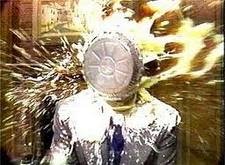
Some of my favorite Americans were great pie (tossing) devotes, including the Three Stooges, Laurel and Hardy, Jackie Gleason, Johnny Carson, Charlie Chaplin, Tyrone Slothrop, Bugs Bunny, Gilligan, the Beastie Boys, Lucille Ball, Dr. Strangelove....
What a strong endorsement! But what, after all, could be more American than apple pie, hotdogs, and mom? (Although we might reconsider the wieners, what with all of the hot dog eating contest controversies -- it's enough to make the Black Sox look clean!) Furthermore, what goes better together than pie and tea? And what's more American these days than considerations of tea?
You think, perhaps, that this is a joke. "Why pie," asks the regular reader of LoS? Consider, however, that the Catholic's Lord's body is baked dough, the very staff of life, as we've previously reported. Consider, too, that the Montpelier Argus and Patriot once wrote that:
Mince pie, like Masonry, arouses curiosity from the mystery attaching to it. Its popularity shall never wane until faith is lost in sight.
So let's step back a bit, peek under the crust, and dig into the pie ... er, rather, dig into the history of the pie.
As far as I can tell (using my google-fu & a bit of guess work), Egyptians are credited with inventing pie, but this accreditation appears to simply stem from their invention (again, as far as I can tell) of a flaky baked crust that they layered with honey -- more like a pastry, I expect, than a pie. The notion spread from the Egyptians to the Greeks to the Roman to Europe at large, where the pie slowly evolved into a method for preserving meats (i.e., meats were spiced, sugared, and encrusted to prevent the growth of bacteria).
I would imagine that the expansion from a pastry-like product was slow going. Consider that Greek spinach pie is--let's face it--not pie at all. It's probably, I would guess, the Romans who really created the first dishes that we might recognize as the modern pie. (Wikipedia disagrees.)
But Rome fell and the Dark Ages descended upon the pie.
Of course they say that the Dark Ages are only dark because we've failed to shine a light upon them. Did the pie survive this age of great European migrations because pie made meat portable? Did local varieties emerge and and take root when Rome fell? We lack, it appears, the historical documents (like "Ye Dark Ages Cookbook") to know.
At any rate, once kingdoms were formed, the wealth and security of nations allowed the pie to flourish. It seems, in fact, that pie creativity may have pinnacled in the 1500s. Cookbooks from the time feature (or so my google-fu tells me) meat pies of all sorts, from turtle to peacock, with bird legs often extruding the crust to form convenient handles. Fruits first entered the fillings around this time, and, incredibly, even living things were encrusted:
Sing a song of sixpence,
A pocket full of rye.
Four and twenty blackbirds,
Baked in a pie.
When the pie was opened,
The birds began to sing;
Wasn't that a dainty dish,
To set before the king?
This isn't just some make believe tune. Kings had large pocket books and major entertainment needs; their chefs soon had all sorts of living things bursting forth from of pies, from song birds, to human dwarfs, to jugglers who emerged a-juggling.
But if the pie's creative zenith resulted from exorbitant wealth and kingly boredom, it declined with the emergence of democracies and the settlements of frontiers.
America, in fact, took the pie for its own. Someone once asked Answers.com "Did ben franklin like pie?"; the "favorited" answer (provided by Cheese445532) was "yep, if he was normal in that regard".
But to turn to more authoritative sources, there's a great article entitled "The Real American Pie" that I hope you'll read. I've stuck a lot of links into this post, but if you read just one, this should be it. (And if you read two, well, this history of the pie is pretty damn good, too.)
In "The Real American Pie", Cliff Doerksen spins a wonderful yarn of the pie's evolution in America, which I'll try to butcher down into one or two bloody paragraphs. Pie was, for this frontier land, a return to the pie as preserved meat. Mince meat was the pie of the day -- the pie of America, in fact. It was apparently reviled on the one hand as a papist abomination that caused murder-inducing nightmares if not outright death; it was proclaimed as a Darwinian winnowing agent of weak genetic lines on the American frontier and was decried by abolitionists thanks to its alcohol level that was closer to brandy than beer.
On the other hand, it was widely popular. Doerksen seems to consider it the cheeseburger of its day.
Until, Doerksen reports, it was mysteriously supplanted by apple pie, all of sudden-like in the 40s.
Doerksen illuminates, struggles, and leaves us with this paradox of the pie, both hated and loved, popular yet vanishing; we shall, however, forge ahead into contemporary times, well aware of the irony that the past that is closest is murkiest.
Of today we can say safely, at least, that mince meat is a watered-down dish, safe for children and vegetarians, and consumed almost chiefly on Thanksgiving and Christmas (and, hopefully, National Pie Day and National Pi Day, too). It's been replaced by apple pie in popular American culture, where, since the 40s, apple pie has reigned as the American dish; today it feels only natural to declare apple pie so, for we assume it is linked straight back to Johnny Appleseed, a great American mythos, right up there with my home-state's hero, Acrefoot Johnson.
But how appropriate that, as Doerksen exposed, our national pie changed in the 40s -- for the world was a-changin' to.
Here, my friends, I am afraid that I begin to struggle as a writer, finding it difficult to present the Truth within the Narrative -- at least without bending the Truth. I suspect that if you want to challenge me on the Truth of this post, you will challenge the veracity of the next few paragraphs as I try to trace the national mood of the United States through its use of the pie.
But I will try.
Or at least I would like to try. I would like, for example, to describe the thrown pie's arc in terms of the US' transition from the patriot zeal of the World Wars, to the growing distrust of the 60s, and on to the violence of contemporary terrorism. I would like to see "American as apple pie" as a concept in motion, a symbol that evolves over time as revolutionaries grapple for control of the nation. Consider the great prank of "The Pieman" splatting NY's mayor with apple crumb because he's a crumby mayor of the Big Apple: Does this not represent the pie wrestled from its status as a symbol of stolidness and patriotism only to be flung back at the power elite?
Were the elite not brought down to earth, reduced to clowns, just as the pie itself is reduced to clownery?
And from these prankish beginnings, these counter-cultural flings, can we further describe the changing national character by showing pie tossers moving from coconut cream fillings (a tasty prank for the pied) to bitter shaving cream and on to the Al Pieda who were ready to kill ideas with pie?
And if the apple pie is America, might we then trace the trajectory of the nation in the arc described by the tossed pie?
Or may we at least pie chart the national mood?

No. I think I've stretched the truth too far to fit my yearning for a narrative. Pie tossings have, I do truly think, moved from merriment, to prank-ish protests, to acts of anger. But I have no proof that their fillings graduated from coconut cream to shaving cream for the purpose of spite; likewise, it's patronizing to imagine that the counter-cultural movements of the 60s and 70s were pranks, and it's dishonest to suggest that terrorism is something new.
But would it be too much for me to misquote Pynchon's opening line in that great American novel, Mason & Dixon, in order to suggest that the pies have flown their Arcs and starr'd our national character? Is it too much to suggest that as pie attacks and our culture have moved toward more extremes, it behooves our national leaders to duck quickly as the public's arsenal moves to ever less tasty tossings?
Ahh, well. Yesterday's pies might always be the best. In times like these, one might do well to remember the immortal words of Jonathon Swift:
Promises and pie-crusts are meant to be broken.We admit it: We love a good prank, for we imagine that it betters society.
In the good words of Daurade:
Better to throw pies than to pull triggers.
Sunday, January 23, 2011
Subscribe to:
Posts (Atom)