So, there I was, drinking a Guinness in downtown Toulouse with my nemesis, in a moment of detente after a hard day of shooting at each other as we ran through the streets and slid over car hoods, watching Toulouse lose to La Rochelle by 3 points in the French Rugby Championship. Seconds remained in the game and the mood was glum.
Then we heard a roar rolling down the streets, thousands of voices raised in joy. Then our TV, which must have been 30 seconds behind those enormous screens set up in Place Capitole for the benefit of the public, showed a magnificent play, as a Toulousain broke free from the melee and ran the entire field to score a touch. Toulouse had just snatched victory from the jaws of defeat, one didn't need to understand rugby to understand that.
Despite ourselves we jumped for joy and hugged strangers and yelled yayyyyy. And true to the rugby spirit, said consoling words to three young women supporting La Rochelle. Rugby is, after all, a sport for brutes played by gentlemen.
In the aftermath, President Macron visited the victorious team and was offered a beer, which he proceeded to down cul-sec: "dry bottom." That is, to say in English, to gulp it down in one go. He chugged the fucker like a champ. Fast and clean. No dribbling chin, no gagging.
Of course, the (mostly) left wasn't having it. "Puerile" someone said. "Toxic masculinity!" cried another.
Hogwash. Anyone who can chug a beer with such elan deserves a freaking thumbs up. So, well done Manu. Just do a better job of being President and get a handle on the current retirement age-related turmoil and you'll get a real cheer.
Toulouse. "La Ville Rose," legendary rugby town, birthplace of Claude Nougaro and Carlos Gardel (maybe). Zebda, Bigflo & Oli, The Fabulous Trobadors....
Toulouse. Known for its vibrant hip-hop and graffiti scenes. I just grokked a (Space) Invader piece earlier today, glued to the wall of the Café des Artistes, hehe. Ate lunch at my son's flat, haha -- we called my 1st apartment the "flat sun" -- on a narrow street (rue Gramat) with facades covered from cobblestones to eaves with big works of graffiti. Local rap collective La Dalle (The Hunger) filmed their video for their song Insatiable at the lad's "trap."
"Get the hip-hop vinyls, Scarface and Halloween posters in the background...."
"I got Scarface on RE-peat!" Hey maig'n, I cain't hep it if'n I'm frum Tampa...."
If you look close enough you'll see one of those Dalle blighters wearing my HS class ring
Toulouse. On the rue Gramat, elderly couples walk by with cameras, digging what's fresh. Classes of lycéens sit and take notes as teachers explain the "graf." The dealers sit perched at either end to sell off-the-truck smokes or "shit"--and it is shit--what they call hash here in France....all of it seems to work.
Untranslated articles, but the quantity alone indicates the little street's fame:
Toulouse. A student town: tolerant, diverse, bustling, working-class. My home for 20+ years (most importantly, natch. Croix-Daurade (The Gilded Cross), La Daurade (Eldorado), Côte Pavé (The Paved Slope....?)....Tolerant of gypsies, Cathars, soothtsayers, Jews, the homeless and the itinerant back in the Middle Ages, and still pretty tolerant today. Early memory: Hanging out in a speakeasy in the basement of a "hairdresser's." We're watching the owner negotiate for a rack of off-the-truck shirts. Me, 5 Ghanaian dudes, and a transvestite prostitute, . A comely lass; 'tis a pity she was a whore, but she was cool. No Bowiesque punch-ups...."like a dude...."
So, according to Kaye's 5 rules of vexillology, which Toulouse flag is better, the old (top) or the new (bottom)? There actually is a right answer.
In your opinion, which one is better?
I'll say this: remove the out-of-place kow-tow -- the obsequious curtsey -- to the fleur-de-lis weighing down the old city flag and you'd already improve it by a factor of appx. 92.2733 %. Unless the market is depressed that year.
"Two high-ranking archaeologists and curators are being held for questioning by French investigators as part of a probe into a global art-trafficking scandal that has implicated the Louvre Abu Dhabi, the Met, and former Louvre director Jean-Luc Martinez.
Jean-François Charnier and Noëmi Daucé are suspected of ignoring warnings about the questionable provenance of at least two allegedly stolen Egyptian antiquities worth millions, and urging the Louvre Abu Dhabi to acquire them, according to the French daily Liberation."
I wrote this on Facebook a few days ago and reproduce it here because it seems to have been well-received....
For
my friends in the US (and elsewhere), this is a weird time in France.
For the last three [now four] weeks we've been in the grips of popular protest
movement that has gotten increasingly violent. Toll booths have been
set on fire or otherwise damaged, a prefecture was torched, a tax office
bricked up. Hundreds have been hurt, including hundreds of police.
Three [make that 4] people have been killed. Friends, and my own son,
have inadvertently gotten tear-gassed.
It was initially sparked by an
increase in taxes on diesel and other energies, but has morphed into a
general anger over the cost of living, a government removed from the
people, the suppression of services in the country such as post offices and schools, while politicians in
Paris live like aristocrats of old, and mega-corporations like Total
pay no tax. (And yet the poor like the rich pay a 20% VAT). It's
neither left nor right, and not led by unions. It's hard to meet the
protestors' demands because they are many and varied. They don't have
and don't want self-appointed leaders. The government has announced a
moratorium on the tax increase, but most suspect it's just a ploy to
calm things down and they'll just put it into effect later than planned. [The government has since announced it will drop the plan to increase these taxes altogether].
This is about city versus country, Paris versus Provence, the rich
versus the poor; one demand is the re-institution of a suppressed tax on
large fortunes.
[City versus country: People in the city don't have to drive, so the concerns of the gilets jaunes are alien to them. A student of mine pointed out that this all really began when the government reduced the speed limit on country roads from 90 to 80 kph. In the city, you can barely drive faster than 30, so again, no problem for a city-dweller. The move was widely seen not as a way to improve safety but a way to impose more fines and collect revenue. An example: I have gotten three speeding tickets in the last year, compared to one in the preceding 15!
City people also don't need to drive for basic services such as post offices and doctors. Country people do.
Rich versus poor: Obviously, rich folks don't give damn about the price of basics; a man driving a Maserati doesn't care if a baguette is a euro or a euro-fifty. For people living on the minimum wage, even twenty cents is a big deal. There are families with two salaries who still finish the month with a serious overdraft. People "get by", but do not prosper, cannot save money, cannot take nice vacations or buy new clothes and sometimes have to get by on pasta at the end of the month. After bills, rent and fuel for the car, a lot of people don't have anything left; indeed, they finish in the negative. An example: I lived this way for years, and thanks to "reforms" due to kick in come January, will have to live that way again. Note that my examples are from my own experience; take my word for it, it applies to just about everyone I know.]
This week the high-school students joined in to
protest "reforms" to the Baccalaureate, and it started to affect me
personally. A blocked metro meant almost an hour to walk home on
Monday, almost missing work on Tuesday, a half an hour wait on Wednesday for a tram
that should come every 8 minutes. Today [last Thursday] I couldn't get to work as the
metro was again shut down and buses stayed away from my workplace.
Two days ago a protest at a HS in Blagnac resulted in the entryway
being torched and apparently other schools suffered the same. My son didn't go
to school because classes were cancelled for fear of the same thing
happening there.
Now the unions are calling for strikes, including
within the police (not the officers, but the canteens, admin personnel
etc.) The farmers might get in on it because they suffer quite a bit.
Wild rumors are flying. I heard some groups threatened to come into
Paris armed. For days the papers have not been talking of a "movement"
or "protests" but "insurrection". It's a wild and tense time, with no
small amount of fear of what will happen come Saturday, which have been
the most violent days so far.
We shall see. Walking thru town to
get home, one could hear people talking only of this and irritated at
the inconvenience, yet not angry. People are in general quite
supportive from what I've seen. Not all, but a lot. There's a palpable
tension and I've heard sirens all day.
Anyway, despite it all, I
feel safe, though I worry for my family and have advised my son to be
alert once school starts back up. I've said he can go on strike if he
feels aggrieved, but to stay away from anyone trying to start fires or
otherwise act in a violent manner. Maybe that's wrong, but to be
honest, I generally support the protest. I abhor the violence, but it
has caught the government's attention. For better or for worse remains
to be seen....
So, if you've seen something on TV or in the papers, this is one view of what's been going on.
[Final thoughts. Saturday (12/8) was not as bad as expected, but from what I saw, the violence which did occur was not perpetrated by the gilets jaunes proper, who are mostly normal working-class men, and a lot of women, but young hooligans with their own agenda. They may wear a yellow vest, but a gilet jaune does not a Gilet Jaune make. The movement is largely trying to calm the violence and we have strong denunciations of arson and vandalism from among the protesters.
I predicted this protest would continue and so far have been proven correct. I think next Saturday will see a significantly cooler situation. X-mas is around the corner and it's getting colder, and the government won't tolerate another day of violence. BTW, don't let Trump 's tweets fool you. A March for the Climate this weekend drew more people than the gilets jaunes protests and among the marchers were several gilets jaunes. People are not fools, they know something must be done about climate change, they just don't want the cost placed entirely on their shoulders.
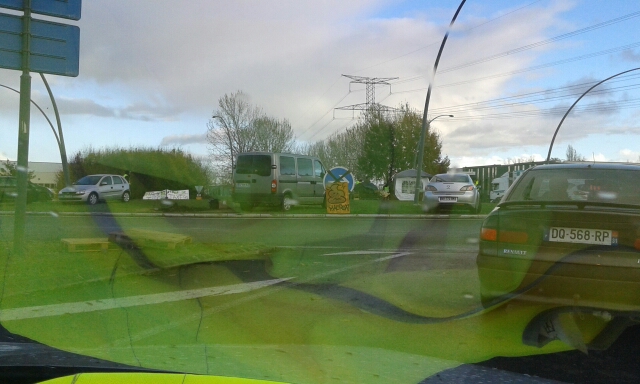
Coming to Toulouse today, I passed a pretty well-entrenched gilet jaune blockade. They had a cabin, a campfire, a friendly attitude, and seemed to be pretty chummy with the Gendarmes present on the scene. That was very interesting to see indeed.]
My friend Waithira Francis has published a book entitled My Name is Toni, which I intend to review on LoS when time permits.
I was supposed to read and review it before publishing for a back cover quote, but alas, I was just too busy to finish the book before she published. I regret that!
What I can say is that it's an semi-autobiographical account of an African woman who emigrates to France and her ensuing adventures. What strikes me is how she manages to both shed light on what it's like to be a woman, an African and an émigrée, yet touch on universally-recognizable experiences and emotions.
Or maybe it's just me. I'm a white, American man but like Francis, an émigré. That shared experience makes our differences much less important. But one need not be an expat to understand and be struck by this book.
In the last two weeks France has been a-buzz with the talk of the "gilets jaunes", or "yellow vests". I, and the Anglophone media it seems, use the term "Yellow Jackets".
A yellow jacket is hornet, and the hornet is both a metaphor for anger (angry as a hornet) and trouble (she kicked over a hornets' nest).
Very appropriate then.
The Yellow Jackets are not part of France's perpetually disgruntled unions nor are they ideologically aligned. They are in effect a popular uprising, ordinary people fed up with, well, just about everything. The original groups were started on Facebook, like the Arab Spring. The initial spark was the decision by Macron's government to increase taxes on diesel in order to encourage people to go electric. This after years of encouraging people to use diesel. There's talk of giving people 4000 euros towards buying a new car, but 4 grand is peanuts compared to the price.
Going green, sadly, is often a luxury of those who can afford it.
While the original motive of the Yellow Jackets was to protest rising fuel prices, it has morphed into something more general; the cost of living, unemployment, low salaries, the struggle ordinary people have simply to pay the bills.
Last Saturday (11/17) over 300,000 people took to the streets to block the roads and slow traffic. Over 2000 roadblocks were erected. Several hundred have been injured in scuffles. In one case a panicked woman hit the gas and killed a protestor. In another case a man tried to force his way through and killed a young man. In Réunion a man fired a starter pistol into the air to get thru a roadblock.
It was only supposed to be a one-day protest but it continued and this weekend it got pretty heated as thousands (8k+) of protestors took to the streets of Paris. They marched and the "casseurs" (literally, "breakers" but hooligans would be apt) came with them
The casseurs broke the windows and set stuff on fire. The riot police fired tear gas and unleashed water canons. Fire and water, gas and glass.
They were even throwing paving stones, that famous symbol of mai '68, the massive general strike punctuated by Situationist slogans, which almost brought down the government, and which aging boomers look back on with such fondness, as they take early retirement from well-paying jobs to pass the next 30 years in their secondary homes while their children and grandchildren scrape by.
Probably with a pittance for a pension in store.
Famous cartoon has an old woman berating a girl: "I was already at work by your age!" Young girl: "And I'll still be working at yours!"
Coming home Saturday evening from taking my son to a chum's, I looked at the thick mist settling onto the fields, swirling thru the headlights. I noticed the local speed-trap radar had been wrapped in a gilet jaune.
On TV, Paris was engulfed in another kid of mist.
I'd been worried about my wife earlier, as I'd heard of two first-person accounts where some protestors had harassed an African woman; still another told an English woman to "go back to her castle in England". Still another told me that her 12-year-old daughter had been harassed for being pro-Macron after not smiling at the Yellow Jackets. It hasn't all been nice and calm. 700+ injured as of 11/21.
Come Sunday, heading back to Toulouse, we waited at a roundabout for a few minutes before the traffic crawled ahead. Large painted signs had been erected and planted into the turf at the center of the circle.
At the next roundabout, more Yellow Jackets; two police vans with two bored-looking policemen sat pacing around. The Yellow Jackets sat on chairs by a fire, a large shelter erected to cover their wood. A Temporary Autonomous Zone. The Yellow Jackets have no leader thus no rules, but they are apparently coming up with some basics: no alcohol for example. Not only bad for their image, but prone to incite violence. Self-governing anarchists of a sort.
Each car was briefly stopped, then let go. The trucks were held up a little longer. My wife had put her yellow vest on the dashboard and as we approached, the yellow jacket at the road block gave us a thumbs up and didn't stop us. My wife returned the gesture and let out a hoot of support. She seemed to enjoy all of this, supporting it completely.
As we entered Toulouse, all the barriers at the toll booth had been removed. We decided to pay anyway, just in case we got filmed. I'm sure they're fining people who drive on thru. A student of mine who commutes to Foix told me he hadn't paid a toll in over a week. The Yellow Jackets just wave him thru...
I support it as well. Everyone I know struggles financially, is overtaxed and underpaid, constantly poor or near-broke, nobody's putting money in the bank, except those like me who get it all taken away for their quarterly tax as an independent worker, going from poor-ish to precarious, starting from zero four times a year.
People are fed up with low wages, high prices, outrageous tax. I support the movement, but the idea of having to place a vest on my dash to get through traffic evokes having to wear a certain kind of armband to avoid harassment. Anecdotes about harassment make me uneasy. It's a mixed bag, a mélange of pissed-off people, and I predict it will continue, roaring back to life every Saturday, each one more ferocious than the last....
The government doesn't know what to do. It's a grassroots uprising with wide support. The elites in Paris, totally disconnected from the people they govern, seem to have the support of the media, if not their silence. Macron addressed the issue today and you'd be hard-pressed to find it on the front page. Libérationhas a brief article, but not much meat. Macron said "I feel your pain" but offered no plan to reduce taxes or concrete actions to ease that pain. The Yellow Jackets are not impressed.
In the following clip, an anchorwoman cuts off a reporter as soon as she says that the police have arrived at a protest armed with tasers and clubs. Even if you don't speak French you can sense the urgency as the anchorwoman speaks over the reporter and "cuts off this live broadcast". This seems to be a lot like the official position thus far. Silence with a slight whiff of panic.
Hélas, even left-wing newspaper Libération admits this wasn't censorship, but that this local news ran out of time; the "censored" journalist herself says she wasn't censored. Still, it looks bad, and it's been widely circulated as "proof" of censorship and symptomatic of elite attitudes towards the Yellow Jackets.
As a metaphor at least, it works....
In Italy, the gilets jaunes are protesting Europe. In Belgium, the gilets jaunes are more like those in France; under the name Mouvement citoyen belge, they're protesting the cost of living, notably energy costs, and plan to run candidates for office to bring a voice to the people. As in France, there's no specific political alignment.
The principal supporters of the Yellow Jackets from the political arena seem to be voices from the far right and far left, meeting somewhere no longer on the fringes but in the dead center of the country, among people who give a fig for ideology. They just want to be able to afford to drive to work.
And eat. "Let them eat cake?" Or as Macron said, "If you want a job, all you have to do is cross the street." Hollande's ex said in private he referred to the poor as the "sans-dents," the "toothless." Sarkozy referred to protestors as "racaille," or "scum". Chirac, speaking of public housing, decried the "noise and smell".
Arrogance, elitism, and disconnected from the people they "govern".
Another popular maxim floating around is "Macron takes himself for Louis XIV but will finish up as Louis XVI"....
For a tiny little town (pop. 391) just a few klicks away from the middle of nowhere, I've managed to pass through Bassoues three times in the last 15 or so years. The first time, I was astonished to come across a statue of what appeared to be a soldier (shield, raised sword, spear) who turned out to be Saint. This was St. Fris, a supposed nephew of Charles Martel, who led a small band of Franks to repulse a Saracen invasion at this very spot.
St. Fris holds a certain fascination for me because he was my introduction to the world of folk saints. These are highly localized, their real names often unknown, their very existence quite often doubtful. Their legends, however, often share mythical elements not only with each other, but with more well-known religious figures. The hagiography of St. Fris, for example, shares details with St. James, of Compostela fame, in that after his death, his body was somehow miraculously encased in rock.
From within this rock, a spring appeared, with miraculous healing properties. We see the same story at Rocamadour, with the legends of Saints Quiteria and Liberata; with the majority of what are known as Black Madonnas; with the hermit Dadon, who after his "furtive translation" (i.e. theft) of Saint Foy's remains, struck the ground with his staff and voila! H²O! The same story is found at Covadonga, in Asturias, in the story of Pelagius, who in 722 is said to have pretty much kicked off the Reconquista.
So, despite being a figure with an extremely limited geographical domain, he is nonetheless endowed with the powers over the forces necessary for the survival of what Julian Barnes calls the Ultimate Peasant: water, health, protection from attackers. St. Fris is pretty much limited to the Gers: he saturates Bassoues; there's a small cult at Vic-Fezensac (a town with a strong connection to another local element of folklore: the bull); and a small shrine at the cathedral in Auch. Fris isn't even his real name; the legend states that when his uncorrupt body emerged from a rock being licked away as if it were salt, no one knew his name, so they called him St. Fris after his familial connection to the Frisian Islands.
I recall being happily surprised in Asturias when I came across two hamlets, one dedicated to St. Sernin, and, more surprisingly, the "Saintes Puelles" (here called "Pueyes -- the Argentine "ll" and "y" share the same "zh" pronunciation so the changed spelling is fonetickly the same). I mention this because I wonder if somewhere along the St James Way we can find either a hamlet named after Fris, or a chapel; would you give me a bust in a basilica maybe?
Anyhow, third time's a charm because as I recounted in a previous post, I never managed to get some photos in my first two visits.
So, without further ado, I present thee with the photographs:
This first is typical of regional architecture, thick walls of rough-hewn stone; small, round widows; often asymmetric facade; a single tower; spare to zero ornamentation.
St. Fris Basilica
St. Fris shrine at l’Étendard hill
This shrine is located at the site where St. Fris allegedly planted his flagpole/spear in the ground, his line in the sand, and with a rousing "into the breach" pep talk, rallied his troops to defeat a rear-guard of Moors as they fled south after being routed at Poitiers.
There's a cinematic quality to the story of St. Fris; it could make a good film. St. Fris rallies his men and defeats the Moors, but one last arrow, let loose by a young, embittered hothead finds its mark and strikes the young champion.
Lakeside chapel dedicated the St. Fris
Fris' horse, suddenly without guidance, bolts, the dying Fris slumped in the saddle, bouncing brutally as the horse flees in terror. It comes to a spot near a river. The corpse of the young hero falls to the ground, is encased in rock and lays undisturbed for centuries, until a cow, licking away at the rock, reveals St Fris, apparently still magnificently mustachioed, for all representation of the saint feature long, Asterix-like facial-hair.
The chapel itself is unremarkable and also typical of the region. Unfortunately one cannot see inside. The S.F. monogram under the bell is a nice touch.
Lakeside chapel: facade
Finally, here's a photo of the scared spring with reputed healing powers.
Sacred spring: St. Fris chapel
So basically, since the Middle Ages, pilgrims came specifically to see the relics of St. Fris or visited on their way to Compostela (probably this is what accounts for the legend that Fris' body, like that of St. James, was encased in stone). Pilgrims would ether drink or bathe in these waters for their reputed healing powers, but it wasn't until 1890 that the village priest, one Abbé Blajan, had the chapel built and (not pictured), a small bathhouse where numerous miracles have been reported.
I can think of half a dozen similar fountains within a short distance from my home. In my village the fountain was reputedly best for fevers and stomach troubles. Dedicated to John the Baptist, the current rude structure is only made of mud but has stood since 1713 on the site of a much more ancient chapel. In at least two neighboring villages there are chapels with healing springs. All of these are positioned along the local tendrils of the St. James Way that converge upon St. Jean-Pied-le-Port, both the beginning of the "French Road" to Santiago and the last stop in France before pilgrims cross the Pyrenees to arrive at Roncevalles.
So, finally LoS has some photos from my own telephone to illustrate the places where St. Fris was struck and where his body came to rest. I made a longish detour on my return journey after three-plus days on the St. James Way, following the same route as millions of pilgrims before me.
St. Fris was the nephew of Charles Martel, who in 732 had defeated the Moors at Poitiers. As the Moorish army fled, their rear guard encountered a small group of Franks led by Fris; his legend is thus directly tied to the battle which is said to have stopped the until-then indefatigable advance of the Moors into Europe.
Ironically, later battles had Charlemagne, Martel's grandson, and thus Fris' cousin, allied with the Moorish Wali of Barcelona and Girona to combat his rivals in the Iberian peninsula. The Wali received military aid and Charlemagne saw an opportunity to shore up his power and strengthen the Christian position in general. In 778 Charlemagne was dealt his only military defeat at the Battle of Roncevaux Pass as his rear-guard was ambushed by Basques in revenge for Charlemagne's attack on Pamplona, a Basque capital, during his adventures in the Basque Country. Fris' encounter reverses the roles, some wishful thinking to clean up an otherwise spotless military record.
In 824 a second battle occurred, where a combined Basque and Muslim army defeated a Carolingian expeditionary force. Lots of shifting alliances, no? The Carolingians had gone to quash a rebellion in that pesky Pamplona and met no resistance. However, marching back with plunder, they were ambushed at Roncevaux pass and soundly defeated, much like Charlemagne 46 years prior. The Basques were the true victors here, for the battle led directly to the establishment of the independent Kingdom of Pamplona.
So, though Fris's tale is probably a fiction, there is a possible historical basis for the story.
Sure, you may have heard of the soft-spoken and hard-drinking poet & novelist, but did you know of Charles Bukowski's sideline as a designer of "collectable" stuffed toys?
I didn't think so!
Apparently, "they" haven't released these in the US or UK so as not to damage Mr. Bukowski's street cred. But in France, where the fine art of plush toy design is as revered as Camembert cheese and stripey shirts, they fly off the shelves like, um, wild horses running away over the hill. Or something like that. Models include the Impotent Old Drunk, the Scabby Crack Whore, the Unlucky Gambler and the Psychotic Hobo.
Now these are transitional objects to be proud of, to "de-simpify" your kids, who have no doubt been ruined by mawkish cuteness and glorified adverts: in short, food for cretins. Grab this bull by the balls and squeeze 'til it yells "Uncle!"
Or, as it would yell in France -- the talking bulls of Limousin are legend: "Oncle!"
I was reading Christopher Dawes' book Rat Scabies and the Holy Grail th'other day and he mentioned a product called Lyle's Golden Syrup. Specifically, the tin; this features an olde-fashioned logo (dating from 1885) featuring a dead lion, above which fly a swarm of bees. According to Wikipedia:
This is a
reference to the Biblical story in chapter 14 of the Book of Judges in which Samson was travelling to the land of the Philistines
in search of a wife. During the journey he killed a lion, and when he
passed the same spot on his return he noticed that a swarm of bees had
formed a comb of honey in the carcass. Samson later turned this into a
riddle at a wedding: "Out of the eater came forth meat and out of the
strong came forth sweetness".
While it is not known exactly why this image and slogan were chosen,
Abram Lyle was a deeply religious man, and it has been suggested that
they refer either to the strength of the Lyle company or the tins in
which golden syrup is sold.
What really struck me about this was the motto on the tin, which reads:
"Out of the strong came forth sweetness"
Readers of LoS will recall that in our last post, we reproduced the coat of arms of Americana, a Brazilian town founded by Confederate emigres; it not only features a beehive and two bees, but the motto "Ex Labore Dulcedo" which I have seen translated as "The Sweetness of Labor" or "Pleasure arises from Labor" but which I think could be translated as
"Out of Labor comes forth Sweetness"
The Confederados who founded Americana were farmers, specializing in, unsurprisingly, cotton, but also in watermelon. They probably had their fair share of beekeepers as well. But the hive here was probably chosen because the Confederados were overwhelmingly Freemasons, and the Freemasons used the beehive as a symbol both of industry and of a well-ordered society. Both the Mormons and the Jacobins borrowed the symbol from the Masons. Indeed, Utah is called the "Beehive State". The Jacobins were drawing on French tradition as well.
In 1653 the Merovingian King Childeric's tomb was found, containing hundreds of small golden bees, and Napoleon later adopted this symbol for himself as opposed to the Bourbon fleur-de-lys; as a symbol of the first royal dynasty of France, perhaps the bee was far more appropriate to mark the foundation of a new France than the symbol of a recently vanquished dynasty. To this day, metropolitan France is referred to as the "hexagon" for it's rough approximation of the form. And of course, honeycomb is a series of hexagons.....
No indication that Abram was a Freemason, by the way, and I'm not suggesting a link between the Mormons, the Confederados of Lyle's Golden Syrup. Just the common symbolic currency of the era....
Aucamville/Aucamvila, Tarn-et-Garonne. Photo by Daurade
For the 0% of the French population that only speaks Occitan, the Tarn-et-Garonne has conveniently placed a new sign at the entrance to our village, just at the end of the Fondemenge cul-de-sac. I see this sign at 1 o'clock (biplane tail gunner-wise) every time I leave the confines of our cozy little hamlet/a.k.a. nest of vipers. This is a good thing for those non-existent Occitan monolinguals, it'd be hard to know you were in "Aucamvila" if you only had a sign for "Aucamville." Una soleta lenga basta pas jamai!
Occitan is a Romance language spoken in southern France, some valleys in northeast Italy, Monaco, and the Val d'Aran in Spain. In the Val d'Aran it is an official language and the only place I have seen it used on street signs and stores in a widespread way. The region where this language is spoken is unofficially called Occitania.
Many scholars don't see Occitan as one unified language, and others include Catalan in the same family; indeed, some dialects of Occitan are closer to Catalan than they are to other Occitan dialects. In fact, until the end of the 19th century, Catalan was often considered an Occitan dialect. Don't tell a Catalan that, though. Anyway, this could have been a politically-driven interpretation pushed to dampen Catalonia's nationalist aspirations.
There is a kind of friendly rivalry among both peoples where Occitania meets Catalonia in the southwest of France, but there is more deeply a kind of solidarity between them as threatened minority languages, though Catalan has flourished in the last 50 years and seems here to stay. Things get really interesting in the natural border between the two, the Pyrénées. Every valley seems to have its own distinct dialect more or less influenced by Spanish, Catalan or French. The people here will all have a smattering of French and Spanish and Catalan. This is especially true of Andorra, where all three languages are spoken widely though Catalan remains the language with which Andorrans identify the most. Andorrans, however, are a minority in their own land, and a proper tally of ts linguistic groups might reveal that Portuguese is also widely-spoken among the Principality's guest workers. Occitan and Catalan quite naturally blend elements from both Spanish and French, and they blend with one another as well. It wouldn't be surprising to see Portuguese enter the mix; thanks to the Troubadours, legends from northern Portugal also flourish in the southwest of France, especially in Gascony, and in Asturiano, a.k.a. "Bable" (Babel?), they pronounce "o's" like "u's" ("quesu" and "vasu" for "queso" and "vaso") -- much like in Occitan.
Google Earth
The Catalans, who have fiercely protected their language since the depredations of Franco, have officially recognized a form of Occitan called Aranès in the Val d'Aran. Here you'll see signs in Spanish and Catalan, as well as some French. But you also see signs in Aranès. In Toulouse, street signs are in French and Occitan, and neighboring municipalities often have a second sign at the edge of town with its name in Occitan: Toulouse - Tolosa (pronounced Toulousa -- remember to "o" sound like a "u"). But these French examples are more a tip of the hat to history; it's not really a part of the quotidian linguistic reality: the Town Hall is the "Mairie" not the "Ajuntament". Even in the Val d'Aran, I'm not sure how widely it's spoken. Dominic Smith concludes that Aranès probably has "the brightest future" for all the Occitan dialects, but that it seems to be losing ground to Castilian Spanish or other more "practical" languages. Some schools in the southwest of France have offered Occitan as an elective beginning in middle school, and there are bilingual programs and even Occitan primary schools known as Calandretas (which though private, are free). But elective and bilingual programs are being cut as belts tighten and parents increasingly favor focusing on languages such as English. Toulouse has become less provincial and isolated, attracting foreigners such as myself and French people from other regions who are not as connected to the language as people with deep roots here. Very few people speak it, especially outside the home, although a few phrases are commonly heard at the café.
From Wikipedia: "Occitania" with its major dialects
Occitan has at various times been known as Limousin, Languedocien, Gascon, and Provençal, but nowadays these appellations refer to dialects. Other dialects include Auvernat, Gascon, which include Aranès and Béarnese; there is also an Alpine dialect. The Toulousain dialect is called Moundi. A clear-cut taxonomy of these dialects is difficult and there are differing classifications of them, just as there are disagreements over the wider question of their relationship to Catalan.
There are two principal written standards: a classical norm and one created by Frédéric Mistral in the early 20th century. The Mistral standard is based on Provençal and similar to French -- both of which have led to criticism from later Occitanists. Mistral is largely unknown outside of -- and within -- France, but he won the Nobel Prize in Literature in 1904, for his poems in Occitan.
Attempts to standardise the spoken language have been a 20th century phenomenon and to me, doesn't reflect the historical and even current reality of the language. Some speakers reject this process altogether because they take pride in their way of speaking it, which may differ from even a neighboring village (or may have differed -- it would be hard to hear this in action). The French are very attached to and strongly identify with their "terroir" -- a connection often more profound than they have to the Revolutionary-era departments.
Proposed flag for an idependent Occitania.
Some Occitanists are cultural flag-bearers, but for others there is a political element to their "Occitanism". This tends to be very regionalist and while some call themselves nationalists, they bear little in common with the far right the word usually describes. On the contrary, they tend to celebrate multiculturalism within their own borders and feel like a distinct cultural element of France's melting pot (France doesn't seem to have taken to the "salad bowl" theory -- Occitanists usually self-identify as French as readily as Occitan; in fact very few see themselves Occitan at all, but Languedocien, Gascon, or Provençal, etc.) They tend to be strongly in favor of decentralization; conscious of the fact that Paris has suppressed their language and their culture, they favor local autonomy. Standardization of the language is philosophically incompatible with this viewpoint.
Proposed flag for an independent Catalonia; the Estelada or "Lone Star" (1918)
In Catalonia, the people have struggled to maintain their separate identity from Madrid, and language is a critical part of that effort; that is why they have allowed the Val d'Aran to make Aranès their official language and to recognize its autonomous government, called the Conselh Generau (General Council).It's status is actually unique in Catalonia; it's basically a comarca, or county, but with a few additional powers. This is both a nod to its unique cultural identity and also its isolation; until not so many years ago the valley was cut off from the rest of the world during the winter months. A tunnel finally connected it to the rest of Spain year-round. I have already mentioned there is a measure of Catalan / Occitan solidarity based on cultural similarities and their shared struggle as minority languages, but there are deep political roots dating back to the Middle Ages. Toulouse had far more dealings and affinity with Barcelona than Paris for centuries; it's only been a relatively short time that Toulouse or even the south has been part of France.
Occitan was once the language of a culture which, compared to the north, was arguably more artistically refined; a culture in which Jews, heretics and soothsayers were generally more tolerated; and where women had the right to inherit and manage property. It was once the language of poetry and songs the troubadours spread it throughout Iberia, traveling the St. James Way. Because the southerners did not adhere to the custom of primogeniture, where the eldest son inherited all the domains of the father, but a system in which property was divided among all the children, the Midi was a patchwork of tiny fiefs, dwarfed by the vast holdings of the King of France and his vassals. The abundance of little holdings meant an abundance of small armies; to go to war wasn't matter of calling up a couple of powerful vassals but trying to wrangle up and hold together far more plentiful forces with varying allegiances, rivalries, petty squabbles and power games. More refined or not, they proved no match for the French.
The northern crusades against the south were essentially land grabs propagandized as fights against heresy (Catharism above all) and were bound up with the French version of manifest destiny, not to expand west beyond the horizon, but turn up all the corners of a map of Gaul so that they curled back and touched each other at the tips just above Paris. This might help explain the modern-day Occitanist's sympathy for political devolution. People have longer memories in Europe, but this centralizing tendency was an obsession during the Revolution. Louis the XIV said "I am the state". It was highly centralized, around his person. This was true of the Medieval kings, but they were more itinerant, the court and thus the center of the Kingdom was wherever the king happened to be. Louis XIV might have agreed, but by this time he had become almost synonymous with Versailles; the Revolution re-centered it on Paris, not a man, and they ran roughshod over regional variation to make this vision a reality: the metric system replaced older and local systems, the new departments replaced traditional regions which had been named for the aristocrats who controlled them, or vice versa: Armagnac, Foix, Corbières, etc. The elderly and even some middle-aged folks will still tell tales of getting hit with a stick for speaking "patois". There's a famous photo of a school, a roofed-over area, a wall painted with the words "Speak French, Be Clean" which is actually quite sad. This is in Catalan France, but the same attitude was held in Occitan France as well.
The campaign has worked. It is a dying language. Native speakers are mostly elderly; three of my neighbors who spoke it are either dead or have succumbed to Alzheimer's. There was an Occitanist wave of Basque or Breton-style nationalism in the 70's, and there are still some people of that generation who speak and teach Occitan -- many of them in the aforementioned threatened bilingual programs. Some younger people, determined to preserve their heritage, are also learning Occitan and at least one bar in Toulouse encourages the use of Occitan within its walls. Local radio and TV have programs in Occitan and local signage is often bilingual. There is an Occitan community -- several Occitanist political parties and institutes of Occitan studies -- but they don't represent a living language of daily life. It's not even the predominant language in the Val d'Aran and many French people -- its speakers among them -- don't consider it a "real" language at all.
Only 1.5 to 2 million people speak the language, but it can be found in some fairly far-flung places. Forty Occitan-speaking, poverty-stricken families from Aveyron established Pigüé, Argentina in 1884. Protestant Waldenses from Italy fleeing persecution established communities in the U.S., Uruguay, Argentina, and Germany. One Occitan-speaking group left in 1893 and established what would be become Valdese, N.C. Both groups brought their Occitan with them. That means in the Americas, there are traces of both the Alpine and Languedocien dialects of Occitan. The language is still spoken in Pigüé, but I'm not sure about Valdese. Cathy Pons' thesis dissertation in 1990 might be an indication: Language death among Waldensians of Valdese, North Carolina.
It may well be that soon all we'll have of
this language are some field recordings, street signs, and a few
die-hards by which to remember what was once the leading cultural
language in Europe.
Looking for more information on the leader of the Aveyron colonists, I came across something interesting. According toLes aveyronnais dans la Pampa: fondation, développement et vie de la colonies, Pigüé was a hotbed of occultism, Freemasonry and political radicalism starting in the 1890's -- just after the Aveyronaises arrived. The book mentions the "virulent" protests of the Masonic Logia Emilio Zola against the installation of the Catholic Frères des Ecoles-Chrétiens in 1905.
This leads me to wonder what role, if any, Freemasonry has played in the Catalan and Occitan independence movements. The Catalan independence flag is called the Estelada, or Lone Star, and was inspired by Cuba's flag. We know that the Cuban flag was designed by a Freemason and incorporated Masonic symbolism, and that the Catalan movement looked carefully to the Cuban independence fight as a bellwether of their own chances if they chose to take on Madrid. The Estelada has inspired other Spanish separatist movements to adopt the same lone star as a symbol, just as it was inspired by Cuba's flag, itself just one in a long-line of "lone star" flags used by independence movements led by Freemasons in the Caribbean, South and Central America, Florida, and above all, Texas. I know that all sounds rather wingnut, so please see Lone Star Republics for details. I should also mention that there are a couple of "lone star" flags in Africa. Need I say that in both theory and practice, Freemasons were all over these African movements as well? Really, the number of flags is quite significant, so much so that it's increasingly hard for me to say that one flag was inspired by another, but it's more like one guiding ideology led the revolutionaries who waved them to put them on their flags. So, piqued by that anecdote and that flag, I'm gonna dig around a bit and see if Freemasonry is involved, or not.
Conques
is a little village in the Aveyron whose greatest claims to fame are
the relics of Sainte Foy and the monastery which grew wealthy around
them. This is a tiny town, yet it boasts a large and magnificent
basilica in the Romanesque style, well-maintained and in a context so
picturesque you may begin to wonder where the film crew is hiding. In
French -- as in English -- the word conque means shell and is descended from the Latin concha. I giggle at this because in Argentina the concha refers to the female genitalia. My wife says it all the time when she's pissed off at say, an olive jar she can't open: "¡La concha de la lora!"
Which literally means "The (female) parrot's shell!" but really means
"Cunt of a whore!" It's used where an American might say "God fucking
damn it!" or some such. Why not?
The metaphor is more clear when seen
When
you see a conch, with its flesh tones and here smooth/there bumpy
texture, not to mention the overall form, it's clear from whence the
metaphor arrives. Shell metaphors are not entirely lost in English,
either: surely you've heard of the bearded clam? It's not strictly
feminine, for that matter. A pair of masculine accouterments, depending
on the region, can be referred to as "mountain oysters." Curiously,
there actually is a Modiolus barbatus,
or "bearded mussel." It is also known as the "horse mussel" or
(getting so clever here) the "bearded horse mussel." In any event, this
isn't some term of modern perversion; the shell's connection with the vajayjay is of ancient provenance.
According to legend, Conques (Concas
in Occitan) was named by its founder, a hermit named Dadon, who thought
that the hills encircling the village resembled a shell. Being a
hermit, he may have been, uh, lonely. Whether or not the origin story
is true or not is beside the point. Maybe it does resemble a shell,
which might partially account for why the area holds a special place in
the hearts of pilgrims along the Saint James Way,
which passes directly through the village. The symbol of the Camino de
Santiago pilgrimage is the shell. I recall a lecture in which the
professor described the shell as a representation of the journey
of the human soul; in this interpretation the road to Compostela would
also be the journey of one's soul towards a state of plenary
forgiveness, perfection and paradise. It is more than metaphor, because
in Roman Catholic doctrine, making this pilgrimage did in fact earn the
pilgrim total absolution from his or her sins.
The magnificent reliquary of Sainte Foy
Dadon
came to this wild place at the
end of the 8th century but apparently didn't stay long. Perhaps he left
after he was joined by a group of Benedictines; it certainly would have
messed with his plan to lead the hermit's life. These monks founded
the monastery which still exists today.
The monastery would have probably drifted into obscurity if not for Sainte Foy.
In 866 her relics were brought here from Auch in what has been called a
"furtive translation"; stolen, in other words. Once ensconced in
Concas, the relics and the monastery soon came under the
protection of the Carolingian monarchs.
St. Roch showin' some leg
At
first, Conques was a local attraction, but over time it developed into
an important destination for regional pilgrims; in the 11th century
Conques became an important stopping point along the Saint James Way as
well. During the same period the
village was becoming a monastic center of the highest importance, a
status attested to by the quantity and quality of the cult objects in
its treasury. Conques is today a tiny village of less than 300
permanent residents but it still has the single largest collection of
goldsmithery in France. These relics are not just museum pieces; they
are still used in religious processions and services. The reliquary of
Saint Foy in majesty is an important example of the style and
iconography of the Romanesque and typifies images of the Virgin dating
from this period, including contemporary and later "Vierges Noires" or Black Madonnas.
Pilgrims coming to Conques from long distances, even from beyond the Pyrénées,
were first recorded in the mid 11th-century; this is an example of the
growing popularity of pilgrimages which turned many local shrines into
centers of international importance. It was also in the 11th century
that a kind of "cult of femininity" developed in the song and poetry of
the the Troubadours and the theology of the Church. (See LoS: Women) In addition to Pilgrims, the Way was also a major route for the
Troubadours, whose voyages did much to spread the notion of courtly
love, the cult of the Virgin, and the cults of obscure saints such as Sernin, Liberata, Quitteria, etc. The patron of the Saint James Way is male -- St. Roch
-- but the shell
which serves as the Way's "logo" is a female symbol. As a metaphor for
the vagina, the shell evokes (among other things) maternity, sexual
desire and original sin.
The
cult of the Virgin took off in the Romanesque period. Hitherto a
background presence, Mary rather abruptly swung into place as a central
figure in the Christian narrative, a place she still occupies in
Catholic France today (See LoS: The Virgin and the Cross).
Both in hymns and iconography, she changed from a distant and ethereal
figure into something more earthy. Laced with liberal doses of
conscious and unconscious sexual desire, worship of the Virgin was also
inexorably linked with feminine concerns; praying for her aid in
childbirth was common, and her symbolism at this time -- e.g. her foot
crushing the serpent -- was an evocation of her perpetual Virginity, her
exception from the pains of childbirth and the expiation of original
sin. The evolution of the Virgin into a more intimate and "earthy"
interlocutor was almost certainly due to the influence of St. Bernard,
a towering figure in the Medieval Church, both in theology and concrete
affairs. He wrote the Templar Rule and was instrumental in creating
what would become Christendom's most powerful order; he whipped up
internal pogroms against Cathar/Albigensian/Bogomil heretics and preached the Second Crusade
against Islam. He was instrumental in drumming up support for Pope
Innocent during the schism beginning in 1130. One of his disciples
became Pope Eugenius III. He was also one of the founders of the renewed
Cistercian order. A big deal to be sure.
The tympanum of the Basilica of Sainte Foy
The pilgrims' patron, St. Roch, is recognizable by a
plague sore or wound on his inner thigh, a kind of gash that never
heals, which bleeds but never bleeds out. Roch is often pictured
daintily lifting his garment to reveal this wound.
Roch
was said to have born to a mother who'd been barren until she prayed to
the Virgin. When he caught the plague, he retired to live in a forest,
where his dog helped him to heal by licking his wounds. In the forest
he was sustained by a miraculous spring. Miraculous springs are all
over Marial legends, a survival perhaps of Celtic traditions: sacred
groves, springs and high places are associated with any local Virgin of
note. LoS has recounted numerous examples of such springs associated with: the Virgin; many obscure saints such as the aforementioned Quitteria and Liberata,
(sisters and Virgin Martyrs of the distant pagan past whose cult
stretches from Aquitaine to northern Portugal -- essentially along the St. James Way); and even male saints
such as St. Fris,
who also exhibits many of the characteristics of the Virgin. Upon his
death, St. Fris' body was swallowed up by a rock; when it was later
re-discovered, a miraculous spring appeared from within the rock. The
body was incorrupt.
This echoes the story of St.
James. When brought ashore in Iberia, a massive rock closed around his
relics; this rock was then taken to Compostela.
One
of the seven sisters of Quitteria and Liberata (there were nine in
total) was named Euphemia, or Eumelia. Cornered by pursuing Roman
soldiers, she threw herself from a cliff to
avoid capture. Where she fell, the rocks opened and swallowed her
whole;
a spring immediately appeared on the spot.
Picturesque, you say?
I've
had occasion to write about "the Milky Way" before; I'll here reiterate
that, like Rome, Compostela held significance way before the Christians
adopted it. The pilgrimage to Compostela was a Celtic tradition that
symbolized the journey of the soul from birth until death, following the
sun until it sank into the sea at the end of the known earth. Unlike
today, the Celtic pilgrimage did not end in the city itself, but at the
beach and into the very ocean -- following the Sun towards death as it
disappeared beyond the horizon at a significant westerly point. Perhaps
this ocean terminus is why the shell is the Camino's symbol -- the
journey is the destination. As previously stated, the medieval mind,
attuned to a more visual language as opposed to the written word,
recognized the shell to represent the soul's journey through life.
Think of Botticelli's "Birth of Venus"; the goddess is being birthed
from the waters riding a shell. The goddess of erotic love is here a
bit demure, but she surfs a giant shell, a vagina basically; "con" in
French is the rather commonplace translation of the English "cunt". The
root of course the same as concha. So it's not just the Argentines who make the link between the shell and the female sex. It's found in the Latin roots.
The basilica today
A
small tower at the cemetery is marked with this pair of circles
inscribed with a star. I took a compass reading and it's not oriented
towards any of the cardinal points.
Ostensibly,
the cult at Conques is centered around Sainte Foy, a.k.a. Santa Fe,
a.k.a. Saint Faith. Faith personified. Faith was first associated with
the city of Agen, where she was martyred during the reign of Diocletian
for refusing to sacrifice to Pagan gods. This was said to have
occurred in the 3rd century. In the 9th century a monk stole her relics
and brought them here. Legend has it that where he fell, exhausted, he
struck his staff upon the ground and the water broke: a spring sprang
and he survived. Today a small chapel stands at this spot. The
sexual imagery is inescapable. A man wields a phallic staff and,
driving it into the ground, causes life-giving waters to erupt from
"mother" earth.
St. Fris is said to have created a spring when
he planted his standard in the ground. His cult, which is highly
localized in the Gers and almost unknown outside a few scattered places,
developed around the same time as that of Saint Faith, that is to say
when the nameless monk stole her relics. Fris, Roch, Sainte Foy, the
Virgin, all associated with healing waters. Even today, the Pyrénées
are dotted with towns built around thermal spring; cures effected at
these spas are reimbursable by the national health insurance. No
coincidence then that Lourdes, another Pyrénéen town, one of the most famous
pilgrimage sites in Catholicism -- is based around its healing waters. The
modern pilgrim still honors these saints by carrying symbols of the
masculine and feminine powers and the sexual union behind the miracle of
life, as well as the source of the sin he or she is trying to expiate:
the modern pilgrim carries a staff, to which they usually attach a
shell. All in the name of the Holy Faith.
----
And
I was going to do more with this when I began months ago but its been
sitting around as a draft for so long I'm just gonna ding the bell and
hand it off to the runner who takes it straight to the presses. Then a
sniff of cocaine, a Tom Collins, and a few hours of stimulating talk
before the fireplace with my manservant Jacky.