Showing posts with label Aucamville. Show all posts

Friday, March 11, 2016

Aucamville Project 14: Qu'es aquò?

Aucamville/Aucamvila, Tarn-et-Garonne.  Photo by Daurade
For the 0% of the French population that only speaks Occitan, the Tarn-et-Garonne has conveniently placed a new sign at the entrance to our village, just at the end of the Fondemenge cul-de-sac.  I see this sign at 1 o'clock (biplane tail gunner-wise) every time I leave the confines of our cozy little hamlet/a.k.a. nest of vipers.  This is a good thing for those non-existent Occitan monolinguals, it'd be hard to know you were in "Aucamvila" if you only had a sign for "Aucamville."  Una soleta lenga basta pas jamai!

Occitan is a Romance language spoken in southern France, some valleys in northeast Italy, Monaco, and the Val d'Aran in Spain.  In the Val d'Aran  it is an official language and the only place I have seen it used on street signs and stores in a widespread way.  The region where this language is spoken is unofficially called Occitania.

Many scholars don't see Occitan as one unified language, and others include Catalan in the same family; indeed, some dialects of Occitan are closer to Catalan than they are to other Occitan dialects.  In fact, until the end of the 19th century, Catalan was often considered an Occitan dialect.  Don't tell a Catalan that, though.  Anyway, this could have been a politically-driven interpretation pushed to dampen Catalonia's nationalist aspirations.

There is a kind of friendly rivalry among both peoples where Occitania meets Catalonia in the southwest of France, but there is more deeply a kind of solidarity between them as threatened minority languages, though Catalan has flourished in the last 50 years and seems here to stay.  Things get really interesting in the natural border between the two, the Pyrénées.  Every valley seems to have its own distinct dialect more or less influenced by Spanish, Catalan or French.  The people here will all have a smattering of French and Spanish and Catalan.  This is especially true of Andorra, where all three languages are spoken widely though Catalan remains the language with which Andorrans identify the most.  Andorrans, however, are a minority in their own land, and a proper tally of ts linguistic groups might reveal that Portuguese is also widely-spoken among the Principality's guest workers.  Occitan and Catalan quite naturally blend elements from both Spanish and French, and they blend with one another as well.  It wouldn't be surprising to see Portuguese enter the mix; thanks to the Troubadours, legends from northern Portugal also flourish in the southwest of France, especially in Gascony, and in Asturiano, a.k.a. "Bable" (Babel?), they pronounce "o's" like "u's" ("quesu" and "vasu" for "queso" and "vaso")  -- much like in Occitan.

Google Earth
The Catalans, who have fiercely protected their language since the depredations of Franco, have officially recognized a form of Occitan called Aranès in the Val d'Aran.  Here you'll see signs in Spanish and Catalan, as well as some French.  But you also see signs in Aranès.  In Toulouse, street signs are in French and Occitan, and neighboring municipalities often have a second sign at the edge of town with its name in Occitan:  Toulouse - Tolosa (pronounced Toulousa -- remember to "o" sound like a "u").  But these French examples are more a tip of the hat to history; it's not really a part of the quotidian linguistic reality:  the Town Hall is the "Mairie" not the "Ajuntament".  Even in the Val d'Aran, I'm not sure how widely it's spoken.  Dominic Smith concludes that Aranès probably has "the brightest future" for all the Occitan dialects, but that it seems to be losing ground to Castilian Spanish or other more "practical" languages.  Some schools in the southwest of France have offered Occitan as an elective beginning in middle school, and there are bilingual programs and even Occitan primary schools known as Calandretas (which though private, are free).  But elective and bilingual programs are being cut as belts tighten and parents increasingly favor focusing on languages such as English.  Toulouse has become less provincial and isolated, attracting foreigners such as myself and French people from other regions who are not as connected to the language as people with deep roots here.  Very few people speak it, especially outside the home, although a few phrases are commonly heard at the café.

From Wikipedia: "Occitania" with its major dialects
Occitan has at various times been known as Limousin, Languedocien, Gascon, and Provençal, but nowadays these appellations refer to dialects.  Other dialects include Auvernat, Gascon, which include Aranès and Béarnese; there is also an Alpine dialect.  The Toulousain dialect is called Moundi.  A clear-cut taxonomy of these dialects is difficult and there are differing classifications of them, just as there are disagreements over the wider question of their relationship to Catalan.

There are two principal written standards:  a classical norm and one created by Frédéric Mistral in the early 20th century.  The Mistral standard is based on Provençal and similar to French -- both of which have led to criticism from later Occitanists.  Mistral is largely unknown outside of -- and within -- France, but he won the Nobel Prize in Literature in 1904, for his poems in Occitan. 

Attempts to standardise the spoken language have been a 20th century phenomenon and to me, doesn't reflect the historical and even current reality of the language.  Some speakers reject this process altogether because they take pride in their way of speaking it, which may differ from even a neighboring village (or may have differed -- it would be hard to hear this in action).  The French are very attached to and strongly identify with their "terroir" -- a connection often more profound than they have to the Revolutionary-era departments.

Proposed flag for an idependent Occitania.

Some Occitanists are cultural flag-bearers, but for others there is a political element to their "Occitanism".  This tends to be very regionalist and while some call themselves nationalists, they bear little in common with the far right the word usually describes.  On the contrary, they tend to celebrate multiculturalism within their own borders and feel like a distinct cultural element of France's melting pot (France doesn't seem to have taken to the "salad bowl" theory -- Occitanists usually self-identify as French as readily as Occitan; in fact very few see themselves Occitan at all, but Languedocien, Gascon, or Provençal, etc.)  They tend to be strongly in favor of decentralization; conscious of the fact that Paris has suppressed their language and their culture, they favor local autonomy.  Standardization of the language is philosophically incompatible with this viewpoint.

Proposed flag for an independent Catalonia; the Estelada or "Lone Star" (1918)
In Catalonia, the people have struggled to maintain their separate identity from Madrid, and language is a critical part of that effort; that is why they have allowed the Val d'Aran to make Aranès their official language and to recognize its autonomous government, called the Conselh Generau (General Council).  It's status is actually unique in Catalonia; it's basically a comarca, or county, but with a few additional powers.  This is both a nod to its unique cultural identity and also its isolation; until not so many years ago the valley was cut off from the rest of the world during the winter months.  A tunnel finally connected it to the rest of Spain year-round.  I have already mentioned there is a measure of Catalan / Occitan solidarity based on cultural similarities and their shared struggle as minority languages, but there are deep political roots dating back to the Middle Ages.  Toulouse had far more dealings and affinity with Barcelona than Paris for centuries; it's only been a relatively short time that Toulouse or even the south has been part of France.

Occitan was once the language of a culture which, compared to the north, was arguably more artistically refined; a culture in which Jews, heretics and soothsayers were generally more tolerated; and where women had the right to inherit and manage property.  It was once the language of poetry and songs the troubadours spread it throughout Iberia, traveling the St. James Way.  Because the southerners did not adhere to the custom of primogeniture, where the eldest son inherited all the domains of the father, but a system in which property was divided among all the children, the Midi was a patchwork of tiny fiefs, dwarfed by the vast holdings of the King of France and his vassals.  The abundance of little holdings meant an abundance of small armies; to go to war wasn't  matter of calling up a couple of powerful vassals but trying to wrangle up and hold together far more plentiful forces with varying allegiances, rivalries, petty squabbles and power games.  More refined or not, they proved no match for the French. 

The northern crusades against the south were essentially land grabs propagandized as fights against heresy (Catharism above all) and were bound up with the French version of manifest destiny, not to expand west beyond the horizon, but turn up all the corners of a map of Gaul so that they curled back and touched each other at the tips just above Paris.  This might help explain the modern-day Occitanist's sympathy for political devolution.  People have longer memories in Europe, but this centralizing tendency was an obsession during the Revolution.  Louis the XIV said "I am the state".  It was highly centralized, around his person.  This was true of the Medieval kings, but they were more itinerant, the court and thus the center of the Kingdom was wherever the king happened to be.  Louis XIV might have agreed, but by this time he had become almost synonymous with Versailles; the Revolution re-centered it on Paris, not a man, and they ran roughshod over regional variation to make this vision a reality:  the metric system replaced older and local systems, the new departments replaced traditional regions which had been named for the aristocrats who controlled them, or vice versa:  Armagnac, Foix, Corbières, etc.  The elderly and even some middle-aged folks will still tell tales of getting hit with a stick for speaking "patois".  There's a famous photo of a school, a roofed-over area, a wall painted with the words "Speak French, Be Clean" which is actually quite sad.  This is in Catalan France, but the same attitude was held in Occitan France as well.

Aiguatébia-Talaus school

The campaign has worked.  It is a dying language.  Native speakers are mostly elderly; three of my neighbors who spoke it are either dead or have succumbed to Alzheimer's.  There was an Occitanist wave of Basque or Breton-style nationalism in the 70's, and there are still some people of that generation who speak and teach Occitan -- many of them in the aforementioned threatened bilingual programs.  Some younger people, determined to preserve their heritage, are also learning Occitan and at least one bar in Toulouse encourages the use of Occitan within its walls.  Local radio and TV have programs in Occitan and local signage is often bilingual.  There is an Occitan community -- several Occitanist political parties and institutes of Occitan studies -- but they don't represent a living language of daily life.  It's not even the predominant language in the Val d'Aran and many French people -- its speakers among them -- don't consider it a "real" language at all.

Only 1.5 to 2 million people speak the language, but it can be found in some fairly far-flung places.  Forty Occitan-speaking, poverty-stricken families from Aveyron established Pigüé, Argentina in 1884.  Protestant Waldenses from Italy fleeing persecution established communities in the U.S., Uruguay, Argentina, and Germany.  One Occitan-speaking group left in 1893 and established what would be become Valdese, N.C.  Both groups brought their Occitan with them.  That means in the Americas, there are traces of both the Alpine and Languedocien dialects of Occitan.  The language is still spoken in Pigüé, but I'm not sure about Valdese.  Cathy Pons' thesis dissertation in 1990 might be an indication:  Language death among Waldensians of Valdese, North Carolina.   

It may well be that soon all we'll have of this language are some field recordings, street signs, and a few die-hards by which to remember what was once the leading cultural language in Europe.

Some phrases in Occitan (w/audio files) 

Coda:
Looking for more information on the leader of the Aveyron colonists, I came across something  interesting.  According to Les aveyronnais dans la Pampa: fondation, développement et vie de la colonies, Pigüé was a hotbed of occultism, Freemasonry and political radicalism starting in the 1890's -- just after the Aveyronaises arrived.  The book mentions the "virulent" protests of the Masonic Logia Emilio Zola against the installation of the Catholic Frères des Ecoles-Chrétiens  in 1905.  

This leads me to wonder what role, if any, Freemasonry has played in the Catalan and Occitan independence movements.  The Catalan independence flag is called the Estelada, or Lone Star, and was inspired by Cuba's flag.  We know that the Cuban flag was designed by a Freemason and incorporated Masonic symbolism, and that the Catalan movement looked carefully to the Cuban independence fight as a bellwether of their own chances if they chose to take on Madrid.  The Estelada has inspired other Spanish separatist movements to adopt the same lone star as a symbol, just as it was inspired by Cuba's flag, itself just one in a long-line of "lone star" flags used by independence movements led by Freemasons in the Caribbean, South and Central America, Florida, and above all, Texas. I know that all sounds rather wingnut, so please see Lone Star Republics for details.  I should also mention that there are a couple of "lone star" flags in Africa.  Need I say that in both theory and practice, Freemasons were all over these African movements as well?  Really, the number of flags is quite significant, so much so that it's increasingly hard for me to say that one flag was inspired by another, but it's more like one guiding ideology led the revolutionaries who waved them to put them on their flags.  So, piqued by that anecdote and that flag, I'm gonna dig around a bit and see if Freemasonry is involved, or not.

Tuesday, June 3, 2014

Aucamville Project 13: Accursed Houses

Aucamville has been around a long time.  Bronze coins found here attest to a Gallo-Roman presence.  I'm not sure exactly if this is early or late Gallo-Roman, but if we just leave it in the air we can still safely say the village is between 1500 and 2000 years old!

Who know what weird things have gone down in these past two millennia?  Is it at all surprising that the village features at least one haunted house?  What surprises me is that there aren't more legends of hauntings and weird happenings.


The house isn't actually tilted, the spirits have fuggered the image!
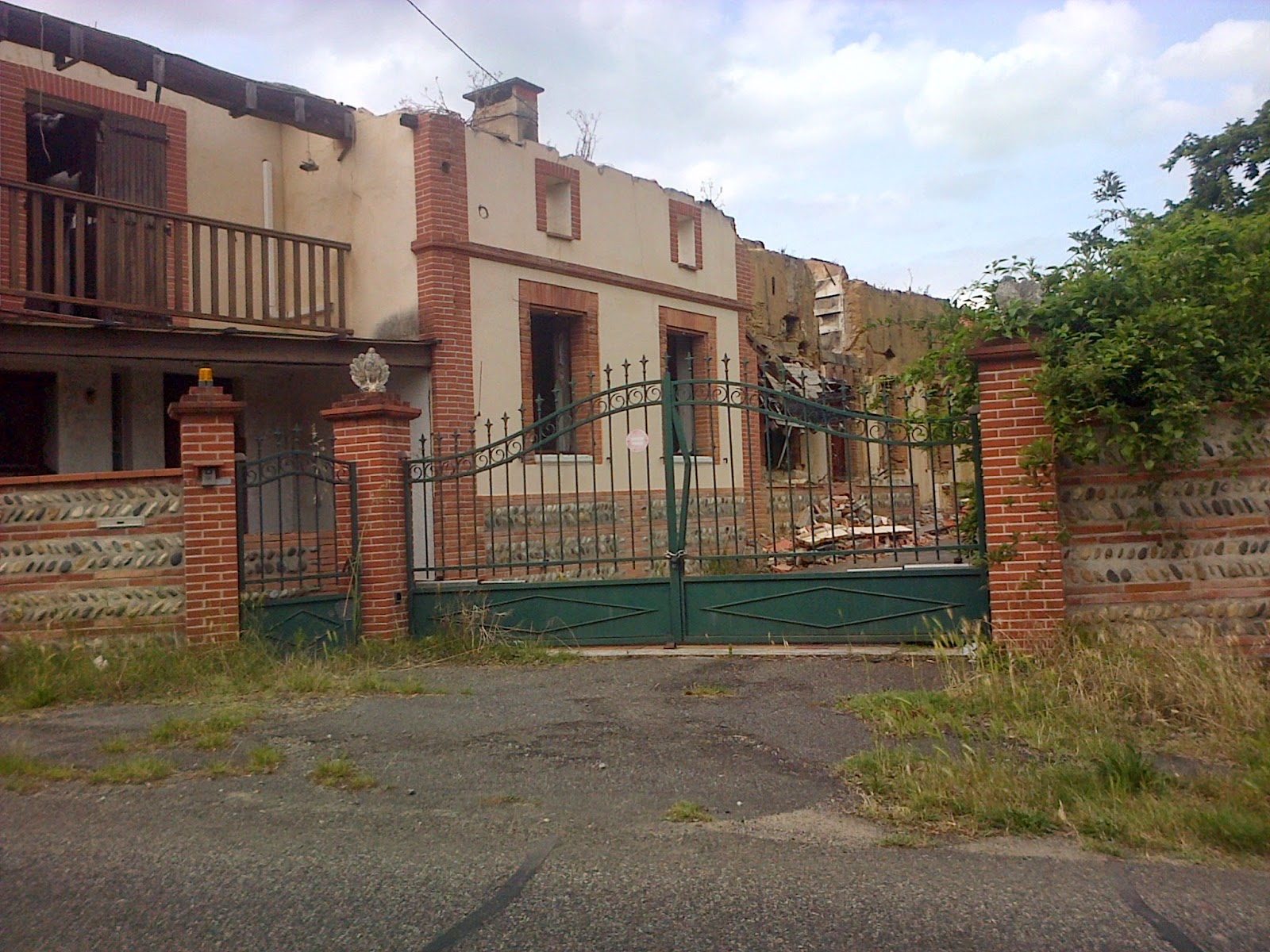
This house was apparently used as a barracks by the German Army during the occupation.  It's a grand house and now in a total state of decay.  It's quite dangerous and threatens to collapse into its large basement any time now.  I'm surprised I hadn't heard of this until just the other day, but apparently villagers swear it's haunted.  No apparitions or cold gusts of wind, though.  Just the sound of boots, dead German soldiers, tramping through the ruins.  I've cruised by this place in the dead of night, three sheets to the wind and haven't heard any tramping boots.  Just one latched shutter somehow got open and hasn't budged since.  But rest assured!  I'm on the case, Egon.

And there is another house, which isn't said to be haunted....but to my mind it is.  Just across the road from where I live there is a handsome house which has been empty since I moved here in 2007.  It's progressively fallen into greater disrepair; in 2005 there was a fire and for a short while some people seemed to be actively dismantling it, although that seems to have ceased.  It used to be a rather elegant tavern named the "auberge de Tail"  but people now call it the "Auberge Rouge" or "Red Tavern."  "Red" as in "Blood"....

L'Auberge Rouge
The full story is a bit hazy, but for an unknown period of time a homeless guy by the name of Georges Haurdine lived and worked at the auberge.  Proprietor Altobella Capelleri had lured him to the auberge with promises of work, room, and board, but neglected to mention the regular beatings.  Described as "slow", Haurdine was exploited by Capelleri, and through a combination of intimidation and violence she was able to keep him like a slave.  Apparently a "family friend" was filmed raping him on several occasions and there were even rumors of sadistic parties involving public officials, but that seems par for the course in France.  Not the parties, but the rumors.  Not so surprising when you consider that this is the country which gave us Gilles de Rais and the Marquis de Sade.  Unlike Gilles de Rais, however, these tales were (probably) either deliberately fabricated to smear the political class or got mixed up in the popular imagination with the "Affaire Alègre" in which Toulousain serial killer Patrice Alègre claimed he organised S+M orgies for public officials and killed on their instructions to cover things up.  Eyes Wide Shut, wot?

Mr Haurdin's body was never found.  As the story goes he was beaten and left for dead by Capelleri herself.  She then had her husband and son bring the body to the pigs, then afterward to a well, where it lay rotting for 6 months.  Unhappy with the progress of decomposition, they retrieved the body, burnt it in the tavern's kitchen chimney and then disposed of the ashes in various trashcans throughout Toulouse.

Maybe the house isn't haunted....but I certainly am....

An earlier article with a few remarks on the Capelleri story.

Wednesday, May 21, 2014

Aucamville Project 12

Aerial view of the village center.

Aucamville (82!) now has a new website.  That is all.

Sunday, March 9, 2014

Addenda: St. Jean-Baptiste and Iron flowers.

1. RE: The Vandals of Toulouse

Last week I was at the Église St. Jean-Baptiste in Ondes.  This week it was the 14th-century Église St. Jean-Baptiste in Le Burgaud.  For a guy with no head, John the Baptist gets around.

I happened to be sipping a Trappist ale and looking at the church yesterday, the form of the clock-tower and it's roof coming together in my mind as an obelisk.

I turned to my friend P---- and mentioned the common LoS speculation that church architecture featuring two bell-towers flanking the facade has its roots nourished in the black soil of the Nile Valley.

For an idea of what the Egyptian precedent looked like, check out the image these model makers have, an Egyptian temple entrance on a page for a model called, oddly enough, Temple Entrance (made from mold #98, or so we're informed in sentence one).

The description of the model states, almost in a severe tone it seems to me:

"You will need to cast mold #98 eight times to build the entrance shown here."

Which sounds more like witchcraft ritual than model building.

This picture of the obelisks at Luxor isn't actually the best image with which to make my case, as only one obelisk is pictured.  But the base is still there and we can see where it was located.

This was in my mind as I walked to the church and reflected on what I knew about the history of the village.  Not much.  The Knights Templar had a commandery here and there was a leper colony of sorts, but that's about it.  Even that info was flawed; turns out it was the Hospitallers and I still have no idea where they penned up the lepers.

The obelisk of the bell-tower, alas, was not the ferpect mefathor, as there was only one, The tower is primarily a functional feature of the structure; to hold the clock, of course, but also to make space for the stairs.

If you're not too familiar with the architecture of the Midi, I'm sure that even from afar the thin wall rising up from the facade tickled yer elmo.  This is a clocher-mur ["bell-wall"], or bell gable.

The odd thing thing is that at either side of the base of the pointy isosceles triangle that forms a sort of pediment of the clocher-mur, there are two clear-as-day make-no-mistake-about-it obelisks.  Stumpy, but clearly defined.  A search of Google images France for "mur-clocher Toulousain" has a few other examples where these horn-like obelisks pop up.

French Wickerpodiologe has a section dedicated to the bell gables of the Midi.  No less a personage than Eugène Viollet-le-Duc (1814-1879), popular architect and General Inspector of Diocesan Buildings--churches in other words--noted the use of brick in their construction in his influential architectural dictionary.  Wicketsnoodle suggests that the use of brick accounts for the exceptional development of the bell gable in the Midi.  Makes sense.  Brick is lighter, cheaper, easier to work with, faster and more flexible than working with cut stone. 

The commander of the Hospitallers here lived in a house attached to the church, itself  a part of the town's ramparts.  This accounts for the presence of arrow slits in its walls.  It was the Hospitallers, in fact, who ordered the church built.  I assume their presence here was due to Le Burgaud being a stop on the road to Santiago de Compostela, but the surrounding forest, the Aubets spring and high places were sacred places before their Christianization.

The sheer face of the wall, the small rose window, the massive brick piers that buttress the facade do give the church a somewhat fortified appearance, but the ramparts and city walls that once encircled the village are long gone, dismantled in more peaceful times to be cannibalized for the stone and bricks

The church is undergoing renovations, but one can still see the traces of a graffito that had been tagged on the church:  the anarchist symbol and the phrase "Un pays sans dieu."  A country without God.

On a side note, this Hospitaller church was built to replace a chapel dedicated to Saint Leonard of Noblac, a patron of prisoners.  He was invoked to secure freedom and even during his lifetime, attracted a lot of ex-cons to his abbey, many of whom stayed to work the land he provided for them.  Leonard was strongly associated with the road to Compostela, which probably accounts for the presence of a chapel here.  I wonder if his association with Compostela was bound up with is role as patron of prisoners; presumably criminals would be tempted to go to Compostela for the plenary indulgence offered to those who made it.  Wiping the slate clean of sin would have special appeal for them.

Leonard often was also invoked for assistance in childbirth; this and a special role for prisoners is interesting for those interested in the cult of the Virgin.  Despite having no record of any veneration or church dedications to Leonard since his death in the 6th century, his cult took off in the 11th, just as the cult of the Virgin was in full flower after the influence of St. Bernard.  Obviously, people had the same worries everywhere and the Virgin couldn't handle the caseload alone.  We've seen male saints take on attributes of the Virgin before (e.g. St. Fris).  The cults of many saints exploded at this time, globalized as it were, beyond being obscure local cults (e.g. St. Fris or Stes. Liberata and Quiteria), due to the passage of so many people through the south of France on the way to Compostela.  Of course, the influence of the Troubadours as transmitters and relaters of popular culture cannot be overestimated.

Speaking of culture, in the late-sixties a café was created in Le Burgaud that still exists today, a small beacon of culture in the cornfields featuring theater and music, often very avant-garde stuff which would be not so common even in Paris, let alone a one-Solex town in a poor farming area.  The original idea was to take young people in difficulty, often ex-cons, who would come to the healthier environment of the country and work and live at the café, assisting and performing in its productions.  Today it's more of a cultural association, but on some nights groups of young people from the inner city will be working in the café.  A fascinating continuity with Saint Leonard's project and the musical diffusion of his legend--the café has been a stop for numerous poor musicians, who play in exchange for a meal, a carafe of wine, a place to crash and gas money for the next tavern or music hall.  It reminds me of when I learned Toulouse had a reputation as a tolerant and cosmopolitan city, known for its large number of students and vagabonds, since the early middle ages.  This, too, is still true today.

For more about Le Burgaud, see:  Notre Dame des Aubets.


2. RE:  Aucamville Project 11: Mary on the Cross (redux)

Basically, this is just another example of a cemetery marker in wrought-iron, also typical of the Midi, with a floral motif.  We would suppose this plant metaphor refers to the death and resurrection of Christ, reborn like the plant world in Spring.  Jesus as vegetal god!

The details on some of these crosses show that the cross isn't being overrun by flora, but is itself a tree, possibility the Tree of Life....

The French often have a family tomb with a plaque for each member therein interred.  The grieving, instead of laying a new stone after each death, merely add the plaque and then leave small votive plaques, porcelain flowers, religious icons:  "Dearest Mother and Wife", "Our beloved Uncle", etc.  Thus the cemetery is a cluttered place.  France being France, the religious usually honor Toussaint by going to a special mass.  Everybody goes to the cemetery to lay flowers, but only chrysanthemums.  More restrained than Todos Santos, or Dia de los Muertos, and without the macabre joys of Halloween aka All Hallows Even.

OK, sorry for the beleaguered tone of this post; it's my second go-round after the fist version, longer than this, got sucked away into a Blogger bug black hole and I ended up working on this version until long after the midnight oil burned itself out.  Anyway, there are scores of bell gables in the region, I'll try to snap photos of the surrounding villages, almost all of which have a parish church like that at Le Burgaud.  I'll leave you with a photo of Aucamville's church for a comparison.

Photo by Didier Descouens: http://commons.wikimedia.org/wiki/File:Aucamville_%28Tarn-et-Garonne%29_Eglise.jpg


Sunday, March 2, 2014

Aucamville Project 11: Mary on the Cross (redux)

3/3:  I'd forgotten I'd already done a (quite different) little riff on this theme:  The Virgin and the Cross.

Toulouse is known as "la Ville Rose" (the Pink City) because of the brick with which its buildings have been constructed since at least the Middle Ages.  These bricks are not the smallish rectangular jobbies you might think of in American or English construction.  In Toulouse and the surrounding areas the principle brick is called a "foraine" and is about 45 x 25 cm and 5 cm thick.  They're quite heavy and make for a solid wall.  45 centimeters is no small shakes.
 

The gatehouse to the Aucamville cemetery gives a sense of the ingenuity with which these foraines can be put to use.  The walls are made with them, as are the decorative elements of the cornice and the pediment, even the frame of the arched entry.  I've always liked this gatehouse, which is simple  but elegant.  The size and shape of the cross in the pediment is determined by the material:  four foraines make up each arm, and to me, it has always looked something like a flower.  If you look at our other posts about architecture in Toulouse (example), you'll see that everything from walls to bridges to obelisks to chateaux are made with these foraines.  I suppose that's due to the fact that the soil around here is pretty much pure clay.  If I dig in my garden, I will find this clay with some river stones mixed in, but very little dirt or vegetal matter.

In Toulouse, the Terre Cabade cemetery (see the previous example I mentioned), whose entrance features two brick obelisks, takes it's name from this clay-like earth--"cavade" in Occitan.  (Like Spanish, the v and b sound is pretty much interchangeable in some Occitan dialects).

For stately buildings, this clay is put into a more or less standard mould and fired in a kiln to produce bricks of terra cotta, or terre cuite.  But humbler buildings, barns and even homes will be made of unfired brick.  The clay is mixed with some straw and dried in the sun.  The uncooked bricks have the same dimensions as a foraine.  They are not usually used on the north face of a structure, and even the humblest of buildings will use cooked brick at their foundation, as well as to frame windows, doors and reinforce the corners of a structure; sometimes a row or two will be thrown in to solidify the wall, along with smooth flat river stones, or galets.  This architecture is much like that of the American Southwest, with wooden beams and adobe walls.  The principal difference is that in France, one almost never finds a flat roof.

Anyway, this is less about architecture than it is to present a few images for The Gid, something that astonished him:  the Virgin Mary at the center of the cross.

The two examples presented here are typical of the region, in material and imagery:  they are made out of wrought iron as opposed to cut stone, and the crosses use a vegetal motif.  Get your Joseph Campbell out, as Yggdrasil definitely comes to mind.  In the first example below, I find a deft piece of work; the vines curl about Mary's head and the leaves are clearly star-shaped, thus evoking Mary's halo of stars.  Whether intentional or not, the leaves as a crown of stars symbolically connect Heaven and Earth, referring (I believe) to the Tree of Life as a kind of axis mundi (see Aucamville Project 4).  It would also connect the very terrestrial act of burying the dead with the post-mortem voyage of the soul to heaven.

Example 1.  Note how the vine forms a halo of star-shaped leaves around Mary's head.
In the second example, we find a form more common in this area, where the Cross itself is like a tree.  The flowers are lilies, symbols of the Virgin, almost exploding from behind her in a luscious bouquet of vegetal grace, iron-clad to boot.  The spring-like form to the right of Mary's head (from the viewer's perspective) adds an especially dynamic touch.  Recall also that the fleur-de-lis, a stylized lily, is a long-standing symbol of French royalty; the lily as a symbol of both French royalty and the Virgin Mary would also link Mary with France.  As an aside, a cock is also commonly used on these wrought-iron crosses and it, too, is a symbol of France.  Current notions of laïcité aside, France is a decidedly Catholic country, or at least a Marial one:  no village is complete without a statue of the Virgin.

Example 2:  The Queen is dead, long live the Queen.
These use of these crosses is not confined to grave markers; for a detailed discussion of the many ways they are used, please see "Too late, baby. Slay a few animals. At the crossroads."

I'm also looking forward to an upcoming guest post by LoS pal Tim Wilson, who will write about these crosses, especially in the funerary context, and traditions derived from the pre-Christian worship of Hecate.  I don't know what he'll write, but I'd like to mention that Hecate is a tripartite goddess who was often portrayed facing three directions; this is linked to her function as a goddess of crossroads, of which death is a sort, I suppose!  Hecate, unsurprisingly, is sometimes viewed as an influence on Marial attributes; the latter's symbol, the lily, in it's stylized fleur-de-lis version, is often used to symbolize the trinity.  Hecate was also seen as a Savior, the Mother of Angels, which definitely fits in with Mary's role in Catholicism.  She is also associated with the underworld, which is especially resonant in the context we're looking at here.  I predict Tim will go into these ideas pretty thoroughly and, if I know Tim, not without a great deal of erudition and a dash of humor.

Finally, the third example below is less typical of the region, but the mandala-like, vaguely floral motif at the center really grabbed my attention.  It may merely be a pretty abstract design, or it may be intended to represent a flower or even the sun; a floral motif is clearly present at the base of the cross, with leaves growing up the sides and some kind of flower on the middle, a lily perhaps, or a lotus.  The flower strikes me as vaguely Egyptian.  The extremities on the arms and top of the cross also seem like stylized flowers.  If the "mandala" is a solar symbol, this could allude to the Occitan cross used in these parts, which some theorize may derive from a Gaulish solar disc.

This stone cross also has a weird androgynous quality, evoking at once both a curvaceous feminine form and a phallus.


So in these iron trees and this stone representations of flowers, as well as in the flower-like design of the gatehouse pediment, we have an interesting visual metaphor for the ephemeral being immortalized.  The flower is ephemeral but, like the Christian hope for the faithful at the end of the world, returns to life.

One final thought.  As the Aucamvillois bury their dead in the clay, one can't help but wonder that if on some level they are reminded of the origin of all life in Adam, who the Bible tells us, was formed by God from a lump of clay and then fired in His kiln, so to speak.

Human life grown from the soil, like a brick....or a flower.

Wednesday, January 18, 2012

"Too late, baby. Slay a few animals. At the crossroads."


This "croix de chemin" both marks an intersection and memorializes a chapel to 
St. Blandine, destroyed during the Revolution.

This post began when I mentioned to Gid that here in the south west of France one often finds roadside crosses (croix de chemin) with the Virgin Mary at the center as opposed to a crucified Jesus.  The Gid was a bit surprised by this and requested a photo, so I've tried to oblige him.  These crosses do in fact sometimes represent the crucified Jesus.  They can also be unadorned, simple crosses or crosses made to look like unworked logs covered in vines and flowers.  Some are adorned with symbols of the Crucifixion:  a cock, spear, ladder, various tools and implements.....

In the Toulouse region, these small monuments are suchlike:  they are generally about chest-high square pillars, maybe 3 feet (1m) to a side, made of brick.  A cross is mounted on top, made of wrought iron.  Viola.  Simple.  They are ubiquitous.  In the relatively small town of Aucamville, I can count more or less a dozen off the top of my head, but perhaps there are more....

I've pondered these monuments for years and have several theories about their origin; I lay them out in three categories.

Category one is practical.  Imagine when roads were simple dirt tracks, at best.  When it snows, the roads would quickly become covered, side roads easy to miss.  The cross would then pop up, like those poles you see by the side of the road in the mountains, in order to mark the edge of the road.  I should mention that these crosses invariably mark the junction of either a t-intersection or crossroads.

The southwest, however, is not the snowiest of regions, so perhaps this explanation is not the origin--merely added value.  They may have been markers in the wider sense:  "OK, Johann, head towards Grenade and when you come to the second cross, go left." Or maybe, "The farm you're looking for is three crosses down the road."  Where the streets have no name, the cross guides.

My second category is linked to superstition.  My first instinct was to think of the Blues legends of the crossroads.  You know, go to the local crossroads at midnight and make your deal with the devil, play guitar like Ralph Macchio, etc.  A cross would offset this unholy place, no?  In fact, I have read that crossroads were traditionally regarded with apprehension as places where the roads converge were especially prone to unforeseen encounters.  Strangers presented a larger danger in those days, I think.  Cathar heretic?  Sorcerer?  Plague victim?  Without an explicit diabolical association, they could still represent vague forms of danger from the four corners of the earth.

I tend to think that a crossroads, being a cross, might have provoked unease because people were essentially trampling a cross underfoot.  Maybe by dedicating a cross at these spots, the populace felt they'd mollified Jesus into not sending Michael down with a flaming blade in order to make quick with the smiting.  It seems quite possible, much like the theory that the red cross became a symbol of health after the practice of painting them on walls to prevent peasants from pissing there....

The third category is something I'd wondered about and in discussing these things with my neighbor, my feeling was supported: Christianization.  Recall that the Romans had tutelary and guardian deities (lares) for just about everything: cities, neighborhoods, down to the individual households.  There were even lares of intersections:

Lares Compitalicii (also Lares Compitales): the Lares of local communities or neighbourhoods (vici), celebrated at the Compitalia festival. Their shrines were usually positioned at main central crossroads (compites) of their vici, and provided a focus for the religious and social life of their community, particularly for the plebeian and servile masses.

This festival was annual and its name itself derives from "crossroads": 

In ancient Roman religion, the Compitalia (Latin: Ludi Compitalicii) was a festival celebrated once a year in honor of the Lares Compitales, household deities of the crossroads, to whom sacrifices were offered at the places where two or more ways meet. The word comes from the Latin compitum, a cross-way.

There is even precedent for honoring a feminine deity at the crossroads.  Apparently, a "mother of the lares" was honored at them, her devotees hanging woolen effigies which were believed to have replaced the actual sacrifice of children.  Hmm, a mother deity....the sacrifice of children....the cross with Mary at the center may have some kind of foreshadowing here.  The roadside crosses too, are often decorated with flowers upon Mary's feast days.

From the Late Republican and early Imperial eras, the priestly records of the Arval Brethren and the speculative commentaries of a very small number of literate Romans attest to a Mother of the Lares (Mater Larum)....She is named as Mania by Varro (116–27  BC), who believes her an originally Sabine deity. The same name is used by later Roman authors with the general sense of a bogey or "evil spirit". Much later, Macrobius (fl. AD 395–430) describes the woolen figurines hung at crossroad shrines during Compitalia as maniae, supposed as an ingenious substitution for child sacrifices to the Mater Larum, instituted by Rome's last monarch and suppressed by its first consul, L. Junius Brutus.

In this context the following may even indicate aspects of the Black Madonna:

Modern scholarship takes the Arval rites to the Mother of the Lares as typically chthonic, and the goddess herself as a dark or terrible aspect of the earth-mother, Tellus...Mercury leads her to the underworld abode of the dead (ad Manes); in this place of silence she is Tacita (the silent one). En route, he impregnates her. She gives birth to twin boys as silent or speechless as she. In this context, the Lares can be understood as "manes of silence" (taciti manes).

Manes of silence?

Hecate, another figure associated with the underworld, was thus honored, and her shrines served as signposts to find one's way, one would assume in a literal and spiritual sense.  This most certainly included the afterlife as well, as Hecate was the goddess of this realm.  These three forms: literal direction, spiritual direction and navigating the underworld, neatly echo our three categories of purpose outlined above.

In a similar fashion, food was often left at the crossroads to honor Hecate, especially at junctions where three roads converged --what we often call a "Y-intersection".

Frequently a pole was erected at the intersection and three masks would be hung from it to pay homage to Hecate and to request her guidance in helping to choose the right direction.


Interesting in this context is that the iron crosses used for the croix de chemin markers often serve to adorn grave markers as well.  Could we here be seeing an echo of Greco-Roman devotion, in which literal space was marked by a kind of road sign which also had connotations of the journey of the soul in the afterlife?  As we will see, the roadside cross was often used along the route to the cemetery, so that the funeral procession could stop and make appropriate prayers.

Could this ancient association of the crossroads with a goddess of the underworld have influenced the the legend that the Devil, Lord of the Underworld, will appear at a crossroads 'round Midnight?

Crossroads also played a part from time to time in the Imperial cult, indicating that the honorees were not only feminine principles:

In 86 BC, offerings of incense and wine were made at crossroad shrines to statues of the still-living Marius Gratidianus, the nephew of the elder Marius, who was wildly popular in his own right, in large part for monetary reforms that eased an economic crisis in Rome during his praetorship.

After returning to the subject of the roadside cross and formulating the above speculations, I decided to re-read some articles I hadn't read in a while on the topic.  The first, from French Wikipedia, is "Croix de chemins".  This article distinguishes three types of cross:  memorial crosses, boundary crosses and crossroad crosses.  I've spoken a bit about the idea of the memorial and boundary marker in past posts, but in this article I focus mainly on the third type.  This category is the only which has an article of it's own:  "Croix de carrefour".  Under the "functions" heading it mentions the religious use, of course, but indicates they were also used as guide stones, specifically for when roads were covered by snow.  Whereas I'm quite sure  I thought of the first point independently, I think this is where I first heard of the idea that they were used in snowy conditions, but, as I've mentioned, the Toulouse area isn't the snowiest of regions.

The crossroad cross is described as having its origin in the Christianization of megaliths and other pagan monuments, as well as in the practical purpose of defining the limits of parishes, the location of hamlets, as a guide for religious processions.  Why the crossroads?  As stated before; one can get lost more easily there than on the straight and narrow and besides, they've always stood for uncertainty from any direction, a place where the likelihood of a malefic encounter is heightened: 

Le carrefour, dans de nombreuses symboliques, évoque un choix pour lequel il est facile de se tromper de direction, donc de tomber sous la domination des puissances maléfiques.

I have focused primarily on crossroad crosses, but this here site deftly summarizes the roles and types of crosses:  the roadside cross; the processional cross marking the route of, hey hey! religious processions; the boundary cross; the cemetery and village cross (unlike the crossroad crosses which often feature Mary, these usually feature a crucified Jesus); crosses at bridges, summits and springs; finally, memorial crosses.

Unless you read French, this site won't do you much good and the pics aren't stunning but they do their job and show you what the crosses look like.  Note these come from Cantal, north of where I live in the Lomagne area northwest of Toulouse; the Cantal Crosses have much more variety and are hewn from stone.  As I've said, these parts, like most of the buildings in Toulouse and environs, the socles are made from brick and the crosses themselves wrought iron.

I've posted a few example from Aucamville, including one in my possession that was once a grave marker.  No, I didn't desecrate a grave....it had been thrown on a pile of rubble after having presumably come loose from the tomb.  Some of these village cemeteries are in a shocking state of disrepair and it's not uncommon to find a pile broken headstones and iron thrown into an unused corner of the cemetery, invariably behind a high-brick wall on the edge of town....questions of sanitation and what not.

OK, so this is a hubbub of ideas.  I'm not so sure I've done the subject justice, confusedly evoking both underworld figures such as Hecate and Tellus:  "chthonic....a dark or terrible aspect of the earth-mother" and the Virgin Mary.  In the French Southwest at least, Mary, like her pagan counterparts, is a tutelary figure of the crossroads and a spiritual guide.  Yet Mary herself, though usually associated with Isis, the Great Mother and Cybele, has in the Black Virgin the cthonic aspect of these other goddesses; BV's were often found in caves or buried in the earth.  Perhaps it should come as no surprise that Apuleis, in perennial LoS favorite The Golden Ass, identifies Hecate with Isis. Googling "Hecate and the Virgin Mary" I'm not surprised many people make the link.  And why not?  Being thrice-headed, she represents a trinity.  Her powers linked to regeneration and rebirth are not incompatible with Mary's, nor her dominion over childbirth.  The Virgin is indeed believed to have a special role in childbirth; for both Mary and Hecate, this roles was represented by a serpent.

Though Hecate evolved into a vampiric and terrible figure, she began more benignly, something of a protectress.  By the Middle Ages, she was a Witch Queen.  Could this be a result of the growing popularity of Mary in the Middle Ages, perhaps a subsequent need, even if unconscious, to distance her from her prototypes?  Is it a coincidence that midwives and healers, working in Hecate's domain, began to be accused of being witches?  The first witch, Lilith, Adam's first wife, was transformed into a demon when Yahweh booted her from Eden for daring to proclaim herself equal to Adam.   But it was Eve who eventually brought Adam down and brought the curse of pain and suffering upon the process of giving birth.  But Mary, free from their Original Sin, was able to counter the pain and danger of birth, if the right prayers were offered and objects such as her belt rented for such occasions (ND de la Daurade).

It is said that four rivers flowed from Eden to the four corners of the world, forming a great cross.  Each crossroads is a microcosm of this vast cross covering the world.  The center of each crossroads is the center of the world, if not the universe. The axis mundi is "a point of connection between sky and earth where the four compass directions meet. At this point travel and correspondence is made between higher and lower realms".  Hecate and Mary, are unsurprisingly both considered as mediators between heaven and earth, Hecate especially seen as a gatekeeper and patron of the liminal; what could be more liminal than birth, or death?  Each one impossible without the other.

Trouble was knowing which paths lead to heaven and which ones to hell.  Linger too long, and who know who'll turn up.  Choices, choices.  At least in the Southwest, you've got the Virgin Mary looking over you, sometimes from a cross cast to look like wood, decorated with vines and flowers.  An instrument of death, with wood taken, according to legend, from the Tree of Life, if not the Tree itself.  Carpentry seems to have played a large role in the symbolism of rebirth; the tree returns to life each Spring, the carpenter transforms dead wood into useful, even if sometimes cruel creations.  Jesus, the carpenter, killed on a wooden cross.  Noah saved humanity in a big wooden Ark.  The other tree in Eden, that of the Knowledge of Good and Evil, has a name that says it all.  Good and evil, more paths, more choices.

None of this is a direct analogy, role by role, blow by blow, but it is a kind of associational cloud in which we can see faces peering back us, at times distinct, at others, blending into one.  At times distinct and unique all at once, leaving us with a vantage point filtered as if through old glass, forms defined by what isn't rather than what is; questions as opposed to the artificial transparency of answers.

I once saw a sign that said "if you can't dazzle 'em with diamonds, baffle 'em with bullshit."  I may make it my new motto.  That or "Wherever you go, there you are."

Tuesday, October 25, 2011

Aucamville Project 10: The house with some teeth in its walls

Got teeth?
We had some friends over the other night and--like my wife and I and just about all our other friends in Aucamville--they are knee-deep in renovating an old house.

(In our case "old" is an unknown quantity; we've only recently learned that the last person to live in our house was a veteran of the Great War who came to live here in 1918 or '19.  Apparently he was a bit eccentric, perhaps shell-shocked.  To this day the neighbors still refer to him as "le Parisien.")

So these friends are scraping away at a wall one day and come across a small cache of....teeth.  Molars.  Big adult ones.  But it doesn't end there.  They keep looking and stuffed in the cracks all over the wall....more teeth.  Adult teeth, children's teeth.  From several people.  This has been going on for some time now and they don't know how many different people these teeth come from.

I've heard that the hills have eyes and the walls have ears, but teeth?

My friend is convinced something dark and sinister occurred here long ago.  I proposed that perhaps the earth used in building the wall came from the ancient cemetery nearby at St. Pierre de Merdans (see my post about this St. P de M here).  My friend disagrees:  it's not the same kind of earth, why only teeth and not other bone fragments and most of all, the teeth aren't mixed into the adobe bricks or mortar, they were most certainly placed there after the wall was built.

Perhaps my friend's imagination is being colored by a more recent tale, which we've already covered, about a severed arm found in the woods, that itself recalling the horrible tale of the local tavern whose owner pretty much imprisoned and abused, physically and sexually, a hapless vagrant for years.  And then she killed him.  The remains have never been found.

Me, I don't know.  Perhaps a dentist lived there.  Maybe it was an odd family custom:  pop the teeth into the cracks.  Maybe they felt it would prevent their own teeth from cracking.  Or they simply found it amusing.

I tried Googling it, to see if there was any folklore around putting teeth into mortar or brick for superstitious (or other) reasons, but came up with nothing.

Any theories?

Addition 11/28:  From Sir James Frazer's The Golden Bough (XXI. 8.):

The Armenians do not throw away their cut hair and nails and extracted teeth, but hide them in places that are esteemed holy, such as a crack in the church wall, a pillar of the house, or a hollow tree. They think that all these severed portions of themselves will be wanted at the resurrection, and that he who has not stowed them away in a safe place will have to hunt about for them on the great day.

Don't know if this is related.... 

Addition 12/12: 

Back in 2009 Gid posted about someone finding a bunch of teeth in clothes at Wal-Mart, which may be some odd practical joke:  http://lawsofsilence.blogspot.com/2009/03/human-teeth.html

More germaine, however, is a blurb my sister in law told me about from a French book of superstitions.  In the US we have the Tooth Fairy, you know, where we put a fallen tooth under the pillow and in the morning find a coin or some money in its place.  Apparently in Great Britain and Ireland it was customary to bury the teeth.

In France, the Fairy is a little mouse, La Petite Souris.  The basic exchange is the same, but the actor is different.  According to some French traditions, people put the tooth in mouse holes found in the walls of the home in exchange for even greater wealth down the line, and that the real tooth would be replaced by one made of silver.  The blurb on this was rather short and ambiguous.  We'll see what we can dig up.

French Wikipedia gives us this info:

Par exemple, aux Philippines, quand un enfant perd une dent, il la jette au-dessus du toit de la maison. De cette manière, une souris lui en rendra une autre qui sera aussi solide et blanche que les dents de cette souris. Au Togo, on dit aux enfants de jeter leurs dents de lait au-dessus du toit de la maison, et surtout de ne pas ouvrir la bouche.

Basically in the Philippines children throw their teeth on the roof of the house; the little mouse will then exchange it for one as solid and white as his own.  In Togo, kids throw their teeth on the roof but must keep their mouths closed.  The French text is unclear if this means only during the duration of this little ritual or if it means they need to keep it closed for a long time afterwards.  I certainly see the practical value of that bit of folklore!

Anyway, all this proves nothing, but lends plausability to my initial reaction that the teeth in the Aucamville house are related to some sort of folk belief, even if only to follow an amusing custom....

Tuesday, February 1, 2011

Aucamville Project 9.5: A resolution of sorts

The human forearm discovered two weeks ago in a wooded area near the chapel of Notre Dame de Boisville has been matched to its owner (see A gruesome discovery).

La Dépêche du Midi reports that the methodical search by gendarmes and military personnel yesterday has turned up a body.  The badly decomposed cadaver was found 500 meters away from the arm on a slope covered with dense underbrush.  A loaded pistol was at his side and a bullet was lodged in the skull.  The arm appeared to have been carried off by a wild animal, which the reporter adds parenthetically:  was "surely a fox."  How he knows that I'm not sure.

The identity of the man hasn't been released, but he is said to have been an 85 year-old who disappeared from Toulouse on the 28th of August, 2010.  He was known to have been depressed and  suicidal.  Before his disappearance he left a note:  "You will never find my body."  The only mystery left now is how he ended up in this relatively secluded spot.  Did he know the place?  How did he get here from Toulouse, 40 kilometers away?  Good questions.

This area has been inhabited since time immemorial, so it's no surprise this macabre story is not without precedent.

As I mentioned before, a religious hermit who had taken refuge in the chapel was murdered here by two brothers.  According to a monograph on the chapel in my possession, the chapel was guarded by a recluse by the name of Frère Paul, who lived from alms.  He had already been robbed of some money and two chickens when he was found murdered a few days before Easter, 1754, his body thrown into a ditch.

But there is a more recent and similar case.  In May, 1999, a group of schoolchildren and chaperons were doing Spring cleaning on the banks of the Garonne near this chapel and found....a human leg and part of its thigh.  And they were only looking for soda cans and other detritus.

It was never matched to a body.  The police speculated it had been washed down following the annual high waters of Spring resulting from the runoff caused by melting snow in the Pyrenees.  A week later all that could be said was that the person was between 1.69 and 1.76 meters tall, between 35 and 65 years old....and wore a size 44 shoe.  The leg was wearing a black one.

But it gets weirder.  Three months later, in Moissac, a spine, three ribs and strips of flesh were discovered near the river.  "WTF?" I ask.  The Dépêche noted at the time that "Nature regularly exhumes human remains.  Last May 29th a leg was discovered at Verdun.  The only certitude is that it was a man's leg.  Other than that, the coroner isn't able to give any more clues that might help investigators."  It furthermore noted that the leg had not been identified....I don't know about the Moissac remains.

That is definitely some weird shit.  I mean, a vertebral column?

And there is another story, this time in Aucamville proper.  Just across the road from where I live there is a handsome house which has been empty since I moved in, and is falling into disrepair.  It was a tavern named the "auberge de Tail."  The full story is a bit hazy, but apparently the owner Altobella Capelleri had "hired" a homeless guy by the name of Georges Haurdin.  Now, this guy was a bit slow and was subject to the worst abuse.  He was eventually beaten to death after having been kept like a slave for an unknown period of time.  During this period he was beaten regularly and also raped and filmed by a "family friend" on several occasions.  His body, however, was never found.  As the story goes he was beaten and left for dead by Capelleri herself.  She then had her husband and son bring the body to the pigs, then afterward to a well, where it lay rotting for 6 months.  Unhappy with the progress of decomposition, they retrieved the body, burnt it in the tavern's kitchen chimney and then disposed of the ashes in various trashcans in Toulouse.  (Full story here).

No wonder the house lays falling apart.  Cursed forever.

Although Capelleri concocted an elaborate tale of an "accident", a son from her first marriage testified to her sadism, which included burning his penis with a cigarette.  What horror for this poor boy and his siblings, revisited upon a hapless vagabond years later.  The exact date of the murder is unclear, however; sometime between October, 1993 and July, 2004.

People began thinking of this when the arm was discovered, despite the years separating the events.  In any event, Capolleri was sentenced to 20 years in prison last September.

So.  A dismembered forearm, a floating leg, flesh, ribs and spine....and then this horrifying tale.  Long-time readers of LoS will see many familiar themes here, but I'll leave that for you to ponder.

Wednesday, January 19, 2011

Aucamville Project 9: A gruesome discovery

A pal texted me just a short while ago to alert me that a human forearm has been discovered in a wood near Aucamville.  The police are looking for the rest of the body, if there's one to be found, in an ever-widening circle around the chapel of Notre Dame de Boisville (post from July 1, 2010).

The article can be found here, but there's not much to be learned.  Dogs found it while their master was walking them in the woods, the arm has been sent off to be CSI'd and the police are looking for more clues.

Yow.  You know we've been a bit quippy about those Canadian feet.  A lot less funny when it's a kilometer or so from your house, a place I frequently go during Summer to relax and watch the sun go down....

Still, several bad puns present themselves:  It's Armageddon!  Notre dame de Brasville ("bras" being "arm" and rhymes with "bois"), Aux Armes, Citoyens!  We should stop by and lend the police a hand, etc.  All in poor taste, I know.  Sorry.

Finally, an historical tidbit.  Just before the Revolution, scandal rocked these parts when a religious mystic who had made this chapel his home was murdered by two brothers.  In a place this old, one need not dig too deep for histories of violence....

Jan. 20

Local rag La Dépêche du Midi reports that results of the DNA analysis should be ready tomorrow and that the arm is not from the ossuary adjacent to the chapel.  Depending upon the results, a major excavation may begin towards the end of the month. 

Investigators have also dismissed rumours about a student dissection gone wrong.  I'm not sure if this in response to a rumor or if they just want to head this one off at the pass!  I'm sure it's the former, which means I'm missing out on some good speculatin' down at the café!

Jan. 21

Update from the Dépêche.  The arm belonged to an adult male.  The police are currently compiling a list of missing persons, focusing on the two départements which meet at the area, but also looking at national cases.  A large search is anticipated with sniffer dogs and manpower.  The Margestaud creek and Garonne will be explored with a kind of sounding device.  A helicopter will add eyes in the sky.  A lot of excitement for such a quiet place.

This story has got me to thinking about dismemberment in history.  A missing hand has been a recurring literary device.
  • I recently read The Lost Symbol, where it kicks off (punches off?) the "plot"
  • ....this made me think of Luke Skywalker /Darth Vader....Vader is actually referenced in the book in what I took as a reference to the shared mythological resonance of a severed hand.  
  • Captain Hook comes to mind.   
  • The Monkey's Paw revolves around the magical power of not a human but a monkey's hand....which brings me to the Hand of Glory.   
  • This guy has a neat collection about the HoG "and other gory tales about human hands."  
  • And then there's Jesus, who according to some translations said:  "If your right hand offends you, cut it off...."  (Matthew 5:30; Mark 9:43).
Any other famous dismembered hands come to mind?

Wednesday, October 13, 2010

Aucamville Project 8: Saint-Pierre de Merdans

So far in the Aucamville Project we've examined some chapels which all have a connection to water.
  • Notre Dame des Aubets is associated with a sacred spring.
  • Saint Jean-Baptiste de Margestaud was also the site of a sacred spring said to cure various ailments. In addition, it is a stone's throw away from the Margestaud, one of the two streams that traverse the commune of Aucamville.
  • Notre Dame de Boisville overlooks the confluence of these two streams at the point just before they flow into the Garonne.

The second stream is called Saint Pierre de Merdans and here too, a chapel once stood. Now there is nothing but some foundations and a socle adorned with a cross, but this site contains the remains from Aucamville's long history, from Roman times to the present....

According to some sources, the last chapel here was destroyed during the Revolution. But this was just the last in a series of chapels....


As far as I have been told, the site began as a cemetery. According to a guy living near the site, one can still dig up bones without too much trouble at a depth of 10 centimeters; some of these bones were collected into an ossuary at the beginning of the eighties.

A small, square (pagan) temple was at one point located on the spot, traces of which are still visible. Several Gallo-Romain villas were once located around the site; bricks and Roman coins found in the area confirm the antiquity of the place.

The site was Christianized during the Romanesque period and the first chapel was erected. The foundations are still visible. Another neighbor believes this Romanesque structure was destroyed during the 100 Years War.

Within these foundation walls are a smaller set. These apparently belong to a Medieval chapel erected within the ruins of the Romanesque. The current socle and cross seem to sit in what was once the apse of this chapel. Behind this there are other remnants which appear to be circular. I don't know the age of these; one neighbor says they are from the Romanesque church, but the place is so overgrown with brambles it's difficult to get a precise layout of the place. This second chapel, according to the second neighbor, was destroyed during the Wars of Religion. If this is correct, then the chapel destroyed in the Revolution was the third incarnation, at least. The timeline is fuzzy and I'm wondering where to go next for more precise archeological information. How many chapels were there? When were they built? When were they destroyed? Several permutations seem possible.

Internet references are sparse. There's the blurb I've linked to above. I also came across an excerpt from a letter by our old pal abbé Firmin Galabert (Aucacamville Project 5) parish priest and historian of Aucamville.

From the Bulletin archéologique et historique de la Société archéologique de Tarn-et-Garonne, Tome IX:

M. l'abbé Galabert envoi sa lettre mensuelle, datée d'Aucamville:

Le lièvre n'ayant pas autre chose à faire en son gîte qu'à songer j'ai réfléchi souvent pour trouver la destination de cette cuve carrée, de béton, que la Société archéologique visita sur ma paroisse, tout près des ruines de l'église de Saint-Pierre de Merdans, et il me semble qu'on pourrait facilement y voir une cuve ayant servi au baptême par immersion, mode pratiqué jusqu'au XIIIe siècle, et le trou ou piscine pratiqué dans le fond serait le point d'où partait le canal d'écoulement.

Like a hare having nothing other to do in his cottage but muse, I have often thought about the purpose of this square, concrete cistern that the archeological society visited in my parish, just next to the ruins of the church of Saint-Pierre de Merdans; it seems to me that one can easily see in it a cistern used for baptism by immersion, a mode practiced until the 8th century, and the hole or pool in the bottom would be the opening of the drain.

Si on objecte que la profondeur de la cuve qui est d'environ 40 centimètres ne permettait pas de couvrir entièrement d'eau les adultes, je répondrai que à l'époque où remonte cette cuve baptismale, il n'y avait plus d'adultes à baptiser, et que, du reste, alors on aurait ajouté à l'immersion le baptême par infusion.

If one objects that the depth of the cistern, which is about 40 centimeters, would not have entirely covered an adult in water, I would reply that at the time from when this baptismal font dates, there were no longer adults to baptise and that, moreover, in such a case we would have added baptism by infusion to that by immersion.

Je ne suppose pas, en donnant cette antiquité à ladite cuve je ne suppose pas que les ruines de la chapelle actuelle remontent aussi haut dans l'histoire, mais on peut croire qu'une autre église avait déjà précédé celle-là, car je puis dire avec Horace:

Multa renascentur quae jam cecidere
Cadentque quae nunc sunt in honore...

I do not assume, in giving said cistern such antiquity, I do not assume that the ruins of the current chapel go back as far in history, but we can imagine that another church preceded it; to quote Horace:

Multa renascentur quae jam cecidere
Cadentque quae nunc sunt in honore...

(Many things will be reborn that have already fallen, and many will fall that are now honored)

Que si l'on refuse de voir dans ce béton en briques une cuvè baptismale, on peut aussi y voir des restés de bains: romains ou gallo-romains, et l'orifice du fond aurait également débouché dans un tuyau d'apport ou de retour des eaux.

If we refuse to see a baptismal font in this concrete and bricks, we can also see the remains of baths: Roman or Gallo-Roman, and the hole in the bottom would have also flowed into an intake pipe or water return.

Du reste, aux alentours de la chapelle, surtout de l'autre côté du ruisseau, le sous-sol renferme bien des ruines que la charrue soulève quelquefois.

Otherwise, around the chapel, especially on the other side of the stream, the ground covers many ruins sometimes brought to the surface by the plow.

----

This quote, though sparse and very small in scope, evokes two themes I find fascinating about this place. The first is it's survival over a long period of time as a place of burial and worship; however Christianized, it's origins are surely pagan.

The second is theme of water. Not only is it located near a stream, but Galabert here muses about the Baptismal rite. I cannot help but recall that Aucamville was a Wisigothic village and that the Wisigoths had an important reverence for water; one wonders if there could be some relation between this and the fact that Aucamville's other chapels are associated with water and date from much farther back in time than the current structures.