Showing posts with label measurement. Show all posts

Monday, July 13, 2015

A renovated rose by any other name is still a renovated column, dagger, mark, monolith, monument, needle, pillar, pylon, shaft or tower


This here's a photo of the entrance to Toulouse's Terre Cabade municipal cemetery, a small necropolis atop the Jolimont at the dead end of the aptly named Avenue du cimitière.  Opened in 1840, the gate reflects the Egyptomania which gained renewed impetus in France after Napoleon's scientific/military adventures in Egypt some 40 years prior, a fascination with far-reaching manifestations in Western culture.  Some of these were physical signs: architecture, interior design, jewelry, women's make-up, funerary monuments.  Some of these were born into the realm of ideas:  large swaths of the Western esoteric tradition are widely (sombunall) regarded as having emerged out of the syncretic crucible of that was ancient Alexandria; Hermeticism is the namesake of Hermes Trismegistus, an apocryphal personage who was perhaps a blend of Hermes and the Egyptian god Thoth.  They are both scribes, messengers....deities of magic.

To make a long story short, the "Egyptian Revival" is kind of a misnomer; I think several basic components of Egyptian thought and art never left us and indeed, in Black Athena: The Afroasiatic Roots of Classical Civilization, Martin Bernal proposes that Greek civilization did not arise from Indo-European sources as much as it derived from Egyptian and especially Phoenician colonization.  I've not read Bernal's book but I have often pondered the link between Phoenicia and Greece.  A relative dearth of material about the Phoenicians has led antiquarians to approach the topic carefully, but we can say for sure that their influence was wide-reaching, as they are known to have traveled beyond the straights of Gibraltar, likely up to Ireland, carrying their goods and their culture along with them.  Phoenicia, more a confederation of city-states than an empire, was passed back and forth like a football for centuries, too weak to fight off their powerful neighbors -- Egypt, Persia, Assyria and the like -- but too wily and important to merit obliteration.  We do know that their skill as builders was widely admired and when Solomon needed to build the Temple, he turned to his neighbors in what is now Lebanon and got it done.

The two pillars that marked the entrance, Jachin and Boaz, were long part of Phoenician religious architecture and probably derives from the Egyptian practice of marking the entrance to temples with obelisks.  But I've written about all of this before; it does however bring us neatly back to the photo which started this post; the Terre Cabade entrance.  Basically, what drew me to snap a photo again was the fact that one of the two administrations in the Capitole since I first photographed it decided to re-point the bricks and cap the obelisks with a golden -- gilt aka "dorada" aka "daurade" -- pyramidion, or at least a golden pyramidion sheath.  At first I just thought they'd capped the rotten tooth so to speak and re-did the mortar in the bricks, but it appears the wall has also had a new roughcast and a coat of the tan paint so liberally used in Toulouse.


As Stephen Curl points out in The Egyptian Revival, "Egyptianism" was intimately linked to Freemasonry.  Jachin and Boaz are an important element of any Masonic Lodge, which is itself a schematic representation of Solomon's Temple.  The central myth of Freemasonry turns on the story of the Temple's construction and of chief architect Hiram Abiff.  "Egyptian" Masonic rites date back to Napoleon's expansion into Egypt and were later stimulated by discoveries such as the Rosetta Stone which allowed for the decryption of hieroglyphs; this pursuit had become something of an international obsession and the biggest breakthroughs were made by a Frenchman from Figeac named Champollion, who published his findings in the 1820's.  The French still regard Champollion as a national hero.

So voici a little context behind this renovation I came across a couple of months ago during one of my periodic dérives through the streets of Toulouse.  For more of the history and symbolism behind the funerary architecture of the Terre Cabade, please refer to my earlier article.

I'd here like to drop in an interesting bit of history I'm not entirely sure what to make of.  I'm finishing up Robert Crease's World in the Balance about the search for an absolute system of measurement and naturally a good part of the narrative is taken up by the invention and progress of the metric system, another topic I've dealt with quite a bit on LoS.  I was quite chuffed to see that he linked the success of the metric system to some historical developments I have identified as being in philosophical harmony with this most rational of measurement systems:  the diffusion of the scientific method, the rise of capitalism and the emergence of the modern nation state.  I have also (insufficiently) discussed how the metric system was used during the French Revolution as a tool to overthrow the old feudal order, or ancien régime, with its patchwork of aristocratic and churchly fiefs.  But this idea of the metric system as a revolutionary tool is not confined to France.  Crease points out that in Africa, for example, the adoption of the metric system by newly independent states in the wake of the Second World War was a decision made as part of the decolonization process, reducing the influence of British culture, including their measurement system, which is, after all, known as "imperial" measurement.
 
I think this is neatly summed up in the "macaron" of the BIPM, the international agency responsible for maintaining metric standards and overseeing further inquiry into metrology.  My post about that seal is worth a look-see if only for a summary of the seal's concise visual statement about the revolutionary value of the metric system, as well as its celebration of commerce, scientific rationalism and representative democracy.  One principal figure in the seal is our friend Hermes, who in addition to being a god of magic is a god of weights and measures.

What I really want to mention here is a story in Crease's book about the origin of the idea that the Great Pyramid at Giza is in fact a metrological monument; this idea is today so widespread I can't do the subject justice here, but the whole genre of sacred geometry/metrology with regards to the Great Pyramid appears to have started with an anti-metric book entitled The Battle Of The Standards: The Ancient, Of Four Thousand Years, Against The Modern, Of The Last Fifty Years, The Less Perfect Of The Two, by John Taylor (1864).  Taylor's first pyramid book had appeared in 1859 and was enormously popular in its day; his second book develops his ideas and bears a title bound to grab the attention of anyone versed in English Masonic history.

Taylor wrote that it was probably Noah who'd overseen the construction of the Great Pyramid following the instruction of the "Great Architect"  -- the Masonic name for God.  Freemasons honor Noah as a builder and as a reservoir of antediluvian wisdom, and symbols associated with him form the foundation of several relatively auxiliary Masonic degrees.  Without going into details, Taylor proposed that the Pyramid was built to provide "the measure of the earth" from which sacred measurement standards could be derived.  As Crease says, the "battle" in the title of his book was "whether to use the ancient, sacred and natural measurement system or the modern, artificial metric one."

Not having read the book, I can only speculate on what follows, but my gut tells me the book is linked to a conflict in English Freemasonry.  English Freemasonry was marked in the fifty years preceding publication of Taylor's book by the unification of two rival Grand Lodges to form the United Grand Lodge of England in 1813.  What makes this seem a little less far-fetched is that the two rival factions were known as the Ancients and the Moderns.  I wonder if the battle of the standards in the title was also a battle between rival interpretations of Freemasonry's tenets?  Was this an important subtext to the book, or is it merely coincidence?  Or was Taylor just playing with the double sense, taking a dig at the "Moderns" within Freemasonry?  As "building" is the central metaphor of Masonry, reflected in the Fraternity's very name, it would seem likely that someone of an esoteric bent such as Taylor would express to some degree Masonic ideals in a book about measurement, especially given Freemasonry's link with "Egyptianism".  

Taylor's work, though influential in the esoteric tradition, was not well-received by the scientific community, even though his predecessors were of an impeccable scientific pedigree.  His formulation of the "pyramid inch" was based upon no less a personage than Sir Isaac Newton's formulation of the "sacred cubit", something he was inspired to do upon reading mathematician John Greaves' book entitled Pyramidographia (1646) (source)  Needless to say, Newton's work was partially derived from close readings of Scripture and analysis of its description of Solomon's Temple and Noah's Ark.  These interests have led many writers to speculate that Newton was a Freemason, but despite the intersection of interests, there's no evidence that this is the case.

So, I intended this post to be a sentence or two saying "oh looky they've renovated the obelisks!"  It was hard to keep it simple because Egyptian architecture has long been a source of fascination within (and apart from) the esoteric tradition and you simply can't study one without eventually coming across the other.  Sacred geometry, divine revelation and numerology are inexorably linked with the exoteric knowledge and artifacts of science and architecture; domains we see as apposed to magical thinking today were anything but to people such as Newton and Taylor.

I think Taylor was a Freemason judging from his works and associations -- but I can't positively identify him as having been a member.  The same is true for Taylor's chief disciple Charles Piazzi Smyth, one-time "Astronomer Royal for Scotland" and a scientist with a great deal of mainstream credibility.  Smyth elaborated on Taylor's ideas, doing some damage to his reputation in the process.  Despite the eventual disproving of the existence of a "pyramid inch" by William Matthew Flinders Petrie, Smyth had made some valuable contributions to Egyptology after becoming engrossed in Taylor's work; he was the first to photograph the interior of the Great Pyramid and his measurements, which had been the most accurate to date, led him to produce numerous valuable designs and drawings.  A British Israelite (basically the idea that Western Europeans, especially Britons, were direct descendants of the Lost Tribes of Israel), Smyth claimed that the "pyramid inch" had been handed down to history by Noah's son Shem and that the Hebrews had built the Great Pyramid under Melchizedek.  Melchizedek, incidentally, has been interpreted by some to be one and the same as the aforementioned Shem and a prototype of the Messiah.  Hebrews 7:1-21 quotes Psalm 110:4 in calling Jesus "a priest forever after the order of Melchizedek".  Not only was it a divine revelation, but it could be used to tell the future; the Great Pyramid was thus a "repository of prophecies."

Dig this:
Smyth's theories on pyramid prophecy were then integrated into the works and prophecies of Charles Taze Russell (such as his Studies in the Scriptures), who founded the Bible Student movement (most visible today in the Jehovah's Witnesses....)
I have already spoken quite a bit about the connection between the Jehovah's Witnesses and Freemasonry, as well as Moorish Science.  Russell, if anything, was a bit cagey and cryptic as to whether he was himself a Freemason or not.  What continues to fascinate me about the JW's is that given the Witnesses declared abhorrence of all thing occult-related, their founder was steeped in occultism, pyramidology, quasi-Masonic ruminations and ongoing revelation from God on high.  Check out Smyth's  tomb (left) and that of Russell (right) :


OK, being something like a broad but shallow river, I leave off with the task of determining if Taylor and Smyth were Freemasons and looking into the oceans full of virtual ink spilled about the "occult/Masonic conspiracy" filter through which the Internets seem to view Smyth and Russell's relationship.  Recall that despite his dubious ideas about the construction and metrology of the Great Pyramid, Smyth was a genuine and accomplished, much like Newton, whose own  spiritual beliefs we would today consider quite eccentric, but in the day didn't seem to give him any pause regarding their compatibility with science.

Not a bad dip into the river for something that began as a kind of OCD-like reflex to document whatever small changes occur to monuments I've written about!

Further reading:

Here's an interesting review of an episode of America Unearthed about another pseudo-scientific attempt at applying a newly-discovered metrological standard -- the "megalithic yard" -- to the layout of Washington D.C. in an attempt to prove that the city is a giant monument to Goddess Worship: Review of America Unearthed S02E07 "Secret Blueprint of America".  The review is rightfully skeptical, but  it covers some of what I've touched on here and demonstrates that the kind of thinking that motivated Taylor and Smyth is alive and well -- and still finding an appreciative audience....

Tuesday, May 17, 2011

They hide in a luminous cloud

In our last post (A man a plan a canal etc.) we looked at the place on the Canal du Midi where scientific prowess meets mythological resonance.  Briefly put, there is a monument built upon seven great boulders at the watershed of the canal, which legend states will one day come together and herald the end of the world by a great flood or tidal wave.

It wasn't too great a leap to then briefly discuss the flood myth archetype and its Biblical variant....the story of Noah and the Ark.  From floods and Noah I thought of NOAA, the National Oceanographic and Atmospheric Administration.  Visiting their website, I was amused to see the lead story on their page was titled "Be careful about floods."

An anymous commenter wrote, "Don't be alarmed.  It's only the universe winking at you."  Well, if the universe is going to wink at me coyly, I can't just let it slide past, no?  Basically, I've gotta flirt with the universe.

It would be interesting to learn to what extent the bureaucrats who put the NOAA together were aware of the Noah connection.  Did they notice it after the fact, an utter yet happy coincidence?  Or perhaps they were brainstorming name ideas and Noah suggested itself, so they tweaked the words until they came up with a fitting acronym.  Or perhaps someone had the idea from the get-go and the entire name was developed to fit around it.

Whatever the case, it's a great name.  After all, Noah saved himself and his family and all those animals, ensuring the continuation of life on earth, because he had been forewarned.  For an organization who has a mission to predict the weather (short and long-range forecasting) and plan accordingly, a fitting metaphor indeed.

Forecasting is only part of its mission, performed by the National Weather Service.  NOAA's broader mission is to "to understand and predict changes in the Earth's environment and conserve and manage coastal and marine resources to meet our nation's economic, social, and environmental needs."

Just as the Canal du Midi is a masterpiece of engineering and hydraulics, but motivated by commerce, so goes NOAA; it isn't a bastion of pure-science, with lab-coated geniuses gazing at clouds.  The NOAA is part of the United States Department of Commerce.  It's strategic vision  is "an informed society that uses a comprehensive understanding of the role of the oceans, coasts, and atmosphere in the global ecosystem to make the best social and economic decisions." (emphasis added).

Applied science at its finest.

NOAA was formed in1970 by Richard Nixon, who proposed it "...for better protection of life and property from natural hazards...for a better understanding of the total environment...[and] for exploration and development leading to the intelligent use of our marine resources..."

At this time, NOAA absorbed the United States Coast and Geodetic Survey (1807), the Weather Bureau (1870) and the Bureau of Commercial Fisheries (1871).

Like I usually do in these cases, I went to Wikipedia for a bit of background on NOAA, which is responsible for the details above.  What led me to write this post, however, is the flag:
NOAA flag.  Wikimedia Commons
The triangle is a long-standing obsession of mine, and this one struck me as particularly worthy of comment (obviously).  It's not a very elegant design but it does resonate.  The triangle with a circle inside (as with the triangle alone or with an eye) is an old Christian symbol for Divinity, evoking as it does the Trinity (see here).  Freemasons also use the triangle, or delta, alone or with the Eye of Providence to represent Divinity.  Triangles with circles have also become associated with the Illuminati (founded 1776).  The circle in the conspiratorial context is taken as a stylized eye and the triangle is more or less interchangeable with a pyramid.  Conspiracy hunters have dozens of sites wherein dozens of logos with variations on the triangle and circle are said to be Illuminist sigils.  This symbol existed well before the Illuminati, but that doesn't stop the conspiracy theorists; it merely proves the Illuminati is much older than "they" are telling you.

The triangle in the circle is another symbol with a long and storied lineage.  Google it and you'll find it in a staggering array of contexts.  It's mosly known as being the AA logo where the triangle represents "Unity, Service and Recovery".  Interesting here is that on the flag we have both the triangle within a circle and circle within a triangle. (The bird is a seagull, representing the ecosystems of the oceans and coasts.  Not only does this reflect the use of a bird as the national symbol, it harmonizes nicely with the Biblical flood narrative in which Noah uses a dove to determine if the floodwaters have begun to recede....)

I don't want to trace the various uses of this symbol, it's simply too vast.  But I would like to link it to a number of previous LoS explorations.  But first things first; the NOAA flag is based upon an earlier flag, that of the US Coast and Geodetic Survey.

US Coast and Geodetic Survey.  Wikimedia Commons
This flag was in 1899 and remained in use until the creation of NOAA in 1970, at which time the design became incorporated into the new organization's flag.  The NGS was preceded by the United States Coast Survey, created by Congress in 1807 to conduct a "Survey of the Coast".  As Wikipedia says:  "This organization represented the Jefferson administration's interest in science and stimulation of international trade." (my emphasis)

Unsurprising.  As I have already written, Enlightenment intellectuals such as Jefferson linked the development of science, laissez-faire economics and representative democracy as interconnected expressions of "Reason".   Jefferson was also responsible for the expedition which left us the Mason-Dixon line.  The accurate measurement and definition of geographical space was crucial to fostering a society which fulfilled this ideal and allowed its expressions to function correctly.

And that is exactly what the flag represents:  "It symbolized the use of triangulation in surveying."  The following link (Sea Flags) has a bevy of historical and contemporary NOAA flags which feature the red, white and blue, the triangle and stars.  For more on the link between this revolutionary tricolor, the star, the circle and triangle see our post ¡Viva la Revolución!


I was struck here by a similarity to the logo of Météo France, another topic I've written quite a bit about.  It features the red white and blue, a circle and a triangle.  Here the triangle penetrates the circle but is not circumscribed by it.  The colors, as in the the NOAA/NGS flags, refer back to the French national colors.  The circle perhaps represents the globe and the triangle both the revolutionary values of France (more on this to follow) and the triangulation mentioned as the inspiration for NOAA flags.  As a symbol of both Divinity and Reason, it redefines God within a Deist framework and implicity exalts Reason as a means of knowing what hitherto only God could know.

If you're rolling your eyes at this point, stop and consider that predicting the weather is akin to seeing a hazy glimpse of the future, knowing beforehand would be like having an inkling of the intentions of God.  Which brings us back to Noah: “Praemonitus praemunitus”.

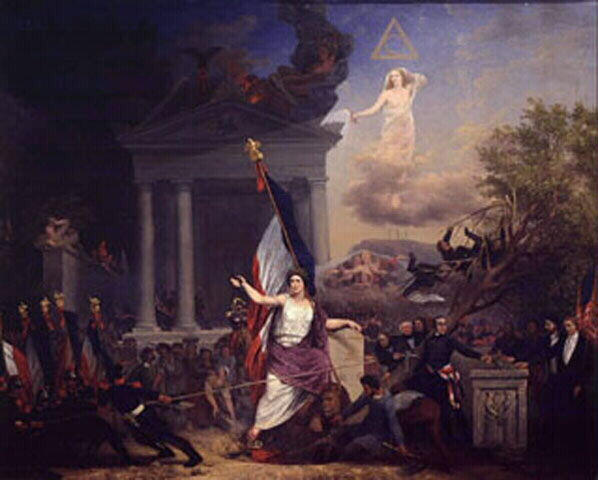
Now, I was pondering all this stuff on Saturday and I realized that the circle/triangle symbol is used in a painting I'd been meaning to write about: L'Arbre de la liberté by Bernard Prosper Debia, an obscure 19th century painter from Montauban and a friend of Dominique Ingres.

Dig if you will the detail I photographed back in April, currently the wallpaper on my cellphone:

Detail from Debia's L'Arbre de la Liberté
The symbol of divinity here is inscribed withe the words "Liberté, Egalité, Fraternité".  This supports my interpretation of the triangle in the Météo France logo.  Here the values of the Revolution have replaced values which had previously been used to justify the power of the Church and the aristocracy, that of divine right.  The laws of Reason and the Citizen replace those of the Church and King.  Here they shine down on a bare-breasted woman, perhaps a version of the Marianne, who, with a kind of mirror or magnifying glass, amplifies this "light of reason" and directs it onto the proceedings below:  the planting of a Liberty Tree.

Debia's L'Arbre de la Liberté, Musée Ingres, Montauban.
Source: http://www.culture.gouv.fr/Wave/image/joconde/0070/m060704_0000721_p.jpg
According to the French Ministry of Culture website, this painting dates to some time before 1876, the date of Debia's death.  (b.1791).  In addition to the triangle and liberty tree, several other revolutionary symbols are pictured.  At least one historical personage is portrayed (Alphonse de Lamartine) but there may be others.  A classical structure in the background is on fire and if my memory isn't faulty a demon of some sorts is billowing away with the smoke.  I'm not sure what that symbolizes.  The quality of this image is pretty crappy, but if you look on the lower right, you see a small America delegation, represented by an American flag, a nod and a wink to the inspiration of the American War of Independence upon France, a depiction of shared values.
In another recent post (In the kingdom of the blind, the one-eyed man is king) about the Temple de la Sagesse Supreme (aka the "Illuminati Pyramid"), I took Pierre Dortiguier to task for saying that the eleven-panelled bronze tablets at the front of the pyramid represented a rebellion against the Decalogue.  I should have added more clearly that by placing the Declaration of the Rights of Man and of the Citizen upon tablets in a form ususally reserved for the Ten Commandments, a reference to a famous painting from 1789, the designer was indeed suggesting that new laws, based upon Reason, were replacing the old, based upon blind faith and obedience.  My issue is with Dortiguier's faulty knowledge, reading symbolism into the vagaries of decomposition, finding "proof" therein of a link to September 11th.  But the idea that one law is replacing another is, I think, valid.  But this is due to the very presense of the Declaration on Decalogue-like tablets, not because of the number of panels comprising these tablets.

So all this is a roundabout way of saying that the flag represents, with a mixture of divine and rationalist precedent, the idea that scientific investigation and Reason have (or should have) replaced revelation.  Whereas Noah depended upon getting his info directly from God, modern man must find it via observation and reasoned analysis.    The scientist was regarded both as patriarch, prophet and steward, not to mention facilitator of commerce.

Thursday, September 24, 2009

Boxing the Compass

The Pyramids, like great wily jackals hungry for time, just won't give up.

There's no need to go on repeating our take on their significance. Peruse any of our posts tagged "pyramids" and see what we're on about.

Light of Reason

In the picture on the right we have placed a pin upon the Météo France inverted pyramid fountain. Head northeast and you'll see a traffic circle decorated as a compass rose aligned perfectly north. Head in a northwesterly direction and you'll see a ray-shaped sidewalk whose point terminates in a green oval. We are finding that this "keyhole" or "eye atop the pyramid" design is itself becoming a common decorative motif wherever our pyramids are to be found.

What is interesting here is that the base of the triangle/ray you have the principal facade and entrance to the DSNA-DTI (Direction des Services de la Navigation Aérienne-Direction de la Technique et de l'Innovation), the French agency responsible for services relating to air traffic control, navigation, communication and monitoring. This includes training, software development, etc. The DTI is a cutting-edge research division.

For some reason they decided to pop a pyramid atop the entrance of this otherwise unadorned facade. From a side difficult to photograph, visible as it is only from a busy road, one can see it is a kind of three-sided pyramid. We find it weird that on their website, in their own photo of the facade taken from within the grounds, a tree obscures the pyramid. It's a bad angle.

And speaking of Météo France, we'd be remiss not to mention their logo, which, though not exactly a pyramid, is a triangle circling or set somewhere above the globe set against a square divided into light and dark halves. Perhaps an echo of the doctrine of opposites and the reconciliation thereof?

What is the red arrow point at? Where is it going? Squaring the circle or boxing the compass, the measurement's the thing.

Wednesday, September 9, 2009

Not so hidden meanings

In a recent post we presented this seal without explanation. It is the old seal of the BIPM, or Bureau International des Poids et Mesures. Not finding any info on the web, we decided to call the BIPM directly to find out of they had any more info. In short measure (ha!) we were put through to a nice lady from the BIPM library. She emailed us this little note she wrote on the images in the seal.

The seal represented on this page is the ‘macaron’ of the BIPM and represents an allegory of science holding in her hands the new metre standard with its decimal divisions. Mercury or Hermes, the god of commerce, invention and weights and measures wearing a winged cap is an allegory of industry, he carries his herald’s staff and as befits the messenger of the gods sits upon a map. The other feminine figure in the seal carries the symbols of industry, the mallet and a gear wheel. The macaron carries the inscription in Greek “Metro Kro” or “use the measure”.

It is suggested that the laurel decorating the ends of the metre represents the triumph of the work of those who made the new metric prototypes.

According to Wikipedia: 
Hermes is the Messenger of the gods in Greek mythology. An Olympian god, he is also the patron of boundaries and of the travelers who cross them, of shepherds and cowherds, of thieves and road travelers, of orators and wit, of literature and poets, of athletics, of weights and measures, of invention, of general commerce, and of the cunning of thieves and liars.

Hermes gives us our word "hermeneutics" for the art of interpreting hidden meaning.

In Roman mythology, Mercury was a messenger, and a god of trade, profit and commerce...

In Celtic areas, Mercury was sometimes portrayed with three heads or faces, and at Tongeren, Belgium, a statuette of Mercury with three phalli was found, with the extra two protruding from his head and replacing his nose; this was probably because the number 3 was considered magical, making such statues good luck and fertility charms.
In light of recent posts, we don't need to add much comment. Relating to Mercury, we would tentatively propose that each figure in the seal is holding some sort of phallus. They are a magical trio indeed.

In addition to being a messenger, Mercury symbolizes trade and profit. Likewise with Hermes, communicating hidden meaning, patron of industry squatting on a map. Thus confirming our suspicion that the metric system was primarily designed to facilitate commerce and measure new divisions of land in service of an emerging industrial and capitalist culture. He is the God of boundaries, invention, commerce, thieves and liars.

Finally, we would posit that the figure on the right, carrying a mallet and sitting behind a gear wheel, is none other than the Marianne, or Lady Liberty. Both can be seen pictured with laurels. Her "mallet" is more like a flag, think Delacroix's Liberty Leading the People. The gear is like a shield. With shield and flag, there's also something of Pallas Athena in her.

During the French Revolution of 1789, many allegorical personifications of 'Liberty' and 'Reason' appeared. These two figures finally merged into one: a female figure....

If the figure is indeed a kind of Marianne, it would only serve to reinforce the idea that the metric system adopted by Revolutionary France was inexorably linked with progress, the advance of reason and the Republican ideal.

New measurement for a new order.

The final, central figure seems to be older and wiser than the others. There appears to some writing on her sash. Does it say Europa? Or are they just wiley wrinkles? Any insight is welcome.

The Gid has found out that the BIPM: 

"was originally charged with maintaining the international standards for various measurements, which were categorized in three "dimensions" (a poor choice of words since the measurements do not correspond to the traditional three dimensions): length, mass, and time -- which originally (?) had the base units of metre, kilogram, and second."

He proposes the three figures represent these dimensions. One can also add that the figures form a rough triangle within a circle. What do you think?

You don't need a weatherman to know which way the wind blows

We want to leave these pyramids alone, honest. But they just won’t let us. A few days after posting about the StorageTek pyramid, we were confronted with yet another.

Let’s jump back a sec. We have argued that the pyramid was chosen as a symbol to honor Western social organization, wealth and power. In Blagnac wealth and power is synonymous with the aerospace industry. Architecture evokes the wings of jetliners, plane parts decorate the traffic circles, the names of streets are named for the heroes of French aviation.

The rocades are no exception. Their names link the sky to the land. The Blagnac pyramids are all situated along the Voie Lactée (Milky Way). To the south the rocade is called the Arc-en-Ciel: the Rainbow Road.

When this other pyramid made itself known, we were hesitant to post about it, for you see, it is inverted. We didn't want to push things too far, what with so many other more obvious and clear-cut cases to look at. But it is striking, situated as it is just a scant few hundred meters across from the StorageTek pyramid. What makes it harder to ignore is that it is a fountain with a pool at the base. Just like every other pyramid we have come across recently.

Of all the pyramids discussed on LoS so far, the most debatable is the one in Odyssud park. One could argue that it’s more of mound than a pyramid. Unlike the others in Place de la Revolution and the Centre Commercial Blagnac, it’s not a fountain. It does sit on an artificial lake at the center of which is an enormous fountain, but the beast itself does not spew water. But close enough for government work, eh?

We could go on about the fact the pyramid fountain adorns the entrance to Méteo France and is flanked by incongruous circular landscape architecture (a round parking lot?). That inverted it resembles a kind of funnel to concentrate the powers of the sky onto the earth (what’s a weather service for other than the measurement, prediction of and thus control of the skies?) We could mention the traffic circle decorated like a compass, perfectly oriented towards the north, which like other imagery we have seen near the pyramids, symbolically extends its power around the globe.

The pyramid is a way to raise the aristocracy and the priestly cast closer to the heavens. In this inverted pyramid (another of which can be found under the famous glass pyramid of the Louvre), we propose that the idea was to bring heavens down to earth.

The doctrine of progress and the perfection of nature is thus implicit.

Friday, September 4, 2009

Further adventures in "crypto-analytical deconstruction" (CAD)

Pyramids, keyholes, Gog/Magog and....golf?

The south side of Toulouse has, over the past 30 years, been transformed from one grid into another. Once a checkerboard of small farms and fields, it is now a checkerboard of office buildings and parking lots. Perhaps there is no more fitting symbol of the transformation of the agricultural economy into a service economy.

To link this zone d'activité to other commercial zones in and around Toulouse, a series of "rocades" have been constructed. To link Blagnac to the north in expectation of further development, the rocade is called the Voie Lactée (Milky Way). To link it to the south the rocade is called the Arc-en-Ciel (Rainbow). On both of these rocades one can see that the access preceded the need; the buildings rise up because now, they can. Their names evoke the aerospace industry which is the agglomerations breadwinner.

A few years ago a Colorado-based company called StorageTek swept into town with the promise of jobs. In exchange for creating a mere 470 jobs, the city of Toulouse gave the company 12 hectares off the Arc-en-Ciel and built a nearly 20 million-euro facility to go on it. Local municipalities also pitched in 7.31 million euros to help the company start operation. To make a long story short, StorageTek didn't come through. Not even half the promised jobs appeared and the company eventually pulled up stakes and left the place entirely, leaving a massive and expensive building and campus, replete with helicopter pad, empty. Toulouse was stuck holding the bill, and they recovered half of the sum later for promises unfulfilled.

As far as these things go, the building is rather handsome and landscaped with a subtle series of sidewalks going nowhere in strange geometric patterns; satellite photos are charmingly evocative of crop circles, at least to the imagination so inclined.


What isn't imaginary, however, is the small pyramid which is set at the entrance to the facility. (Getting a good picture of this pyramid will be tricky, but we'll see what we can do). [Got it! 10/03]

Like the pyramid at the Blagnac Centre Commercial (see Pyramid Power) it is placed within a circular base which serves as a fountain. LoS readers will also recognize this similarity to the so-called "Temple of Supreme Wisdom" in Blagnac (see Can an evil tree produce good fruit?)

Like both Blagnac fountains, a line at the top of the pyramid serves to accentuate the cap. In this case the round base serving as a pool has an oval extension in the direction of the main building which is a landscaped with palm trees and from above gives the impression of a keyhole.

The [first] picture of the pyramid shown above is nicked from a realtor's website (hope the link mollifies) which also tells us that the name of the campus is "Golf Park." Remember that in Pyramid Power we spoke of another development with an incongruously English name called "Green Park." This latter Egyptianate set of office buildings is also decorated with palms and just down the road is a monument to the A330 test flight accident which viewed from the ground gives an impression of a pyramid; from above it resembles a keyhole.


Note the repetitive circle patterns in this picture, like some sort of Kabbalistic sephirot gone awry, or even simply one giant golf course superimposed on the one the little people play on.

Just to add some spice to the mix, StorageTek left the premises after being acquired by Sun Microsystems. Sun was later acquired by Oracle. The realtor flogging the current empty space is named Bruno Pentecôte (Pentecost). What all that means is in the mind of the beholder. But why couldn't it simply be a Mr. Brown or involve companies with far less evocative names? Pentecost refers to the moment after Easter when the Holy Spirit descended upon the apostles and caused everyone to start speaking in tongues. Or as we call it, babbling! Like a brook.

The name "Golf Park" derives from the fact that the campus sits on a golf course. Here we imply no conspiracy or intentionality, but there are many poetically resonant aspects to this association germane to this post which will become apparent in the next section. The connection between Golf and Freemasonry may or may not be intrinsic, but at least one synchromystic seems to think so. This latter link is especially resonant for LoS because it not only links golf with Freemasonry, but to the moon.

Another resonance, completely a propos of nothing, is that in researching stuff for the Gid's Gog and Magog posts, we discovered that this is the name of an elite English Golf Course! Which is pure comedy gold.

And all that water which went onto the crops now makes nice greens for those with a little disposable green.

The most important resonance is less metaphor than fact. A golf course is, after a park, probably the most blatant example of the Western man's desire to improve upon and sculpt nature, to impose a vision of order upon the organic in order to suit his purposes: to eat, play, mingle and above all, make money.

Tessellation of the plane

While there are several variations within definitions, the word "development" usually implies a notion of progress or improvement. In our opinion this notion is intrinsically linked with a linear notion of time and results in the progressive hierarchical structures one sees for example, in the military, the Boy Scouts and even that old bugaboo Freemasonry. There are systems of ranks which do in fact reach a culmination; it is a linear concept and moving towards the apex is called advancing or climbing through the ranks . Ostensibly towards the tip of a pyramidal organization.

Urban development then, is implicitly presented to people as "progress". We argue, however, that this is linked primarily to the rise of modern capitalism and Western notions of time and space. It's no secret that for many non-Western peoples the concepts of time and property ownership are radically different than our own. They simply don't exist as we envision them.

In lieu of urban development, we prefer the term tessellation of the plane. In recent posts we have rather casually linked this concept to Freemasonry, to which it is most certainly linked, but perhaps we have been unfair in our implications.

Before 1717, there is very little known about Freemasonry; there are cryptic references and speculation, but very little hard data. It would appear that in 1646 Elias Ashmole was initiated into the fraternity. This comes from his own diaries where he says "I was made a Free Mason at Warrington..." There are any number of good articles on the subject available on the web.

Warrington, incidentally, possibly derives its name from "people at the weir." A weir is a low dam. The name Washington is a similar "locational surname" which might be from weis, or wash, which is an estuary or water running in from the sea, perhaps the shallow part of a river. (See water.) Controlling the flow, anyone?

What is certain is that after 1717, the public phase of Freemasonry is well documented. We need not recount the details, but suffice it to say that in the 18th century it flourished and by century's end included notables from all walks of life: the military, the aristocracy, the world of commerce, the clergy. It's also no secret that among the revolutionary upheavals of the time, Freemasons played prominent roles: Bolivar, Washington, etc. Hence the endless reams of conspiracy theory surrounding the New World Order and the Illuminati etc. ad nauseum.

Interestingly for a period in which so many dastardly (or heroic, depending on your perspective) revolutionary deeds were ascribed to the Illuminati, we call this period the Age of Enlightenment. The period where reason and rationalism came to the forefront of intellectual life.

Freemasonry fits into all of this for its very specific rationalist worldview. Freemasonry in many ways embodies the Newtonian model of the clockwork universe. The Universe was not a chaotic and random place. It was strictly subject to laws which could be fathomed by the mind. God becomes the Great Architect of the Universe.

But Newton, rational as he may have been, was also a mystic. He was deeply interested in the Kabbala and numerology. His was a mathematical route towards the understanding of the Mind of God. The Freemasonic model of God as architect can be viewed the same way. Some have posited that the Scientific Revolution turned architecture away from a metier concerned with mystical and numerological consideration into "'blind technological intentionality'....in which rationality was its primary objective."(Albo, 2007). We would argue that while this may be true in some part, the conflict between rationality and mysticism only plays out in minds predisposed to think of them as irreconcilable. However, a fundamental esoteric tenant is the reconciliation of opposites: As Above, So Below. Rationality could be put into the service of mysticism. Newton serves as a perfect example. Freemasonry another.

Which brings us back to the tessellation of the plane. Perhaps the most blatant symbol of this doctrine is the chessboard, where black and white squares form a larger whole; the squares are interdependent within their unity for the great game. And the checkerboard pattern is a common motif in Masonic tracing boards.

Weights and Measures

In the Age of Enlightenment, aka the Age of Reason, we see other developments linked to the tessellation doctrine. The development of the metric system, for example--a perfectly rational system of measurement based upon mathematical relationships existing solely in the mind--has replaced in all but three countries old standards of measurement. Imperial measurements, for example, are based upon the human body: an inch comes from the width of the thumb (indeed the French word for inch and thumb are the same); the foot comes from the average foot. The yard an average human stride. Horses are measured in hands and so forth. Needless to say, this could lead to discrepancies and we are told that the primary motivation for France to adopt the metric system was to resolve disputes involving commerce and taxation; presumably this would extend towards the measurement of land. The metric system was adopted by France in 1791.


Speaking of land, which we feel has become of paramount importance in our apocalyptic times (see Gog and Magog: Ruminations), it was in 1790, at Napoleon's instigation, that the French were obliged to abandon their traditional provinces in favor of the current departments. This change was explicitly for the purpose of imposing a more rational structure on the land and to mitigate cultural differences in order to homogenize and unify the people. Once again, as with the adoption of the metric system the next year, the traditional, organic standards were replaced by rational and more artificial ones.

It was the Age of Enlightenment, after all, and the light of reason was held up like a lamp to illuminate the shadow of ignorance and thus dispel superstition, local tradition and notions of distinct cultural identities. For all its variety, France today remains Europe's most centralized and homogeneous state.

Across the channel in England, it may also be worth pointing out that during roughly the same period (1750-1860) the Enclosure Acts were at their zenith. Roughly speaking the Enclosure Acts were literally government acts to enclose common lands and privatize them, concentrating the land into the hands of wealthy landowners. Marxist interpretation reads this as a way to force the peasantry into the cities and thus create the proletariat, the cheap labor supply for an increasingly industrialized nation. One doesn't really need to be a Marxist to see that this was so; maybe not by design but true nonetheless; it's no coincidence that Age of Enlightenment was also concurrent with the rise of modern capitalism.

It's also no great leap to state that in addition to idealistic notions of rationality, the rearrangement of territory in back in Revolutionary France also were designed to facilitate commerce and economic development as with the adoption of new metric standards by which to measure these new arrangements.

Standardized measurement served both the interests of commerce and the division of land among an increasingly wealthy minority. It is interesting to note that George Washington, famous Freemason and revolutionary, was also a surveyor. But more importantly, he was a land speculator.

So as we run out of space to occupy, in a world where homesteading is a scandalously bygone possibility, where guys like Ted Turner buy up millions of acres of Patagonia and George Bush Senior millions of acres in Paraguay above the largest freshwater aquifer in the world, where the average person dreams the dream and puts themselves 30 to 100 years in debt to own a postage stamp somewhere in which to merely breathe free, what's left to control?

Coups d'état, even revolutions have involved re-appropriating the land and what's beneath it: gold, uranium, even water. That free air might be next. As Below So Above.