Showing posts sorted by relevance for query grail. Sort by date Show all posts

Thursday, July 7, 2011

Fallen stone: tub plundering

Fallen Stone(s) sahu. 1. Occult mirror through which the powers of man are distracted.


Extrapolation


"The meteorite has always exerted a powerful influence over the imagination. What child, nay, what adult, has not marvelled under those graceful arcs of fire, so transient, so tantalizing, that are shooting stars? Is it any wonder that with our contemporary sense of the marvellous, the ancients took the shooting star for something even greater? A stone from the roof of the sky, perhaps even a piece of heaven itself?"
--Elysius Dubord, The Origins of Mormo Worship in Chaldean Mythology (1932)
Twinkle Twinkle
 
Throughout history mankind has worshipped the unknown and the dwelled in shadow, primitivistic urges little advanced beyond the endless sniffing of faeces so common among dogs and lesser species. The belief system built upon the imaginary will eventually collapse and the society to which it gave stucture will succumb to the forces of Associational entropy, drowning in failed belief, anatelic, crumbling evermore. But what of a God whose Will cracks across the sky in a startling display of atmospheric hullabulloo? What of the shooting star, sparkling like diamonds across the breast of Night, popping the dull cork of religions and landing it, once and for all, in the realm of the real, the Archimedic, beyond eternal Poobanism and like that.

Dubord associates Mormo with a minor Chaldean demigod called Mommo, a great warrior, but human. One day he set out to look for a stone which he had seen fall to earth and blinded by the sun invented the first denumbrator. He recovered the stone, which had fallen from the great vaults of the sky where Sirus soars -- from the very arches that support the heavens and separate the gods from the men of earth. When Mommo found the fallen boundary stone, he aquired great powers. He made of himself a king, so arrogant as to challenge the very gods. As powerful as he had become, however, he was no match for the gods; he was banished by Enlil and forced to roam the planet forever. To protect himself and the other gods, Enlil then hid the fallen stone inside the head of another wandering immortal. In his bitter state of earthbound immortality, Mommo sent his followers in search of the stone; when they found a likely candidate for the living hiding place, they naturally cut the person's head off to look inside for the stone. Dubord claims that Mormo, then, is merely Mommo by another name, and that the sacrifices associated with the former are the result of a misreading by Ankaran worshippers of Mommo's purpose: they knew nothing of a fallen stone but believed their god was demanding sacrifice to augment his power and satiate his thirst for death, as in the Mormo Death Cycle.

Dubord's theory, although far from widely accepted, still inspires provocative questions. An entire sub-genre of occult literature has grown up around his rather modest and rigorously scholarly book which has unfortunately caused many to look upon Dubord as some sort of crank who merits no attention whatsoever. But this is unfair to the mild-mannered professor, who in no way intended to posit what many have sought to ascribe to his writings.

That which was lost
 
One of Dubord's "wild step-children" is self-styled "investigative mythologist" William Henry, whose article "Shock ‘n Awe: We Will Rock You" (21 March 2003) contains quite a bit of clever word play linking the current war in Iraq with ancient Babylonian mythology.

As Elysuis points out, it is widely believed that during the period of Jewish history known as the Babylonian exile, Chaldean mythology had a great influence on the development of the mysticism found in the Kabbala. Starting with "Shock and Awe," the phrase used by the US military to describe the first phase of its Iraq invasion, Henry sees a reference to the Kabbalistic name of the feminine presence of God: "Shakina," who was exiled after the destruction of the Temple of Solomon. In her exile, she has variously been referred to as "the Widow" the "Stone of Exile" and the "Precious Stone." Arguably, her return from exile will precipitate the reconstruction of Solomon's Temple, which--according to the fundamentalist Christians George Bush associates himself with--is necessary before the Christ can make his encore performance.

According to an article in the Christian Science Monitor (6 August 2003), Iraqi folklore credited Saddam Hussein's occult powers to a "magic stone" he wore around his neck. What if the whole point of the Iraq war was to recover that stone? Shakina, the Precious Stone, was associated with the Ark of the Covenant, which makes any army who bears it invincible. Henry also points out that another element of the Shock and Awe campaign were the much-vaunted "decapitation strikes."

In Grail Romances, Percival is almost always, despite all other differences among their various authors, called the "Son of the Widow Lady." In Wolfram Von Eschenbach's version, the Templars are the Grail guardians, which is a stone called "lapsit exillis." This is bastard Latin which can be interpreted as "the stone, exiled." Whether the stone fell from heaven or was forced up by geomantic upheaval matters but little -- for Constantine himself, speaking from beyond Life in the vehicle of decapitation, blessed the Christian forces invading the Holy Land. What more does a sword need than the whetting stone of Christianity's true founder?

An Exemplary Construct
 
Freemasons are also referred to as "Widow's Sons," and a lost stone plays an important part in their mythology. A lost keystone, for example, is the whole point of the highest degree of the Royal Arch. Hiram Ibiff, the Freemason's martyred hero, is finally killed by a wound to the head while in charge of building Solomon's Temple.

Decapitated heads are often associated with the grail legends as well as the Templars. Richard the Lion-Hearted is said to have decapitated thousands of prisoners during the Third Crusade. The Templars were said to worship before heads and to hold something which guaranteed fertility and protection, much as decapitated heads have figured in Celtic and Welsh mythology (one of Shakina's places of exile is rumored to be Ireland). This could be the Grail or the Ark, both of which were said to hold these powers.

Peek-a-Boo
 
The biggest problem with piecing this history together is that after legend placed the stone in the head of an immortal, it was never retrieved. The historical record lacks any explicit connection, but this has not stopped people from searching. Texts this ancient are few, so many scholars have looked to Biblical references, including chapter 4 of Joshua, where God commanded Joshua to place twelve stones with the Ark of the Covenant. While it takes an extreme leap of faith to accept that these stones were somehow related to the fallen stone, several interesting facts fall into place once you make the jump.

The Ark, and it's accompaniment of stones, was later placed in Solomon’s Temple. The inner sanctum of the Temple, which held the Ark, was demarcated by encircled stones that separated the Profane from the Sacred. It seems likely that these were the same stones brought to the Ark by Joshua. As in Chaldean mythology, the stones demarked the separation of gods and men.

The treasures of the Temple were later stolen by Nebuchadnezzar II of Babylon. Nebuchadnezzar’s name in Akkadian translates to “Nebo, protector the boundary-stone.”1  No mention of the Ark or the stones is made when the treasures were returned to the Israelites. Interestingly, the Kaaba, the holiest of Islamic shrines, contains a similar arrangement to the Temple, wherein a Holy area is set off from the world of sinners. Is it possible that the stones left the Chaldeans, entered the hands of the Israelites, only to be wrestled away by the Muslims who keep it hidden away?

Another possibility has been posited. Nebuchadnezzar also conquered the Phoenician city of Tyre. Curiously, Hiram I, the King of Tyre, had provided vital assistance with the construction of the Solomon’s Temple. Tyre was later conquered by Alexander the Great, and eventually fell under an early Christian influence. Later still, it was absorbed into the Islamic tradition, only to be conquered during the First Crusade. Legend has it the Holy Grail was recovered from Tyre by the Templars. Did they actually take the stone, which as since been misrepresented as the Holy Grail?

Much of the speculation surrounding the stone and Tyre rests on etymology. The Hebrew and Arabic names for the city (Zor and Sour or Sor, respectively) both translate to "rock" or "stone" in an apparent reference to the rocky island where the city is situated. But the word "Tyre" traces back to Indo-European word "Dyeus", which meant “sky”.2

It's not a great leap to see that this was a town alternatively named for the Heavens and the Earth -- perhaps a strong magnet for a stone fallen from the arches separating Heaven and Earth.

Still Crazy After All These Years
 
If we assemble these references together, a pattern emerges; are the Holy Grail, the Ark of the Covenant, an exiled widow, a fallen stone and a decapitated head one and the same? It is no wonder that much has been made of Dubord's theory. If Mommo went around cutting off heads in order to "get his groove back," the Gnomic, Mormo-infested US government might do the same. Plastic Tub believes that if true, the US didn't find what they were looking for when they pulled a gaunt Saddam Hussein from his hole in the ground. Decapitations are still in fashion all over Iraq as so-called "insurgents," most likely CIA operatives hunting for the fallen stone, make their gruesome home movies in a rather clumsy revelation of their search.

Agents haven't met with much sucess in regard to Bin Laden either. Days after 9-11, a small CIA hit squad led by Gary Schroen was sent to Afghanistan to "Capture Bin Laden, kill him and bring his head back in a box on dry ice." As for his cohorts? Shroen was told to put their heads on pikes. Four years after the attacks he masterminded on 9-11, Bin Laden remains at large. Perhaps his head holds the fallen stone....
"I heard that Saddam Hussein, in solitary confinement, was spending his time writing poetry, reading the Koran, eating cookies and muffins, and taking care of some bushes and shrubs. I heard that he had placed a circle of white stones around a small plum tree."
Eliot Weinberger, What I Heard about Iraq (2005)
The Beat Goes On
 
The fallen stone has made its way into other mythical traditions as well. At Islam's holiest site, there is a shrine called the Kaaba, or Kaba. One of the cornerstones is a meteorite 50 cm in diameter, surrounded by a silver band that holds it together due to damage sustained while being returned 22 years after it was stolen by Ismaeli raiders in 930 CE. The stone is believed to have fallen during Adamic times and that it was originally a dazzling pure white, having turned black after absorbing the sins of true believers. This stone is called Al-Hajaral Aswad.

(Many have speculated that the Ismaelis were to have some important contact with the Templars. Interesting in this story is that the Templars in their turn are said to have influenced the Freemasons, who place a great deal of importance on symbolic cornerstones. The White House and the Capitol Building, for example, have Freemasonic cornerstones.)

In Matthew 13:45-46, Jesus tells a parable known as the "Pearl of Great Price." In this parable a merchant finds a pearl so alluring he sells all of his belongings to buy it, ending up wealthier than ever. In this parable Jesus is commonly believed to be illustrating that the pearl, or the Kingdon of Heaven, is worth sacrificing everything for; it is the ultimate treasure.

In the Acts of Thomas, a Gnostic text from ca. 200 CE, one also finds the "Hymn of the Pearl" (aka "Hymn of the Robe of Glory") as a metaphor for the exile and redemption of the soul. In the Hymn, a noble youth is sent to Egypt to recover a precious pearl guarded by a serpent. Once there, he loses his identity, forgetting not only his family and where he comes from, but who he is as well. After a series of encounters he comes back to himself, lulls the serpent to sleep and snatches the pearl, recovering the splendid, glittering robe which had ben made for him by his parents and which during his "exile" he had removed and forgotten. In a bit of Jungian synchronicity, ancient Chinese lore relates that pearls were formed in the brains of dragons, and guarded between their teeth. The dragon had to be slain before the pearl could be retrieved. Pearls were said to fall from the clouds when dragons fought. The black pearl, in particular, was a symbol of wisdom.

Some of these themes are repeated in the Pearl, a 14th century poem believed to be by the author of Sir Gawain and the Green Knight, a Grail Romance. In this poem, a young man falls asleep and dreams that he has lost his precious pearl. Perceiving a maiden, he asks if she is his lost pearl. She says that his pearl is not lost, but a rose which has withered. The youth wonders if the maiden has replaced Mary as the Queen of Heaven. Later, wearing the pearl, she instructs him on sin and redemption and exhorts him to forsake all he has to buy the pearl. He asks of the New Jerusalem, and she says he may not enter but can see it. He is led up a river to a spot where he sees the Blessed entering the Kingom of God and plunges into the river to join them; he awakes from his dream at this point, resolved to fulfill the wishes of God. Is this maiden--associated with the lost stone-- Shakinah, guide to the reconstructed Temple?

In Polynesia, the black pearl was called "the pearl of queens" or the "queen of pearls." Many legends surround the pearl. According to one, Oro, the god of peace and fertility, came down to earth on a rainbow, offering the pearl oyster to man. In another, the spirits of coral and sand adorned one "Te Ufi" with a cloak of the colors of all the fish that swim in Polynesia. The glory of the heavens came to rest on the ocean bed in the iridescent mother-of-pearl, which was considered a gift from the sky to the sea.

The Greeks and Romans thought pearls were born in oysters when rain or dew penetrated between the layers. The Persians thought the same, but they believed that if a pearl was imperfect it was due to thunder in the sky. Another says pearls are born from the meeting of a rainbow with the earth.

The Pearl of Great Price is also the name of the second holiest Book of Mormonism, which of course is a well-known front for a powerful Mormo Cult. Although not a meteorite, the pearl is a stone of great power. In fundamentalist belief systems, the fallen stone represents a literal thing, an object to be retrieved from within someone's head. More mystically-oriented believers feel that the pearl is symbolic of some sort of knowledge, a key to heaven, if you will, represented by a stone hidden in the head of an "immortal," or person of lasting import and influence.

Wednesday, December 21, 2011

Tossa del Mar and La Virgen de Montserrat

Previously published on my old website.


La Virgen de Montserrat, La Moreneta, "The Little Black", is one of the most celebrated Black Virgins among the approximately 500 reported to exist worldwide. Patroness of Catalonia, she takes her place among those Black Virgins which in addition to generating fervent devotion, serve as national symbols, such as Our Lady of Guadalupe in Mexico and the Queen of Poland at Czestochowa.

La Moreneta is not restricted to a purely nationalist role. Secondary images—copies—can be found outside Catalonia at Lourdes and Santiago de Compostela, two of the most important pilgrimage destinations in the Catholic world.[1] When I first entered Tossa del Mar’s (Catalonia) parish church and ran directly into a Black Virgin I was stunned. Her presence was much less surprising when I realized I was facing a reproduction of La Moreneta rather than a primary image proper to Tossa. Nevertheless she was unexpected, for I had never run across a mention of her presence there. Even the ubiquitous Begg Gazeteer[2] lists copies of La Moreneta and other famous Virgins, but nothing about Tossa.

The parish church at Tossa is dedicated to Saint Vincent, a Hispano-Roman Christian martyred during the reign of Diocletian in 304 CE. The church has chapels dedicated to the Immaculate Conception, the Ascension of Mary and both the Virgen of Carmen and the Virgen of Lourdes. La Moreneta is found at the entrance, to the right. Opposite her and at the same height there is a statue of the Virgin of Fatima. That makes six separate shrines to the Virgin in this modestly-sized church, including some of the most revered apparitions in the Catholic world: Lourdes, Fatima and Montserrat.

A seventh image is found on an 18th century tapestry representing the legend of the invocation of the Mare de Déu del Socors (socors = aid, assistance, rescue). As the legend goes, a small boy called Xixanet was playing marbles one day and broke a jar of cooking oil his mother had given him to fill. “The Devil take you!” she cried in anger. And take him he did. A demon arrived to carry the clumsy lad away to the Pit. Horrified and repentant, the mother quickly called upon the Virgin, who arrived with her sceptre (known as “sa mitja cana”[3]) and drove the demon off and sent him back to whence he came. This act is remembered in a popular dance performed when this miracle is celebrated on July 2nd. July 2nd, in addition to being a feast day for several other saints, is also the original day of the Feast of the Visitation, the day the Virgin Mary went to visit Elizabeth, mother of John the Baptist. This Virgin is honoured in Tossa in a small chapel near the parish church. It was erected in the 16th century by mariner Antonio Caixa after a promise made for favors received. She remains the Patroness of Tossa’s sailors and fishermen.


Begg’s entry on La Moreneta is extensive and worth quoting in its’ entirety: 

The documentary evidence for the devotion to Our Lady of Montserrat dates from 932 when the count of Barcelona confirmed and renewed an endowment made to the shrine by his father in 888, soon after the BV was found among the rocks. The gift was confirmed again by in 982 by Lothair, King of France. According to the legend, the rocks of Montserrat, formerly smooth, became serrated at the Crucifixion, after which the statue, carved by St. Luke, was brought from Jerusalem to Barcelona by St. Peter. It was hidden on the Sierra de Montserrat to save it from the Moors, and was found by shepherds guided by a choir of angels, possible in the 8 C. (Moss and Cappannari state it is known to have been black since at least 718). When the Bishop of Manresa tried to move it to his cathedral it refused to budge.

The present statue is a 12 C.(?) majesty; 38 ins; seated with the child held centrally. Montserrat is the home of Catalan nationalism and scholarship, where the language has always been preserved thanks to the great monastery library of the Benedictines and the famous boys’ choir, the Escalona. The sardana is danced regularly in front of the Church. [As with the non-black Virgin of Tossa] The BV is concerned with fertility and marriage, “No es ben casat qui no dun la done a Montserrat” (He is not well wed who has not taken his wife to Montserrat). St. Ignatius of Loyola received his vocation there and hung up his sword. Wagner was inspired to write Parzival there (Montserrat as Grail Castle). Goethe and Schiller both attributed great importance to Montserrat, and the house where Beethoven died was an ancient fief of the abbey.

Former Temple of Venus

Right off the bat, one notices themes typical to other Black Virgins. Found by shepherds (or herdsmen), the statue was immovable thenceforth from the place where it was discovered. The special relationship with fertility and marriage is common (see Notre Dame de la Daurade). It’s also quite common to find important Marial shrines on the site of old pagan temples. The Grail connection is a bit more fanciful; it is surprisingly common folklore among les Noires, at least in Begg's work; but one must be careful to sift through the manure to make sure any Grail connections are not the more recent additions of goofballs. That said, the idea that the Grail is not a thing but an idea, some kind of secret knowledge, is intriguing when we consider that La Moreneta was supposedly hidden at this site to protect her from the Moors. There are a number of Black Virgins, such as those at Tarascon-sur-Ariege and at Thuir, associated with victories over the Moors. In the legend of St. Fris, who in many ways is a surrogate for the Virgin, a victory over the Moors results in the death of our hero, whose body was then hidden within a rock, only to spring forth with new life centuries later. In many details St. Fris’ legend there are echoes of Santiago de Compostela, patron saint of Spain known as Santiago Matamoros: “the Moor-Slayer.”

In another article Michael P. Duricy clarifies some details. At first the image was called La Jerosilimitana due to the belief that it had been carved in the early days of the church. In what Duricy calls a “well-attested” account the image came to Montserrat in 718 to save her from the Moors. She then disappeared until about 890, when shepherds reported to their priest that they had heard singing and seen lights in the mountains, a fact confirmed by both the priest and Bishop. La Moreneta was discovered in a cave and placed in a small church erected to house her.

Several sources consulted (Duricy, Morris) seem to favour the notion that La Moreneta is black due to prolonged exposure to candles and incense smoke. If Moss and Camppannari’s assertion that she was known to have been black since at least 718 is correct, a date which comes more than 150 years before her cult became well-established, this seems unlikely. The original statue, wherever it may be now, has long since disappeared. It would have easily predated the intense interest in Mary that developed in the 11th and 12th centuries. Perhaps, says, Duricy, what the shepherds found was a statue of Isis and Horus, often pictured as black and whose iconography was adopted by Christians for their representations of Virgin and Child.

The current effigy, however, dates from much later. Its blackness may result from the influence of the commentaries upon the Virgin by St. Bernard, or may come from some Grail-related esoteric symbolism. Perhaps it faithfully reproduces the color of the lost original. I reject the notion that it was the result of candles and smoke. My tentative proposal, a notion coming from recent encounters with other legends, is that there is some connection with the long struggle against the Moors; how exactly I’m not quite sure. I am reminded though, of the Al-Hajar-ul-Aswad, the “Black Stone” around which the Kaaba is built. This is the holiest shrine of Mecca, the focal point of Islam. The Black Stone is said to be black from having absorbed the sins of the faithful, who make the Hajj in hopes of kissing the stone and thus expiating their guilt. Its silver frame is a vaginal form, echoing the shape of the Moon around whose cycles the Muslim calendar is based.

But this speculation remains at this time something of a flight of fancy……what I would like to know is when she first became called “Moreneta” which as we stated at the beginning means “little dark one.” Perhaps we should amend that to mean the “little Moor.”

Works Consulted
:
Begg, Ean. The Cult of the Black Virgin.

Capella de la Mare de Déu del Socors. (tourist pamphlet in Catalan and Spanish)

“Cana” http://ca.wikipedia.org/wiki/Cana

Duricy, Michael P. Our Lady of Montserrat. http://www.udayton.edu/mary/meditations/olmont.html

Iglesia Parroquial San Vincente. (tourist pamphlet, Spanish)

See Also:

Morris, Paul N. Patronage and Piety: Montserrat and the royal House of Medieval Catalonia-Aragon.


Notes:

[1] In the Middle Ages, Compostela ranked with Rome and Jerusalem as a way to earn a plenary indulgence for all ones’ sins.

[2] Found in the of the interesting if not-entirely-reliable Gazeteer of  The Cult of the Black Virgin.

[3] According to Catalan Wikipedia, a “cana” is an old unit of measurement found throughout the old Catalan and Occitan world measuring more or less 1.6 meters depending upon the region. A "mitja cana" or half-cana would thus measure 80cm or about a foot-and-a-half long.

Thursday, July 1, 2010

Aucamville Project 7: Notre Dame de Boisville


The Aucamville Project began, ironically, with a little ditty on a chapel (ND de Aubets) that isn't even in Aucamville, but the neighboring commune of Le Burgaud. Today we continue to break municipal boundaries with a brief essay about the chapel of Notre Dame de Boisville, which is just across the border with the commune of Verdun-sur-Garonne. The first part of this post is mostly an adaptation from a brief pamphlet prepared by Les Mariniers de Notre Dame de Boisville (The Mariners of ND de Boisville), an association formed to preserve the site.

Some History

The chapel itself sits on a hill overlooking cultivated fields and the D26 between Verdun and Grenade.

Although the Garonne River now flows calmly past about 100 yards or more distant, it once flowed around the base of this hill. Before the dams and floodgates which did a lot to tame the river, this was apparently a trickly place to navigate; the legend of its founding reflects this.

According to the legend, some sailors were making their way down the river and encountered trouble; their efforts to make their way to shore were stymied and they risked sinking into the raging waters. Fortunately for them, a statue of the Virgin they were transporting pointed to the place where they could safely escape the torrent. The sailors, grateful, erected a chapel on the spot.

Another version of the legend has it that the sailors were cruising along when their boat became
inexplicably becalmed. Attempting to use poles to free themselves, the sailors found themselves entirely immobilized. The statue of the Virgin then pointed to where they should go. For some reason, a statue coming to the rescue wasn't enough for these mariners, so they continued their futile efforts. The statue pointed three times before they decided to make their way over to the place where the chapel stands today.

This spot sits at the confluence of the Margestaud and St. Pierre streams and was and ideal spot for a village. Boisville was apparently quite sizable for the Middle Ages but there are few vestiges remaining. Some large dressed blocks and pointed stones still form one wall of the chapel; these are the remnants of a small 12th century castle. Except for these stones the chapel today is entirely a renovation. It was ruined in the Wars of Religion but rebuilt in the 17th century. It was restored again and enlarged in 1888; the façade with small bell-wall dates from this time.

Boisville was dependent upon Cistercian abbey of Grandselve, which exercised considerable influence over this entire area. Alas, the abbey was razed during the Revolution and only the Gatehouse remains. Around 1350 nearby Grenade grew in prominence and Boisville began to be depopulated, but the chapel remained.

Local legend has it that the statue was a Black Virgin, burned during the revolution. The current polychrome statue dates from the 17th century. People make a pilgrimage there every year on the Sunday after Pentecost.

The Diocese of Montauban adds some more information. One might assume that Boisville meands roughly "Woodville" (Bois = Wood) but apparently its is a patronym from the Germanic "Boso". (This sheds perhaps new light on the origin of the name Aucamville; is it from "auca"-- duck, or as others have it from a Germanic name: Auka?)

Another name for the Virgin is Notre Dame de Bon Secours (Rescue). Apparently, between Aucamville and Bon-Encontre, this chapel was one of many "sacred relays" erected a point in the river considered espcially dangerous for navigation.

This chapel is small: 12m by 5m and the bell-wall is 10m in height. It also serves as a funerary chapel (I can attest to this, although the marked graves of local aristocrats have been replaced by an unmarked ossuary to house all the remains found at the site--where or even if the aristocrats -- de Marveille, de Saint Blanquat -- were removed elsewhere I don't know). The chapel is pretty much barren as its trappings have all been stolen, especially in recent years; hence the chapel is always locked.

The diocese site reaffirms that the orignal statue venerated there was a Black Virgin and was replaced by the current 16th century polychrome Virgin and Child in 1802. This Virgin is said to specialize in the protection of children, the prosperity of property and the salvation of souls.

Some Jibba Jabba

Even though largely discredited and for the attentive reader an offensive display of creeping assertion and wild speculation disguised as serious history, Holy Blood, Holy Grail (HBHG) is a great read and it's hard not to be captivated by its central thesis. Indeed, the spectacular success of Dan Brown's The Da Vinci Code, which borrows liberally from the former, is to our way of thinking a demonstration of the power the thesis exerts. Namely, that Jesus and Mary Magdalene married and had a family that continues to exist today.

HBHG asserts that after the crucifixion, Mary Magdalene made her way to France. This legend is not the authors' invention; it dates back to the Middle Ages and is a well-entrenched part of the folklore of Provence. What the book claims is that this bloodline became the founding dynasty of what would become France, the Merovingians (457-751 CE). This proved to threaten the power of the Church who thus betrayed the bloodline and tried to kill off all of Jesus' descendants. Thus in 1099 we find the creation of the Priory of Sion, who created the Knights Templar as a front and as both a military and financial arm.

As a novel, it's a marvelous work. As a serious history is more than a little flawed. The Priory of Sion itself seems to have been an elaborate joke; it's pretty much a dead letter as far as its central theory goes.

Whatever the case, my first encounter with the chapel was redolent of imagery which linked back to HBHG and I must imagine that some of this was set up by people who are familiar with the mythos.

First, let me state that I'd heard of the chapel from a neighbor and that unlike the Chapel of St. John the Baptist of Margestaud, which I found immediately, this one eluded me. Then one day I simply happened upon it. I'd passed it a dozen times and had never grokked it. Hidden in plain sight, as it were.

The first thing I noticed was that in the clearing before the chapel there is a small sign that says "Attention - Bees - Ay!...That stings!..." Now that I look at it, that alone sounds like one of the weird cryptic messages one comes across whenever dealing with the Priory of Sion and the Rennes-le-Chateau "mystery." Noon Blue Apples, etc. But it's pretty prosaic; there are actually beehives in the woods behind the sign. It's a simple warning.


The bees, however, were a symbol of the Merovingians. 300 were found attached to the robe of Childeric I when his grave was excavated in the 17th century. Napoleon had reproductions stitched to his robe when he was coronated in 1804. Resonance galore.

The chapel has an outdoor altar, made of a large slab of stone looking all the world like a dolmen. This is set next to a bifurcated tree which, as a friend told me later, has healing properties in French folklore. If one threads their way around the trunks in a proscribed number of figure 8s, it is supposed to recharge one's batteries, so to speak. Not that this is related to the HBHG story, mind you, but everyone I've taken to this site remarks on the unmistakable "pagan" ambiance of the place.


What really set me off onto this HBHG train of thought, however, is that on the cross behind the altar, decorated not with Christ but with Mary, as is common in these parts, there hung a medallion with the symbol of the Knights Templar! Who put it there and why, I cannot say. Was it a random visitor? Was it the owner of the site? (The chapel is on private property). Was it linked to the fact that the tombs were those of aristocrats? Were they a Templar family in the days of old?


On a later visit this medallion was gone (I'd been tempted to nick it for myself) and yet another visit found the cross smashed into pieces. It has since been replaced with a simpler cross--no Mary.

It was soon after that the marked graves of the aristocrats were removed and replaced with an unmarked slab.

All of this taken together could not but excite my imagination and any number of scenarios present themselves, from simple acts of vandalism by bored local youths or the result of a secret conflict between the descendants of Templars and their Catholic rivals. And anything in between, really. Keep in mind I know nothing and believe less. These are only enigmas because I am ignorant.

The abbey of Grandselve was founded in 1114 and became attached to that of Clairvaux in 1144/45. Clairvaux was founded by St. Bernard in 1115. It was Bernard who created the rule of the Knights Templar in 1128 and it was under his influence that the Virgin Mary, who had heretofore played only a minor role in Christian thought, was transformed into the primary intercessor between man and God.

"No one can enter Heaven unless by Mary, as though through a door" he wrote. Could this explain the distincly vaginal form of the church portal as it developed in the following years? Does the following medallion found at Boisville also evoke a woman's sacred gate?


Finally, the idea of the "Mariner" intrigues me. On the most obvious level, the mariner in Les Mariniers de Notre Dame de Boisville refers to the sailors who brought the Virgin to this spot. On another level there are tantalizing symbolic associations. The first of these is the Freemasonic body called the Royal Ark Mariners. Ostensibly this obscure appendant body refers to the story of Noah and the Flood, but for the life of me I can't find out why it is the "Royal" ark. If the ark carried Noah and the earth to a new beginning, could a "royal" ark be a metaphor for the grail? The grail, or "saint graal" aka "sang real" (royal blood) is, for the authors of HBHG, the bloodline of Jesus.

I've even seen it suggested that the Ark referred to is really the Ark of the Covenant, which some legends relate was brought back to France by the Templars. This last association would appear to be a fanciful misinterpretation as I haven't come across any Royal Ark sources making such a link. Plenty of legends say that the true mission of the Templars in Jerusalem was to investigate the ruins of the Temple, and that their goal was to find either the Ark, or the Grail. Or both, assuming they weren't one and the same.

The idea of the mariner is also linked with the legends that bring Mary Magdalene to France, via Egypt, from whence they were expelled or cast adrift in a small boat which made its way to what is now Saintes-Maries-de-la-Mer. Sarah, a servant on that voyage, has been proposed as the real inspiration behind the Black Virgin; others have posited Mary Magdalene.

The identification of Mary the Virgin and Magdalen the whore brings me back to the half-serious question I posed above regarding St. Bernard's statement that "No one can enter Heaven unless by Mary, as though through a door". Is it then coincidence that one theory for the origin of the Black Virgin is that is grew from Bernard's statement that the phrase "I am black, but comely" (from the blatantly erotic Song of Solomon 1:5) referred to the Virgin Mary? Imagine my surprise then, when leafing through Ian Begg's Cult of the Black Virgin, I find this "The Ark/Grail is the symbol of the virgin whore wisdom, who mixes all things in an orgy of syncretism...." (p.52)

Having thus deftly conflated the Ark and the Grail, he also conflates the Ark of Noah and the Ark of the Covenant on the page prior. Like a women, all are vessels, symbolically linked.


To ask one final question regarding the link between mariners and the Virgin: What are we to make of the chapel at Rocamadour where there is a reproduction of its famous Black Virgin--in a boat? Keep in mind that another theory about the origin of Black Virgins is the iconography of Isis, who in addition to being seen ad infinitum suckling Horus, is elsewhere often depicted in a sacred boat, or barque. In fact, some medieval legends have it that the name Paris comes from the name Isis, or even means "boat of Isis." The head of the Priory goes by the title "Nautonnier" or "navigator" and apparently claim this comes from Sirius, which is said to guide the boat of Isis....

Heady stuff, to be sure; even the little chapels weave their way in an out of the Great Tapestry.

So, there you have it. Who'd a thunk such a miniscule blip on the map could lead to so many vast and perhaps unanswerable questions? Just another sunny day on the Laws of Silence.

Monday, February 16, 2015

Noon Blue Apples


If you don't know the story of Rennes-le-Château (RLC), let me try and break it down for you.

In the late 19th century a priest named Bérenger Saunière was appointed as the village priest of RLC.  He found his church and presbytery in a sorry state, reflecting the overall poverty of this small village, remote and isolated atop a large hill.

At some point Saunière came into a large amount of money, the origin of which is unknown, but which at least in part came from trafficking masses.  Ads placed in various Catholic newspapers throughout Europe, as well as his own account books, attest to this fact.  But the amount of money this previously impoverished priest spent is the equivalent of millions of euros in today's money, so it is possible there were other sources.  Having been punished for preaching Royalist views from the pulpit, it's possible that some moneyed Royalists furnished him with cash, but this is speculation.  Fact is, we simply don't know where all the money came from.

Saunière refurbished his church quite elaborately and built himself an impressive villa complete with large gardens he stocked with exotic animals such as peacocks and llamas.  He also built an orangery and a personal library in the form a small castle with a crenelated tower.  This was stocked with rare and expensive volumes.  Indeed, Saunière lived well, and his accounting ledgers show an impressive collection of fine wines and spirits, gourmet foods and other small luxuries.  His largess extended to the village as well, for it was he who paid for its electrification.  He also had a road built, winding upside the hill from the village of Couiza.  Though his early renovation angered the villagers -- his work had displaced their family tombs -- his generosity eventually won their loyalty.  After being called into account over his lavish ways by his Bishop at Carcassonne, Saunière went; once.  After that he simply refused to go, eventually being suspended, then replaced.  But when his replacement arrived, the villagers didn't go to mass at the church, but to the masses held by Saunière in his private chapel!

After his death in 1917, he was survived by his servant and confidant, some have said mistress, Marie Dénarnaud.  The money had pretty much dried up at this point and Marie found it difficult to maintain the property, so it was bequeathed to one Noël Corbu in 1946.  Corbu claimed that Marie had told him the real story of Saunière's wealth and promised to reveal the location of an extensive treasure in exchange for room and board until the end of her days; however, when she died in 1953, she hadn't revealed the secret.  In 1955 Corbu opened a hotel and restaurant on the property and in 1956 gave a serialized interview in a regional newspaper, claiming Marie had told him that Saunière had found the treasure of Blanche de Castile, accumulated to pay the ransom of Saint Louis, most of which was still hidden in the area.  He also claimed Saunière found some mysterious parchments which were of enormous value.

Now this of course could all be true.  It's also possible Marie invented it all in order to scam her way into a secure retirement.  It's also possible that Corbu, a published novelist, made it all up to promote  his hotel and business.  Corbu was pretty much correct in assuming a story of hidden treasure would attract visitors.  Today the place attracts thousands of visitors a year for nothing more than a lovely view, a small but admittedly interesting church -- and an intriguing enigma.  It has attracted treasure-hunters from the start, obliging the town to pass a law in 1965 specifically prohibiting excavations in the commune.  By that time Corbu had sold the property and died soon after in 1968 in an auto accident (which adds a little something to the mystery).

In 1966 Pierre Plantard and/or Philippe de Chérisey published a book which linked the treasure to the Merovingians, based upon an earlier book that had quoted Corbu extensively.  This book was credited to St. Anthony the Hermit.  These two in fact created a whole host of documents that later cropped up in Gérard de Sède’s 1967 book, L'Or de Rennes.
The central claim in L'Or de Rennes was that Saunière found parchments proving that the lineage of the "last" Merovingian king, Dagobert II, assassinated on 23 December 679, did not die with him as had previously been thought. His son was presumed to have escaped the massacre and took refuge at Rennes-le-Château, where he founded a line of descent before being buried in 758 in the church crypt. These genealogical documents implicated to an exceptional degree the Priory of Sion, a secret organisation working behind the scenes ever since the Carolingian and Capetian usurpations for the recognition of the legitimacy of the Merovingian line of descent to the throne of France. Pierre Plantard claimed to be descended from Dagobert II. 
Their motivations are obscure.  Plantard was a royalist who had been involved in various right-wing secret societies and who supported a Merovingian restoration.  He may have actually believed he was the rightful heir to the throne, as he claimed.  There is some indication they felt some financial gain might be made from it.  De Chérisey was a self-described satirist who had been involved in various surrealist-inspired groups such as Oulipo and the College of Pataphysics.  It was he who forged the parchments upon which de Sède and later authors have based many of their claims.  Both he and Plantard have admitted the forgery, and the current holder of the parchments has had them tested and determined that they are only a few decades old.  De Chérisey was an artistic man; perhaps the whole thing was for him an amusing intellectual game, from encrypting the documents to weaving an alternate reality.  In this latter regard he was, like Corbu, a stunning success.  Like Corbu, he never seemed to have made any money from it.  De Sède, Plantard and De Chérisey all fell out with one another over time for reasons which involved, among other things, royalties and other monies.

In 1969, Henry Lincoln read de Sède's book while on holiday in France.  Intrigued, he convinced his bosses at the BBC it would a great subject for a documentary.  In 1982, Lincoln, Michael Baigent and Richard Leigh published The Holy Blood and the Holy Grail.  The book elaborated upon all the elements heretofore present, but brought in a whole host of other mysteries.

The Holy Blood and the Holy Grail claimed many things, but the centerpiece was that the Priory was guarding a secret, namely, that the Holy Grail -- the "Sangreal" -- was really the "sang real", the Royal Blood evoked in the title.  This royal blood was the bloodline of Jesus Christ, which had survived and become the Merovingian Dynasty.  The Priory was dedicated to protecting and restoring the dynasty.  Now, the idea of a royal bloodline was not unique to this trio of authors; indeed, they supported many of their claims by bringing in pre-existing French legends.  That Mary Magdalene ended her days in Provence, for example had been a widespread belief in Medieval France.  But the book has since had a tremendous impact on our culture and contemporary spirituality.

One great book -- Foucault's Pendulum -- satirized its methods and conclusions and one absolute ball of shit -- The Da Vinci Code -- borrowed freely from its ideas and became an international publishing phenomenon, selling millions of copies and igniting dozens of copy-cat books, documentaries, a Hollywood adaptation and a number of sequels.  Dan Brown became a very rich man.  Today the corpus of books studying the phenomenon of a Jesus bloodline are legion, as are books about Rennes-le-Château, becoming a genre of its own in the world of esoteric literature.

I think that as a sociological phenomenon, it's actually an important story.  First of all, the hoax itself is extensive.  It consists of just enough fact to make it credible and all the right elements -- such as secret societies, encrypted documents and hidden treasure -- to make it irresistible.  But how this hoax and story mixed with history in order to produce such a complex web of beliefs is amazing, for today it encompasses a whole range of what could be termed New Age ideas:  numerology, mystical toponymy, UFO's, whatever.  If you can think of a connection someone else probably already has too -- and published a book about it.

The parchments forged by De Chérissey contain secret messages.  The first reads:

"À Dagobert II Roi et à Sion est ce trésor et il est là mort." 

"To Dagobert II King, and to Sion belongs this treasure and he is there dead."

The second has another equally cryptic phrase:

"Bergere pas de tentation que Poussin Tenniers gardent la clef pax DCLXXXI par le croix et ce cheval de dieu j’achieve ce daemon de gardien a midi pommes bleues"

"Shepherdess, no temptation. That Poussin, Tenniers hold the key: peace 681. By the cross and this horse of God. I complete (or destroy) this daemon of the guardian at noon blue apples"

The encryption that reveals this nonsensical phrase is very complicated, you can read about it here.  In order to make the encryption work, it was necessary to use up all the extra letters.  This is why the phrase "blue apples" appears.

You will recall that Plantard and de Chérisey's first book was attributed to Saint Anthony the Hermit.  On his feast day, January 17th, it has become tradition to visit RLC in order to witness the noon blue apples.  Basically, at noon light shines through a stained-glass window and casts blue blobs of light onto the sculpture of Christ on the pulpit.

I set out this year for RLC with my brother-in-law, jazz crooner Alfredo Buendia.  Alfredo has just returned from Rio, where he spent the last few years busking and selling his CDs, playing for weddings and events.  It was a clear if frigid day, and we made good time, stopping just after Fanjeaux to pick up some bread, cheese, ham, chocolate and a couple of beers.  A bit later, in Mirepoix, we had lovely croissants and cafés au lait under the bastide.  If I'd had my head about me, I'd have realized we were going the wrong way -- Mirepoix is not on the road to Limoux from Fanjeaux, and Limoux was the next point on the map we didn't have, before heading the last few kilometers down to Couiza and then up to RLC.  So we plunkered along various routes until I realized something was amiss.  We lost a good half-hour getting back to Mirepoix until I feared we'd miss noon.  But we made it with about 15 minutes to spare.  This meant that upon arrival, there was nowhere in the village to park.  This also meant we didn't have to stand around uselessly waiting for it to happen.

There were a lot of people in the church, but it wasn't jammed.  We found a place pretty easily and fortunately, we're both pretty tall.  There were a lot of English voices in the crowd, which was unsurprising, but there were a smattering of Dutch voices as well.  In Summer, a lot of Dutch head this way, so it's not surprising there'd be some in Winter as well.  While we waited, I surveyed the crowd.  A lot of men wore mustaches and wore fedoras (including myself!)  There were few women in woolen scarfs and dresses of a style that looked to me like what older hippies or Wiccans would wear.  Not saying all Wiccans dress alike!  But there was a certain vibe, something akin to gaydar I guess, which would all be perfectly natural in this place, on this day, at this time.

One guy handed me a tract and said a few things that were hard to follow.  Some mystical shit.


This tract is in French with unusual spelling.  The content is rather strange, railing against consumerism and hypocrisy of the French in the wake of the Charlie Hebdo murders.  The man implies that he is in fact the "true king."  It's filled with puns, at one point saying we're all hostages to the 14th letter: "N".   Alfredo and I were talking about this guy over sandwiches and a lady next to us said that he'd removed "l'N" from his writings, that is to say, "la haine," or hate.

Later, this guy, apparently named René and the leader of some sort of local commune, something of a notorious eccentric, tried to climb up into the pulpit but was shouted down by the crowd.  He continued his discourse outside the church, standing atop a low wall before the crucifix, his arms outstretched and wearing a crown upon his head.

As noon rolled around the wan blobs of blue light did creep across the pulpit and surround the head of the Jesus carved there.  No one seemed overwhelmed, but there was lots of discussion and photograph taking.  Some guy mentioned that the light wasn't bright enough because of a tree branch that had grown across the front of the window and that the mairie had promised to cut it back for next year.

There are many sites across the globe where architecture has been designed so that the sun would shine one a certain spot or through a certain window on a specific date, but to me, this seemed more coincidence than anything else.  Unless something more spectacular happens when the light is stronger, it's pretty much a non-event.  It's quite possible De Chérisey had noticed this and included noon blue apples in his text as a reference, having already chosen this Saint as the pseudo-author of his first book with Plantard.  Or he may have merely chosen the phrase and someone else then noticed the blobs of light, connecting the two.  It's not as if this phenomenon is especially striking.  First of all, the same lights will appear on days before and after the 17th; they won't be in a much different a position than they are on that day.  Secondly, on that very day there were other places where blue circles were cast on the walls that were much clearer and distinct than those on the pulpit and no one seemed to be making a hubbub over them.

The 17th is pretty much a non-event where nothing out of the ordinary happens.  Except for the fact that several dozen carloads of people make their way here to observe the phenomenon, look for an audience or simply get together.  I'll bet most of these people just use it as an excuse to come here.  Of course there must be a smattering of true believers, but I'll bet they're not the majority.  There are people like me, curious to see for myself and mainly, to observe the people.  I didn't come to observe the event as so much the event around it. And why not?  It's a lovely drive and the village is charming.  I always leave feeling good, charged up.

After RLC, we went to Rennes-les-Bains and had more great coffee and went up and down the main thoroughfare of the village in search of local oddities.  We scoped out some things in the village cemetery and, as you can see in the video, took a short hike to the rock formation known as the "Devil's Armchair" and the "Trembling Rock".   Because of RLC, everything around here is invested with esoteric meaning.

I'd passed through these parts a few years ago with my kids, it's always a great visit.  I'm a skeptic, but an open-minded one.  Nothing I've seen yet has convinced me of anything especially mystical about this place, but the reputation does precede it and lends it an air of mystery another place might be lacking.  But all that aside, it's a lovely place to pass a day or two and I would like to make Noon Blue Apples Day an annual event.  Check back next January to see how it turns out.

Friday, January 14, 2011

Women

This title is misleading, because it might just as well read "Woman" and be accurate. Therein lies the central problem I am working on. I don't want to be too simplistic here in reducing all these figures to manifestations of one feminine ideal: capital "W" Woman, and what she represents. But I'm tempted because the conflations and interminglings are so plentiful.

In these examples we find piety, suffering, chastity and martyrdom. But we also find strength, courage and victory. The women here are patrons, benefactresses, protectresses and mediators.

Beauty and erotic allure are also important elements for some of these women. The shapely, comely figures, young, virginal; sometimes a little older and wiser; sometimes strong and wily. Woman, in all Her allure. In these examples, there are no old women. Indeed, there are not even mothers. (Belle Paule is an exception; as a real person she lived to an astonishingly old age for her time and her children were as much reputed for their beauty as she.)

Another exception to this last rule is the Virgin Mary, whose presence hovers all over these other women like an umbrella. As a Mother, she is the supreme example. But this may be mitigated by the supernatural nature of her conception. "Immaculate" is the word, and it extends into these other feminine examples as well.

On the other hand, what we have here in this series of maidens or women are beings so pure and distant as to be unobtainable, or sexless allegorical creatures which exist in realms distant from the touch of man. To approach these women as sexual beings would seem perverse. There's a double enjeux going on, a complex interplay of approach and withdrawal which is itself is a kind of sexual engagement with a mental idea, or ideal.

The hesitancy with which I approach this subject is a structural metaphor for what I see in these depictions of women, as well as the effect of the interplay between eroticism and chastity. These women are "unapproachable" and in their remarkable chastity "irreproachable" as well. Which is a sort of paradox; perhaps it is the combination of these two factors which gives their erotic aspects a bittersweet sentiment.

I have arranged the women in chronological order, mixing substantiated dates with estimated ones. Where a legend arose without assigning a particular date to the story, I used the date of the legend. When the women correspond with another datable event, I use the date of the event.

Here I will present my first attempts to come up with some common characteristics of feminine ideals present in several figures: real, legendary and allegorical; these are initial thoughts and shouldn't be considered my definitive words on the topic. I'm hoping that eventually, should this lead me somewhere, I may turn it into a more staid and scholarly work. For now it will be typical LoS fare.

Also, after the Venus of Lloret post, many friends responded with a bemused "Why, you're becoming a feminist!" Hardly. I'm not planning to enter the Womens' Studies field just yet; many might even find my words typically masculine, slightly offensive. Who knows? Neither pandering to nor refuting a "feminist" line is my intent. I just want to document what I've come across and my reactions to it.

Simple? Good. Let's begin:

"Les puelles" (c. 257)
: legend


Two Christian women (puellae remembered as "les Puelles") piously gathered up the remains and buried them in a "deep ditch", that they might not be profaned by the pagans.

Source

Saint Sernin is the patron of Tolouse and its first Bishop. Legend has it one day as he walked past the altars of the pagan gods and their oracles fell silent; he was asked to pay homage to the gods and he refused. He was seized and executed: tied to a bull which dragged him to his death.  The Puelles then properly buried his remains.  They are celebrated both for their chastity and their martyrdom.

LoS Posts: 

Dame Carcass (795; 12th c): legend; savior; tutelary


The Emperor Charlemagne besieged the town [Carcassonne] in 795, which was held by Dame Carcass, a Saracen princess. After a five year siege, the only food left was one little pig and a bag of corn. Dame Carcass gave the bag of corn to the pig and sent it out to the ramparts. Charlemagne raised the siege, since he thought there was enough food even to feed a small pig. Before the Emperor left, Dame Carcass rang out the bells making them sound the word Carcassonne.

Source

When I first heard this tale, Dame Carcass launched the pig over the ramparts on a catapult. Maybe that was a bit of Monty Python's Holy Grail sneaking into the picture.

This tale seems to be pure hogwash, heh heh. It would have taken place in the late 8th century but the legend doesn't seem to have appeared until the 12th. It was subsequently reworked in later centuries and is with us today, a colorful and amusing anecdote.

Interesting that the clever woman here is a Muslim woman, yet she offers up the last of the food, a pig. Whether or not she paraded it on the ramparts or flung it over the wall, it is anomalous, unless interpreted as a rejection of the foul swine. This gesture, according to the legend, saved the town.

(I have long had the creeping suspicion that the famous "Black Virgins" which are clusterd in Aveyron and the Pyrenees, may have some link with the Moorish/Christian conflict, some at least have their origins ascribed to this period. I'm not exactly sure where to go with this question.)

At some point Dame Carcass had bells rung in victory, leading someone to say "Carcass sonne" , or "Carcass is ringing the bells." Hence the name of the town. I see her as both a military savior and a tutelary figure.

This is not about Toulouse, but it relates to the theme and broadens the context. I think the rise of the legend is aligned with the rise of a cult of femininity which was at the time leading both the the troubadours notion of the idealized woman in their tales of courtly love, as well as in the rising prominence of the Virgin and her redefinition as a more earthy, emotional and at times erotic figure.

Women who operated the catapult killing Simon de Montfort (1218): legend; saviors


After maintaining the siege for nine months Simon was killed on 25 June 1218. His head was smashed by a stone from a mangonel operated by the women of Toulouse - "donas e tozas e mulhers" (noblewomen, little girls and men's wives). He was initially buried in the Cathedral of Saint-Nazaire at Carcassonne but his body was soon removed to his home in France.

Today, the spot where Simon de Montfort met his end is marked by a plaque set into a wall of pink Toulouse brick (see left). It reads: "Old Montoulieu Gardens - During the siege of Toulouse in the course of the Albigensian Crusade Simon de Montfort was killed here in 1218". The last two lines are a quotation from the Song of the Cathar Wars, laisse 205, cited above: both read "now a stone hit just where it was needed" first in French then in the original Occitan.

Source

Again, women save the day. A catapult is involved. These women are the representatives of all women in Toulouse: noblewomen, little girls and men's wives. All pitching in. I assume that this is analgous to the "We Can Do It" propaganda of WW2. Everyone pitches in to save the homeland when the men are off to war.

Simon is still hated in Toulouse to this day. We may one day look more closely at the guided, falling stone that killed Montfort (Mount Strong, or Strong Mountain) with a blow to the head. 

In Wolfram Von Eschenbach's version of the Grail legend, the Templars are the Grail guardians, which is a stone called "lapsit exillis" or the "stone that fell from heaven."  And head wounds have a variety of esoteric sources, from the murdered Hiram Abiff of Freemasonry to the mysterious "Head wound man" in Tim Wilson's films Water:Pillow and Mamu Rising.

We see of course that strong women are part Toulouse's historical symbolic landscape as well as in the rest of France. Jeanne d'Arc, our next figure, is also a savior, but there is also great suffering and piety in her story. She is at times a Holy Fool, and object of pity and amusement before becoming something of wonder and fear, before reverence.

Jeanne d'Arc (c. 1412-1433): savior; suffering little girl; saint


Source

Jeanne d'Arc is not a woman of Toulouse, and she is our first historically verifiable woman. A few remarks can be made here, but nothing that can truly add to the vast scholarship on her life and her meaning. Toulouse has a Place Jeanne d'Arc and there one finds a gilded (daurade) equestrian statue of her. In every church in the south, you will find an icon of her, often right next to the altar, St. Michael slaying the dragon on the other side. In these, she, feminine principle, combines with another armored spiritual entity, Michael. She shares in his victory over Satan. He shares her victory, spiritually, which ultimately lead to French liberation. I suppose the Arc cult picked up steam during WW2.  The French Nationalist party Front National uses her as their symbol.

Jeanne d'Arc, associated with Michael, also assumes a role of the Virgin as ass-kicker of the serpent. In the south at least, Mary is often portrayed treading upon a serpent's head, vanquishing sin. (See Aucamville Project 6 and Jesus was in shape).

She was full of beans that kid!

Clémence Isaure (late 15th c): legend; patroness


LoS Post:
A Legend born from a scam

Floral games named after Flora, (Greek Chloris), the first a goddess the second a nymph associated with flowers and vegetation, rebirth and Spring. Both were married to Gods of the West Wind, heralds of Spring. Ovis states that when she spoke, she exhaled roses. These roses as well as her fertility role, evoke the Virgin Mary. Indeed the Floral Games (Jeux floral) founded in Toulouse by the Consistoire du Gai Savoir (later Compagnie des Jeux floraux) were named after Flora and were held in honor of the Virgin Mary.

Belle Paule (1518-1610): patroness; beauty


Of all the women in this list, only Paule grew old, living to 88. She must have seemed immortal. Ironically, it is her in which beauty and erotic allure reach their zenith. According to the legend, she was obliged to go about averting her gaze so as not to cause disorder; she was likewise obliged to appear at her window once or twice a week in order to appease the adoring crowds below. A book was written about the intimate details of her perfect anatomy. Yet another writer found an anagram in her name for "pure virtue guides." Her chastity was equal to her erotic allure. Buff, and rebuff.

In our introduction we recalled that she had a number of children, each as beautiful as she. It was with this in mind that Toulouse chose to name a new children's hospital after her: the Hôpital Paule de Viguier. This hospital is interesting in that it combined pediatric care with care for mothers and to a lesser extent couples. This name was chosen in 2002. According to their website:

Le conseil d’administration du CHU a décidé de donner au nouvel hôpital de la Mère le nom d’une femme du XVIème siècle qui avait, avec la mythique Clémence Isaure, passionné les toulousains de la Renaissance.

The site recounts her history and legend. What is interesting here is how Paule de Viguier is evoked side by side with Clémence Isaure, a legend. The two are often confused and to some extent, conflated.

All the other girls on this list, on the other hand, were fixed in their youth by early deaths. They are pious and saintly, but damaged, suffering, sometimes deformed. Maybe mentally ill. In any even, disease laid them low very young....

LoS Post:
Belle Paule of Viguier

Dame Tholose (1544): tutelary; allegory


When entering the Marly courtyard, visitors can see Dame Tholose (ill. 1 ; cat. 3), a figure which used to be on top of the Dupuy column in Toulouse which has very wisely been put on deposit at the Musée des Augustins. This allegory is by Jean Rancy whom we mentioned above and who, like Pierre Biard’s Fame from the Louvre (ill. 5 ; cat. 36) displayed nearby, is inspired directly by Italian Mannerist models, particularly Mercury by Jean de Bologne.

Source

La statue de Dame Tholose est revenue dorée. Elle a été installée en janvier 2007 sur la colonne qui domine la place Dupuy. L’été précédent, Dame Tholose alias la Renommée perchée en haut de la colonne Dupuy, avait été emmenée pour être copiée et restaurée. En 1830, Urbain Vitry, architecte de la ville de Toulouse, eut l’idée d’utiliser pour le monument à la gloire du général Dupuy et de la 32ebrigade qui s’étaient illustrés pendant la campagne d’Egypte, une statue des collections municipales «Dame Tholose». En 1832, la girouette et l’écusson furent remplacés par des couronnes de laurier et la statue fut placée en haut de la colonne Dupuy. C’est ainsi qu’elle fût rebaptisée La Renommée.

Source

As a allegorical or tutelary figure, Dame Tholose is not particularly unique and is in fact not really known by Toulousains. Clémence Isaure and Belle Paule are more well-known names but 99 out of a hundred Toulousains couldn't tell you much about them, depite the artistic iterations to be found on Place Capitole and the Mairie's Salle des Illustres. Dame Tholose, however, brings to mind once again Marianne, the feminine symbol of Republican France. Marianne herself is one of a long list of female tuelaries: Columbia in the US (Lady Liberty, is a more famous manifestation); Britannia in England, Mother Russia. I am curious as to why Russians refer to a Motherland and Germans a Fatherland. I thought it had to do something with Protestantism and the rejection of Mary as such an important figure, but I don't think this theory holds much water upon closer examination. Germany has quite a large Catholic population whereas other Protestant Countries do have women as national personifications. Interesting though that of all the women national personifications of Europe, many are clearly the same figure with similar iconography; I suspect thay all owe a great debt to Athena.

Dame Tholose was the first non-Biblical sculpture erected in Toulouse since Classical Antiquity.  Bare-breasted, she recalls images of Liberty, as in Delacroix's Liberty Leading the People (1830).  The Revolution, radical as it was, failed to eliminate the woman as savior from the collective consciousness.  Liberty gave way to the Marianne, which forms the basis of the Republic's "logo" and is still evoked in its campaigns.  A pregnant Marianne was used in 2010 to publicize a government development program, amid much scandal and feminist anger.  Interesting that for the future health of the nation, a pregnant allegorical figure.  The white cap and garment has other connotations, namely, the ancien régime and....virginity.  She stands against a blue background, traditional color of the Virgin.  Is an immaculate conception being evoked here?  Apparently, the circle of gold stars on a blue field which makes up the European flag.  Oddly, the flag's designer admits to being inspired by the twelve-starred Vigin Mary described in the Book of Revelation and the date it was adopted adopted, 8 December (1955) is on the same day Catholic Feast of the Immaculat Conception of the Virgin Mary.

St. Germaine (1579-1601): suffering little girl; saint


From her birth she seemed marked out for suffering; she came into the world with a deformed hand and the disease of scrofula, and, while yet an infant, lost her mother.

Saint Germaine of Pibrac is know as the "saint of the country" or "regional saint" of Toulouse. Many Saints have trucked through these parts, Benedict, St Vincent de Paul, Aquinas' bones rest here, for example....but it is St. Germaine who is honored. There is not a church in the area without a plaster icon of her (likewise Jeanne d'Arc, St. Thérèse and St. Bernadette).  She is depicted barefoot, perhaps a small lamb at her side, her apron held in her hand and spilling roses to the the ground.

In Pibrac, a large stately basilica stands in her honor. It is much more recent and cut in stone, hence the cleanness of its lines, so unlike the crumbly brick aethestic of the majority of area architecture....

In Launac, near Toulouse, the church is filled with icons of Mary, and one, crowned, was once evidently the subject of great devotion: the crown being our first indication, a few votive plaques another. In the altar to Saint Germaine, Jeanne d'Arc guards the entrance. The cloth hanging from her armor is blue and decorated with fleur de lys. Saint Germain's red skirt, identically draped is red and likewise decorated. Strange monarchic watermark on two-thirds of the tricolor!

Germaine was said to have died just when men were beginning to find her beautiful, which seems a striking detail of her legend.  Years later, her body was found to be incorrupt. She was canonized in 1867.

Source

St. Bernadette (1844-1879): suffering little girl; saint


As Bernadette later reported to her family and to church and civil investigators, at the ninth visitation the lady told Bernadette to drink from the spring that flowed under the rock, and eat the plants that grew freely there. Although there was no known spring, and the ground was muddy, Bernadette saw the lady pointing with her finger to the spot, and said later she assumed the lady meant that the spring was underground. She did as she was told by first digging a muddy patch with her bare hands and then attempting to drink the brackish drops. She tried three times, failing each time. On the fourth try, the droplets were clearer and she drank them. She then ate some of the plants. When finally she turned to the crowd, her face was smeared with mud and no spring had been revealed. Understandably, this caused much skepticism among onlookers who shouted, "She's a fraud!" or "She's insane!" while embarrassed relatives wiped the adolescent's face clean with a handkerchief. In the next few days, however, a spring began to flow from the muddy patch first dug by Bernadette. Some devout people followed her example by drinking and washing in the water, which was soon reported to have healing properties.

Like Saint Germaine, her body was exhumed some 40 years later and found to be incorrupt.  She was canonized in 1933.

Source


St. Helena (d. 1885): folk saint

LoS Post:
A Saint in the Terre Cabade

A saint particular to Toulouse.  I've translated an article about her I'll post one day.  She is one of the Virgin's intermediaries and another example of a holy virgin in a region already spoken for.  I see this as a part of a continual need for a more intimate and personal saintly interlocutor; other saints have too many prayers to attend to, as it were.

St. Thérèse (1873-1897): suffering little girl; saint


Monday April 9, 1888 was the Feast of the Annunciation. That morning, Thérèse took one last look at her childhood home and left for Carmel.

Her basilica is the second-largest pilgrimage destination in France, after Lourdes. Even her parents are beatified. She is known as "the little flower". Incidentally, after moving from the Daurade I lived on Rue Belle Paule, just across from a church dedicated the Saint Thérèse.

These last four saints are of the suffering little girl variety and although Germaine lived in the 16th century, her cult was a 19th century phenomenon.  They become objects of affection; there is nothing erotic in them due to their age and pituful circumstances.  I wonder if this is linked to the "invention of childhood" which took place at this time.  When technology, post-Revolutionary ideology and a more affluent working class made it less necessary for children to go straight to work in the fields and mines and to go to school instead.  Question mark.

Source

The Virgin Mary

Um, where to begin? One thing I didn't know: "Mary, mother of Jesus, is mentioned more in the Qur'an than in the entire New Testament." (Wikipidia) I am most interested in Black Virgins (or Black Madonnas, Vierges Noires in French), which I have yet to delve into on LoS in great depth. She has been dancing around a number of posts but alas, far too many people much more informed and intelligent than I have written a great deal on the topic and I'm not sure what I can add to the dialogue.

I am working from the assumption that she is some kind of Christian-era über mother and as such assumes many of the roles of all women; or, conversely, that other saintly women become intermediaries, local girls on the inside to catch the ear of the queen.

Mary also assumes many aspects of Pagan Goddesses. Isis certainly springs to mind. The Black Virgins are said to have any number of Pagan antecedents: the Magna Mater, Artemis, Aphrodite. Mary is often assocted with healing springs and grottos. The Black Virgins are often found buried or among vegetation. Their presence is often signaled by the strange comportment of animals, especially bovines.

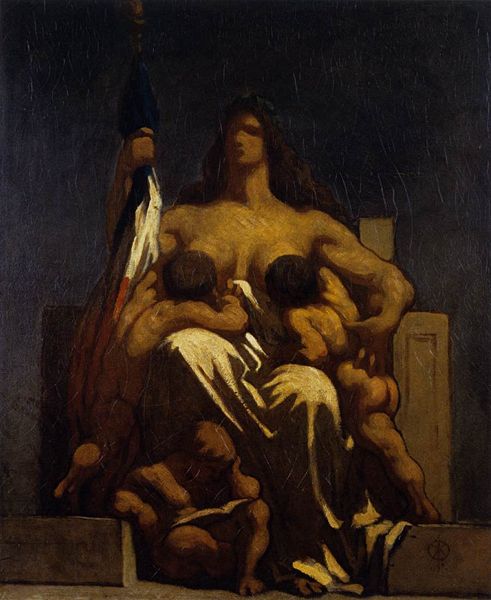
Isis seems to have absorbed many local goddesses as her cult spread.  Certain Hellenic images are virtually indistingishable from images of Mary and Jesus.  We're not speaking of the original Egyptian Isis but her much later Hellenized and Romanized Mystery Religion versions.  So it's hard to say which iconography influenced which; some Marial-looking depictions of Isis may have been based on Christian models.  Of course, Mary is rarely pictured actually nursing, as with Isis Lactans, but Honoré Daumier pictured the Marianne, who we have linked to the Virgin, doing just that in Marianne Généreuse (1848).

What's next?

Theres definitely a lot more to go into.  This is just a catalogue, a brief survey of things I've been thinking about and looking into.  A lot could be said about the ideal woman of the Troubadours, the historical situation of women in Languedoc as opposed to France and other depictions in art but that might be better left for another post.  This one's gotten long eough already!