Showing posts with label death. Show all posts

Saturday, July 1, 2023

R.I.P. Monte Cazazza (1954-2023)

Artist, prankster, and industrial music pioneer Monte Cazazza has passed on.  

His work can be streamed here.

Cazazza was an underground legend who deserves wider recognition, He worked with Factrix, Survival Research Laboratories, and Boyd Rice, pioneers to a number.  It was he who first coined the phrase "Industrial music for industrial people," popularized by Throbbing Gristle.  Anyone up on their industrial music history will recognize among Cazazza friends and collaborators the creators of what evolved into today's industrial acts:  NIN, Marylin Manson, et al.  The purists sneer at these pale shadows....the founders' music grew from avant-garde performance art and the writings of Burroughs and Luigi Rosso as much as any pre-existing music.  Indeed, they had to actually invent some of the instruments they used.

Cazazza's version of Brion Gysin's Kick That Habit Man is an indication of his avant-garde influences.  The permutations of this phrase were generated by a computer and were meant to be recited -- and were -- at events such as the Domaine Poétique, a kind of happening featuring pre-recorded sound, light shows and projections, and the recitation of works such as the permuted poems of which Kick is only one example.


Cazazza is also a member of a club including Billly Childish and Sonny Vincent:  artist/musicians banned from art school campuses.  I'm not gonna provide a link to those tales.  You'll learn more by searching it out for yourself.  Cazazza was ahead of his time; an entire genre owes him its very name....

R.I.P. M.C.

Monday, October 10, 2022

Tamám Shud

The Somerton Man, Post-Mortem

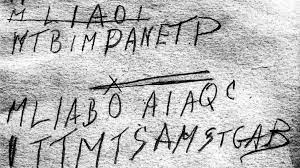
WRGOABABD

MLIAOI
WTBIMPANETP
x
MLIABOAIAQC
ITTMTSAMSTGAB

Perhaps we can add WTF?

It's 1948. The Second World War has ended, but the Cold War is just beginning. The Spectre of Communism has begun haunting Europe in earnest.  Anyone, anywhere could be a spy.....

"Have you no sense of decency, sir?"

In 1948, a John Doe was found lying on Somerton Beach, a suburb of Adelaide, Australia, propped up against the rocks like a man taking a nap, perhaps recovering from a night on the town.  Or lying down to watch the sea as his life slipped away. 

Many seemingly strange details about the Somerton Man have caused many people to speculate that the man was a spy.  No labels on his clothes, some of which were determined to be American.  An unused train ticket.  No ID.  Well-shaven.  The body of an athlete or a dancer.  A strange code linked to a rolled up pîece of paper found in a hidden pocket.

His suitcase was found 6 weeks later at the local train station. Which turned up more clues that led nowhere.  It contained the usual stuff:  slippers, extra clothes, etc.  But there was also "an electrician's screwdriver; a table knife cut down into a short sharp instrument; a pair of scissors with sharpened points....and a stencilling brush."  (This quote and the basic story comes from Wikipedia, but I have read a lot of articles, and there really are a lot out there.)

Somerton Man's tools....

A few weeks after his death a police inspector found a rolled up scrap of paper in a hidden pocket sewn into Mr. Somerton's pants.  It is printed with the expression "Tamám Shud."

Someone pointed out that this is the final phrase from the Rubaiyat of Omar Khayyám and translated from Persian means "It is ended."  The end, basically.  It was a popular book at the time. I myself have a copy dating from about the same year as the Somerton edition.  My grandmother's, I believe.  It was translated by Edward Fitzgerald in the 1860s and still seems to be a popular and respected translation.  Many early translations of other books haven't aged so well.  Most translations of the roughly contemporary Les Chants de Maldoror by Franco-Uruguayan Isidore Ducasse (as Le comte de Lautréamont) are lambasted by translator Alexis Lykiard.  No holds barred.  I don't have my copy at hand (just moved) but I've never seen a translator speak so harshly about the work of others.  And the example he cites justify words like "travesty".

Wild, wild, world, because a few weeks later, the very same copy of the book from which the phrase was torn, turned up; the scrap found on Somerton matched where it had been torn from this copy.  It had been tossed onto the back seat of someone's car. The book, oddly, had been found 10 days before Somerton's body was discovered. That, to me, is very strange. If he tossed the book into the car, why didn't anyone report seeing him in the ten days he was in the area? Could it indicate he wasn't the one who'd tossed the book?  Could it indicate Somerton was murdered and the scrap of paper was placed in the hidden pocket?  If it was Somerton, what was he up to in the ten days after he tossed the book and died on the beach?  Maybe the guy who found it had a wonky memory of when it was found.  

The random (?) letters which start this post were found scribbled in the book, along with a phone number. Amateur sleuths have attempted to decrypt the letters as if it were a code, and some think one would need a specific book to solve the cipher.  But 'til now, nothing has been made of them.  Others say it was probably just his way of keeping track of the horse races, or something equally banal.  Why horses?  Easy, the man recently identified as Mr. Somerton was keen on the races.

Code....or shopping list?
The phone number led to a nurse, Jessica Thompson, who lived half a kilometer from where Mr. Somerton was found. She was brought in to see the death mask that had been made. She claimed not to know the man, but was apparently clearly upset when she saw the plaster cast, to the point one man present thought she might faint.  It could be that she was upset at seeing the visage of a dead man.  But she was a nurse and might be expected to know how to deal with death.  Plus, her number was in the book.  Maybe Mr. Somerton didn't write it.  

But, dig this. The woman's daughter thinks her mum was lying and knew the man. Mum, you see, spoke Russian, but was cagey about how, when, and why she'd learned it. Mum also apparently told the daughter she did know Somerton but lied to the police because it was "not at their level." Is the daughter lying? Was mum? Was either telling the truth? Dead people tell no tales....All these details make tales of espionage more credible but more importantly, prove nothing.

Said nurse also had a son, Robin Thompson.  A professional dancer.  Of course. Remember Somerton had legs some described developed like a dancer's.  Somerton also had a rare ear configuration found in 1 to 2% of the caucasian population.  He also had hypodontia, a rare genetic disorder affecting the teeth, found in about 2% of the general population.  Guess what, Jessica's son, the dancer, had both conditions, which experts say is up to a 1 in 10 or 20 million shot, coincidence-wise.

Maybe the reconstruction was made to resemble the nurse's son, but they do resemble each other....

So, Somerton has the number of a woman living 400m away from where died, who nearly faints upon seeing his death mask. Somerton had a dancer's legs and two rare conditions affecting his teeth and ears. The woman's son is a dancer with the very same rare features of the teeth and ears.  The woman speaks Russian, was interested in Communism, and according to her daughter, lied to the police about knowing Somerton because it was "above their pay-grade".  Weird stuff.

What's even weirder is that a researcher found Robin's daughter and was able to test her DNA, and found that Robin was NOT related to Somerton. How weird is it that a woman who some say clearly knew Somerton had a son who shared so many rare features with him, yet the son wasn't his?  This woman spoke Russian and had an interest in Communism.  Whose own daughter thinks she was lying?  There are so many made-for-TV intersections which suggest espionage that -- truth being stranger than fiction -- probably are in fact just coincidences....

Somerton may have been a spy, but many of the seemingly strange details can also be explained more prosaically. I have nothing profound to add to the case by way of speculation, but like many others, I find it a compelling mystery, quite sad. The man was no bum. He was well-dressed, clean-shaven, and had a thing for poetry. But the anonymity of his death, alone on a beach, probably by suicide, well, it's sad.  At what point did this man's life go off the rails....and why?  

If you accept the spy theory, perhaps he was murdered. He was poisoned by digitalis. I don't know if the Soviets in 1948 were as keen on poisoning people as the Kremlin has been under the Putin regime, but heck, it's not inconsistent.  If true, he didn't spend all of his final hours alone....so with whom?

When I found out about this story, I was kind of obsessed for a few days.  I got turned on to it by recent developments which perhaps reveal the man's identity. 

The Wikipedia article and the following video pretty much sum up the case.  The latest theory is that this man was named Carl Webb, an electrical engineer who'd abandoned his wife a year prior to his death.

People turn up dead every day. Not sure why this case from decades ago still strikes me so much....Carl Webb was apparently one of six children. He had an estranged wife. This case was a sensation at the time, and no one who knew him heard about it?  Or came forward to identify the body?  Possible.  I suppose Australia in 1948 was still fairly wild and woolly.  Like the US, very big with lots of small towns dotting large, open spaces.  Radio and telephones existed, but not the internet, no computerized databases, and TV wasn't introduced in Australia until 1956.   Still, there were a lot more newspapers filled with photographs.  No one filed a report that could have led to an ID?  No one saw a paper and said, holy-moly, it's Carl.  Wouldn't the family be on the lookout after he'd abandoned his wife?

Australian authorities contacted the FBI and Scotland Yard, turning up nothing; this further fueled speculation about the espionage. Perhaps he was from behind the Iron Curtain....?

Webb was apparently some kind of engineer or technician who lived in the proximity of people in military positions of a sensitive nature. To what degree this is significant is debatable. Some researchers don't flat out reject it, but remain hesitant to accept the Webb identification.  If it wasn't Webb, the whole "living near special ops people" is irrelevant.  So, was this a saga of espionage or an affair of the heart?  Or neither?

Who knows in the end? Wikipedia has pretty thorough summary:

https://en.wikipedia.org/wiki/Somerton_Man

YouTuber Joe Scott does a really good job of summarizing the facts with lots of images. He avoids undue speculation.  Sometimes Scott's mannered presentation annoys me, but I've watched his stuff and they are well-organized and illustrated.  I'd recommend looking at his videos on any subject he's covered that strikes your fancy.  He really does do good work.  


The following article talks about the possibility that the man is Carl Webb, who disappeared after leaving his wife in 1947.   The Somerton Man died in 1948. It also addresses whether or not the Somerton Man, Webb or not, was in fact a spy.

https://www.abc.net.au/news/2022-09-02/is-carl-webb-really-the-somerton-man-and-was-he-a-spy/101375542

All in all, this is a really fascinating story and an interesting window on Australia in the years immediately following WW2.  The Webb ID isn't too fantastical, which in my book, lends it credence.  I'm a pretty sceptical person though, so until the 5-O/Po-Po/Keuf concur, or family steps forward, I mark Webb a good probability but not a certainty.  It seems to fit.  Dying a year after he left his wife; a family connection to a man named Keane (a name found on one article of clothing from which the labels hadn't been removed); a love of poetry; a photo of Webb's brother....they bear more than a passing resemblance.  All circumstantial.  None of these deets preclude him from being a spy, either, so for those with their hearts set on a Cold War drama, if the man is proven to be Webb, you'll have a lot more to work with.  

As Sherlock would say:  "The game is (still) afoot!"  

I know that sounds terribly insensitive, but this case has been famous since it first occurred 70+ years ago, which doesn't indicate a high degree of interest or concern among the family who survived him.  If it is Webb, that's 5 siblings and their children, grandchildren, and possibly great-grandchildren.  Not to mention cousins, aunties, family friends.  National news and not one friend or family member steps up?  A remarkably uncaring family?  Was Webb a total "good riddance best forgotten" prick?  

If the speculation that Mr. Somerton wasn't Australian bears weight....maybe he was from behind the Iron Curtain after all.  Prosaic or nefarious, this possible identification rakes up even more enigmas.  The Somerton Man was, and is, famous; and not a single person has stepped up to identify him.  Granted, those photos were post-mortem.  But surely a sibling or other relation would have recognized him?  That no one has done so again, makes me feel incredibly sad....Think if all you will be remembered for is that you turned up dead on a beach with some weird stuff in your pockets

We just have to wait and see....or....

Shai-hulud

The Voice of Shai-Hulud, from the Oral History
"Over here sand blows, over there sand blows. Over there a rich man waits, over here I wait."
Tamám Shud

XCIX.  Rubaiyat of Omar Khayyám, 5th ed.  Edward "Eddie the Veggie" FitzGerald
Ah Love! could you and I with Him conspire 
To grasp this sorry Scheme of Things entire, 
Would not we shatter it to bits--and then 
Re-mold it nearer to the Heart's Desire!

And finally: 

Owa Tagu Siam 

Stimes Addisson, A Brief History Roman Mystery Cults from Greece, Persia, and Egypt.

By 300 C.E., the mystery cult called the rites of Auca (originally Ghaz) surpassed Mithraism and Christianity among soldiers in Britannia and sewage technicians from Gaul, Germania, and Syria Palaestina to Rome itself.  If not for Constantine's well-hidden anatidaephobia, it may have won out over Christianity and the cult of Sol Invictus; a nagging seat of power in the outre-mer legions was dedicated to Mithraism, whose initiatory grades appealed to men accustomed to advancing in rank; the rites of Auca had no such progression.  Their "life-mantra" was the Latin phrase "Owa Tagu Siam" literally meant "Let me be."  Their "death chant" finished with the congregation saying the Persian "Tamám Shud".  The officiant then intoned "tazh shrw'e shdh ast" or "It has only just begun." 

Be careful out there, wannabe Baker Street Irregulars.  What is true and what is an absolute crock is harder to delineate in this info-bite world. The internet is often one big tautology: A cites B in it's references; B then cites A.  I learned that to my embarrassment circa 1996, when I sent an email with a photo purporting to show a missile downing a jetliner just after it left JFK.  This theory still has, er, wings, and there's even a documentary about it.  The NTSB blamed faulty wiring around the central fuel tank.  The alternate take is that the US Navy shot it down by accident during routine target practice.  TWA flight 800.  I'd presented conspiracy theory as fact.

I'm getting off track here; just reiterating my preoccupation with confirmation bias.  You want Mr. Somerton to be a spy and you will find plenty of evidence to support your theory.  At one point I played around with conspiracy theory and what is referred to as "twilight language" in order to get into the mind of the would-be conspiracy buster.  Read the facts and then theorize; don't theorize prematurely and bend the data to fit.  Not to sound like a know-it-all.  I'm certainly guilty of confirmation bias and the making the red-car-phenomenon something which it isn't.  As a perception phenomenon it is indeed a window on and a shaper of reality.  I think I'm generally aware of it though, and also aware that more often than not, I'm absolutely fuggin' right!  About everything.  Haha.  I kid.  

Was Somerton a spy?  I don't know.  He could have been from the Soviet bloc or an Australian asset.  There are so many unknowns about the most banal and what should be public details of the man,  that determining whether or not he was a spy is probably impossible to determine.  So, I've really flogged this one.  Like many people, something about the story grabbed me and is still holding on.  For all the flip and cavalier things I've said, I really mean it when I say it saddens me.  My gut feeling is that he was a troubled guy with a flair for the dramatic, who abandoned his wife to recapture a lost love, the nurse perhaps, and, not finding it, took his own life.  I may very well be wrong, and I don't insist on this notion in the slightest.  It's just an inkling.  OK.  Now I can say

Tamám Shud........?

Note:  Significant updates on 12/10.  So much for Tamám Shud! 😀

Tuesday, October 4, 2022

Well, it is true. Not the human being part.


If this is one of the first things you thought of when you heard the news, please share your experience below.  I'm not trying to be disrespectful, I had nothing against her.  But I'm guessing the news had an extra layer of meaning for generation of pale gloomy dorks, male and female, on both sides of the pond.

And just think, for those a few years older, she weren't no human being....


BTW, know how to identify totally worthless website? It calls The Smiths a "new wave band" and says TQID is their second album....

Monday, April 18, 2022

Gravestone of Lt. Col. John B. Adkins, USAF

John B. Adkins

Bushnell, Sumter Co., Florida, USA

LOT 112, 0, 120

This post may seem a bit odd, but in the course of recently researching D-Day, I came across an article about the Normandy American Cemetery.  That in turn led me to take a look at the website of the Florida National Cemetery, and then on a hunch looked for and found this entry for my father on Find a Grave, made by one "13th Generation Fairbanks in America."

Apparently, the Mr. Fairbanks who photographed this marker has been documenting gravestones for eight years, and is currently focusing on veterans' final resting places.

I don't think it's morbid, but a way of both honoring my father and thanking the volunteer photographers, especially Mr. Fairbanks, for their efforts.

Dad did 2 tours in Vietnam, one in '67-'68 at Tân Sơn Nhứt (where he experienced the Tet offensive), and then again in, I think, '73.  

He retired after 25 years in the service after a posting at SOCCENT (MacDill AFB, Tampa, FL). 

Incidentally, I was born on the very same base.

Not sure what his job at SOCCENT consisted of, but he carried a red passport (one of three he had) with some pretty interesting visas stamped inside....  

When I once asked exactly what it was he did, he said, "I could tell you, but then I'd have to cut your head off and put it in my safe." 

I once visited his office, and while he was on the phone, happened to look down into the heating vent, where he had placed a white, folded card printed with the phrase "THINK WAR!" in red.

One day, I will dig out a letter he wrote his parents from his off-base barracks, in which some of the same ironic humor, and even cynicism, paint an interesting portrait of life in Saigon for the young (21 y.o.) Lieutenant from rural Ohio.
  
And people wonder why I tackle such dark subjects on LoS with humor.

Saturday, October 3, 2020

The cold is rising

I've long been a fan of poet Alfred Starr Hamilton, and years back had a web page or two dedicated to him. Those pages have since been transferred to this here blog. So, it is with some surprise I see on the tubes a Band Camp page for the Bye Bye Blackbirds with a song called....Alfred Starr Hamilton. Why? I dunno. Not sure how the lyrics jibe with the man, but hell, why not link to it here for the sake of completism. 

 Alfred Starr Hamilton by Bye Bye Blackbirds. 

Time's a rag doll
With something bright and cold in its chest
Words can strip bark and seep between the buttons of your vest
The cold is rising
Is someone here to tell me it's fine?
So fine
Smoking by the window
Fine
Freezing in the winter

All right, I'll be listening, I'll be listening, baby
All right, right now

You know I love you
Unravelling and troubling the signs
With words that stand still and brighten in the corners of your eyes
So come inside, dear
Where everyone will tell us it's fine
So fine
Smoking by the window
Fine
Freezing in the winter

Tuesday, January 2, 2018

Ah-choo

To quarantine or not to quarantine....
100 years ago, in January, 1918, the first cases of the H1N1 influenza virus, or "Spanish Flu" were observed.  It may have started in France, or maybe Kansas, scientists aren't sure, but by the time it simmered down it had killed between 50 and 100 million people, or 3 to 5 % of the world's population, making it one of the worst natural disasters in recorded history.  And it struck almost everywhere, even the Arctic.

Why the "Spanish" Flu?  Apparently censorship in many countries involved in the Great War, e.g. Great Britain, the U.S., Germany, and France minimized early reports in order to protect morale, whereas in neutral Spain, the media reported on the pandemic more freely.  People thus assumed Spain was harder hit and hence the name.

In Spain they called it the "Naples Soldier" which was taken from a musical operetta titled La canción del olvido (The Song of Forgetting).

Such a tragedy, the Great War ended in November, 1918, but one could argue that the conditions (destroyed infrastructure, overcrowded camps, general mayhem) it created helped propagate the virus that kept on killing for another 2 years.  There were two waves of the pandemic, the second even deadlier than the first, but by December 1920, it was over.

Happy 2018.

See 1918 flu pandemic for more details

Friday, November 24, 2017

Las Vegas Mass Murder


Back when I first head about the horrendous mass shooting at the concert in Las Vegas I immediately honed in on a few details I knew the synchromystics would be exploring.  I abandoned that article because it seemed to me that it would be pointless.  Lots of "true believers" would be hard at work decrypting the "twilight language" and finally, it seemed to be in bad taste.  I'd already pretty much decided to leave synchromysticism behind and focus on history, public art, and folklore, but even there I've flagged.  I spent the better part of 2017 working on a novella (which will be published by an honest-to-God publisher -- Whiskey Tit -- in 2018) and have since been working on a full-length novel.  Hence the paucity of posts and their brevity.

But I didn't want to bin these notes so I'll just post them here for the heck of it.  Strangely, when looking at the link for the 23 enigma, I saw a link to a phenomenon named after an old Texas joke:  A guy shoots a slew of rounds into the side of a barn, then paints a target around the densest cluster of hits....then claims to be a sharpshooter!  The fallacy is defined thus:

[The] Texas sharpshooter fallacy is an informal fallacy which is committed when differences in data are ignored, but similarities are stressed. From this reasoning, a false conclusion is inferred. This fallacy is the philosophical or rhetorical application of the multiple comparisons problem (in statistics) and apophenia (in cognitive psychology). It is related to the clustering illusion, which refers to the tendency in human cognition to interpret patterns where none actually exist.

I've always thought synchromysticism to basically be a form of apophenia or clustering illusion, but it was startling to hear this term used after years of looking at synchromysticism in the context of America's deadliest mass-shooting.  

Also reminds me of a witty remark apparently made by my great-uncle Homer B. Adkins: 

Basic research is like shooting an arrow into the air and, where it lands, painting a target.

-------------------------------------------------------------------------------

What the synchromystics will be looking at:

The gunman fired from the Mandalay Hotel, referencing a city in Burma/Myanmar.  A country expelling Muslims.  A "person of interest" -- a girlfriend or roommate -- was sought, described as "Asian", named "Marilou Danley".  Perhaps Indonesian, a predominantly Muslim country. [She is in fact Australian-Filipina]  She is no longer a person of interest in the case.

Concert venue dominated by Luxor Hotel with its giant pyramid and obelisk.... (Masonic symbolism)

Shooter was described as firing from the 32nd floor....

23 arms were found in shooter's room.... 

The shooter's father was a notorious bank robber on the FBI's "most wanted" list....

Thursday, November 23, 2017

Thursday, February 25, 2016

Night of the hunter


Now here's a headline bound to make us look twice:


The society in question is the Austrian outfit called the Order of St. Hubertus (official site), an order of knights founded in 1695 by Count Franz Anton von Sporck in what is now the Czech Republic, in the region known as....Bohemia!


His goal was to gather "the greatest noble hunters of the the 17th Century, particularly in Bohemia, Austria and countries of the Austro-Hungarian Empire, ruled by the Habsburgs."  Count Sporck was quite the philosophical dilettante; in addition to the order of St. Hubert, he is alleged by some to have founded a branch of Freemasonry in Bohemia.  This is debatable and seems to have originated in 1888 with an unsubstantiated claim by a Czech journalist, but if your spider senses are tingling anyway, maybe they should be.  The U.S. chapter of the Order was started in 1968 at the Bohemian Club.

Feeling the weight of dull care yet?
George Wood was appointed Grand Prior and founded the American Chapter in 1968. The first Investiture of American Knights took place at the Bohemian Club in San Francisco. The ceremony was presided over by then Grand Master Karl Messany.
Scalia breathed his last in his room at the Cibolo Rach.  The cibolo is the "near threatened" American Bison, which once roamed the Great Plains in vast numbers, but were hunted near to extinction by trigger-happy travelers west in the 19th century.  Stories report that men would shoot from the windows of their trains as they passed, into herds so thick they barely even needed to aim.  The animals were left to rot.  They weren't hunting, they were target shooting, killing for the thrill of killing.  As the plains Indians' primary source of sustenance, these "hunters" were quite consciously depleting the tribes' hunting grounds, effectively starving the tribes off their lands.

Is "cibolo" a thumbing at the nose, then, dickish hunters honoring their bison-killing forefathers?  Cibolo Ranch was certainly a place to forget dull care.  Is its name a flippant disregard for the massacre of the American Bison?

I'm pretty sure that's all wrong.  It could also be meant as a solemn reminder of the tragedy of the slaughter of so many of God's creatures.  Perhaps the name should be taken in the spirit of their motto: 

"Deum Diligite Animalia Diligentes"  Et deinde occidere eos 

"Honoring God by Honoring His Creatures"  And then killing them 

Scalia traveled to the Ranch with D.C. lawyer C. Allen Foster, a passionate hunter who passed his 65th birthday in the Czech Republic at an old castle and hunting park.  Dull care was definitely lifted in a series of hunts, wine tastings, sightseeing and a masked ball.  Eyes wide shut?  It sounds exactly like the kind of aristocratic event one would expect from a group of knights.  So what's a defender of the constitution doing by buddying up to a group of aristocrats with pretensions to Medieval splendor?


"Cibolo" also puts me in mind of Craig Baldwin's film, ¡O No Coronado! (1992).  As one website puts it, the film is "a delirious, open-ended historiography that updates issues of imperialism, tourism, treaty rights and environmental protection from the 16th century to the present and beyond."  Quite appropriate; as the expedition falls apart, a delirious Coronado rushes about in a frenzy muttering "Cibola cibola cibola" over and over.  According to the NPS, "Cibola" is a corruption of "She Wo No" or "Land of the Zuni."  Coronado, driven mad by the future, a future that expeditions like his unleashed, a future where the cibolo were slaughtered as part of the long-haul campaign to exterminate the natives not forced into the mines and the slave plantations.

Foster, for the moment, is traveling.  Perhaps in Argentina.  Check's in the mail, so to speak.  One woman hung up on the Post reporter when asked for comment.  Maybe she has some dull cares.

The Post concludes that 
Law enforcement officials told The Post that they had no knowledge of the International Order of St. Hubertus or its connection to Poindexter and ranch guests. The officials said the FBI had declined to investigate Scalia’s death when they were told by the marshals that he died from natural causes.
Poindexter is the ranch's owner and Scalia's second traveling companion to the ranch.  He told the Post that he "wasn't aware" of any connection between Scalia and the Order.  That said, both Foster and Poindexter "hold leadership positions within the Order."

The Order describes itself as
....a true knightly order in the historical tradition. The Order is under the Royal Protection of His Majesty Juan Carlos of Spain, the Grand Master Emeritus His Imperial and Royal Highness Archduke Andreas Salvator of Austria and our Grand Master is His Imperial and Royal Highness Istvan von Habsburg Lothringen, Archduke of Austria, Prince of Hungary.
Its stated purpose is innocuous enough:  conservation, fellowship, support good hunting practices, promote hunting, encourage sponsorship and "To promote the concept of hunting and fishing as an intangible cultural heritage of humanity."

I don't know why this goal struck me.  It makes me think that hunting in the knightly tradition is an activity of the aristocracy, strictly regulated and poachers -- meaning the landless -- dealt with severely.  Of course this is a far cry from the attitude of most American hunters, who tend to see what they do as more than a sport, but a right of every American citizen, whose tools are protected in the Constitution.  Again, a document Scalia swore to defend.  Yet he goes and dies while palling around with its aristocratic practitioners, an Order led by Archdukes and sponsored by the King of Spain.

Strange bedfellows for a defender of democracy.  And a strange deathbed scene:  a "breathing apparatus" nearby -- but off, his head propped up on a magical three pillows (hey, Sporck's Masonic Lodge was said to have been the Three Stars), a pillowcase over the eyes....  Apparently everything is order, but the investigation has raised some eyebrows and some wonder why no autopsy was performed.

I think we'll be hearing more about this as the days go by....

Thursday, September 11, 2014

El Mano de Dios

I've already written directly about Gauchito Gil and San La Muerte, two of the more popular Argentine folk saints.  Both have widespread and fervent cults, with thousands of devotees, roadside shrines ranging in size from small altars to sculpture gardens and even centers of pilgrimage:  holy cities, so to speak; despite all this, despite the many attestations of miracles, the Catholic Church does not recognize these saints.

San La Muerte and Caspar, the dead baby.
This may be understandable, at least in the case of San La Muerte, aka Saint Death or Holy Death.  An imposing figure, a skeleton, often robed and wielding a scythe, sometimes leaning forward in his throne, he is basically a sainted Grim Reaper.  Although some pray to him as one would with any other saint, for matters of love (red), money (gold) or other worldly powers and concerns, he is suspected to be the patron of more sinister worshipers, and nefarious deeds have been discovered and ascribed to his influence.  His cult is strongest in northeast Argentina, especially in Corrientes.  Some speculate the cult is a product of the encounter between Guaraní ancestor worship, which included the veneration of bones, and the influence of Jesuit missionaries in the 1760's; but fact is, nobody know exactly when or how it started.

A similar figure is, unsurprisingly, also worshiped in Mexico.  I say unsurprisingly because death, skulls and skeletons are a common Mexican artistic motif and Todos Santos (All Saint's Day), or the Day of the Dead, is one of Mexico's most rambunctious and widely-celebrated religious traditions.  Death is mourned and celebrated with drink, fireworks and feasting at the local cemetery.   The image of the mother is also an important motif in Mexican culture and the national patroness is La Virgen de Guadalupe, an image ubiquitous in Mexico and wherever Mexicans live.  She is the heart and soul of Catholic Mexico.  Not surprising that death is, unlike in Argentina, a woman:  La Santisima Muerte.  This would be an interesting area of study; the respective gender of "Saint Death" in Mexico and Argentina and why such a similar figure appeared in both countries.  I wonder if it could be something as secular as the fact that both countries are the largest producers of cultural products in Latin America:  music, television, literature and especially cinema.  Not sure why this would be, but for some reason the possibility came to mind.

Anyway, pictured above is my red San La Muerte.  I had actually first purchased a flashier gold statuette, but my mother-in-law knocked it off a table while tidying up, and it broke into pieces.  She's a psychoanalyst and my wife is as well; my wife is always trying to tell me that many of my accidents are not that at all, but unconscious reflections of inner desires or aversions.  So it's ironic that her mother, who disapproves of these things, "accidentally" broke it.  The iconoclastic mother-in-law.

In writing this I learned that Guatemala also has a skeletal death saint, El Rey San Pascual, who seems to be pretty much the same as Argentina's San La Muerte.  The three death saints I've discussed are believed to have their origins in pre-Colombian religion; indeed, the syncretism between non-Christian religious beliefs and Catholicism is a Latin American-wide phenomenon.  African traditions have blended with Christianity to produce Candomblé (Brazil), Voudon (Haiti) and Santería (Cuba) to name but a few.  In countries with a fewer African Americans, such as Guatemala and Mexico, this process took place with Native American beliefs.  The Catholic Church has always been tolerant of the syncretism, up to a point.  Indeed, allowing the use of "pagan" traditions was first applied to European Christianization and even has a name:  Interpretatio Christiana.  This has become a point of contention in countries once dominated by Catholicism but now rife with various Protestant and Evangelical sects, which seek to eliminate pagan traditions from Christian belief and practice.  In Guatemala, this has led to riots on several occasions; one notorious brawl took place of the steps of the cathedral in Chichicastengo.  

"Chichi" has a very strong syncretic religious culture.  I witnessed a ritual in nearby Utatlán, at the end of a long, incense-filled, tunnel-like cave under a Mayan temple complex.  I also saw what was clearly a fertility ritual before a stone idol called Pascual Abaj; this sits atop a hill closer to Chichi than Utatlán.  I photographed this ritual at the friendly urging of the man performing it, and made extensive notes on the precise actions he performed.  One day I'll dig up this notebook and photos to share here on LoS.  I was also personally blessed by a curandero in Nebaj, a bit farther north, at a shrine hidden in a cornfield.  It involved lots of prayers and the burning of various materials we picked up at the local market.  What bound all three of these rituals was the free intermingling of the names of recognizable Catholic saints with Mayan gods.  Syncretism in action.  There was also a Day of the Dead in the Guatemalan town of Todos Santos; this was an emotional experience for me, having not long prior lost my father, and I danced and drank all night with a family who must have sensed my grief, as I was welcomed into the kitchen periodically throughout the night to warm up, rest and drink bowls of a delicious gruel that kept me going and helped absorb the copious amounts of alcohol I imbibed -- which in this town, is a big part of the ritual observance.  I feel privileged to have witnessed and participated in these rituals so I am eager to meet some practitioners of Afro-Catholic religions.  My only concern is to avoid becoming a gawking tourist; I need to participate, but I do not want to contribute to the "touristification" of these rituals.

I used to say that my only further use of psychedelics would be to try ayahuasca with a shaman to guide me, but ritual ingestion of ayahuasca, aka yagé, has unfortunately become a kind of drug tourism, the Quechua and Aymara-speaking regions treated like some kind of New Age Amsterdam, a New World Kathmandu.  William Burroughs and Allen Ginsberg wrote an excellent book on their search for the drug, entitled The Yagé Letters.  A detailed and often hilarious account, it doesn't get into folk saints, but it does  describe a serious series of psychic and spiritual investigations.  It has also undoubtedly helped spawn the kind of zonked-out pilgrimage to the hinterlands I used to undertake without understanding the potential deleterious effects this can have on a spiritually rich but financially impoverished people.  Some will end up selling their religion to the highest bidder and others will become hucksters, with either no real knowledge of the shamanic role or just jiving the gullible and saving the real traditions for themselves.  This is, not in the specific context of spiritual tourism but tourism in general, why I turned a bit cold towards traveling in parts of Mexico and Guatemala, not for lack of "authentic" experience, but for contributing to the kind of human interactions that reduces everything to an exchange of goods and services for cash.  I realize tourism can be an important economic boost for a country, and if anyone needs a boost it's Mexico and Guatemala, but I'm kind of leery of the whole "Gringo Trail" these days.  I'd still like to experience the Afro-Latin-American traditions though.


But back to my collection of figurines, next pictured is Gauchito Gil.  I've discussed his story before, but it's worth repeating that before his murder, he'd enlisted in the war against Paraguay to escape the wrath of a local police chief, jealous of his affair with a wealthy widow.  After his return, he refused to fight in the Argentine Civil War and fled from the authorities into the pampa, more or less forced into the role of a bandit.  Gil was eventually captured and killed by the police, but not before he informed the gendarme who was about to cut his throat that his dying son would recover; he did, and the grateful policeman spread Gauchito's cult as thanks and penance.  Gil's roadside shrines are painted red and red banners hang from them or fly overhead.  His cult, like that of San La Muerte, is strongest in the north, in Corrientes, but it has spread throughout Argentina and into neighboring Brazil, Paraguay, Uruguay and Chile.  He even has a Facebook page.  But who doesn't?  Even San La Muerte is social media savvy.

Before Gil's throat was cut, he was hung upside down on a tree typical of the pampa.  This recollects Old World sources such as the crucifixion of Jesus (not to mention Mithras and Osiris) and also the self-sacrifice of Odin, who hung upside down on the Norse axis mundi named Yggdrasil, an ash tree to Gil's algarrobos.  Argentina has strong connection to Italy, so it's more likely that the upside down Gil was inspired by Italian pitture infamanti, portraits of criminals hung by their heels upon a tree, a way to humiliate condemned men, especially those deemed traitorous.  When the Roman populace rose up against them, Mussolini and mistress Clara Petacci were dragged from their home, hung by their heels by an angry mob and beaten to death.  The hanging by the heels part always intrigued me; perhaps I jump too quickly to conclusions in seeing a connection.  But this practice was almost surely based on the Roman predilection for crucifying the condemned upside down if an extra dose of humiliation was required.  The pitture infimati in turn became the model for the The Hanged Man, the 12th card of the Tarot's Major Arcana.  In the Tarot, the hanged man is usually hung from either a tree, or a leafy tree-like Tau, the man's body cross-like, his face serene, seemingly out of place in a less than serene predicament.  He also has a nimbus around his head, like a saint or a martyr.  This may be because the crucifixion is a prelude to illumination, as in Odin's case, or resurrection, as in the case of Jesus.  For that matter, in Gil's case as well, for while the man died on the tree, his cult was also born; the man became the saint, his power to intercede on behalf of the powerless announced.  Tarot-designer A.E. Waite doesn't see The Hanged Man as a martyr and it's not generally interpreted in this light, but the cardcould easily have formed the basis of Gil's iconography.  A position usually reserved for reviled criminals but who was, in Gil's case, a saint.

I mention the bit about Gil refusing to fight and the story about being drafted because this element also plays into the story of La Difunta Correa.  Legend is that circa 1840 a woman named Correa set off to rejoin her husband, who'd been drafted to fight in the Argentine Civil War.  (Other versions of the tale have her fleeing into the pampa because she had her child out of wedlock, while others yet have her fleeing the sexual advances of corrupt officials -- a common element in the "virgin martyr" category of saint; there are dozens of examples in the "official" canon).  She died of thirst on the way and, when some gauchos came across the body four days later, her baby was still able to suckle at her breast.  The gauchos buried her and saved the baby.  So both Saints' tales involve the gaucho, still a powerful symbol of freedom, men who live beyond the confines, and law, of the city, in the wide and wild pampa, with their own code of justice, symbolized by the gaucho's knife.  The tango, another symbol of Argentine society and a powerful erotic dance, is said to have been born in the brothels, evolving from the milongas which were first danced by pairs of men, imitating the movements and gestures of a knife fight.  Both stories also attest to the heavy weight these Civil Wars put on people's hearts, as brother fought brother and tore the people apart.  Some versions of Correa's story also involve unjust officials whose actions set in motion the Saint's martrydom.  So we have two massively popular cults, very death-centered, plus the worship of death itself, all three of which seem to have grown most rapidly in the years following the Falklands/Malvinas War.  This war is a big part of contemporary Argentine consciousness, the outline of the islands instantly recognizable on signs in countless cities reading "Las Malvinas son Argentinas!"  The Malvinas are Argentinian!  This war also brought down a brutaldictatorship and with its exit came countless revelations of a long reign of terror effectuated by the police and the military:  kidnappings, murder, horrifying detention centers, theft of children, the stuff of nightmares.  It's a scar on every family, and my own is no exception.

Below is the latest addition to my collection.  La Difunta Correa's cult is centered in Vallecito and was first spread by cattle drivers -- gauchos -- and now more by truckers.  Roadside shrines are apparent because devotees leave bottles of water to represent her "eternal" thirst.

There is a Catholic antecedent to this story, by the way.  There is a story in Jacobus da Vorigine's Golden Legend about a barren couple, a Roman Governor and his wife, who had their prayer for a child granted to them by Christ, via Mary Magdalene's intercession.  The governor and pregnant wife then set sail for Rome to meet St. Peter, but the wife died en route, during childbirth.  Making land, the governor found he could not bury the body, so he covered it with his cloak and left the doomed baby by her breast.  He returned two years later, shocked to find his child still alive, having suckled at his mother's breast the whole time, her body incorrupt.  Mary Magdalene, who'd accompanied him, then resurrected the wife!

La Difunta Correa
I don't have a figurine for this last saint, but my mother-in-law, the iconoclast, told me about him when she gave me La Difunta Correa:  Miguel Ángel Gaitán.  Miguel was a baby who died in 1967.  In 1973 a violent storm unearthed his coffin and his corpse was found to be incorrupt.  This is a pretty common first step towards sainthood.  A saint specific to the Toulouse region, Germaine of Pibrac, is such a saint.  And of course the incorrupt body of the Roman Governor's wife precedes the story of Gaitán and La Difunta Correa. The locals made four attempts to shelter the coffin but each time a tomb was erected, it was later found demolished.  This is actually quite a common motif in legends surrounding miraculous images of the Virgin.  It was then decided simply to place the coffin in a chapel, but even then, the lid was found to have been removed; after this went on for a while the boy's mother decided to put a glass lid on the coffin and today, the little mummy receives thousands of visitors yearly and answers prayers.  This too is not unheard of in "official" Catholic saints.  I've seen plenty of saints in glass coffins; in Cortona, Italy, where I stayed for 3 months back in 1990, the dried cadaver of an obscure local saint, Saint Margaret of Cortona, was placed upon the parish church's altar.

A bit out of place, but it just occurred to me that the story of Correa is also a strong symbol of a mother's love for her child, which recalls what I said about the role of the mother in Mexico, but also the role of the Virgin.  The incorruptibility of the body is an indication of spiritual purity, itself linked to sexual purity.  For the Virgin is free from original sin, an innocent not corrupted by the carnal pleasures responsible for the Fall and thus, the aging and infirmity-prone corporal bodies from which Adam and Eve were originally free.  Makes the Christian Science concept of sin as a kind of disease seem a bit less innovative; the incorrupt bodies of the pure are the other side of the doctrine that sin causes corporeal corruption....

So none of these miracles or stories, and even their specific details, are out of place among the enormous roster of Catholic saints, many so local that most people haven't even heard of them, even Catholics from the same country.  St. Fris, anyone?

People are hungry for religion, especially receptive to the idea that prayer and offerings can result in miracles; where poverty is endemic, sickness, education, money and success are concerns with more hopelessness attached to them than in much richer countries.  And in the last few decades, Argentina has slipped deeper and deeper into poverty and all its accompanying woes.  It is a country dominated by a profound sense of insecurity, for the future, for the hope of economic recovery and an end to corruption, the explosive growth of shanty towns and above all, crime.  This in a country already wounded by a recent war and a brutal dictatorship, many of whose criminal perpetrators are still alive.  I would only expect these cults and others like them to grow.  Everybody's looking for a miracle, to be touched by the Hand of God.  Or at least one of his deputies.

With folk saints, all the familiar elements of official Catholic saints are recycled and put into a more contemporary and familiar context -- not, for example, Roman Gaul, but contemporary Argentina.  And this will continue to happen, whether officially recognized or not.  In France, the current most popular "official" saints date largely from the 19th century; long enough ago that the historicity of the accounts is not an issue, but close enough in time and within familiar enough events to reassure the devoted that their saint knows exactly what they might going through.  As the times continue to change, we can expect periodic updates to the legends of existing folk saints, as well as the development of entirely new ones.  The age of miracles isn't over.  Evangelicals will speak in tongues and be slain in the Spirit like the apostles, the logical conclusion of the Protestant devaluation of the role of the priest as an intermediary, the belief that each man and woman can read the Bible for themselves and develop a special relationship with the Christ.  Catholics, still valuing the role of the priest, will continue to look towards even holier intermediaries, and if the old ones are found lacking -- because inevitably, poor people will remain poor, sick people will not recover and the sterile will remain childless -- new ones are just waiting to be found.

Friday, July 11, 2014

Tea for Tomb

Meissen obelisks
Terre Cabade Cemetery, Toulouse
I stumbled across these ceramic Rococo obelisks (c. 1750)  during an online search unrelated to ceramic Rococo obelisks. Like pyramids, I often associate obelisks with death, not so much for their Egyptian origins but because so many tombs and war memorials use them. A chapel overflowing with death-related iconography in Toulouse's Notre Dame de la Daurade (see the three images below) is flanked by two frescoes; the chapel's side walls are decorated on one side with images of the arts and spiritual might, the other side with images of the the sciences and worldly might, arranged in a fashion much like they are on these table settings. A kind of (perverse?) dissonance that these gaily-colored ornaments evoke (for me) a dark altar in a chapel of death. Roughly contemporary to boot. Construction on the current church was begun in 1761.


Sunday, March 2, 2014

Aucamville Project 11: Mary on the Cross (redux)

3/3:  I'd forgotten I'd already done a (quite different) little riff on this theme:  The Virgin and the Cross.

Toulouse is known as "la Ville Rose" (the Pink City) because of the brick with which its buildings have been constructed since at least the Middle Ages.  These bricks are not the smallish rectangular jobbies you might think of in American or English construction.  In Toulouse and the surrounding areas the principle brick is called a "foraine" and is about 45 x 25 cm and 5 cm thick.  They're quite heavy and make for a solid wall.  45 centimeters is no small shakes.
 

The gatehouse to the Aucamville cemetery gives a sense of the ingenuity with which these foraines can be put to use.  The walls are made with them, as are the decorative elements of the cornice and the pediment, even the frame of the arched entry.  I've always liked this gatehouse, which is simple  but elegant.  The size and shape of the cross in the pediment is determined by the material:  four foraines make up each arm, and to me, it has always looked something like a flower.  If you look at our other posts about architecture in Toulouse (example), you'll see that everything from walls to bridges to obelisks to chateaux are made with these foraines.  I suppose that's due to the fact that the soil around here is pretty much pure clay.  If I dig in my garden, I will find this clay with some river stones mixed in, but very little dirt or vegetal matter.

In Toulouse, the Terre Cabade cemetery (see the previous example I mentioned), whose entrance features two brick obelisks, takes it's name from this clay-like earth--"cavade" in Occitan.  (Like Spanish, the v and b sound is pretty much interchangeable in some Occitan dialects).

For stately buildings, this clay is put into a more or less standard mould and fired in a kiln to produce bricks of terra cotta, or terre cuite.  But humbler buildings, barns and even homes will be made of unfired brick.  The clay is mixed with some straw and dried in the sun.  The uncooked bricks have the same dimensions as a foraine.  They are not usually used on the north face of a structure, and even the humblest of buildings will use cooked brick at their foundation, as well as to frame windows, doors and reinforce the corners of a structure; sometimes a row or two will be thrown in to solidify the wall, along with smooth flat river stones, or galets.  This architecture is much like that of the American Southwest, with wooden beams and adobe walls.  The principal difference is that in France, one almost never finds a flat roof.

Anyway, this is less about architecture than it is to present a few images for The Gid, something that astonished him:  the Virgin Mary at the center of the cross.

The two examples presented here are typical of the region, in material and imagery:  they are made out of wrought iron as opposed to cut stone, and the crosses use a vegetal motif.  Get your Joseph Campbell out, as Yggdrasil definitely comes to mind.  In the first example below, I find a deft piece of work; the vines curl about Mary's head and the leaves are clearly star-shaped, thus evoking Mary's halo of stars.  Whether intentional or not, the leaves as a crown of stars symbolically connect Heaven and Earth, referring (I believe) to the Tree of Life as a kind of axis mundi (see Aucamville Project 4).  It would also connect the very terrestrial act of burying the dead with the post-mortem voyage of the soul to heaven.

Example 1.  Note how the vine forms a halo of star-shaped leaves around Mary's head.
In the second example, we find a form more common in this area, where the Cross itself is like a tree.  The flowers are lilies, symbols of the Virgin, almost exploding from behind her in a luscious bouquet of vegetal grace, iron-clad to boot.  The spring-like form to the right of Mary's head (from the viewer's perspective) adds an especially dynamic touch.  Recall also that the fleur-de-lis, a stylized lily, is a long-standing symbol of French royalty; the lily as a symbol of both French royalty and the Virgin Mary would also link Mary with France.  As an aside, a cock is also commonly used on these wrought-iron crosses and it, too, is a symbol of France.  Current notions of laïcité aside, France is a decidedly Catholic country, or at least a Marial one:  no village is complete without a statue of the Virgin.

Example 2:  The Queen is dead, long live the Queen.
These use of these crosses is not confined to grave markers; for a detailed discussion of the many ways they are used, please see "Too late, baby. Slay a few animals. At the crossroads."

I'm also looking forward to an upcoming guest post by LoS pal Tim Wilson, who will write about these crosses, especially in the funerary context, and traditions derived from the pre-Christian worship of Hecate.  I don't know what he'll write, but I'd like to mention that Hecate is a tripartite goddess who was often portrayed facing three directions; this is linked to her function as a goddess of crossroads, of which death is a sort, I suppose!  Hecate, unsurprisingly, is sometimes viewed as an influence on Marial attributes; the latter's symbol, the lily, in it's stylized fleur-de-lis version, is often used to symbolize the trinity.  Hecate was also seen as a Savior, the Mother of Angels, which definitely fits in with Mary's role in Catholicism.  She is also associated with the underworld, which is especially resonant in the context we're looking at here.  I predict Tim will go into these ideas pretty thoroughly and, if I know Tim, not without a great deal of erudition and a dash of humor.

Finally, the third example below is less typical of the region, but the mandala-like, vaguely floral motif at the center really grabbed my attention.  It may merely be a pretty abstract design, or it may be intended to represent a flower or even the sun; a floral motif is clearly present at the base of the cross, with leaves growing up the sides and some kind of flower on the middle, a lily perhaps, or a lotus.  The flower strikes me as vaguely Egyptian.  The extremities on the arms and top of the cross also seem like stylized flowers.  If the "mandala" is a solar symbol, this could allude to the Occitan cross used in these parts, which some theorize may derive from a Gaulish solar disc.

This stone cross also has a weird androgynous quality, evoking at once both a curvaceous feminine form and a phallus.


So in these iron trees and this stone representations of flowers, as well as in the flower-like design of the gatehouse pediment, we have an interesting visual metaphor for the ephemeral being immortalized.  The flower is ephemeral but, like the Christian hope for the faithful at the end of the world, returns to life.

One final thought.  As the Aucamvillois bury their dead in the clay, one can't help but wonder that if on some level they are reminded of the origin of all life in Adam, who the Bible tells us, was formed by God from a lump of clay and then fired in His kiln, so to speak.

Human life grown from the soil, like a brick....or a flower.