This title
is misleading, because it might just as well read "Woman" and be accurate. Therein lies the central problem I am working on. I don't want to be too simplistic here in reducing all these figures to manifestations of one feminine ideal: capital "W" Woman, and what she represents. But I'm tempted because the conflations and interminglings are so plentiful.
In these examples we find piety, suffering, chastity and martyrdom. But we also find strength, courage and victory. The women here are patrons, benefactresses, protectresses and mediators.
Beauty and erotic allure are also important elements for some of these women. The shapely, comely figures, young, virginal; sometimes a little older and wiser; sometimes strong and wily. Woman, in all Her allure. In these examples, there are no
old women. Indeed, there are not even mothers. (Belle Paule is an exception; as a real person she lived to an astonishingly old age for her time and her children were as much reputed for their beauty as she.)
Another exception to this last rule is the Virgin Mary, whose presence hovers all over these other women like an umbrella. As a Mother, she is the supreme example. But this may be mitigated by the supernatural nature of her conception. "Immaculate" is the word, and it extends into these other feminine examples as well.
On the other hand, what we have here in this series of maidens or women are beings so pure and distant as to be unobtainable, or sexless allegorical creatures which exist in realms distant from the touch of man. To approach these women as sexual beings would seem perverse. There's a
double enjeux going on, a complex interplay of approach and withdrawal which is itself is a kind of sexual engagement with a mental idea, or ideal.
The hesitancy with which I approach this subject is a structural metaphor for what I see in these depictions of women, as well as the effect of the interplay between eroticism and chastity. These women are "unapproachable" and in their remarkable chastity "irreproachable" as well. Which is a sort of paradox; perhaps it is the combination of these two factors which gives their erotic aspects a bittersweet sentiment.
I have arranged the women in chronological order, mixing substantiated dates with estimated ones. Where a legend arose without assigning a particular date to the story, I used the date of the legend. When the women correspond with another datable event, I use the date of the event.
Here I will present my first attempts to come up with some common characteristics of feminine ideals present in several figures: real, legendary and allegorical; these are initial thoughts and shouldn't be considered my definitive words on the topic. I'm hoping that eventually, should this lead me somewhere, I may turn it into a more staid and scholarly work. For now it will be typical LoS fare.
Also, after the
Venus of Lloret post, many friends responded with a bemused "Why, you're becoming a feminist!" Hardly. I'm not planning to enter the Womens' Studies field just yet; many might even find my words typically masculine, slightly offensive. Who knows? Neither pandering to nor refuting a "feminist" line is my intent. I just want to document what I've come across and my reactions to it.
Simple? Good. Let's begin:
"Les puelles" (c. 257): legend
Source
Saint Sernin is the patron of Tolouse and its first Bishop. Legend has it one day as he walked past the altars of the pagan gods and their oracles fell silent; he was asked to pay homage to the gods and he refused. He was seized and executed: tied to a bull which dragged him to his death. The Puelles then properly buried his remains. They are celebrated both for their chastity and their martyrdom.
LoS Posts:
Dame Carcass (795; 12th c): legend; savior; tutelary
The Emperor Charlemagne besieged the town [Carcassonne]
in 795, which was held by Dame Carcass, a Saracen princess. After a five year siege, the only food left was one little pig and a bag of corn. Dame Carcass gave the bag of corn to the pig and sent it out to the ramparts. Charlemagne raised the siege, since he thought there was enough food even to feed a small pig. Before the Emperor left, Dame Carcass rang out the bells making them sound the word Carcassonne.
Source
When I first heard this tale, Dame Carcass launched the pig over the ramparts on a catapult. Maybe that was a bit of Monty Python's Holy Grail sneaking into the picture.
This tale seems to be pure hogwash, heh heh. It would have taken place in the late 8th century but the legend doesn't seem to have appeared until the 12th. It was subsequently reworked in later centuries and is with us today, a colorful and amusing anecdote.
Interesting that the clever woman here is a Muslim woman, yet she offers up the last of the food, a pig. Whether or not she paraded it on the ramparts or flung it over the wall, it is anomalous, unless interpreted as a rejection of the foul swine. This gesture, according to the legend, saved the town.
(I have long had the creeping suspicion that the famous "Black Virgins" which are clusterd in Aveyron and the Pyrenees, may have some link with the Moorish/Christian conflict, some at least have their origins ascribed to this period. I'm not exactly sure where to go with this question.)
At some point Dame Carcass had bells rung in victory, leading someone to say "Carcass sonne" , or "Carcass is ringing the bells." Hence the name of the town. I see her as both a military savior and a tutelary figure.
This is not about Toulouse, but it relates to the theme and broadens the context. I think the rise of the legend is aligned with the rise of a cult of femininity which was at the time leading both the the troubadours notion of the idealized woman in their tales of courtly love, as well as in the rising prominence of the Virgin and her redefinition as a more earthy, emotional and at times erotic figure.
Women who operated the catapult killing Simon de Montfort (1218): legend; saviors
After maintaining the siege for nine months Simon was killed on 25 June 1218. His head was smashed by a stone from a mangonel operated by the women of Toulouse - "donas e tozas e mulhers"
(noblewomen, little girls and men's wives). He was initially buried in the Cathedral of Saint-Nazaire at Carcassonne but his body was soon removed to his home in France.
Today, the spot where Simon de Montfort met his end is marked by a plaque set into a wall of pink Toulouse brick (see left). It reads: "Old Montoulieu Gardens - During the siege of Toulouse in the course of the Albigensian Crusade Simon de Montfort was killed here in 1218". The last two lines are a quotation from the Song of the Cathar Wars, laisse 205, cited above: both read "now a stone hit just where it was needed" first in French then in the original Occitan.
Source
Again, women save the day. A catapult is involved. These women are the representatives of all women in Toulouse:
noblewomen, little girls and men's wives. All pitching in. I assume that this is analgous to the
"We Can Do It" propaganda of WW2. Everyone pitches in to save the homeland when the men are off to war.
Simon is still hated in Toulouse to this day. We may one day look more closely at the guided, falling stone that killed Montfort (Mount Strong, or Strong Mountain) with a blow to the head.
In Wolfram Von Eschenbach's version of the Grail legend, the Templars are the Grail guardians, which is a stone called "lapsit exillis" or the "stone that fell from heaven." And head wounds have a variety of esoteric sources, from the murdered Hiram Abiff of Freemasonry to the mysterious "Head wound man" in Tim Wilson's films
Water:Pillow and
Mamu Rising.
We see of course that strong women are part Toulouse's historical symbolic landscape as well as in the rest of France. Jeanne d'Arc, our next figure, is also a savior, but there is also great suffering and piety in her story. She is at times a Holy Fool, and object of pity and amusement before becoming something of wonder and fear, before reverence.
Jeanne d'Arc (c. 1412-1433): savior; suffering little girl; saint
Source
Jeanne d'Arc is not a woman of Toulouse, and she is our first historically verifiable woman. A few remarks can be made here, but nothing that can truly add to the vast scholarship on her life and her meaning. Toulouse has a Place Jeanne d'Arc and there one finds a gilded
(daurade) equestrian statue of her. In every church in the south, you will find an icon of her, often right next to the altar, St. Michael slaying the dragon on the other side. In these, she, feminine principle, combines with another armored spiritual entity, Michael. She shares in his victory over Satan. He shares her victory, spiritually, which ultimately lead to French liberation. I suppose the Arc cult picked up steam during WW2. The French Nationalist party
Front National uses her as their symbol.
Jeanne d'Arc, associated with Michael, also assumes a role of the Virgin as ass-kicker of the serpent. In the south at least, Mary is often portrayed treading upon a serpent's head, vanquishing sin. (See
Aucamville Project 6 and
Jesus was in shape).
She was
full of beans that kid!
Clémence Isaure (late 15th c): legend; patroness
LoS Post:
A Legend born from a scam
Floral games named after Flora, (Greek Chloris), the first a goddess the second a nymph associated with flowers and vegetation, rebirth and Spring. Both were married to Gods of the West Wind, heralds of Spring. Ovis states that when she spoke, she exhaled roses. These roses as well as her fertility role, evoke the Virgin Mary. Indeed the Floral Games (Jeux floral) founded in Toulouse by the Consistoire du Gai Savoir (later Compagnie des Jeux floraux) were named after Flora and were held in honor of the Virgin Mary.
Belle Paule (1518-1610): patroness; beauty
Of all the women in this list, only Paule grew old, living to 88. She must have seemed immortal. Ironically, it is her in which beauty and erotic allure reach their zenith. According to the legend, she was obliged to go about averting her gaze so as not to cause disorder; she was likewise obliged to appear at her window once or twice a week in order to appease the adoring crowds below. A book was written about the intimate details of her perfect anatomy. Yet another writer found an anagram in her name for "pure virtue guides." Her chastity was equal to her erotic allure. Buff, and rebuff.
In our introduction we recalled that she had a number of children, each as beautiful as she. It was with this in mind that Toulouse chose to name a new children's hospital after her: the Hôpital Paule de Viguier. This hospital is interesting in that it combined pediatric care with care for mothers and to a lesser extent couples. This name was chosen in 2002. According to their
website:
Le conseil d’administration du CHU a décidé de donner au nouvel hôpital de la Mère le nom d’une femme du XVIème siècle qui avait, avec la mythique Clémence Isaure, passionné les toulousains de la Renaissance.
The site recounts her history and legend. What is interesting here is how Paule de Viguier is evoked side by side with Clémence Isaure, a legend. The two are often confused and to some extent, conflated.
All the other girls on this list, on the other hand, were fixed in their youth by early deaths. They are pious and saintly, but damaged, suffering, sometimes deformed. Maybe mentally ill. In any even, disease laid them low very young....
LoS Post:
Belle Paule of Viguier
Dame Tholose (1544): tutelary; allegory
When entering the Marly courtyard, visitors can see Dame Tholose (ill. 1 ; cat. 3), a figure which used to be on top of the Dupuy column in Toulouse which has very wisely been put on deposit at the Musée des Augustins. This allegory is by Jean Rancy whom we mentioned above and who, like Pierre Biard’s Fame from the Louvre (ill. 5 ; cat. 36) displayed nearby, is inspired directly by Italian Mannerist models, particularly Mercury by Jean de Bologne.
Source
La statue de Dame Tholose est revenue dorée. Elle a été installée en janvier 2007 sur la colonne qui domine la place Dupuy. L’été précédent, Dame Tholose alias la Renommée perchée en haut de la colonne Dupuy, avait été emmenée pour être copiée et restaurée. En 1830, Urbain Vitry, architecte de la ville de Toulouse, eut l’idée d’utiliser pour le monument à la gloire du général Dupuy et de la 32ebrigade qui s’étaient illustrés pendant la campagne d’Egypte, une statue des collections municipales «Dame Tholose». En 1832, la girouette et l’écusson furent remplacés par des couronnes de laurier et la statue fut placée en haut de la colonne Dupuy. C’est ainsi qu’elle fût rebaptisée La Renommée.
Source
As a allegorical or tutelary figure, Dame Tholose is not particularly unique and is in fact not really known by Toulousains. Clémence Isaure and Belle Paule are more well-known names but 99 out of a hundred Toulousains couldn't tell you much about them, depite the artistic iterations to be found on Place Capitole and the Mairie's Salle des Illustres. Dame Tholose, however, brings to mind once again Marianne, the feminine symbol of Republican France. Marianne herself is one of a long list of female tuelaries: Columbia in the US (Lady Liberty, is a more famous manifestation); Britannia in England, Mother Russia. I am curious as to why Russians refer to a Motherland and Germans a Fatherland. I thought it had to do something with Protestantism and the rejection of Mary as such an important figure, but I don't think this theory holds much water upon closer examination. Germany has quite a large Catholic population whereas other Protestant Countries do have women as national personifications. Interesting though that of all the women national personifications of Europe, many are clearly the same figure with similar iconography; I suspect thay all owe a great debt to Athena.
Dame Tholose was the first non-Biblical sculpture erected in Toulouse since Classical Antiquity. Bare-breasted, she recalls images of Liberty, as in Delacroix's
Liberty Leading the People (1830). The Revolution, radical as it was, failed to eliminate the woman as savior from the collective consciousness. Liberty gave way to the Marianne, which forms the basis of the Republic's "logo" and is still evoked in its campaigns. A pregnant Marianne was used in 2010 to publicize a government development program,
amid much scandal and
feminist anger. Interesting that for the future health of the nation, a pregnant allegorical figure. The white cap and garment has other connotations, namely, the
ancien régime and....virginity. She stands against a blue background, traditional color of the Virgin. Is an immaculate conception being evoked here? Apparently, the circle of gold stars on a blue field which makes up the European flag. Oddly, the flag's designer admits to being inspired by the twelve-starred Vigin Mary described in the Book of Revelation and the date it was adopted adopted, 8 December (1955) is on the same day Catholic Feast of the Immaculat Conception of the Virgin Mary.
St. Germaine (1579-1601): suffering little girl; saint
From her birth she seemed marked out for suffering; she came into the world with a deformed hand and the disease of scrofula, and, while yet an infant, lost her mother.
Saint Germaine of Pibrac is know as the "saint of the country" or "regional saint" of Toulouse. Many Saints have trucked through these parts, Benedict, St Vincent de Paul, Aquinas' bones rest here, for example....but it is St. Germaine who is honored. There is not a church in the area without a plaster icon of her (likewise Jeanne d'Arc, St. Thérèse and St. Bernadette). She is depicted barefoot, perhaps a small lamb at her side, her apron held in her hand and spilling roses to the the ground.
In Pibrac, a large stately basilica stands in her honor. It is much more recent and cut in stone, hence the cleanness of its lines, so unlike the crumbly brick aethestic of the majority of area architecture....
In Launac, near Toulouse, the church is filled with icons of Mary, and one, crowned, was once evidently the subject of great devotion: the crown being our first indication, a few votive plaques another. In the altar to Saint Germaine, Jeanne d'Arc guards the entrance. The cloth hanging from her armor is blue and decorated with fleur de lys. Saint Germain's red skirt, identically draped is red and likewise decorated. Strange monarchic watermark on two-thirds of the tricolor!
Germaine was said to have died just when men were beginning to find her beautiful, which seems a striking detail of her legend. Years later, her body was found to be incorrupt. She was canonized in 1867.
Source
St. Bernadette (1844-1879): suffering little girl; saint

Like Saint Germaine, her body was exhumed some 40 years later and found to be incorrupt. She was canonized in 1933.
Source
St. Helena (d. 1885): folk saint
LoS Post:
A Saint in the Terre Cabade
A saint particular to Toulouse. I've translated an article about her I'll post one day. She is one of the Virgin's intermediaries and another example of a holy virgin in a region already spoken for. I see this as a part of a continual need for a more intimate and personal saintly interlocutor; other saints have too many prayers to attend to, as it were.
St. Thérèse (1873-1897): suffering little girl; saint
Monday April 9, 1888 was the Feast of the Annunciation. That morning, Thérèse took one last look at her childhood home and left for Carmel.
Her basilica is the second-largest pilgrimage destination in France, after Lourdes. Even her parents are beatified. She is known as "the little flower". Incidentally, after moving from the Daurade I lived on Rue Belle Paule, just across from a church dedicated the Saint Thérèse.
These last four saints are of the suffering little girl variety and although Germaine lived in the 16th century, her cult was a 19th century phenomenon. They become objects of affection; there is nothing erotic in them due to their age and pituful circumstances. I wonder if this is linked to the "invention of childhood" which took place at this time. When technology, post-Revolutionary ideology and a more affluent working class made it less necessary for children to go straight to work in the fields and mines and to go to school instead. Question mark.
Source
The Virgin Mary
Um, where to begin? One thing I didn't know: "Mary, mother of Jesus, is mentioned more in the Qur'an than in the entire New Testament." (Wikipidia) I am most interested in
Black Virgins (or Black Madonnas,
Vierges Noires in French), which I have yet to delve into on LoS in great depth. She has been dancing around a number of posts but alas, far too many people much more informed and intelligent than I have written a great deal on the topic and I'm not sure what I can add to the dialogue.
I am working from the assumption that she is some kind of Christian-era über mother and as such assumes many of the roles of
all women; or, conversely, that other saintly women become intermediaries, local girls on the inside to catch the ear of the queen.
Mary also assumes many aspects of Pagan Goddesses. Isis certainly springs to mind. The Black Virgins are said to have any number of Pagan antecedents: the Magna Mater, Artemis, Aphrodite. Mary is often assocted with healing springs and grottos. The Black Virgins are often found buried or among vegetation. Their presence is often signaled by the strange comportment of animals, especially bovines.
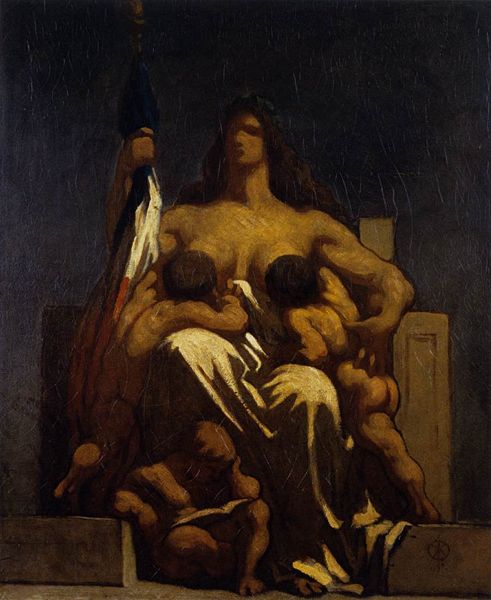
Isis seems to have absorbed many local goddesses as her cult spread. Certain Hellenic images are virtually indistingishable from images of Mary and Jesus. We're not speaking of the original Egyptian Isis but her much later Hellenized and Romanized Mystery Religion versions. So it's hard to say which iconography influenced which; some Marial-looking depictions of Isis may have been based on Christian models. Of course, Mary is rarely pictured actually nursing, as with Isis Lactans, but Honoré Daumier pictured the Marianne, who we have linked to the Virgin, doing just that in Marianne Généreuse (1848).
What's next?
Theres definitely a lot more to go into. This is just a catalogue, a brief survey of things I've been thinking about and looking into. A lot could be said about the ideal woman of the Troubadours, the historical situation of women in Languedoc as opposed to France and other depictions in art but that might be better left for another post. This one's gotten long eough already!