Showing posts with label sun. Show all posts

Tuesday, December 26, 2023

It's always sunny in Kazakhstan


It's It's been a while, but because we're a) into flags, b) into suns, and c) into numbers associated with Freemasonry, we thought we'd take a gander at the flag of Kazakhstan.

The flag adheres to the basic "rules" of good flag design: not too many colors (2 or 3), meaningful symbolism, no seals or writing, simplicity, and uniqueness.

One might argue the vertical band to the left is an unnecessary complication, but I don't think so, because it's a typical pattern of Kazakhstan.  That said, I could see the flag without the design and not "losing" anything.  The band was originally red, and changing it to yellow was a good decision.

The design of the sun is not like the Argentine/Uruguay type but more like that of Taiwan or Namibia, in that the rays are triangles detached from the circle.   And there are 32 of them. These 32 rays are said to represent the stages of grain development, but I always geek out on the Masonic use of this number.  There are 32 degrees in the Scottish Rite, or 33 if we count the ultimate, honorary degree.  The Rite is also, it so happens, to be symbolized by an eagle.

When I learned about this,. I didn't think it was an intentional Masonic message wink to those on the level.  A 32-rayed sun?  Coincidence.

Here's Wikipedia on the flag's symbolism.  No Masonry mentioned:

....The pattern represents the art and cultural traditions of the old Khanate and the Kazakh people. The turquoise background symbolises the peace, freedom, cultural, and ethnic unity of Kazakh people including the various Turkic people that make up the present-day population such as the Kazakhs, Tatars, Uyghurs, Uzbeks, as well as the significant Indo-European peoples. The sun represents a source of life and energy. It is also a symbol of wealth and abundance; the sun's rays are a symbol of the steppe's grain which is the basis of abundance and prosperity.

People of different Kazakh tribes had the golden eagle on their flags for centuries. The eagle symbolises the power of the state. For the modern nation of Kazakhstan the eagle is a symbol of independence, freedom and flight to the future.

So, there you go.  The end.  And then....

I was about to put this to bed and then decided to Google  "masonry and Kazakhstan."   What resulted surprised me. Apparently the capital city, created pretty much from scratch, is considered to be rife with occult and Masonic symbolism in it's architecture, parks, and monuments, including pyramids, towers, 32 symbolism, pentagrams, an owls.  Hoo boy, this place has it all.  I have a lot to unpack here; it's not so much a rabbit hole as a full-on warren. Gonna need to dig into this and get back atcha.

Until then, check out this link.  Don't know if I can add much more, and it's just so much to deal with!

Link

Friday, July 29, 2022

The Random Sun

At the supermarket, stuck for ideas, I asked the woman at the register to give me a random word.  She said "Soleil."  Sun.  The Sun and political imagery came to mind:  Obama's rising sun logo.  The Japanese flag.  The Sun King.

Then I Googled "national flags with the sun".  I knew The Philippines and Argentina would pop up, but I wasn't familiar with Namibia's flag until today.  When I saw it  (adopted, 1990), I was surprised, because the sun in the upper left Canton is a 12-pointed version stylized almost exactly like that of the Taiwanese flag, which I'd seen when looking into the brief life of the Chinese fascist "Blueshirts."  Dig:

The colors are different.  The Taiwanese rays are longer and completely unattached, but the angles at the base of each isosceles ray of the Namibia flag touch slightly.

At first glance they are almost identical.  Both have 12 rays and are set against a blue field.  Curious that they are stylized in such a similar fashion.

I won't recap the 10+ years of sun imagery and metaphor we've discussed here on LoS, but it seems worth discussing the similarities between these two flags. 

According to the Namibia government website:

The sun symbolises life and energy. The golden colour of the sun represents the warmth and the colour of the plains of the Namib Desert.

The blue symbolises the sky, the Atlantic Ocean, Namibia’s marine resources and the importance of rain and water.

Red represents the Namibian people, their heroism and their determination to build a future of equal opportunity for all.

White refers to peace and unity.

The green symbolises the country’s vegetation and agricultural resources.

No reason why there are 12 rays.

On Taiwan's flag....The twelve rays of the white Sun symbolize the twelve months and the twelve traditional shichen (時辰; shíchén), a traditional unit of time which corresponds to two modern hours. Sun Yat-sen added the "Red Earth" to the flag to signify the blood of the revolutionaries who sacrificed themselves in order to overthrow the Qing Dynasty and create the ROC. Together, the three colours of the flag correspond to the Three Principles of the People: Blue represents nationalism and liberty; White represents democracy and equality; and Red represents the people's livelihood and fraternity.

The explanation for the colors, although not exactly the same, is very similar.  I hadn't really noted that Taiwan's flag is red, white, and blue.  Common flag colors:. USA, France, Russia, the Netherlands, Cuba, Chile, the UK....

Other national flags feature the sun: Argentina and Uruguay, the Philippines....here's a complete list.  

We've looked at some flags with single stars and some with constellations.  I don't think we've looked at any with the moon.  I suppose most of these would be the crescent moon of Islam, although South Carolina is an obvious exception 

....

Coming up next, or in short order, anyway.  Sun, stars, constellations, and soon, the moon....

Monday, February 22, 2016

System of a Dawn

* Guantanamo, Cuba.  2002

* Operation Red Dawn, Iraq. Dec. 13, 2003.  Led to capture of Saddam Hussein.

* Operation Al-Fajr (the "dawn"), Iraq. aka The second battle of Fallujah.  Nov./Dec. 2004

* Operation New Dawn, Afghanistan. Summer 2010

* Odyssey Dawn, Libya.  March 19-31, 2011

http://lawsofsilence.blogspot.fr/2011/03/beware-of-greeks-bearing-strange-gifts.html

http://lawsofsilence.blogspot.fr/2011/03/stars-pentagons-suns-and-implied-eye.html

* Latin American flags

http://lawsofsilence.blogspot.fr/2011/03/stars-pentagons-suns-and-implied-eye.html

* Aurora, Colorado

http://lawsofsilence.blogspot.fr/2012/08/20-rosy-fingers.html

* Freemasonry

As the sun rises in the East to open and rule the day, so the Master rises in the East to open and guide the Lodge, in its labor.

or

As the sun rises in the East to open and govern the day, so rises the Worshipful Master in the East [WM rises.], to open and govern his Lodge, set the craft at work, and give them proper instruction.

* An aubade is a morning love song (as opposed to a serenade, which is in the evening), or a song or poem about lovers separating at dawn.  John Donne, metaphysical poet wrote a famous aubade called "The Sunne Rises" sometime prior to 1633.

* "Sun in the rock" myth, of a heroic warrior deity splitting a rock where the Sun or Dawn was imprisoned.

Friday, May 24, 2013

Masonic Republics?

In a post entitled ¡Viva la Revolución! (3 March 2011) I looked at the influence of Freemasonry in 19th-century Latin America, a series observations and quotes about the Masonic influence on some of the many wars for independence against the Spanish Empire.  I mostly looked at Masonic symbolism on flags, state seals, coats of arms, etc.  We saw that in many cases, the Masonic symbols were indistinguishable from symbols of the French Revolution, which in turn mirror many of those found in Freemasonry.

In retrospect, my article is a rather flawed and superficial piece and represents the serious limits to my reading in the subject.  I hope that this post and others to follow will help flesh out what I've already written, but one should always keep in mind that I'm doing a lot of speculation, kind of like wondering about the subject out loud.

This sequel began as a result of my trip last year to South America, where I saw so many Masonic elements on public monuments my head began to spin.  Buenos Aires and especially Rio de Janeiro are rife with monuments that are either explicitly Masonic or dedicated to groups in accordance with Masonic ideals.  This was also true, to a much lesser extent, in Montevideo, where it nevertheless all started.

Artigas Mausoleum

The monument to José Gervasio Artigas Arnal in the Plaza Independencia bears many striking similarities to the Monument to Estácio de Sá, a monument I hadn't yet seen for myself in Rio, but had written about thanks to a photo and some description from my brother-in-law Alfredo Buendia.  These two monuments also have a lot in common with the Temple du Sagesse Suprême in Blagnac, about which I've written extensively and has since become a well-known object of vilification.

Artigas (June 19, 1764 – September 23, 1850) is called "the father of Uruguayan nationhood" just as George Washington is called the "father of our country" in the U.S.  In fact, there is a group of Founding Fathers, which is an essay unto itself: the implied paternalism of the state, its reflection of a thoroughly ingrained patriarchal society, etc.  But that's another story.

Normal then that the capital city Montevideo would honor the man in a way which is brilliantly symbolic.  His mausoleum is at the center of Plaza Independencia, just as the man himself was at the center of Uruguayan independence.  This Plaza also separates the old city from the new, not only diving pre- and post-revolutionary quarters of the city, but symbolically representing the division of the ancien régime and the new world order and thus Europe and the Americas.

Was Artigas himself a Mason?  He was part of a Masonic-like society called the Society of the Eastern Knights (Sociedad de los Caballeros Orientales), according to the Wikipedia page on compatriot Manuel Oribe. An article in El Pueblo (Salto, Uruguay) states:  Los representantes de la Escuela Hiram reiteraron que José Gervasio Artigas no integró la Masonería pero afirmaron que 'a su alrededor habían masones'.  Simply put, Artigas himself never joined but was surrounded by Masons; the article also traces the strong role of Masonry in the Uruguayan independence movement.

(For those who read Spanish, here's more about the quasi-Masonic Lautaro Lodges). 

In ¡Viva....! I proposed that the sun in the national flags of Uruguay and Argentina (among other countries) derives from Masonic sources.  I wouldn't want to make weirdo leaps of faith, but I couldn't help thinking that Uruguay's full name, the "Oriental Republic of Uruguay" refers to more than its place on the South American continent.  I don't think it's unreasonable to imagine that there was also a sly reference here to Oriental Masonry, the French-born Continental form of Masonry which dominates South American Freemasonry to this day, where each national jurisdiction is known as a Grand Orient as opposed to a Grand Lodge, and which have a number of doctrinal differences from Anglo-American Masonry.  Thus we also see a lot of French symbols among Latin American revolutionary symbols, many of which, as I stated earlier, are also Masonic.

This inkling of mine about the word "Oriental" was reinforced when I saw the Plaza de los Treinta y Tres, or Plaza of the Thirty-Three.  These "33" are in fact the Treinta y Tres Orientales, a fighting force led by Juan Antonio Lavalleja (1784-1853),  a Freemason, whose insurrection against the Empire of Brazil "culminated in the foundation of modern Uruguay."

Funny thing is "The true number of the group has been the object of controversy, based on the existence of various lists of members, published between 1825 and 1832. Albeit thirty-three is the officially accepted number, the names differ from list to list".

I don't believe the number 33 is an average of those lists or scientific estimation, nor is it merely pulled from a hat.  I would wager that it is symbolically representing the 33 degrees of the Scottish Rite, like the the 32 rays of the Sol de Mayo on the Argentine flag and the 1828 version of Uruguay's flag.  This version was designed by Joaquin Suárez (1781-1861) who the GOFMU claims was a Freemason.  (Note that there are 32 degrees to be earned, and one honorary degree; thus both 32 and 33 can allude to these degrees).  Is it possible that Freemasons active in the formation of Uruguay could in this way symbolically lay claim to a Masonic foundation of the fledgling state?  I wouldn't wager my life on it, but grok if you will the following image.  The Estévez Palace, the former workplace of the Uruguayan President and now a museum, displays relics of its early presidents.  One of those articles:  a Masonic sash, with the 33 inscribed within a Delta in glory.  I believe it's Oribe's sash, but my memory fails me and I didn't take notes.  If anyone in Montevideo can confirm this I'd be grateful.

Treinta y Tres, by the way, is also the name of one of Uruguay's 19 provinces.  Its capital city bears the same name and "Together with Ejido de Treinta y Tres and the southwestern suburb of Villa Sara, they form a population centre of around 33,000 inhabitants." 

I was delighted to see on Wikipedia that the population of Uruguay is rounded to 3.3 million!
Oribe's (?) Masonic Sash.  Palacio Estévez.
Artigas' Mausoleum, opened in 1977, contains a great deal of Masonic symbolism.  The above-ground portion is a truncated pyramid, which, like the pyramid on the American one dollar bill, suggests that the nation's work is not finished; it must, like men and Masons, continue to progress in life towards perfection.  It is a symbol which implies betterment through education and walks hand in hand with the notion of scientific and social progress in addition to the fundamental assumptions of capitalism, which despite the negative connotation of capitalism among contemporary  "progressives", was then considered progressive during the Enlightenment; strange to many American ears, the word "liberal" in Spanish and French still implies the tendency towards laissez-faire politics in economics and law.


Truncated Pyramid
Related, or not?
The pyramid is open at the top, which allows a shaft of light, one of the foremost Masonic symbols, to shine upon Artigas' urn.  Two guards are stationed to either side like Jachin and Boaz, the silent sentinels of a Masonic Lodge, but this is certainly a poetic metaphor in my own invention rather than an intentional reference!

Illumination
As Mackey's Encyclopedia says:  "In the ceremonies of Freemasonry, we find the cavern or vault in what is called the Cryptic Freemasonry of the American Rite, and also in the advanced Degrees of the French and Scottish Rites, in which it is a symbol of the darkness of ignorance and crime impenetrable to the light of truth."

If this is an accurate reading of the cavern symbol, the architects of this monument have done well to allow the light to fall upon Artigas' remains.  He who led them out of ignorance and into truth, "illuminated" as one might say.  Hence the sun on the Uruguayan flag, as well as the appellation "Oriental" for the nation?  After all, the sun rises in the East, the direction revered by Masons as the source of light, or wisdom.

I tried to discern numerical symbolism in the number of panels and alcoves in the mausoleum, but didn't come across much, though I do find some meaning in the fact that it resembles the tessellated floor of a Lodge. 

The truncated pyramid, however, does have three layers of marble panels, so this may reflect the basic Masonic degree structure of three degrees.

Monument to Estácio de Sá


Let's compare the Artigas mausoleum to a monument I've previously written about, the Estácio de Sá monument in Rio de Janeiro.  Sá (1520-1567) , like Artigas, was a soldier and the "father" if you will, of Rio.  The monument is a pyramid which above ground is composed of 13 layers.  The American flag of course has 13 stripes the number appears in many places on the reverse side of the dollar bill.  It is also the number of layers in the pyramid in the Temple de la Sagesse Suprême, a monument I'll discuss in the next section.  I read the pyramid, like simpler geometric forms, as abstractions which, though based on naturally-occurring shapes, are not so commonly found in nature; they are "perfected" versions of mountains, fruit, rocks the sun and the moon.  You can see from this photo that in my original post I slightly misinterpreted its form due to the camera angle of the photo at my disposition, but I think this interpretation is essentially correct.

Like the Artigas mausoleum, light shines into the crypt

Before this pyramid is a triangular window, formed with smaller triangular panes of glass. Just like Artigas' monument, this aperture allows light to shine into the crypt below, shaped as a triangle, following the perimeter of the low wall which marks the boundaries of the exoteric monument above:  as above, so below.  This crypt serves as a small exhibition space, but also houses a reproduction of Sá's tomb.  A remarkable parallel.  Unlike the Artigas mausoleum, the pyramid continues underground for several more layers.  A sinister interpretation is that this represents the hidden forces below the surface of everyday politics, perhaps even echoing the cave-like effect produced in a Masonic lodge, where the ceremonial space is always windowless.  A less sinister interpretation as that this represents deeper forms of knowledge, higher values which ironically, are accessed by going into the deeper concerns of man beyond everyday living.

This above/below theme is reflected in the triangle of sand below these windows.  A quirky thought occurs to me:  sand is used to make glass.  Perhaps this is another metaphor for the powers of reason and enlightenment?  Sand is used to make glass, which in turn allows us to illuminate once-darkened spaces.  Here again though, I think we're entering the realm of the poetic imagination rather than objective analysis.

I should also mention that the small paved plaza around the pyramid is a triangle, as is the crypt itself.  Every form used in its construction, then, is a triangle, or based on one.

The triangle on the floor
As my brother-in-law discussed the symbolism with the monitor in Portuguese during my visit, I was able to make out one thing the monitor said, and that is the form of this monument had been inspired by the "fact" that Sá  was a Freemason.  This claim is possible but a bit of a stretch; the earliest indications of Masonic-like lodges date to Scotland and France in the 1530's, but more convincing references to Freemasonry were a century down the line .  Whether true or not, the claim that he was is significant, as well as that the form was chosen as an homage to Masonry.  The architect and people who paid him seem to have wanted to link the founding of their city with Freemasonry.  Indeed, the Flag of Brazil is a very natural green and blue, decorated with stars.  Above this nature symbolism are words, not shapes:  "Order and Progress."  This encapsulates Masonic values regarding the perfectibility of human nature and via democracy, society as a whole.

Pirámide de Mayo


The pyramid is also has a strong solar connection; as tombs of the Pharaohs, they were essential for survival after death.  Like the sun itself, they signify re-birth.  This in turn is one symbolic meaning of the New World, a fresh start, a perfection of the Old, a new day as it were.  We can here point to the Buenos Aires Metropolitan Cathedral.  The pediment, a triangle naturally, depicts the reunion of Joseph with his father and brothers in Egypt.  Though it represents reconciliation, it also provided the sculptor an opportunity to depict the three pyramids of Giza in the background.  Buenos Aires' most prominent landmark is an enormous obelisk, after all, and I've never seen such a prolific use of the obelisk in miniature scattered throughout a city, except in Rio.  I also passed a small pyramid in a public park near the Recoleta cemetery, the cemetery of the city's illustrious and wealthy...and where explicit Masonic symbols abound.  The Sun and two hands shaking in fellowship derive from Masonry; the Phrygian cap was derived from the French Revolution.  All three symbols are ubiquitous in Argentina, as they form they principal elements of the country's coat of arms. 

These symbols are also displayed on the Pyramid of May  (1811), a monument in Buenos Aires' Plaza de Mayo.  The pyramid was ordered by the Primera Junta to celebrate the first anniversary of the May Revolution that led to removal of the Spanish Viceroy and the establishment of the Junta, the first local government on the path to independence.  The president of this Junta, its two secretaries and five of six committee members were Freemasons.

The Pyramid was originally crowned by a ball finial and encircled with 12 pillars, also with ball finials.  The number 13 appears yet again!  This original Pyramid was renovated and significantly modified in 1856 under the direction of Prilidiano Pueyrredón, a Freemason.

As for the sheer number of obelisks and pyramids, however, Rio has Buenos Aires beat, but I think I'll compile that list for another post.

Temple de la Sagesse Suprême


A third monument I'd like to touch upon is the pyramid monument located at the heart of Blagnac's (France) Place de la Revolution named the Temple de la Sagesse Suprême.  A thirteen-layered pyramid sits at the center of the plaza, as if literally at the heart of not only the Revolution, but the subsequent State, represented by an abstract form of a house from within the center of which pokes the tip of the pyramid.  Its symbolic position at the heart of the Revolution is echoes in both the Pyramid of May and the Artigas Mausoleum.  The pyramid rises with the state, from the masses at the bottom to the President at top, which actually rises about the state itself.  The Sun is metaphorically represented by a circular pathway which radiates outwards.  Here the Sun may represent a new day, but also France's self-proclaimed role as a beacon of Liberty, radiating its revolutionary principles throughout the world.  In fact, a tessellated map of world once lay beneath the pyramid, which is a working fountain.  The pyramids of Sá and Artigas are within view of the sea, perhaps this fountain replaces that natural watery setting.  Why that would be I'm not sure, as water is not really a Masonic symbol, although both the anchor and the ark are.  Perhaps then this refers to the story of Noah, whose story is important not only to Freemasonry, but esoteric circles in general.  As we've seen in previous posts, Noah's story represents....a new start for the world.

The light however, is not just symbolic.  In the ensemble of sculptures that flank the pyramid, a dog-like belvedere can emit a beam of light through a hole in the pyramid.  This too is reminiscent of the eye in the pyramid; because this "eye" also serves to transport light, it's not at all "conspiracy theory" to believe it represents a wink in the direction of Enlightenment, if not a direct homage to the Bavarian Illuminati.  After all, Weishaupt did envision a small elite of enlightened men pulling the levers of the state; the pyramid with the eye is thus called the Temple of Supreme Wisdom.  The clincher is a bronze panel which quotes eccentric architect (and Freemason) Jean-Jacques Lequeu: "Happiness is in the angle where the sages gather."  These sages are of course, enlightened, that is to say illuminated men.  Masons of course, meet on the square, a perfect equilibrium of four angles, a perfected microcosm of the natural world's four directions, its winds, its elements....


Templo da Humanidade —  Rio de Janeiro
France's self-image as a beacon of these values is not arrogance.  The beam of light passes through the eye to hit a crystal set within a tri-colored shield held by a stylized revolutionary carrying a halberd and wearing a Phrygian cap, the symbols repeatedly found in Latin American post-revolutionary heraldry, proof perfect that in fact the ideals of the French Revolution did indeed shine upon the world.  There is, for example, a positivist church in Rio, the Church of Humanity, oriented not towards Jerusalem, but Paris!  Positivism as a church values rationality and promotes universal fraternity; order is its foundation and progress is its aim.  There are some really good articles about the link between positivism and Freemasonry and their use of compulsory public education as means of achieving their goals of order and progress. Many positivists were  Freemasons, including fellows like Jules Ferry, who is primarily responsible for the first laws regarding compulsory education in France.  The most Masonically-festooned tomb in the Recoleta is that of President Domingo Sarmiento, the "father of the Argentine education system" and obviously a Freemason.  I wholeheartedly recommend the articles here and here for a history of positivism, Freemasonry, public education and Latin America. 

This little comparison of these monuments is fitting for a fraternity rich in ideas expressed in architectural metaphors, for these monuments express those ideas not with metaphorical architecture, but in real stone.  The link between Freemasonry and independence in Uruguay and Argentina, as well as in France, is I think clearly expressed in the symbols on these monuments.  A quick look at the people honored by them and who had a hand in making them also demonstrate a number of Freemasonic personalities that cannot be ignored.

So, a lot more could be written here, but for now I've hit a wall, the very same upon which I've just laid another brick.  There'll be more to come....

Friday, April 8, 2011

Wave 'em like you just don't care

In this post I would like to trace a series of associations which has led me to realize that for some time now, I have been unconsciously intrigued by women's arms.  It has come up in a number of posts without me actually giving it much heed.  It was only after writing my last post on the Marianne, including a reference to John Ashcroft's alledged uneasiness over giving press conferences before a topless woman called the Spirit of Justice, that I saw that I had been half-consciously developing a theme.


This is Ashcroft before the Spirit of Justice.  She is half of a pair; on the other side of the podium is a masculine figure called the Majesty of Law.  I can't find a good shot of him, but he appears to be holding a torch (torch-bearer!) with only one arm elevated.   The Jefferson Madison Center of Liberty has a photo of this "divine couple" here.  They also show a detail of the base:  it appears as though the woman, apparently nicknamed "Minnie Lou" is standing on clouds.  Two blank tablets, like the traditional image of the Ten Commandments, hide her left leg.  (The Declaration of the Rights of Man and of the Citizen was famously depicted in art on similar tablets--a new covenant indeed).  Emblems are affixed to the clouds, a sun perhaps, or a star.  The sun and the moon, perhaps.

The statue is 12.5 feet of cast aluminium, unveiled in 1933.  It is one of many works by C. Paul Jennewein to adorn the DOJ building.  Jennewein produced quite a bit of architectural sculpture and worked on several public monuments.  His style is rooted in classicism but these works reflect the Art Deco style.  (Jennewein was a noted practitioner of this fusion, called "Greco Deco").

Why her arms are raised, I cannot say.

Tanit votive stela, 2nd c BCE, Algeria.  Now in the Louvre, LoS photo.


From The hand is the whole:

"Tanit was symbolized by an ankh-like glyph with a triangular base surmounted by a bar and circle.  This in turn was surmounted by a symbol representing a crescent moon which also evokes the eye.  In the standard work on the symbol, F.O. Hvidberg-Hansen interprets this symbol as a woman raising her hands."

I was looking through this old post for a correlation with another post I've yet to write, when this passage jumped out at me.  I'd just finished the Marianne post and was struck by the repeated occurrence of an image of a woman raising her hands.  Unfortunately, I find no link with Tanit and Justice.  All the other goddesses associated with Tanit are fertility figures.  Tanit was a lunar goddess, patron of Carthage and a goddess of war, fertility and also, a virginal mother goddess.  She is probably a variation on the Ugaritic (Syrian) goddess Anat.  She has a storied history but again, not much to do with justice.  Her virginity is emphasized and she sometimes bears the title "Queen of Heaven".

National Black Theater (NBT)
I had already mentioned Tanit in connection to the above sculpture and the orant posture of prayer, which some interpret as a surrender to higher powers.  Unfortunately for our train of thought here, the NBT figure is male.  But the orant may help us sidestep that.  Unbeknownst to me at the time is that there is a is a specifically female version of the posture called orante, or orans:

The custom of praying in antiquity with outstretched, raised arms was common to both Jews and Gentiles, and indeed the iconographic type of the Orans was itself strongly influenced by classic [not to mention Egyptian] representations.

... the great majority of the figures are female, even when depicted on the tombs of men. One of the most convincing proofs that the Orans was regarded as a symbol of the soul is an ancient lead medal in the Vatican Museum showing the martyr, St. Lawrence, under torture, while his soul, in the form of a female Orans, is just leaving the body....The Acts of St. Cecilia speaks of souls leaving the body in the form of virgins.

In my article on the National Black Theater I emphasized the spiritual mission of that organization.  The satue of a man in prayer-like position before the sun and triangle, a symbol of divinity, reinforces that message.  The theme of virginity is also noted, but to what end I'm not sure.

The Sailor's Wife, Lloret del Mar.  LoS photo.

As I wrote in an earlier post (♀: Matter and Spirit, or Venus' hand mirror....):

Depictions of Venus Anadyomene also have her doing things with her arms:  wringing her hair, strategically placed for modesty or splayed out in erotic invitation.  I have thought long about the Venus of Lloret.  Her arms are like the Pisces fish or a yin and yang.  One is held up as if shielding the eyes, scanning the horizon, a covering, protective gesture; the other seeming to beckon a distant viewer.  They both shield and invite.  Modest yet alluring.

I had forgotten this post when I began my musings on this theme and had looked at all of the previous four images and posts before I recalled it.  But there it is.  I'm already wondering about arm gestures.  I'm still not sure what the Sailor's Wife here is up to....

The gesture I describe appears to me to have a spiritual significance:  a gesture of praise, supplication or communion.  I think it also has an erotic aspect which to be quite frank, is never far from sacred art or the act of prayer itself.  In my mind anyway!

This erotic aspect may come from other uses of the raised arms.  When angry or insecure, a person tends to cross their arms in a kind of symbolic barrier.  It is literally a closed figure.  The raised arms, on the other hand, are quite the opposite, the body is left exposed, vulnerable.  A woman's breasts are lifted, accentuated.  Raised arms are a gesture of surrender.  They are also waved about to attract attention, to bring someone nearer.   All these are definitely sexier than the closed door of crossed arms!  I also though of the Masonic distress signal, or "grand hailing sign of distress."  This gesture is also a variation on raised arms (Google it).

This is probably stretching the point but isn't distress a kind of erotic situation?  Damsel in distress and what not?  But Masons are men so this isn't so fitting.  I just threw that in for good measure because it came to mind.

Anyway, I don't have much more to say on the idea of raised arms at this point.  Just something that caught my eye.

Thursday, March 3, 2011

A show of hands

I've always noticed that when you start looking into something, like triangles, you start seeing them everywhere.  Coming upon us unexpectedly, the recurrence of images in which we've taken an interest can be delightful, startling, even alarming.  Crediting these sudden appearances with special significance, however, is more than a paranoid delusion; for some it's a sign of conspiracy, for others mystical synchronicity.  It certainly has a poetic aspect to it.  For many it's simply an excuse to say "It's like, weird" and go on to mimic The Twilight Zone theme music.

Or write blog posts.

Following my bout with hand fetishism (see The hand is the whole), I happened to read C.J Samson's Dissolution, a historical crime novel set against the backdrop of the dissolution of the monasteries in the time of Cromwell.

It follows the adventures of a hunchback named Shardlake, sent to investigate the murder of a commissioner in a fictitious Benedictine monastery.  Along with the murder, the monastery church has been desecrated, which includes the sacrifice of a black cock upon the altar and the theft of a sacred relic:  the hand of the repentant thief crucified at Jesus' side.  This hand was nailed to a piece of wood and set in an emerald-studded casket.

Roman Catholic tradition calls the thief Saint Dismas.  His repentance is described in only one gospel, Luke (23:39-43), and he isn't named until the apocryphal Gospel of Nicodemus, which came together some time in the 4th century.  His name comes from a Greek word which can mean "sunset" or "death".  His feast day, March 25th, is also that of the Annunciation, when Gabriel announced to Mary she would miraculously conceive a child.  Thus he is linked both with Jesus's death (sunset) and inklings of his birth (sunrise?)  The sun set and rises again....as does the son.

The sun just just keeps popping up as a symbol of rebirth and and an emblem of "illumination". 

Also, you may recall from our previous post that a "Hand of Glory", the hand of a hanged man, was a tool used by thieves to unlock doors and cause paralysis.  As for relics, the hand of St. John Kemble is still kept in a reliquary at St. Francis Xavier Roman Catholic Church in Heresford.  Also, today (3/3), I stumbled across a blog entry in which a guy describes making a steampunk-flavored lamp using a severed animal paw; he links his macabre contraption to the Hand of Glory and calls it...the Torch of Saint Dismas! 

I've also just remembered that last night I watched Simon of the Desert (Luis Buñuel, 1965) and there's a scene where a thief holds up his stumps--hacked off for his crimes--and our eponymous hero Simon prays from atop his pillar and the thief's hands miraculously reappear....


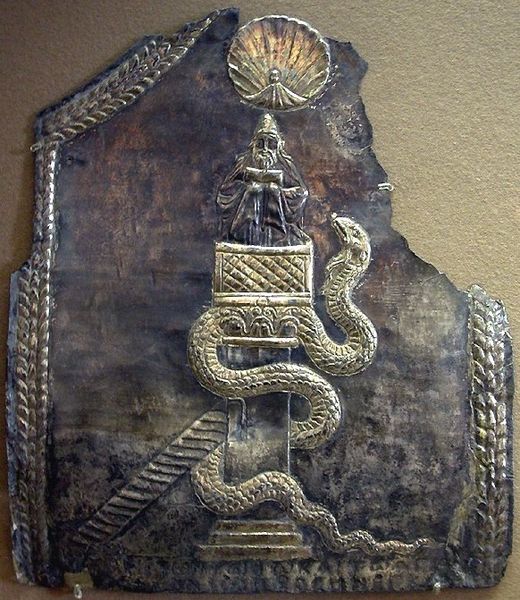
Simeon (390-459 CE) was an actual saint who lived 37 years atop a pillar in Syria.  Imagine my surprise when I saw this 6th century depiction of the saint, currently to be found in the Louvre.  See Jesus was in shape for our rather extensive discussion on the snake/pillar motif.  It all ties together somehow.  Paranoia or perceptual matrix?

So, I really just wanted to bring up these coincidences/synchronicities.  A pair of novels in which the action begins with a severed hand:  one discovered in The Lost Symbol and one lost in Dissolution.  Handy bookends for a post inspired by the local tale of an actual severed hand (A gruesome discovery) and followed by yet more thief-related hand motifs in quick succession.

I'm sure there's a discourse on perception and meaning to be wrung out of this, but not today.

Tuesday, March 1, 2011

¡Viva la Revolución!

In my last post I promised to link the sun and triangle in the sculpture above the door of the National Black Theater to other triangles...and the eye.  I've wandered a bit in this task and not made any startling discoveries; I thus present this less as something insightful than as a sort of record of my wanderings.  Quite a few things have already been written on the topic.  I could have developed this post a lot more extensively but don't really see the point, so my cut-off point is therefore rather arbitrary.

Flag of Argentina featuring the Sol de Mayo
Having an Argentine wife and a large number of both Argentinian and Uruguayan friends, it's only natural that when thinking of the sun as a symbol of regeneration, I thought of the Argentine and Uruguayan flags, both of which feature a jolly sun referred to as the Sol de Mayo, or Sun of May.

The Sun of May is named for the May Revolution of 1810, the first salvo in the Argentine War for Independence.  Some point to it as a representation of the Incan sun god Inti, but I think it's more likely based on European precedents.  The "sun in splendour" is a long-standing European heraldic device, but I propose that its use here was inspired by its use during the French Revolution.  Dig this quote from Wikipedia:

Eye of Providence
The sun, like the phrygian cap on Argentina's coat of arms and the triband flag, was already used as an emblem of the French Revolution. It has been speculated that groups of deputies in the French revolution used a seal very similar to the current Argentine coat of arms, including a sun symbol. In France, the sun was used especially in relation to the Cult of the Supreme Being. The sun in the French Revolution was adopted as a symbol from Freemasonic representations of the all-seeing eye, in a triangle in a burst of sunrays.

Declaration of the Rights of Man featuring fasces, Phrygian Cap and the Eye of Providence in a Triangle

Coat of Arms of Argentina featuring the Sol de Mayo 

It was a particularity of the 17th century to depict the eye in clouds or in glory, but it was used throughout the Middle Ages and the Renaissance, often enclosed by a triangle representing the Trinity--it began as a Christian motif.  This found its way into Freemasonry and from this use was transformed into a sun.  I would also argue that, as we can see in the examples that follow, it was also transformed into a star in glory or was reduced to the triangle alone.

In the early part of the 19th century, Latin America was in a revolutionary tumult against colonial Spain.  A variety of short-lived republics popped up and fell apart, eventually settling into the more or less stable national configuration we see today.  These revolutionaries were inspired by the successful revolutions of France and the United States, so it is unsurprising their symbols popped up in the new flags and coats of arms. The Phrygian cap, for example, used extensively in US and French revolutionary propaganda, can be seen on the flags or coats of arms of Nicaragua, El Salvador, Argentina, Colombia, Haiti, Cuba, Bolivia and Paraguay.

Flag of Chile
Several flags reflect the US design (1777) of red and white bars, a blue canton in the upper left featuring white star or stars:  Chile (1817), the flag of the Liberating Expedition of Peru (1820), Texas (1839), the Confederate States "Stars and Bars", (1861) the first flag of Cuba had blue and white bars and a red canton (1868), the Brazilian state of Amazonas (1982).  At least five other Brazilian state flags have bars and upper left cantons with stars, but these are not necessarily red white and blue.  Other Brazilian flags feature the Phrygian cap.  The Bahia state flag is a variant upon the flag of Chile et. al., but instead of a single star, the blue canton features a triangle.

Flag of the State of Bahia
Interesting that the Sun of May (springtime) in the Argentine flag features 32 rays, perhaps symbolic of the points of the compass or the degrees of Scottish Rite Freemasonry.  Also interesting that the Argentine flag inspired that of Federal Republic of Central America (1823-1838), which has the same triband colors, but replaces the sun tin the middle with a triangle within a circle.  Within this triangle is the Phrygian cap in glory, coming out from under the mountains and under a rainbow, yet another symbol of regeneration.  This symbolism still appears in the coat of arms of El Salvador.

I have already mentioned  the Cuban flag with the star and bars, but recently came across an article about the flag of Puerto Rico.  It is essentially the same flag but the red, white and blue is in a different configuration.  The article has this interesting tidbit:  "The Cuban flag was designed by Narciso López, and the concept behind the design of the flag is based on that of a Masonic apron. López was a well-known Freemason (Solomon's Lodge No. 1, F. & A. M. -- Savannah, Georgia), adventurer and soldier, famous for his attempts to liberate Cuba from Spain in the 1850s."  The author then goes on to make many of the same conclusions and links between the triangle, the sun, the star and the Eye of Providence.

The Cuban government explains the flag thusly:

The equilateral triangle which outstands is the perfect geometrical shape, because of its equal three sides and three angles, which means equality among men.

The three colours (white blue and red) are related to French revolutionary triptych of Liberty, Equality and Fraternity, and besides they the ideals of justice expressed in white pureness, and altuism and highness of those ideals in blue, with the red, reflection of the blood shed in search of freedom. They also incarnate the new republican and democratic ideals that are synthetized in the citizen of the republic, free and equal, with full rights and duties, opposedly to king´s vassals, according to absolute monarchies´ conception.

Finally, the five-pointed star, with one pointing North to indicate steadiness, expresses the balance between moral and social qualities which must tipify the state, and shines by its own light, it is to say, the independent state.

So, the star symbolizes liberty, the triangle equality and the strips union, perfection and fraternity.

I'm not sure where to fit this in so I've plunked this fact down here.  I find it somehow fitting that one nickname for the U.S. flag is Old Glory.  I always thought that this referred to renown or great praise, perhaps beauty, but I can't help now but think it also refers to the glory we have been discussing, that is the representation of rays of light as from the eye, triangle, sun, etc.

If I can make another comments about another flag: that of the Philippines, another country to have thrown of the colonial yoke of the Spanish. The Katipunan (1892) was discovered in 1896, an event which sparked the Philippine Revolution. The Katipunan was an essentially Masonic revolutionary brotherhood; most of the founders were Masons and its initiation rites and hierarchy were based on Masonic models. The first system of initiation was a triangle system, whereby a member initiated two new members unknown to one another. After this proved too unwieldy, the Masonic system was established and the organization was divided into three degrees.

Flag of Puerto Rico; the Flag of Cuba has a red canton with blue and white stripes

Flag of The Philippines
The Philippines' flag is a variation upon the Cuban/Puerto Rican flag: red, white and blue, triangular canton....but instead of a single star there are three stars at each point of the triangle. A yellow sun adorns the middle. This sun is not at all out of line with our other revolutionary flags; the sun is also thought to be a reference to the flag of the Katipunan, the Masonic brotherhood that kicked off the Philippine Revolution.

The Lautaro Lodges were secret, quasi-masonic Lodges and included such revolutionary leaders as: Bernardo O'Higgins (1778-1842) in Chile; José de San Martin in Argentina (1778-1850); Simon Bolivar (1783-1830) just about everywhere a revolution was to be found; Francisco de Miranda (1750-1816) in Venezuela.... It is difficult to escape the fact that Freemasonry inspired these men. It would not be surprising then that as in France, where the Eye of Providence was transformed by revolutionaries into a sun symbolising regeneration and illumination, it would appear in the New World as well. Note also how the sun finds itself replaced by a triangle, recalling its origin, and that in the Federal Republic of Central America, as in the Argentine coat of arms, the sun becomes a Phrygian cap in glory. Triangle, Sun, Eye, Phrygian cap....each one replaces the other.


Lodge Founder Miranda was said to have been made a Mason in 1783, in Philadelphia, at a Lodge frequented by Lafayette:

There is no irrefutable data concerning the exact day and month of his initiation. It appears that, due to contingencies derived from the war, the archives of the Lodge where Miranda received the Masonic Light, were lost. What is amply known, however, is that Lafayette was his Principal Recommender or "Godfather of Initiation". There are also numerous references citing his constant visits to Lodges in New York, and his fraternal meetings with George Washington at a number of Masonic gatherings.

Actually, a lot of doubt has been shed on this. Miranda's diaries only reveal two visits to Lodges, not as a Freemason but as a curious outsider. But this was only part of his wide-ranging interests. Such visits to a variety of incongruous places are multiple. It would appear that the repetition of this story has made it appear to be an ironclad truth when in fact, it is not.

It seems obvious that Freemasons played critical roles in the 19th century revolutions of Latin America, inspired by two 18th century revolutions where Freemasons played equally important roles.  Yet this is a far cry from saying Freemasonry orchestrated them.  The sun, although used as a symbol in Freemasonry--and one should ask here what symbol isn't?--is hardly its most important.  The Phrygian cap and Liberty Pole aren't Masonic at all.  (It occurs to me that the Liberty Pole is a version of the Maypole, a rather phallic component of springtime festivities naturally celebrating regeneration).  The recurrence of triangles and suns, evoking the eye of providence, certainly make it appear as though revolutionary Freemasons had some say in leaving their mark.  None of this is "hidden".  These symbols would have been easily recognizable in their day.  Today, Freemasons make no bones about advertising the Freemasonic affiliation of revolutionaries, even when this affiliation is unconfirmed.  Indeed, one can say the both Freemasons and their critics overstate the role Freemasonry played in these revolutions.  Which is not to say that individual Freemason and Lodges didn't play important roles.  But even here we must be careful to sort the accumulation of received ideas from historical reality.  And besides, the triangle and the sun have long non-Masonic traditions.

We have already discussed how the New World had been regarded as the regeneration of the Old as far back as Francis Bacon.  In the latter-half of the 18th century and beginning of the 19th, several historical transformations came to a head.  I have identified three important historical threads.....the rise of capitalism, the beginning of the modern nation state and the development of the scientific method.  It seems clear that in business and modern diplomacy, as well as in scientific endeavour, competence needed to take precedence over privilege, and that competence needed to be cultivated.  In promoting reason over blind faith, the forward-thinking leaders of the day were in natural conflict with the Church.  In promoting capability over entitlement, they ran into conflict with the aristocracy and the nobility.  As young men, eager to make their way in society, found themselves blocked, their anger naturally grew.  As the desire to progress met resistance, something had to give. 

Naturally, some men grouped together to give history a push in the right direction.  One must also consider that the leader of the Revolutions were mostly men of means; I am always surprised to see how many Generals in the French Revolutionary Army were minor nobles.  Certainly a lot of the rhetoric was self-serving, applying equally to dispossessed masses as well as the minor nobles and bourgeoisie who, without the right name or connections, found their aspirations hampered.

Freemasonry became a tool in this struggle.  I think the doctrine of human improvement, if not perfectibility, runs counter to the idea of natural aristocracy:  the nobility saw themselves as naturally better than others, chosen by God.  The Catholic Church saw all men as born corrupt.  Various Protestant sects saw a man's fate as pre-destined.  But Masons saw things differently:  all men were created equal and can improve.  This would later be worded in the American Declaration of Independence

We hold these truths to be self-evident, that all men are created equal, that they are endowed by their Creator with certain unalienable Rights, that among these are Life, Liberty and the pursuit of Happiness.

I see the "pursuit of happiness" to be of special importance here.  Happiness isn't guaranteed, only the opportunity to achieve it.  I interpret this not in happiness as a mood, but as a state of fully-realized self, whether professionally, spiritually or mentally.  It is the guarantee that no social order will inhibit the industrious individual's right to realize their hopes and aspirations.  At least in theory.  Modern American Freemasons use the motto:  "Making Good Men Better."


Properly understood, therefore, when John Locke, Samuel Johnson, and Thomas Jefferson wrote of “the pursuit of happiness,” they were invoking the Greek and Roman philosophical tradition in which happiness is bound up with the civic virtues of courage, moderation, and justice. Because they are civic virtues, not just personal attributes, they implicate the social aspect of eudaimonia. The pursuit of happiness, therefore, is not merely a matter of achieving individual pleasure. That is why Alexander Hamilton and other founders referred to "social happiness".

"Life, Liberty and the Pursuit of Happiness" also form a neat trinity, bringing us back to the triangle.  This trinity of inalienable rights can also be seen in the French Revolutionary motto:  "Liberté, Fraternité, Egalité".

Still, as I said earlier, one must be careful not to overstate the role that Freemasonry played in Revolutionary movements; we should instead speak of individual Freemasons.


Paradoxically then, the interests of masonic and non-masonic authors have coincided in trying to exaggerate and enlarge the role played by Freemasonry in the independence of Chile and other South-American countries. Wishful thinking replaced the critical apparatus of the historian, and the indiscriminate use of the word ‘Lodge’, without distinguishing between masonic and non-masonic organizations, has compounded the confusion.

The documentary evidence as well, has often been of a sort that raises serious doubts about its validity.  Spanish historians, some of whom are inclined to discover the hidden hand of Freemasonry in any place where Spanish interests have been affected....enthusiastically embraced the theory that the Lautaro lodges (which, for them, were regular masonic Lodges in all respects) were the root and soul of the Latin-American independence movements.

This simplistic view ignores, of course, the other factors operating at the time, such as the growing antagonism between ‘criollos’ and ‘peninsulares’, the weakness of the Spanish crown at the time, the profound influence of the ideas of philosophers such as Rousseau, Saint-Simon, Locke and Hume and the example of the North-American colonies who gained their independence from England.

Did Freemasonry then play no role in the independence of Latin-America? The answer depends, to a large extent, on what we mean by independence. If we refer only to the military actions that led to the final defeat of royalist Spanish armies and their expulsion from the continent, we must admit that the direct influence of Freemasonry was minimal. This does not mean, of course, that we should adopt a radical scepticism on this subject. There is a well-documented participation of individual freemasons in the independence struggles of all American regions, north, centre and south. For some of them, their masonic background and experience was a determining factor in their libertarian efforts. For others, masonic membership was only a minor component of their personal history and view of the world. Since we cannot enter into the hearts of men, we have no way of evaluating the true importance that ‘being a mason’ held for men such as Bolívar.

Complete independence is a long and complicated process, involving many aspects, that may take many decades to come to fruition. In this sense, the contribution of freemasons towards expanding and completing the independence process of which political independence is but the first stage cannot be overstated.

Which seems to be the most sensible view of things; after all, it supports the conclusion I had come to previously!  I was also pleased to find this article by (Freemason) Alex Davidson entitle The Masonic Concept of Liberty:

In summary, we can say that Freemasonry was one of the channels, perhaps the main channel, by which the values of the Enlightenment were transmitted from Britain to America, France, the Netherlands....The essentials of the message were liberty, tolerance and sociability, and.....the idea that through reason, all men could find a way of life that is satisfying and fulfilling.

Secondly, we can show from history that Freemasonry was inevitably the bearer of revolutionary Enlightenment ideas where liberty did not exist. We know with reasonable certainty that the French lodges did not practice politics, yet their philosophy could not but cause many of their members to be active participants in the politics of revolutionary liberation movements. Freemasonry may have been officially neutral, but its members were not. And finally, we can remark that we are all, indirectly, the beneficiaries of Freemasonry and the Enlightenment: we now regard their general political values as so normal that we tend to take them for granted. Secularism, constitutionalism and parliamentarism are their heritage, obviating the need for revolutionary action to achieve liberty.

So.  I think this concludes what I wanted to get at in this article.  A kind of meandering and at times contradictory train wreck of a post that's gone a long way from suns and triangles.  I consulted The Gid on where to go with this, and he had some good ideas, but even his sage advice wasn't enough to save us here.  Like the battery bunny, I just keep going and going and going.  And just because I'm tired of this beast, I'll plant my flag here and cry "¡Ya basta!"

See Also:  Masonic Republics