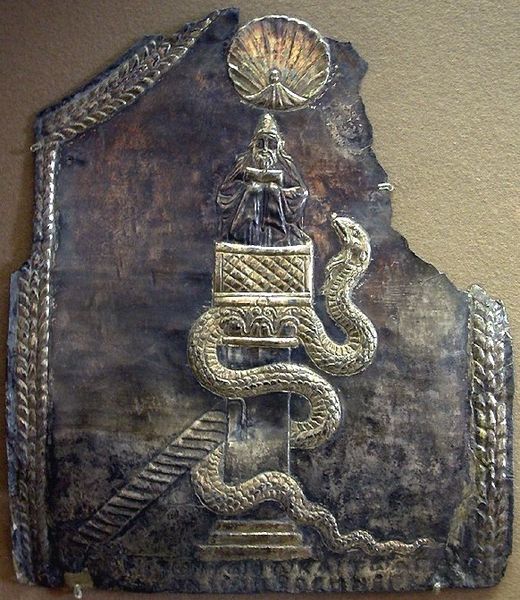
Showing posts with label snake. Show all posts

Thursday, March 3, 2022

A nice letter about the Black Madonna (Vierge Noire) Phenomenon

I got this in my email a few days back.  Not knowing for which it was intended, I just made it a post unto itself.  I don't endorse all the ideas of the author, nor the links, at least not until I've actually explored them.  But so far, it's interesting stuff and I look forward to reading it all more fully....

Hello Steven,  I was trying to post a comment on Laws of Silence about this, but no success. Said I must be a team member  [I've just changed that]. Anyway, the attached is what I wanted to post, plus a Dropbox link and some stuff about the Chapel of Plaincouault.

Chouette. The Black Madonna is something I have looked into considerably over last couple of years. Here are my notes. The serpent is also a good subject particularly in the context of Jung's writings. He was King of Kings on this. What does it all mean for practical purposes? Well what it all drives towards is the probability that Christianity was a cult developed and used by Philip K. Dick's "Empire (that) Never Ended". Further it was probably an Essene cult initially who like many current indigenous populations (see Cosmic Serpent by Jeremy Narby) used Entheogens as a means to achieve higher conscious state(s) in order to move into that other world many are increasingly discovering and finding out that Patriarchy is rapidly (in an eternal sense outside time) moving back towards matriarchy and of extreme necessity. Hekate, Mother Earth, call it what you will. VALIS Vast Active Living Information System. Of a complexity and potential power beyond imagination and then more. In a "fifth dimension". Threaded through 4-D space-time continuum.  "Gallowglaich", Belgique. https://www.dropbox.com/s/897sc45ealryx0a/Black%20Madonna.docx?dl=0Then there is this: Les Champignons de Plaincourault:
Sam Woolfe (2013), “The Psychedelic Origin of Christianity”, 17th April 2013.www.samwoolfe.com/2013/04/the-sacred-mushroom-and-cross-by-john.html
History of Yesterday (2021), How Psychedelics Probably Fuelled the Spread of Christianity”, 15th January 2021.historyofyesterday.com/how-psychedelics-probably-fuelled-the-spread-of-christianity-8d9f22401ac0
"Gallowglaich"

Friday, February 25, 2022

"Russian warship, go f--- yourself!" (a.k.a. "Nuts!")

I.

December 22, 1944.  Battle of the Bulge.  German General Heinrich Freiherr von Lüttwitz attacks the 101st Airborne with a superior force and issues an ultimatum (excerpted):

To the U.S.A. Commander of the encircled town of Bastogne.

There is only one possibility to save the encircled U.S.A. troops from total annihilation: that is the honorable surrender of the encircled town. In order to think it over a term of two hours will be granted beginning with the presentation of this note.

         The German Commander.

The response of General Anthony McAuliffe:

          To the German Commander.

NUTS!

The American Commander.

The 101st held off the Germans for two days until relieved by the 4th Armored Division.  Those dudes had Nuts....

II.

February 25, 2021.  Invasion of Ukraine.  A Russian warship confronts 13 Ukrainian border guards stationed on Zmiinyi (Snake) Island:

“This is a Russian military warship. I suggest you lay down your weapons and surrender to avoid bloodshed and needless casualties. Otherwise, you will be bombed.”

 The Ukrainian response:

"Russian warship, go fuck yourself."

The 13 border guards were all killed.  (Or were they?  27/02:  The guards may have in fact been captured and taken to Sevastopol...Good news for the guards, but the propaganda value is somewhat diminished.  Dying for one's country against unwinnable odds, Russian ruthlessness....There's a good lesson here.  In war, truth is often the first casualty.  Gonna have to hold my tongue a few days before reacting to news from Ukraine, perhaps.  Also, the article to which I've linked says many people are comparing the "Russian warship" riposte to McAuliffe's "Nuts!"  I knew I wouldn't be the only one to grok that....)

III.

13 guards on a 40-acre island.  It shows both the ruthlessness we can expect from Russian forces and the Ukrainian resolve to resist the invaders.  Apparently Ukrainian troops are putting up stiff resistance and have repulsed more than one Russian incursion.  Thousands of ordinary men and women are taking up arms.  I saw an interview with Ukrainian MP Kira Rudik who said she and her staff were armed and ready to fight.  In another interview ex-President Petro Poroshenko said Ukraine will never surrender and showed CNN the Kalashnikov he will use to participate in the defense of Kyiv.  President Zelensky has urged citizens to start making Molotov cocktails.

Sadly, without heavy artillery and air support, the vastly outnumbered and outgunned Ukrainians have little chance of defeating the Russians.  But one never knows.  The Afghanis and Chechens proved superior firepower doesn't always ensure an easy victory over partisans with the will to fight.  Many Russians are aghast at Putin's invasion, and I'll bet many soldiers aren't that enthusiastic either.  And the Ukrainians don't want to live under the yoke of a Russian autocrat.

Ukraine has been described as corrupt, and the government has been heavy-handed with separatists in its eastern regions.  But the Ukrainian people clearly don't want to be occupied by the Russians and, while many have fled, many are gearing up to fight.  If and when the Russians force a military surrender, they can expect heavy losses to the citizen partisans who appear ready to die for their autonomy.  It's not Zelensky and the government I support, but the people who'd rather die than live under foreign domination.  Vive la Résistance!

Russia has just indicated a willingness to talk.  Maybe all Russia wants is to force Ukraine to abandon its desire to join the EU and NATO.  Maybe it's the first country on Putin's wish-list of countries to annex.  Russia might be coming to the table because Ukraine's military has performed better than expected.  Maybe seeing the people arming themselves has made them realize subduing Ukraine will require significant civilian, and Russian, casualties.  A lot of Russian soldiers may be hesitant to kill people who are in many ways their cousins.

One can argue that if the Allies had opposed Hitler from the get-go, after annexing Austria, WW2 could have been avoided.  Perhaps by stopping Putin now another European war can be avoided.  One hopes that Ukrainian military and civilian resistance, an unwillingness to kill large numbers of Ukrainians, and domestic dissent in Russia will make Putin reconsider.  Maybe the willingness to negotiate is another ruse.  Russia has been lying about its intentions up until and since the moment they actually invaded.

Maybe logic is something we can't even apply here.  Putin is either crazy like a fox, a "genius" as his biggest fan Comrade Trumpsky calls him, or he is, quite simply....Nuts.

P.S.  I'd be remiss not to mention the Ukrainian woman who went up to Russian soldiers and offered them sunflower seeds to carry around.  Sounds sweet.  Until she told them that the reason is so that flowers may bloom on the spot where they die.  That's Nuts in a nutshell.

Sunday, February 20, 2022

Union of the Snake


I've done a whole series about snake imagery as it relates to the Crucifixion and the medical profession, as well as the sculpture of Bourdelle, the shenanigans of Moses, and the Black Virgins. Not sure I have more to say on the theme, but in the cause of my ongoing psychogeographical-like efforts to invest the drab and humdrum commute I am obliged to undertake in my ongoing struggle as a wage slave with some meaning, I post this. The Toulouse metro uses a symbol for each station, and the Phaculté de Pharmacie uses a serpent. 

Of course, this is self-evident. What is not is that it's one of the stations I now use frequently in my current pursuit of gainful employment. Signs and symbols keep reoccurring in my personal geography.  My psychogeography. Apophenia, red car phenomenon. Whatever.  Both objectively "true" and subjectively meaningful. As if subjective and objective mean anything anymore, if they ever did.

And hey, it sets my thoughts in motion and makes the drab and deary navigation through the stultifying urban shitscape somehow a little better than completely meaningless..... 

Friday, July 21, 2017

Bourdelle's "La France": Montauban copy

When I first saw Bourdelle's La France in Paris in 2011 (on LoS), it encompassed a lot of what I was writing about at the time, featuring symbols with which I'd become very familiar:  A strong woman as an embodiment of France, a serpent, pillars, and a triangle.

There are four bronze castings of the sculpture made from the original maquette, and the Paris version is the fourth (dedicated June 14, 1948).  Another is in Montauban, the capital of the Tarn-et-Garonne, just a short hop up the road from chez moi.  This second casting was dedicated on November 13, 1932.  The base feautures plaques commemorating every conflict from WWI to 21st-century military actions in places such as Chad and ex-Yugoslavia, a couple of names each on small "ex-voto" compared to the hundreds of names around the base naming the staggering number of victims of the Great War.  If you examine my not-so-great photographs, you'll see that for some reason in version two the spear carried by the Athena-like woman is longer than version four, the spearhead seems slightly different, and it certainly isn't hung with the two wreaths one sees on the Paris casting.

The third version is also quite a bit different, as it (quoting myself): 

had originally been placed at the entrance of the "foire d'Alger." After the foire, it was put on the terrace of the Musée de Beaux-Arts, where she scrutinized the Mediterranean.  This one has the most storied history.
As a symbol of de Gaulle, the statue was blown up on the evening of November 26, 1961 by the OAS (Organisation armée secrète), a far-right group who despised de Gaulle for what they perceived as his treason towards Algeria, then a French Department, after his actions led to Algerian independence in 1962.  The socle was pulverized and the statue damaged. 
After this symbolic attack, the pieces were collected and stored until the statue could be repaired.  The French ambassador obtained permission to recover the statue but the French administration refused to pay for the transport cost, instead foisting the responsibility upon Paris' Bourdelle museum.  It was eventually taken to be repaired but the part of the support which depicted the snakes, as well as that part of the lance which held the olive branches, were too damaged to be repaired.  This lance was later sawed down in order for it to fit inside the museum of the Saint-Cyr Coëtquidan military academy.
So.  Not much new, I just happened to stumble upon La France (#2) in Montauban recently, after having forgotten my idea to try and hunt it down after reading about it while researching the one in Paris.  The different castings each have their own history, and I was surprised to learn they had originally been cast for different kinds of monuments. For example, the original maquette was made to commemorate the US' entry into the First World War.  The project floundered but a half-sized casting was exposed at the Salon in 1923.  In 1925, the full-sized, 9m version was cast for use in an expo, after which it was acquired by Briançon, where it stands alone as the city's war memorial.  The second was made directly for Montauban's monument aux morts.  The commission for the Montauban monument, described as a "temple," was given to Bourdelle in 1921, but the monument was not completed until 1930, a year after Bourdelle's death.  The third sat outside a museum in Algiers, was dynamited by the OAS, and then reassembled for another museum, inside this time, at the École St-Cyr.  Number four honors the Free French and "the call" of June 18 by de Gaulle, and was privately funded.  The OAS must have been thrilled.

In addition to the four 9m casts, there are also some 4.6m casts held by various museums.

Apparently, Bourdelle considered La France to be his greatest work, which is saying something, considering that Bourdelle's body of work is impressive in both quantity and quality.  If you look at his lifespan, 1861-1929, the radical modernity of his work is especially striking.  It's really kind of surprising he's not as well-known as say, Rodin, who was an admirer.  I'm lucky that quite a few of his sculptures dot Montauban.  La France is only one of many Bourdelle's works to be found in and around the historic city center near what is now a museum for another native-son, Jean-Auguste-Dominique Ingres.

Tuesday, July 5, 2011

"Everything begins in mysticism and ends in politics."

Here's a little ditty that brings together a few recurring LoS themes and fancies:  snakes, wimmins, a triangle, political vandalism, violence, sculpture....

It all begins with a quotation from a fellow by the name of Charles André Joseph Marie de Gaulle, known as "Chucky D" to his pals, not to be confused with Public Enemy front-man "Chuck D".   Actually, I just made that up.  One of his nicknames was, however, "the great asparagus."  Which just goes to prove that truth is stranger than fiction.

Flag of Free France; Wikicommons
Nous dirons à la France, simplement, comme Péguy : « Mère, voici vos fils qui se sont tant battus ». General de Gaulle, June 18, 1942
 
The line comes from Charles Peguy's poem Ève (1913).  Péguy was an ardent socialist and nationalist (two words which never sound well together) and later in his short life became a devout and mystical Catholic.  He wrote a play Le Mystère de la charité de Jeanne d'Arc that first appeared in 1910.  Joan of Arc, as we have already seen, remains a potent nationalist symbol in France.  He also had a special fondness for the Virgin Mary; indeed, he spent the night before his death decorating with flowers a small statue in the village where he was stationed.  Despite his devotion to Eve, Jeanne d'Arc and the Virgin, he was killed by a shot in the forehead on the eve of the battle of the Marne on September 5th, 1914.

Charles De Gaulle was evoking Péguy in 1942 to honor the volunteers who fought for Free France. In 1948 a monument was created for these volunteers, the centerpiece of which is a massive bronze sculpture by Antoine Bourdelle, student of Rodin and native of Montauban (prefecture of the department in which I live). Péguy's words "Mère, voici vos fils qui se sont tant battus", undoubtedly because of de Gaulle's speech, are etched on the front.

Appropriate line from a poem (Ève) which also includes the lines:  "Happy are those who die for the carnal earth/ but only if it be for a just war."  I've also come across another interesting piece of information about Peguy's poems here (no author listed):

"The arms of Jesus are the Cross of Lorraine / Both the blood in the artery and the blood in the vein, / Both the source of grace and the clear fountain" (from La Tapisserie de Sainte Geneviève, 1912). Noteworthy, during World War II the Cross of Lorraine was used as the symbol of the forces of Free France. Both the Resistance and the Vichy government cited Péguy's patriotic writings.

The same article also has the following quote:

"Faith is a great tree, an oak tree rooted deep in the heart of France", Péguy wrote in Le mystère des Saints Innocents (1912). 

This is very prophetic, if only a prophecy by coincidence.  The name "de Gaulle" is said to come from either "gaule" a long pole which was used in the Middle Ages to beat olives from the trees, or "galle" which in the language of Asterix means "oak", the sacred tree of the Druids.  One could argue that de Gaulle was France's mighty oak in the storm, rooted deeply and keeping the faith of a Free France alive.  Interestingly, the lance, or long pole (gaule) of the sculpture honoring the fighters of Free France is adorned with olives.  Another prophetic coincidence.  The statue dates from 1922.

Bourdelle's "La France," fourth copy, Paris.  LoS photo.
Peguy's lines translate into ""Mother, behold your sons who have fought so hard."  This line undoubtedly refers to the crucifixion of Jesus as described in John 19 (KJV): 

26 When Jesus therefore saw his mother, and the disciple standing by, whom he loved, he saith unto his mother, Woman, behold thy son! 27 Then saith he to the disciple, Behold thy mother! And from that hour that disciple took her unto his own home. 

Indeed the statue features a stylized representation of the crucified Jesus, on an inverted triangle.  I'm not sure why or if there are other examples of this symbolism.  Its inclusion here is certainly to link Peguy's lines to the Crucifixion, thus effectively linking the dead of the Free French Forces ("FFL" in French) to Jesus' martyrdom.  Thinking back to Ève, which begins "Happy are those who die for a carnal earth", one is reminded of the Beatitudes, which begin with either "Blessed are the...." which some translate as "Happy are the...." 
La France, detail.  LoS photo.
We have discussed the serpent quite a bit.  Here it could refer back to the story of Moses in the desert, quoted by Jesus:  14 And as Moses lifted up the serpent in the wilderness, even so must the Son of man be lifted up: 15 That whosoever believeth in him should not perish, but have eternal life. (John 3, KJV) or the conflation of Biblical types indicating that ultimately, the crucifixion was a victory over Satan. 

But the snake isn't looking very vanquished here.  Indeed; it seems to be quite friendly with the woman.  As wee have seen, Péguy seems fascinated by sacred women and in the "trinity" mentioned above, Eve and the Virgin are linked by the serpent, a link explicitly referred to in French Marial iconography.  As Eve is ostensibly responsible for mortality and the need for sexual intercourse to reproduce, Mary, with a sex-free conception, gave birth to the perfect man who could return us to immortality. "If you believe in that sort of thing," to quote my childhood hero Indiana Jones.  (See my essay here for more on this). 

But perhaps this is pushing it a bit far, as I've read else where that the woman is Athena.  Thus the serpent might represent Erichthonius, of whom Athena is the adoptive mother.  According to the tale, Hephaestus once tried to rape Athena and some semen shot onto her thigh.  She flicked the offending glob onto the ground.  It was from this that Erichthonius was born.  There are variations upon this tale.  Erichthonius may be the snake that accompnaied Athena, a mythical ruler who may have been half-serpent or, in a variation, was once seen with a snake coiled about him.  Thus in this context the serpent may represent wisdom or Athena's unviolated purity.  This would be in keeping with a nationalist rhetoric, or to commemorate the Resistance to foreign invaders.
La France, detail.  LoS photo.
I would also comment on the gesture in this statue.  It is said to be Athena scanning the horizon, but it also forms a kind of salute.  There is something of her gesture of the Venus of Lloret, although I may be pushing this a bit to far.  In that post I discussed that both Venus and Athena, according to some legends, were born as fully-grown, independent women.  This would also fit into a nationalist identity; the statue is called "La France" after all, and it is no one's child.

I found quite a bit more about this statue on a website containing extracts of an article originally appearing in Memoire Vive (2010), the journal of the Centre de Documentation Historique de l'Algérie.  I have translated and summarized the important bits as follows.
 
In 1922 or thereabouts, the French government decided to erect a monument commemorating the arrival of American troops at the end of WW1, in 1917.  It was to be built near Bordeaux and two architects (Ventre and Damour) thought about placing "La France" in front of a lighthouse, scouring the horizon for the arrival of allied troops.

Bourdelle was eventually chosen to execute the work and after some equivocation he took up the task.

The statue was to be 9 meters high, 3.4 meters wide and 1.4 meters deep.  Bourdelle chose to represent France with Pallas Athena in her aspect as warrior goddess, enveloped in snakes, allegedly representing wisdom, but which may have Biblical implications or involve metaphors of purity.  She indeed seems to be holding her arm up as if to look into the distance.  She has a shield and lance, this latter adorned with olive branches of peace (recall that "de Gaulle" may come a word for a pole used to beat olives from trees).

His niece served as the model for the figure, although it was apparently his secretary who posed for the arms.  It is said that when the latter asked why she was enveloped in snakes, Bourdelle smiled and said:  "As they say in France, be careful of the Americans."  (DSK would concur.  Come to think of it, both his tales of woe and Athena's involve an incriminating glob of semen....)

Apparently, four bronze examples of "la France" were made from the original models.

One was used by Bourdelle for his First World War memorial in Montauban.  I'm not sure when it was made, but the memorial was dedicated on November 13, 1932.  It is currently located on the esplanade of the Cours Foucault (pictured here).

Another decorated the entrance to the Grand Palais during the exposition of decorative arts in 1925.  It was stored away waiting for a planned museum of modern decorative arts and it lay there, abandoned.  It was later discovered by the mayor of Birançon, who contacted the artist's widow in order to acquire it for his town.  This one measured 4.55 m in height and was placed on the porch of the local Chateau, gazing over the peaks of the Alps. (pictured here).

In 1938, another example was placed at the exit of the train station of the Bois de Boulogne to salute the arrival a visit by English royals.  The exact location remains unknown and it would appear that this was in fact a gilded plaster copy destined for the Palais de Tokyo, later to become the Museum of Modern Art.

The copy which started this whole post, number four, was erected on June 18, 1948 to commemorate the "appel du 18 juin," the speech by de Gaulle in which Péguy was quoted.  It was erected at the instigation of General de Larminat, president of  the Association des Français Libres.  This rests upon a socle with a plaque honoring the memory of those who fought for Free France, adorned with the Cross of Lorraine.  It replaced the gilded plaster copy while awaiting work yet to be completed, an Apollo by Charles Despiau. 

That same year, de Larminat honored the FFL and colonel Colonna d'Ornano, killed in action in 1941, by placing a similar plaque on the socle of the Algiers version. It reads:

" Mère voici vos fils qui se sont tant battus
Aux volontaires des Forces Françaises Libres morts
pour l'honneur et la Liberté de la France
18 juin 1940, 9 mai 1945 "

This third version (1935) measured 9 meters (high, I assume) and had originally been placed at the entrance of the "foire d'Alger." After the foire, it was put on the terrace of the Musée de Beaux-Arts, where she scrutinized the Mediterranean.  This one has the most storied history. 

As a symbol of de Gaulle, the statue was blown up on the evening of November 26, 1961 by the OAS (Organisation armée secrète), a far-right group who despised de Gaulle for what they perceived as his treason towards Algeria, then a French Department, after his actions led to Algerian independence in 1962.  The socle was pulverized and the statue damaged. 

After this symbolic attack, the pieces were collected and stored until the statue could be repaired.  The French ambassador obtained permission to recover the statue but the French administration refused to pay for the transport cost, instead foisting the responsibility upon Paris' Bourdelle museum.  It was eventually taken to be repaired but the part of the support which depicted the snakes, as well as that part of the lance which held the olive branches, were too damaged to be repaired.  This lance was later sawed down in order for it to fit inside the museum of the Saint-Cyr Coëtquidan military academy.  A fitting tribute...this was where de Gaulle earned the nickname "the great asparagus."  Full circle.
La France, version three: 
http://www.cheminsdememoire.gouv.fr/page/affichelieu.php?idLang=fr&idLieu=781
So, it took some digging but some interesting facts have been brought to light.  The version I saw seems largely forgotten, not quite as honored as her sisters elsewhere.  As I studied this curiosity, kids skateboarded below and a couple of French hipsters cadged cigarettes while a few yards away, hordes of people stood in line for the Basquiat expo.  Which somehow seems a fitting example of another Péguy quote:

"It will never be known what acts of cowardice have been committed for fear of not looking sufficiently progressive."

Thursday, March 3, 2011

A show of hands

I've always noticed that when you start looking into something, like triangles, you start seeing them everywhere.  Coming upon us unexpectedly, the recurrence of images in which we've taken an interest can be delightful, startling, even alarming.  Crediting these sudden appearances with special significance, however, is more than a paranoid delusion; for some it's a sign of conspiracy, for others mystical synchronicity.  It certainly has a poetic aspect to it.  For many it's simply an excuse to say "It's like, weird" and go on to mimic The Twilight Zone theme music.

Or write blog posts.

Following my bout with hand fetishism (see The hand is the whole), I happened to read C.J Samson's Dissolution, a historical crime novel set against the backdrop of the dissolution of the monasteries in the time of Cromwell.

It follows the adventures of a hunchback named Shardlake, sent to investigate the murder of a commissioner in a fictitious Benedictine monastery.  Along with the murder, the monastery church has been desecrated, which includes the sacrifice of a black cock upon the altar and the theft of a sacred relic:  the hand of the repentant thief crucified at Jesus' side.  This hand was nailed to a piece of wood and set in an emerald-studded casket.

Roman Catholic tradition calls the thief Saint Dismas.  His repentance is described in only one gospel, Luke (23:39-43), and he isn't named until the apocryphal Gospel of Nicodemus, which came together some time in the 4th century.  His name comes from a Greek word which can mean "sunset" or "death".  His feast day, March 25th, is also that of the Annunciation, when Gabriel announced to Mary she would miraculously conceive a child.  Thus he is linked both with Jesus's death (sunset) and inklings of his birth (sunrise?)  The sun set and rises again....as does the son.

The sun just just keeps popping up as a symbol of rebirth and and an emblem of "illumination". 

Also, you may recall from our previous post that a "Hand of Glory", the hand of a hanged man, was a tool used by thieves to unlock doors and cause paralysis.  As for relics, the hand of St. John Kemble is still kept in a reliquary at St. Francis Xavier Roman Catholic Church in Heresford.  Also, today (3/3), I stumbled across a blog entry in which a guy describes making a steampunk-flavored lamp using a severed animal paw; he links his macabre contraption to the Hand of Glory and calls it...the Torch of Saint Dismas! 

I've also just remembered that last night I watched Simon of the Desert (Luis Buñuel, 1965) and there's a scene where a thief holds up his stumps--hacked off for his crimes--and our eponymous hero Simon prays from atop his pillar and the thief's hands miraculously reappear....


Simeon (390-459 CE) was an actual saint who lived 37 years atop a pillar in Syria.  Imagine my surprise when I saw this 6th century depiction of the saint, currently to be found in the Louvre.  See Jesus was in shape for our rather extensive discussion on the snake/pillar motif.  It all ties together somehow.  Paranoia or perceptual matrix?

So, I really just wanted to bring up these coincidences/synchronicities.  A pair of novels in which the action begins with a severed hand:  one discovered in The Lost Symbol and one lost in Dissolution.  Handy bookends for a post inspired by the local tale of an actual severed hand (A gruesome discovery) and followed by yet more thief-related hand motifs in quick succession.

I'm sure there's a discourse on perception and meaning to be wrung out of this, but not today.

Thursday, October 28, 2010

Notre Dame d'Alet

Rose window; Notre Dame d'Alet, Montaigut-sur-Save
Let me begin by presenting you with the legend, translated from this page. This text originally appeared in the Almanach Catholique Français (1922).

The Legend of Our Lady of Alet

Around 1200 CE, not far from the Bouconne forest five leagues from Toulouse, an inhabitant of Montaigut named Raymond or, as they say in those parts, Ramounet, was busy plowing his fields to prepare them for the next sowing.

It was hot, the soil hard, the oxen heavy and the man himself a miscreant without fear of God or the Devil. His mouth was far quicker with a blasphemy than a prayer.

The oxen were loathe to obey and the blows Ramounet gave them with his goad did nothing to quicken their step. On the contrary; at one point they stopped and refused to budge. This was all that was needed for the laborer to lose his patience.

A blasphemy was forming on his lips but at the very moment when, to add some oomph to his imprecation, he lifted his eyes to Heaven, he saw the Holy Virgin holding the baby Jesus in her arms. The Mother of God spoke to him:

"Raymond," she said, "go on my behalf to the villagers of Montaigut and tell them I want them to build me a chapel."

Raymond, dazzled, replied fearfully:

"Madame, everyone in Montaigut knows me and if I tell them you appeared to me, they won't believe it."

"Plant your goad in the ground," replied the Virgin.

Raymond obeyed and planted his goad, which was instantly covered in flowers.

As you can imagine, Raymond left posthaste for the village, carrying his flowery goad. He performed the mission entrusted to him by the Virgin and the people believed him. But where to build the chapel? The Holy Virgin hadn't said.

After some deliberation it was decided to build the chapel in the very field where Raymond labored.

But another marvel followed. Despite all the hard work carried out in building the chapel during the day, the night found all the work demolished. Work was thus stopped during several days as no one wanted to waste their efforts. Finally, the exasperated master mason threw his trowel into the air saying:

Where my trowel falls
The chapel will be built

And the trowel seemed to take flight, falling to earth at the summit of a hill that dominates the rich valley of the Save River and overlooks the village of Montaigut.

There, the oratory still visible today was built, magnificently restored under the care of R.P. Caussette in 1867.

Numerous pilgrims come to this sanctuary, open year round for the devotion of the faithful. The principal celebration is on the 8th of September [Nativity of the Virgin].

Notre Dame d'Alet, Montaigut-sur-Save
Nigra sum sed formosa

Every detail of this legend corresponds to those surrounding Black Virgins: the strange behavior of oxen while plowing; the demand for a chapel to be built; lack of success in executing this order until the Virgin herself points out where it should be built; the miracle of flowers. Black Virgins often have special chapels located on hills overlooking towns....

Other details conform perfectly to the characteristics of the Black Virgins, though not mentioned in this article. The chapel dedicated to Notre Dame d'Alet sits on a hill, but the spot where she originally appeared was in a field below. According to the nun who takes care of the chapel, that place is marked by a spring. No need to recapitulate that this is typical of Marial apparitions, black or otherwise.

Unlike run-of-the-mill Virgins, a Black Virgin usually has a fervent cult. Indeed, again according to our learned nun, this chapel was the pilgrimage destination for Toulousains during the entirety of the Middle Ages and the Renaissance. It remained the most important destination in the region until it was eclipsed by the cult of Saint Germaine of Pibrac (1579-1601). Private veneration of Saint Germaine dates from 1644, when her body was exhumed and found to be incorrupt, but her cult seems to have taken wing in the 19th century. (I maintain Saint Germaine is just another, more approachable manifestation, not simply of a virgin, but the Virgin).

But Pibrac had barely taken the number one spot when it was eclipsed by Lourdes, which was attacting thousands of visitors by the mid-nineteenth century. The Virgin abides. In any event, the cult of Notre Dame d'Alet remains active and a procession and pilgrimage are held every year on the day of her Nativity. (Pictures here).

So, we've got oxen, miracles, a spring, an active cult and we've even got the color: Notre Dame d'Alet. The statue presented to me was definitely dusky in hue as a result of the material in which she is made. Like many BV chapels, there are various light-skinned depictions, but the painted ex-votos have been placed around the darker pietà.

All of which leads me to several interesting thoughts. First of all, Notre dame d'Alet is not considered a Black Virgin site, despite all the shared characteristics with this typology. Secondly, recall that the Marial apparition at Montaigut was with the baby Jesus. In fact, such statues are represented here. But it's interesting that the ex-votos and special chapel within the chapel are grouped around a dusky pietà, despite the disparity with the legend.

Ex-voto painting; Notre Dame d'Alet, Montaigut-sur-Save
Is this a sign that on some level, the darkness of this sculpture speaks to the faithful more forcefully than the light-skinned sculptures, despite the fact that the latter are more in tune with the legend?

At the same time, the pietà here is not considered a "Black Virgin." Which leads us back to a point worth pondering. Most popular works about Black Virgins focus on the origin and meaning of the figures. Which is as it should be perhaps, even though it's perhaps a speculative and potentially futile exercise. Theories as to the origins abound; "meaning" is in the mind of the beholder.

What be more easily documented, however, is when the Black Virgins began to be perceived as black. That is to say, when was it that commentators felt it necessary to mention a dark color at all. Moreover, when did this perceived blackness began to take on importance? For there's the rub. Black Virgins, as we've said, have fervent cults; among the faithful this blackness is of critical importance. Indeed, the "restoration" of some Black Virgns have revealed they were originally polychrome....much to the distress of her faithful.

In any event, Notre dame d'Alet is perhaps a valuable case study to test the thesis of Monique Scheer, who for me has written to most useful article on the phenomenon I've read to date. her influence on my thinking is evident in this passage from From Majesty to Mystery:

A positivistic approach toward ascertaining the ontological status of their blackness is most likely futile and in any case tells us nothing of how the color was perceived and interpreted among believers. That is why, in this essay, I will approach the question of when and why the madonnas became black in terms of a history of perception. What patterns of interpretation would have been available and relevant to viewers to make sense of the skin color? How do these change over time? And can the explanation for the existence of this coloring be sought in these meanings?

A few dollars more

I don't have much to say on the following point, but I would like to add that I find in this story a rather obvious sexual component. The laborer, preparing the fields for planting his seed, is stymied by recalcitrant beasts. Lo! A shining woman appears and commands him to plant his goad, or long stick, into the earth. Instantly, flowers appear on his staff. The sexual metaphor may only be apparent to the post-Freudian mind; who knows if such an interpretation would have been considered pre-Freud?

But this sexual metaphor is, to me, just that; the interaction of the brutinsh Raymond and the Virgin not only gives birth to flowers, but presumably sparks a spiritual transformation as well. Tellingly, the Wikipedia article on the goad speaks more about spiritual metaphors than practical concerns. Quoting An Encyclopedia of the Biblical World:

The image of prodding the reluctant or lazy creature made this a useful metaphor for sharp urging, such as the prick of conscience, the nagging of a mate, or the "words of the wise," which are "firmly embedded nails" in human minds (Eccles. 12:11-12).

And quoting The Kabbalah Tree: A Journey of Balance & Growth:

Lamed means 'goad' and in particular an ox-goad, as if we use the power of Gevurah to goad that Aleph ox, the silent letter, into a more tangible physical existence in the heart of the tree [of life]. Lamed begins the Hebrew words for both "learn" and "teach," and so encompasses the most Kabbalist of activities, study. Kabbalah has never been a path of pure sensation, but always has used study to goad us into higher consciousness. Lamed, alone of the Hebrew alphabet, reaches above the height of all the other letters. Through learning we extend ourselves above ordinary awareness.

The goad also is linked to the crosier, or staff carried by high-ranking church officials:

The traditional explanation for the form of Western crosiers, beyond the obvious reference to the bishop as a shepherd to his flock, is this: the pointed ferrule at the base symbolizes the obligation of the prelate to goad the spiritually lazy; the crook at the top, his obligation to draw back those who stray from the faith; and the staff itself his obligation to stand as a firm support for the faithful. It is considered to be both a rod and a staff (Psalm 23:4): a rod for punishing the recalcitrant, and a staff for leading the faithful.

Other symbolism, though perhaps less germane to this legend, will certainly strike a chord with anyone who has followed our posts on serpents and rods:

The Eastern Orthodox and Eastern Rite Catholic crosier, is found in two common forms. One is tau-shaped, with curved arms, surmounted by a small cross. The other has a top comprising a pair of sculptured serpents or dragons curled back to face each other, with a small cross between them. The symbolism in the latter case is of the bronze serpent made by Moses in Numbers 21:8-9. It is also reminiscent of the caduceus or the rod of the ancient Greek god Asclepius whose worship was centered around the Aegean, including Asia Minor, indicating the role of the bishop as healer of spiritual diseases.

How 'bout them apples?

This legend dates from the time when the cult of the Virgin was becoming wildly popular and when the Virgin became an important intercessor in the Catholic mind. The goad, a slightly sexual symbol at the very least, also evokes spiritual flowering, discipline, punishment and leadership....

Throwing down the donny

Finally, it would be remiss not to mention that there is another Notre Dame d'Alet....or was. In Alet-les-Bains there was once a powerful Benedictine monastery, the seat of a bishopric and a cathedral dedicated to Notre Dame. Thus it was often referred to as Notre Dame d'Alet, or Aleth. This word is a Frenchification of a much older Celtic word: Alekhta. The town is obviously very old, founded by Celts upon the Aude River, perhaps due to the thermal springs found there. These were, and still are, considered as healing waters and tradition has it that temple to Diana or Cybele was erected there under Roman influence; this Roman presence there leads one to wonder what kind of syncretization went down.

Although a fascinating story unto itself, I haven't found any indication that this Alet is linked to Notre Dame d'Alet of Montaigut, which also bears traces of Roman presence. Another Aleth in Brittany, like Montaigut, has roots in pre-history, a later Celtic presence and was even later occupied by Romans, but it's hard to say if there is a toponymical relation.

Still on the hunt for the connection....

Sunday, September 5, 2010

Bietan jarrai


Euskadi Ta Askatasuna or ETA (Basque Homeland and Freedom) is a Basque nationalist group which up until now has advocated independence by any means necessary. Apparently, they've recently announced an indefinite ceasefire and promised to try their hand at democratic participation in order to respect the opinions of the majority of Basques. This wouldn't be the first time. The last such ceasefire ended after a few months with a bombing that killed two hapless Ecuadorians.

But we're not here to go into that. We're more concerned with the image above. There's a comical aspect beside the ominous tone; it's almost a parody of political terrorist gestures. It's also just so darn occult-y.

What caught our eye, given our obsession recently with the serpent and rod symbolism, is their logo with serpent and axe. The motto
Bietan jarrai means "Keep up on both" and refers to the symbols; the snake represents politics and the axe, armed struggle. As in "bury the hatchet...in your head!"

There is also something potent in the image of three men, killers ostensibly, echoing the three hoboes from the grassy knoll or the ruffians who killed Hiram Abiff....not to mention those "hear no evil, see no evil, speak no evil" monkeys....

Seriously though, we're willing to bet there is some kind of more esoteric meaning to this symbol and we're hereby soliciting theories....

For Moses, the serpent on a Tau cross led to victory over illness; for Christians, the serpent on the Cross represents Christ's victory over Original Sin and thus, the Devil.

Maybe it's this simple: The snake on the axe represents victory. Maybe not.

Friday, May 28, 2010

Beyond the zodiac

I've been plodding along with a post which has led me across Mithraism more than once, albeit tangentially, and found the image above. It is Leontocephaline (Lion Head to you wrestling fans), a figure perhaps denoting time and seasonal change but who doesn't appear to have been fully explained thus far.

In light of recent posts (Aucamville Project 6 and Jesus was in shape) it is expecially striking: serpent around a kind of pillar, a rod, the caduceus. Here the caduceus is unwingéd but perhaps the man himself bears that function. Plus the two keys evoke the two pillars we have examined as structurally unneccessary elements at the entrance to a sacred space, a liminal point, or gateway to an interior mystery. That they are keys only reinforces the notion of a portal to another space. There are tools, a hammer and tongs, evocative of the BIPM seal, upon which we also find a wing-helmeted mercury carrying a caduceus and other rods or batons. There is also a fir-cone, which has cropped up in our discussions of sacred columns or gateway pillars (Pillars of the Community and Journey to the Center of the Earth).

What it all points to is another question. It seems to be a daunting figure representing a guardian of hidden knowledge, of writing, fertility....all wrapped up in one great phallic investigation, a way the animal is linked to the angelic, the beast with the beauty, the tools metaphors like the working tools of Freemasonry.... Actually, that's probably just my flight of fancy talking. I have no idea what it means, but it's certainly a piece of the ongoing LoS puzzle worth throwing out there.

Friday, April 23, 2010

Aucamville Project 6: From the universal to the particular

Macrocosm and microcosm is an ancient Greek Neo-Platonic schema of seeing the same patterns reproduced in all levels of the cosmos, from the largest scale (macrocosm or universe-level) all the way down to the smallest scale (microcosm or sub-sub-atomic or even metaphysical-level). In the system the mid-point is Man, who summarizes the cosmos.

I think this just about sums up what I intend to do with this latest installment of the Aucamville Project. We've gone on at great length about many themes on LoS: obelisks, sacred stones, the Tree of Life, snakes etc. and there are a few things in town worth mentioning as they reflect this wider dialogue. As most of what needs to be said on the subject has already been said in other posts, I'm just going to present the local manifestations with a few bits of trivia and new observations, with a few personal comments thrown in.


The Virgin Mary and Satan: Smackdown!

In a very recent post (Jesus was in shape) we looked at the symbolism of the serpent and cross, or rod. By way of explanation we also looked at those images of the Virgin where Satan is vanquished under her foot. It's a rather common motif in the South of France. Near our village church there is a small plaza with a statue of the Virgin doing exactly this, vanquishing.

Although the discussion of Mary appears in a recent post, it comes from an article I wrote years ago about Daurade Basilica. You may have also noticed that Daurade Basilica is my namesake. This is because when I moved to Toulouse I lived in a quartier called Croix-Daurade (Golden or Gilded Cross). I then moved to the very center of town where my small quartier was simply called La Daurade, after the basilica. Although far from gilded these days, the orginal building was a Byzantine-style orthogonal church with Byzantine-style guilded frescoes; hence the name of my quartier and now, my moniker. Pretension is deflated when you realize a Daurade is also a tasty fish--the gilt-head breem.

If you check out the English Wikipedia entry on the basilica, there is a column from the original church (400 to 600 CE) with a striking vegetal motif--stone and tree become one.


Our own statue of the Virgin is missing her left arm, smashed apparently by a stone-throwing mysterious stranger (according to a friend who lives next to the plaza). Oddly, I already had (and still have) a small icon of the Virgin, missing her left arm. I'm left-handed, too.


Pole Dancing with Snakes

It occured to me that the portal of the village church is flanked by two small pillars on each side. This is not unusual but is yet another example of the use of in this case not structurally necessary pillars to demarcate the threshold of a sacred space. The capitals of these pillars are sculpted in the form of dragons, or serpents. Though not specifically wrapped around the shaft of the pillar, as in the aforementioned post, there is an evocation of said image, at least in my mind.

Just for kicks, here's a link to some sexy women with serpents.


St. Blandine Chapel: Got Milk?

This chapel was razed during the Revolution and sold off for the building materials. For some reason, pregnant women and wet nurses went to this chapel to pray for abundant milk. Incidentally, pregnant women also go to the Black Madonna at the Daurade to ensure a smooth delivery and for the well-being of their newborns.

Blandine's legend doesn't seem to have anything to do with breast milk. She is the Patron Saint of those falsely accused of cannibalism, however. Her martyrdom was particularly gruesome: roasted alive and then thrown to wild bulls, still living. None of this may be so out of place after all. Local icon Notre Dame de Boisville is still solicited for the protection of children and martyrdom by bull is a potent image in Trans-Pyrenéan culture, especially here: Patron of Toulouse Saint Sernin was martyred by an angry bull. Additionally, a rather large number of Black Virgins are reputed to have been discovered due to the strange behavior of bulls, whether they were especially averse to or attracted to where the Virgins lay hidden.

In any event, the site of the chapel is now marked by a roadside cross which when viewed casually appears to have a serpent coiled around it. In fact this is a ribbon and vines. But still it too reminds us of the rod/cross and serpent motif described in our recent post, as well as another link to the vine imagery once associated with the Daurade. Off the cuff, one could in times past rent the belt of the Black Madonna, a kind of glorified ribbon, to lay over the belly during childbirth. Given what the Virgin crushing the snake implies (again, please see Jesus was in shape), could it be that the serpent, the ribbon and the vines are all symbolically linked to one another, as a way of reminding the faithful of the origins of sin and the ways to defeat it?


Monument aux Morts

This section doesn't merit a funny title. Every town has one of these monuments, often in the form of an obelisk, a form you may recall occupied a lot of our time in 2009. Strictly speaking, in Aucamville, it isn't an obelisk. It's as if Aucamville went for the bargain model and got a 2D version. Viewed from afar it's an obelisk but close up one can see that the pyramidion atop the column only has two slopes and is flat.

You can also see that there are quite few names on it (25 WW1 dead). I'm not sure of the population at this time but in 1954 it was 756 and in 1999 was 790. One can only surmise that during the Great War there weren't many more, there may have been less. It is an indication of what an effect the war must have had on people, no one was immune. Which is why I get a little miffed when people slam the French as "cheese-eating surrender monkeys" for the Second World War. After having 11% of your entire population killed or wounded twenty years prior might make one less enthusiastic about the prospect of doing it all over again. To put this in persective, US casualties amounted to one-third of one percent of the overall population. Not quite the same psychic shock.

Not to downplay US casualties. My great-uncle Tom Sanders was KIA during the Meuse-Argonne Offensive on September 28, 1918 (my birthday). His brother John made it out alive--barely. Hospitalized and medically discharged as a result of exposure to gas, he died a young 47 years old a result of the stress to his heart.

Sadly my great-uncle and over 26,000 other men died as a result of poor leadership and being thrust into battle while too green; they fought this battle not because they were ready, but because they were near the area.

This all took place near Verdun, in the north. Incidentally, Aucamville is 7 kliks away from Verdun-sur-Garonne. Some American men came to France for adventure and found death. I came here and started a new life.

That is all.

Tuesday, April 20, 2010

Jesus was in shape (Gid remix)

The Trigger

It all began with this logo of the Stade Toulousain, the storied rugby union club of Toulouse. I've seen it millions of times and it never rang synchromystic bells, except the red and the black: Stendahl, of course; accounting terminology, yes; the anarchists and reds of the Spanish Civil War. In Toulouse, this latter is not as far-fetched as it may first appear.

The logo appears banal enough, really. A shield, a show of strength, the diabolic and virile colors, aggression and warning, blood and bile, the S. the T. Stade Tolousain. Simple. But one day, my kid was drawing the logo, tracing it from the computer screen, and something struck me. It resembles a serpent and tau I saw in a local basilica; then the associations exploded: the snake on the Tree of Life; the snake vanquished under the foot of the Virgin; but especially, Moses fending off a serpent plague with a bronze snake on a tau--a scene John evokes for the crucifixion.

I'm not crazy. I don't know what the designer of this logo intended. But therein lies not the rub. We're all about the bean-pole of the empty vessel: a head, a pair of eyes, a set of memories, a keyboard. We say sumpin', and we aims to extrapolate upon the association.

Before we wander too far down this associational trail of images, let's take a moment to consider the historical context in which Stade Toulousian arose.

Sporting History

Fraternal organizations date back to the ancient past; we know of them among the Greeks and Romans, for example. During the middle ages, trade-based guilds or lay fellowships of confraternities were common. Closer to our time, the 19th century saw an explosion of groups, fraternities and clubs. In the US, an estimated 50 percent of adult males belonged to a club or fraternity at the beginning of the 20th century, leading historian Arthur M Schlesinger to refer to the US as "a nation of joiners."

Part of this was due to the emergence of a middle class with time on its hands; for the first time, leisure became more widely available and at the same time more regimented, mirroring perhaps the more regimented life of the worker in an emerging industrial capitalist economy. Leisure became sport. Baseball and American Football have their origins in the late 18th or early 19th century, but it wasn't until the second half of said century that the rules were codified and the first leagues formed. The first professional American football league dates to 1903 after evolving out of rugby, although the NFL formed in 1920. Walter Camp, who perhaps is the single most important figure in its development during the 1870's onward, was also a vigorous proponent of exercise, penning several works on the subject. The National League (1881) of Baseball joined the American League in 1901 to form MLB.

Concurrent with the increasing coherence of organized sport, the Anglo-Saxon world experienced an upsurge in so-called "Muscular Christianity." Put simply, this refers to "a movement during the Victorian era which stressed the need for energetic Christian activism in combination with an ideal of vigorous masculinity." Although originating in England, the doctrine found a strong reception in the US. The YMCA (1844), for example, was influenced by it, and the organization's version has left us with volleyball and basketball.

The link of athleticism and Christianity is not as zany as it might seem. The New Testament includes a number of athletic metaphors linking faith with racing and even boxing. According to Wikipedia, "Such metaphors also appear in the writings of contemporary philosophers, such as Epictetus and Philo, drawing on the tradition of the Olympic Games, and this may have influenced New Testament use of the imagery."

19th century religious movements also involved aspects of health and diet. The Mormons (Book of Mormon, 1830) have had bans on caffeine. The 7th Day Adventists (1863) are known for a heavy emphasis on diet and health. Kellog's corn flakes were created by an Adventist as a natural extension of the sect's practices; the Kellog company itself dates to 1906. Mary Baker Eddy (Christian Science, 1866) left us Science and Health. The Oxford Group of the 1920's and 30's sviewed sin as a disease.

In Europe, the same growth of sport and athleticism was occurring. The "father of gymnastics" Friedrich Jahn may have studied theology and philology, but his gymnastics movement, the Turnverein, spread starting in 1811 and influenced a physical culture movement which came to encompass Muscular Christianity. The Czech Sokol and following Scandinavian and Anglo-Saxon culture of bodybuilding and gymnastics were heavily influenced. On other fronts, the German Scout-like Wandervogel was founded in 1896. Baden-Powell founded the Scouting movement in 1907. In sport, the Football Association was formed in 1863. FIFA in 1904. Stade Toulousain, point of origin for all of this, also traces its origin to 1904. Rugby's first rules were written in 1848, that revolutionary year, and perhaps its final form was set off in 1863 when the Football Association formed. Rugby union (15 players) has been governed by the same board since 1886. 13-player rugby (league) can be dated to 1895.

The 19th century ferment of sport, athleticism and a spiritual emphasis on the benefits of being sound in body has had an enduring legacy. Muscular Christianity emphasized manliness and our instinct is that it refelects certain colonial insecurities about the fitness of young men. What but sport can arouse the full-on nationalism of the fans, the undulating flag-waving masses, the closest thing to a Nuremberg rally--witnessed every weekend. Sport was wholesome. Billy Sunday, popular evangelist in the 1920's, denounced drinkin' and card playin', but baseball was okay, even edifying. The Fellowship of Christian Athletes (1954) would also seem to adhere to this mode of thinking. The Promise Keepers, though not specifically a sporting group, is centered around the idea of masculinity and reclaiming one's role as a man: fit, rugged, head of the household. Telling that the groups was founded in 1990 by the head football coach at the University of Colorado. And this guy uses the Muscular Christianity heritage flat-out, athletic/spiritual metaphors abound, time to trim the "spiritual gut", etc. His program: "In short, it's a fitness program for men based on the example of Christ... "

Okay--now that we've placed the formation of Stade Toulousian into the context of rising fraternalism and Muscular Christianity, let's start that tour of images that we've associated with the logo of Stade Toulousian.

Healing Serpents


Let's begin with the chapel of the Black Virgin at the Daurade Basilica in Toulouse, where we find several serpent images. First, near the chapel, we find a depiction of the tablets of the Ten Commandments and a staff. A snake is coiled around the staff, which has the form of a tau. This refers to a curious incident in the Old Testament book of Numbers. In Numbers 21 the Israelites have just set out from Mount Hor by way of the Red Sea and, disheartened by their difficulties, speak reproachfully against God and Moses. So the lord sends fiery serpents among the people and many die from the bites. The people return to Moses and recognizing their sin, ask Moses to pray for a reprieve.

“And the LORD said to Moses, “Make a fiery serpent, and set it on a pole; and every one who is bitten, when he sees it, shall live”.

So Moses made a bronze serpent, and set it on a pole; and if a serpent bit any man, he would look at the bronze serpent and live.” (Numbers 21:8-9)

According to my annotated Bible this echoes the serpent magic practiced in the ancient world, e.g. Egypt. The bronze serpent, called Nehushtan, itself became an object of worship and the Israelites burned incense before it until the reign of Hezekiah, who broke it into pieces (2 Kings 18:4).

In Exodus 7:8-13, we find the famous story of Aaron’s rod. God instructs Aaron and Moses to impress Pharaoh by throwing down the rod, which becomes a serpent. Pharaoh has his sorcerers do the same, but Aaron’s rod swallows them up. The incident is repeated in the Quran, and many traditions developed around the rod, associating it not only with the Tree of Life, but the Cross. Indeed, Jesus himself makes the connection between the incident in Numbers and his own destiny: “And as Moses lifted up the serpent in the wilderness, so must the Son of man be lifted up, that whoever believes in him may have eternal life.” (John 3:14-15). Its inclusion of the snake/tau image at the Daurade sanctuary thus refers not only to the healing powers of the Virgin but of redemption through Christ.

Another depiction of the serpent in the Daurade Basilica can be found in a massive oil painting of Mary as the Queen of Heaven. She has a halo of stars and stands upon an upturned crescent moon. In this image the snake is being vanquished. Mary’s right foot rests upon his head and his body seems uncomfortably pinioned underneath the moon. It is a common theme and is even in my own village of Aucamville, one can find a statue of Mary treading upon the wily Beast.

Initially I was baffled by these representations of the serpent, but an illuminating essay on Biblical typology by George P. Landow, Professor of Art History and English at Brown University, partially clears up the matter of the unusual imagery:

Certain problems arise in making representations of Genesis 3:15 since it comprises a prophetic, rather than an historic or legal, type…. One common solution is to combine two realistically depicted images in a realistic - that is, non-historical - manner. For example, mediaeval carvings of the Madonna which show her with one foot upon a serpent take Mary as the seed of the woman. These carved Madonnas offer visual images of a symbolic or spiritual act, since Mary nowhere in the Bible treads upon a snake. The artist therefore has juxtaposed two realistic images, one of Mary and one of a serpent. Whereas the pictorial representation of a legal or historical type depicts only those elements present in the type itself, this portrayal of a prophetic type conflates two times, for it includes the serpent from the Fall and Mary, mother of Jesus, in the same image. A second instance of such conflation of two times appears in those mediaeval Crucifixions that include a snake curled around the Cross. The snake rarely gives the impression of having been bruised, and only the viewer's knowledge of Genesis 3:15 explains its presence.

Genesis 3:15 then, is where God says to the serpent after Eve admits to eating of the apple: “And I will put enmity between you and the woman, and between your seed and her seed; it shall bruise your head, and you shall bruise his heel.” The logic of the paintings is thus explained, but the reason for the inclusion of the prophetic type in the Daurade remains elusive until we read on to 3:16: “To the woman he said “I will greatly multiply your pain in childbearing; in pain you shall bring forth children…”

Thus, the iconography of the chapel serves to remind the pregnant woman precisely why she suffers, and why the intercession of Mary is necessary. For Mary conceived without sin and gave birth to the Savior who, through his Sacrifice upon the Cross, gave humanity the opportunity of washing away their sins.


At the opposite end of the transept from the Black Virgin, there is a depiction of the Cross. As the Sacrifice of the Christ offers humanity the chance for salvation from sin, Mary offers the pregnant woman salvation from the punishment incurred through Original Sin as described in Genesis 3:16. In this chapel a cross with a tetragrammaton in glory has a snake coiled around it. We speculate that this connects the role of Christ with Mary; references the actions of Moses; calls to mind the intrinsic relationship between sin and the Trees of Life and Knowledge; and among other possibilities, reminds us of Christ as Healer.

Salvation Through Health

As the examination of the iconic serpent imagery in Daurade basilica shows, the serpent is a complex symbol associated with a variety of meanings; two common tanglings are religion and health. Thus, for example, we find the previously discussed tale of Moses' bronze serpent. Originally it healed, but as time went on, it was worshiped.

Likewise, Asclepius, the Greek god of healing, was symbolized by and often depicted carrying a wand or rod around which a serpent was wrapped. It is still used in medical symbolism today.

Another ancient symbol used in medicinal symbolism is the Caduceus, typically represented as a winged staff around which two snakes are coiled.

It often used interchangeably with the Rod of Asclepius, although the latter is considered more accurate despite the common usage of the Caduceus. The Caduceus has been linked with Tamit, the Phoenician goddess of the moon, but is more usually associated with Hermes, father of alchemy and known to the Romans of Mercury. In alchemy, the crucified serpent was used to represent making the elixir of mercury, a healing potion of sorts, which was made by removing the “volatile” element. The serpent represents the poisonous mercury held in check by the “soufre d’or” of the cross.

Predating both these rods, as well as that of Moses, is the Mesopotamian god Ningishzida. He was a god of healing; unless you prefer to think Western Civ and/or the Israelites grew up in a vacuum, it's hard not to see the link; the serpent(s) and stick represent healing and thus, health in general, and it has been with us from the farthest reaches of our symbolic history. Logos redolent of these ancient images proliferate from this image as far back as 2000 BCE.

The Salvation Army; plus obligatory Masonic References

Earlier, we tried to place the formation of the Stade Toulousian in an historical context fraternalism and Muscular Christianity. Other images come to mind. Check out the Crest of the Salvation Army, an image which we obviously associated with Stade Toulousian logo:

The Salvation Army was founded in 1878--right in the same time frame as the rise of rugby and other popular team sports. The Crest features a cross and crown reminiscent of those featured prominently on the early publications of experimental sects with radical health proscriptions: Christian Science (1879) and Jehovah’s Witnesses (1869). The Salvation Army, like the YMCA (and also, Alcoholics Anonymous) promotes the health of "mind, body and spirit." This three-part mission refers to Jesus' stages of development. This idea of progressing in steps or stages, passing rapidly through thresholds echoes the idea of ranks in the military and Scouting. In the logo a five-pointed crown is decorated with five gems and surmounted by five five-pointed stars. There are seven “shots” at the bottom of the crest which represent the seven truths of the Gospel. The S in the center wrapped around the cross represents “Salvation”. It also reads as a dollar sign and a snake on the cross. Spiritual hygiene for the armies of the Lord. Blood and Fire. The red and the black.

This cross and crown is also the symbol of the Masonic Knights Templar.

In addition to the Knights Templar, the 33 rays of the sun (count 'em) might be evocative of Freemasonry, to a mind so primed....

Freemasonry is, of course, much older than the Salvation or rugby or the YMCA, or the Scouts, but it is easy to imagine that any well-established fraternal organization, like Freemasonry or the Benedictines would have had a powerful influence (both directly and indirectly) upon a era so focused on joining and forming teams and organizations of men. The aforementioned Football Association was formed at pub called The Freemason's Tavern, later destroyed to build The Freemason's Hall, headquarters of the UGLE. Some people believe a baseball diamond is the Masonic square and compasses. Random we searches reveal that this guy's interests include Freemasonry and soccer. Freemasons even seem to have been pretty important in transmitting to us the lovely game of golf.

Which brings us to money, the filthy luchre of sport!

$: There is no other god but me

When we think of religion, how not but think of money money money. Actually, I didn't think that, but I did think that the pole and snake dance reminded me of the dollar sign--which is the next symbol to explore in our associational tour: Mr. Moneybacks. Ducks bathing in seas of golden coins. Silver, more likely, one theory is that the S and I comes from der silver mines in SLP. And that's San Luis Potosi not Salt Lake Punk. There are many other theories of its origin, but for us, we like the weirdo esoteric explanations, things we've touched on in LoS. This is because we wear sausage gloves.

Some say the dollar sign derived from the symbols of Hermes, god of tricksters, bankers and thieves. We've already talked about him. Supporters of this theory point to the image of the Caduceus Hermes often carries. Others point to an alchemical provenance; it has been used to represent cinnabar since the 18th century. You will remember the serpent and cross has other alchemical meanings. It may also derive from the Spanish coat of arms. Previously discussed due to the inclusion of the Pillars of Hercules, here draped with an s-shaped ribbon, the image evokes many LoSian themes....

Bringin' it All Back Home

[Sorry, D, but I didn’t come up with a snappy conclusion for this. In your earlier draft you’d mentioned in the intro that you were going to take us through Palestine? I didn’t get that, so I wonder it maybe you had some more associational images in mind. If so—it’d be pretty easy to keep tacking on more sections like we’ve done here, each section basically focusing on one or two images that you associated with the Stade Toulouse image. You’ve good work here! Keep at it! – gid]

And that's a good enough ending for me.