 |
Woody Guthrie
|
Over the years, LoS has made some posts about swastika-shaped buildings people found on Google Earth and then claimed are homages to Nazism. Finding that preposterous, those posts were rather sarcastic. But this year we've looked at some monuments seen from the air that were indeed intentionally created to honor not just Nazism, but Lenin and Mussolini as well.
Snark, begone!
This present post began when we looked at fascism in the 20's and 30's and examined the parallels between the backgrounds of fascist leaders. The political parties involved invariably had uniformed paramilitary arms (almost always identified by the color of their shirts). The dictators, almost to a man, had a background in the arts and an interest in occultism and/or mysticism. Leaders of various fascist movements around the globe, prior to their political lives, were poets or novelists, playwrights, or, in the case of Hitler, a painter. Some of them had been pretty successful at it. There are a handful of journalists in the mix.
Naturally, there are a lot of fascist flags and emblems in this post in order to compare and contrast their aesthetics. If you're triggered by that sort of thing, you might as well stop here. Just to be clear, fascism is not something we find amusing or with which we sympathize. I think I can speak for The Gid when I say we are not only completely unsympathetic to fascism, but we are decidedly anti-fascist. Not black-bloc Antifa types hurling bricks at ATM's, but just good-old American anti-fascists, like our grandparents. Like Woody Guthrie. You know, like it was before Herr Trump and his GOP and Fox News enablers made "anti-fascist" sound like a sinister thing.
So, with that said, we are unapologetically intrigued at how many of those fascist leaders were artsy types involved with mysticism and the occult. And colored shirts.
The earliest fascist party we'll talk about is the NSDAP, aka the Nazis. The movement's influences from Viennese occult lodges are well-documented. See The Occult Roots of Nazism for details. The book is a legitimate work of scholarship, not whacky conspiracy nonsense. It's a long book, too long to summarize, but it shows how much of the more esoteric ideology and imagery Hitler used in his Nazi aesthetics and ideology originated with his involvement in these groups, especially the Thule Society (1918).
Thule was a mythical place believed by the ancient Greeks to be the northernmost region of the world. The Thule Society, and the Nazis, believed it to be the homeland of the Aryan race. This is why both used the swastika as an emblem.
The Thule Society itself was influenced by The Theosophical Society, founded in 1875 and based primarily on writings of Russian occultist Helena Blavatsky (Theosophy = Theology + Philosophy). Theosophy quickly became quite influential in European occultism. The Thule Society embraced a more racialized version of Theosophy called Ariosophy (developed by Lanz von Liebenfels).
"Ario" refers to the Aryans, an ancient Indo-Iranian people. They, like many ancient Eurasian peoples, used the swastika as an important religious symbol. Until Hitler tarnished it, the swastika was a widely-known symbol for good luck in the West, and is today still widely-used in India and East Asia by Hindus, Buddhists, and Jains. The Theosophy "logo" contains a Hindu-style swastika, facing right and set a at a 90° angle.
"Swastika" is a Sanskrit word (roughly meaning "conducive to well-being") and can be found decorating Hindu and Greek temples, Hopi designs, and has even been found in an ancient synagogue in Capernaum. Some years ago Microsoft removed the swastika from it's "special characters" Unicode after customer complaints. It had been included because Japanese maps use the symbol to indicate the location of shrines and temples, much as on Western maps use a cross to indicate a church, a Star of David a synagogue, and a crescent, a mosque.
 |
SA Flag
|
The Nazi flag is pretty well-known, so I won't include it here. What I will show is the flag of the SA. Note the lightning-bolt motif. The SA (Sturmabteilung, 1921) was the paramilitary wing of the NSDAP (Nationalsozialistische Deutsche Arbeiterpartei,, 1920). Not to be confused with the SS, the SA were uniformed, paramilitary members of the political party and commonly referred to as the "Brownshirts." They served as bodyguards and muscle for the fledgling Nazi party. Hitler had served with some distinction as a corporal in WW1, after which he embarked upon an unsuccessful career as an artist. Germany's defeat left him deeply embittered, and his artistic failures only deepened that bitterness. He details how he came to blame both of these experiences on Jews in Mein Kampf. The theatrics and spectacle of Nazism may be the expression of his frustrated artistic ambitions. He was a very hands-on dictator, designing everything from the cutlery to the furniture he used in the Chancellery. Even as the Russians marched on Berlin in his final days, he pored over Albert Speers' plans and models for the Berlin of the "Thousand-Year Reich."
It was during his lean years as a starving artist that Hitler became involved in the occult demimonde in Vienna and was exposed to Ariosophy. It was here he picked up on the swastika, Aryan lore, and even the idea of a "master race."
To what degree he believed in the mystical ideas is unclear, and one must be careful not to overstate the degree to which he adopted the beliefs of these occult groups into his worldview, but he knew political theater, and effectively used it to manipulate an entire nation.
 |
Flag of the Regency of Carnaro
|
Gabriele D'Annunzio had an important if indirect influence on Hitler's theatrics. He was both rival and influence on Mussolini. The black shirts of his paramilitary group, the famous balcony speeches....he was even at times called Il Duce. When Hitler became the dictator of Germany he took the title Der Führer or "leader," a practice he picked up from Mussolini.
D'Annunzio adhered to a mystical philosophy and had became involved in an esoteric form of Italian Freemasonry. His political ambitions were briefly successful in creating the Italian Regency of Carnaro (1919-1920) where he was sometimes called "Comandante." Basically a city-state, its charter was an odd mix of anarchist, proto-fascist and democratic republican ideas.
He started as a poet, playwright, orator, journalist, (and aristocrat). He ended up founding his city-state and is credited with creating Italian fascism. Like Hitler, he served in WW1, but as a lieutenant.
Benito Mussolini was influenced by portions of the constitution, and by D'Annunzio's style of leadership as a whole. D'Annunzio has been described as the John the Baptist of Italian Fascism, as virtually the entire ritual of Fascism was invented by D'Annunzio during his occupation of Fiume and his leadership of the Italian Regency of Carnaro. These included the balcony address, the Roman salute, the cries of "Eia, eia, eia! Alala!" taken from the Achilles' cry in the Iliad, the dramatic and rhetorical dialogue with the crowd, and the use of religious symbols in new secular settings. It also included his method of government in Fiume: the economics of the corporate state; stage tricks; large emotive nationalistic public rituals; and blackshirted followers, the Arditi, with their disciplined, bestial responses and strongarm repression of dissent.
The Roman salute, BTW, is never depicted or even described in Roman art and literature, and is now known as the Fascist salute. Although D'Annunzio created it, it's now most commonly associated with the Nazis. And D'Annunzio's influences on Mussolini evoke many of Hitler's practices. No Eia, eia, eia! Alala!" but plenty of Seig Heils!
 |
Flag used by Italian Fascists
|
 |
MSVN Flag
|
As dictator, Mussolini took the title Il Duce, but he'd actually first been called that after being made editor of the Socialist newspaper Avanti!. He too had served as in WW1. Like Hitler, he both rose to the rank of corporal and was wounded in action.
The Great War clearly had an immense impact upon the three future dictators. Not having read their own words on the subject, I wouldn't want to begin to armchair-psychoanalyze them, but I'm willing to bet there's no dearth of material on the subject.
Filippo Tommaso Marinettii was a poet, art theorist, editor, and fascist. He co-wrote the Fascist Manifesto (1919).
Marinetti was also the principal architect of Italian Futurism. Futurism had an enormous impact on Modernist art. It was roughly contemporaneous with Dada, and each movement influenced the other. Many Dadaists went on to become active participants in the Surrealist movement. From Surrealism grew Lettrism and Situationism, the latter of which proved very potent; in May, 1968, students inspired by its ideas spearheaded a series of strikes and street protests that almost toppled the French government.
The Dada-Surrealism-Lettrism-Situationism lineage was decidedly Marxist. Futurism, on the other hand, in Italy, was fascist in nature.
Among other Modernist movements, Italian Futurism influenced the development of concrete poetry and music. Indeed, the essay The Art of Noises gave birth to an entirely new kind of music, musique concrète, that integrated everyday sounds into compositions: train whistles, honking horns, engines, etc. Music critic and cultural theorist Greil Marcus traces the development of late-20th century Punk and Industrial music back to Futurism and Dadaism.
The term "Industrial" hearkens back to the ideas of Italian Futurism. The very name "Futurism" derives from the movement's concern with technology, invention, and its effect on art. Electronic music and sampling led to Industrial, House, Hip-hop, and a whole slew of avant-garde experimentation.
(See Ubuweb for examples of Lettrist, Situationist, Dadaist, and Futurist works, among other Avant-Garde movements.)
 |
Throbbing Gristle Logo
|
Noises produced by everyday objects would wind up in the compositions of Edgar Varèse, sometimes called the "Father of Electronic Music," and of course the early Industrial genre, especially Throbbing Gristle (TG), Z'ev, Boyd Rice, and Cabaret Voltaire (named after the cabaret in Zurich which was one of the birthplaces of Dada, ca. 1916).
Rice has called himself an "aesthetic fascist," is an occultist and was once a highly-visible member of The Church of Satan. TG, friends of Rice, also flirted with fascist imagery and used Oswald Mosley's lightning bolt as a symbol for the band.
David Bowie also used the lightning bolt symbol in his stage sets. In the coked-up years around 1976, Bowie famously said in an interview that "Adolf Hitler was one of the first rock stars." His mother was in Mosley's BUF - see below - and he did flirt with fascism, although I don't think he was a fascist.
I think Bowie was making the same connection between the adulation of rock stars at concerts and fascist rallies Pink Floyd made in The Wall. In the film, rock star Pink has a mental breakdown, and, in a drugged state, imagines himself as a fascist dictator and holds a series of rallies. The black and red crossed banners of Pink's political party, the black uniforms of Pink and his followers, the violence they stir up, are clearly modeled on real-life English fascist Oswald Mosley and the Nazis.
Marilyn Manson's best songs all seem to be covers. And he covered the imagery of Rice, Pink Floyd, and Mosley on his Antichrist Superstar tour when he used a similar lightning bolt-in-a-circle logo, black military-stye uniforms, big podiums, and banners in his stage sets. Manson was also a friend, even a protege, of Rice, and joined the Church of Satan.
Manson seems to have put on the show Rice wishes he could have staged, but couldn't, because Rice's music is simply far too extreme to make the kind of money Manson has made during his career. Oh, and don't forget channeling Alice Cooper. In Cooper's day it was "shock rock," or what the "Decadent" French poets, including Baudelaire and Rimbaud, called "Épater la bourgeoisie," that is to say, shock the middle classes.
But most of it was show. For a real transgressive rocker, check out G.G. Allin! That dude ate laxatives before his shows so he could shit on stage, smear it over his usually naked body, fling it about, and punch up audience members. Not really on point, but he transgressed the norms in ways that make Cooper and Manson look like Girl Scouts. Need it be said that at times Allin adopted fascist elements in his look?
TG co-founder Genesis P-Orridge went on to found Thee Temple of Psychick Youth, an "anti-cult" with strong influences from The Process Church of the Final Judgement, whose symbol in some ways resembles a swastika. Both groups toyed with fascist imagery and embraced convoluted occult doctrines. The Process Church also inspired the name of Adam Parfrey's Process Media. Parfrey was a pal of Boyd Rice and published Anton LaVey and works about the Process Church.
 |
Flag of the BUF
|
So, Oswald Mosley, finally. Like D'Annunzio, Mosley served as a lieutenant in WW1 and was an aristocrat (Sir Oswald Mosley, 6th Baronet). After serving as an MP for different political parties, he founded the British Union of Fascists (1932). The BUF had a paramilitary wing called the "Biff Boys". They wore all black uniforms and their flag was a lightning bolt with a similar color scheme to the Nazis. Like the NSDAP and the Italian Fascists, his party's uniformed paramilitary put a little fisticuffs into his politics.
A brief aside. Biff Boys....Can't help but think of the Proud Boys. The Proud Boys are an alt-right and some say Neo-Fascist group who serve much the same purpose as the Biff Boys or any other x-shirted group. They like brawling with leftists.
 |
| Proud Boys Flag |
They favor black and yellow Fred Perry polo shirts, a brand previously associated with skinheads (much to Fred Perry's chagrin). The Proud Boys aren't the paramilitary arm of a specific party, but they tend to wear MAGA hats and thus, identify as pro-Trump. They engage in street brawls with Antifa, BLM and other progressive or leftist groups. They espouse pretty much what you'd expect of any reactionary group: Western chauvinism, anti-Feminism, anti-Communism, homophobia, racism, antisemitism, and an unabashed belief that a good punch-up is an effective way to keep the left in line.The Proud Boys was founded by English-born Canadian Gavin McInness. He was a journalist and a co-founder of Vice magazine. I wonder if these journalists, frustrated by the lack of direct results with their words, turn to fascism and street-fighting as a way to more effectively propagate their views. Instead of op-eds, why not pop heads?
Across the pond, The Silver Legion of America (1933), was founded by William Dudley Pelley as a direct result of Hitler becoming Chancellor of Germany, where Hitler, presumably, was busy designing spoons. The "Legionaries" were informally called the Silver Shirts. Like Mussolini, Pelley had been a journalist, but he was also an award-winning screenwriter, and had become a spiritualist. He never became a dictator, just a fascist sympathizer, but like Hitler and Mussolini, he took a title anyway. Followers called him "The Chief." Another writer/journalist mystic with a thing for shirts. He first became famous in 1933 when he wrote about an out-of-body experience during which he claimed to have visited other planes of existence and which left him able to levitate, see through walls, and leave his body at will. His religious system has been described as "a mixture of theosophy, spiritualism, Rosicrucianism, and pyramidism."
His politics were typical fascist fare: anti-Communism, antisemitism, patriotism, corporatism, and something which persists today among Neo-Fascist Christian Identity movements, British Israelism. During WW2 he opposed FDR and was eventually charged with sedition and later, securities fraud.
After being released from prison he developed a religious philosophy involving UFO's and aliens. Which is a whole other canna worms. There's a whole slew of literature about Nazis, UFO's, the Thule Society, and the Vril Society. This latter is a weird one. A genuine religious ideology based on a novel. You've heard of Marmite for sure. What about Bovril? The founder of that goop believed it would boost your "Vril energy." Alien-given super powers!
Some posit that there was a Vril Society that served as an inner circle of the Thule Society before WW2, and others claim a Neo-Nazi group in Vienna continued the work, which is where it is alleged the UFO-links were elaborated. Thing is, the Vril concept comes from a novel. But many occultists, including Blavatsky, believed it was based on actual occult knowledge.
 |
| Flag of the Falange Militia |
|
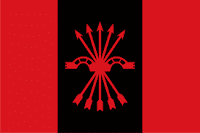
Francisco Franco took the title "El Caudillo," and the fascist paramilitary of the FE de las JONS (1934) was known as the "Falange Militia," unofficially called the "Blueshirts." Caudillo roughly translates to "Warlord" or "Strongman," but could just as easily be translated as "Chief" or "Head Man," like our next (non-fascist) artistic mystic who went into fringe politics.
Alone among our fascists, Franco wasn't into any mystic stuff, not a poet, journalist or painter. He did write a novel, Raza, at some point, but he wasn't really an artist. He was a career military man, and his fascist ideology was your typical antisemitic, nationalist, anti-Masonic stuff. Franco never really made use of the grand theatrics, eye-catching symbols, or rallies, etc. But he was also the only fascist dictator who lasted. After the Civil War that put him in power, there was pretty much peace. He was authoritarian and brutally repressive, but Spain experienced economic prosperity, and, after, his death in 1975, his successor King Carlos was able to help transition Spain back into democracy. And it remains democratic.
Every few years my wife gets her ballots in the mail, and it seems half of them are for Falangist candidates. I once bought a clay kid's figurine of a Blueshirt giving the fascist salute from what I suspect was a German Neo-Fascist. He gave me 50% off because it was "for the boy" and "it is cute, no?"
I no longer have it because I broke the fucker. A kid's toy, basically a fascist kewpie doll. One of my weirder lapses of ethics
 |
Flag of the Social Credit Party
|
John Hargrave was involved in Scouting and first created the Kibbo Kift Kindred (unfortunately abbreviated as KKK, 1920), which morphed into the Green Shirt Movement for Social Credit (circa 1932), finally becoming the Social Credit Party of Great Britain and Northern Ireland (1935). During his KKK days he was known as the "Head Man" (Caudillo?). His party's Green Shirts marched, provided security, and brawled with Mosley's Blackshirts and Communist Red Shirts. Although not a fascist, Hargrave was a charismatic and authoritarian leader, known for his theatrics, ritual, and the use of a uniformed paramilitary.
These paramilitary groups almost remind me of street gangs, and like the Crips (blue) and Bloods (red), signaled their allegiance by the color, not of their bandanas, but their shirts. Hargave was also an occultist:
John Hargrave was many things; a pagan cult leader, a brick hurling
radical, a pioneer of universal income, a thriller novelist, a psychic
healer, an inventor of note, a control freak, and always, to the very
end, a utopian dreamer.
 |
Boyd Rice Wolfsangel
|
Boyd Rice, mentioned before, is best known as as avant-garde musician of the early Industrial scene, a more pop-based kind of musique concrète that grew out of a melange of the "classical" tradition and Italian Futurism. Rice is also an artist, essayist, novelist, and occultist. He has definitely "flirted with fascism," integrating the ouroboros, as in the Theosophy "logo," and the Wolfsangel, an old German rune, into his personal iconography.
Similar runes figure on several German coats of arms. After its use by the Nazis, including several SS and Wehrmacht units, it has been adopted by several Neo-Nazi groups, including the Aryan Nations. Rice says it represents the occult principle of the "reconciliation of opposites," but given its association with Neo-Nazis, it's a dubious choice at best. Note also that the ouroboros figures on D'Annunzio's flag of the Regency of Carnaro. Rice cites D'Annunzio as a personal hero; perhaps the archetypal "aesthetic fascist...."
 |
Church of Satan Emblem
|
During later years the Church of Satan adopted an inverted pentagram traversed by a lightning bolt, recalling Mosley and its (ironic?) use by Bowie, Manson, and TG. The Satanic Bible uses quasi-fascist rhetoric cribbed from the Social Darwinist and antisemitic Might is Right.
The Church of Satan, though not explicitly fascist, embraces strength, force, vengeance, and rule by the elite. Its iconography and doctrines have always leaned right, even though the Church itself denies any political ideology. Members such as Marilyn Manson and Rice have embraced fascist aesthetics, and though they themselves might not actually be fascists, toying with its imagery, if anything, neatly demonstrates the foundation of this post. Namely, the intersection of art, fascism, and the occult.
 |
Flag of the the Tatenokai
|
 |
| Emblem of the MSVN | | |
|
|
Another author that dabbled in fascistic, ultra-nationalist politics was Japanese author Yukio Mishima, who created a paramilitary group called the Tatenokai (楯の会, 楯の會) or "Shield Society." They were ardently anti-Communist, nationalist and sought to restore the Emperor to power. They even attempted a coup in 1970.
Though there's no indication Mishima was directly inspired by D'Annunzio or Mussolini, the speech he gave to try and rouse military cadets to rise up against the government was given from a balcony, a staple of Italian fascist stagecraft. The flag of the Tatenokai brings to mind the emblem of the MSVN, but I think this is more coincidence than anything else.
The flag includes the symbol of the Japanese emperor, the sun, and a samurai helmet. It resembles the MSVN flag in form. Both flags evoke power through armed might, and both pay homage to their nations' imperial pasts; one with the fasces of the Roman emperor, the other with the sun of the Japanese emperor. Fascist rhetoric evokes the mystical past because the present often sucks, the future's uncertain, and past is always easy to portray as "glorious." Atavism is a staple of right-wing ideology (Make America Great Again).
By the by, Mishima was apparently wont to evoke the ouroboros towards the end of his life. No other indication, as far as I know, that he was into the occult...
Would-be fascist occultists are still walking around. Have you heard of one Augustus Sol Invictus, born Austin Mitchell Gillespie? Better call Sol.
"Invictus" is a Florida lawyer who attempted to win office as a Libertarian, yet who has been denounced as a Neo-Nazi.
During his campaign for the US senate he was accused of dismembering a goat and drinking its blood. Invictus admitted he made this sacrifice as a way of thanking the gods after a pilgrimage he made to the Mojave desert. He denies being a fascist, and apparently has renounced his past enthusiasm for eugenics, but who knows? He was a Thelemite, but was expelled from the OTO, ostensibly for the goat sacrifice, but also just as likely for his popularity among white supremacists.
That said, I should point out a certain hypocrisy regarding the sacrificed goat.
Near Tampa is the community of Tarpon Springs, a community founded by Greek immigrants. The Greek Orthodox Church remains an important institution there today. Normally, it it forbidden to keep and slaughter animals in a residential area or without a bevy of permits. But in keeping with Greek tradition, Tarpon Springs residents are permitted keep and slaughter a sheep at their homes to celebrate Easter. One hopes it's fast and not cruel, but whatever the case, a whole community sacrifices animals at Easter and it's a-ok. A Thelemite does it and it's bonkers.
Of course, the Greeks don't drink the blood, I think. Not literally, anyway. If you believe in transubstantiation, Catholics literally drink the blood of Christ and eat his flesh. Every week. Sol Invictus may be a weirdo, but hell, millions of other theophagists are just fine.
If I were much more clever, I would try to figure out why the occult, art, and fascism often hold the same allure. But I won't. I think it's clear artists want to say something, to bring something from nothing. To make manifest their will. Isn't politics something like that as well?
I believe Crowley was the one who defined "magick" as making one's will manifest. "Do what thou wilt." Makes me think of Triumph of the Will (1935).
Without getting overly heady, in many ways art, occultism, and magick boil down to effecting one's will. It's not done by voting or by committee, but by thinking it and willing it into existence. Fascist states were essentially big canvases upon which a leader imposed his vision, without scruple.
I don't know how to end this thing, so I suppose I will simply end it here and let you make of all this, erm, what thou wilt....


