Please see Les Saintes Puelles and Les Saintes Puelles 2 before continuing.
My research into the Puelles has led me to Toulouse, Mas-Saintes-Puelles and even Asturias, but the next line of inquiry practically started in my own backyard.
 |
| St. Libérate; reliquary in the Eglise Notre Dame, Bouillac |
Not long from Aucamville there is an empty field where a large and prosperous monastery once stood. The Abbey of Grandselve, or Abbaye de Notre Dame de Grandselve, is known primarily as a Cistercian abbey but was in fact established by Benedictines, in 1114. The history of this abbey would be a story unto itself. All that remains is the gatehouse; the cloister, abbey church, dormitories etc. exist only as hedges planted to give visitors an idea of the size and layout of the place. Striking if you consider that the abbey church here was once the largest Romanesque church in Europe, an honor now belonging to the St. Sernin Basilica in Toulouse.
Several items from the church are now located a few kilometers away in the village church at Bouillac; these include ornate gold and silver reliquaries, pillars and the remnants of sculpted works.
The sculptures struck me because of the iconographic elements recalling the Puelles statue at Tautavel. These sculptures depict Mary Magdalene and Saint Anne: Magdalene is identified by her flowing hair and the jar she carries. Saint Anne is identified by her book. This symbolizes her teaching the Virgin Mary to read and is a common attribute from the Middle Ages onwards. If you've read our previous posts, you may recall that at Tautavel our Puelles carry a book and a jar as well.
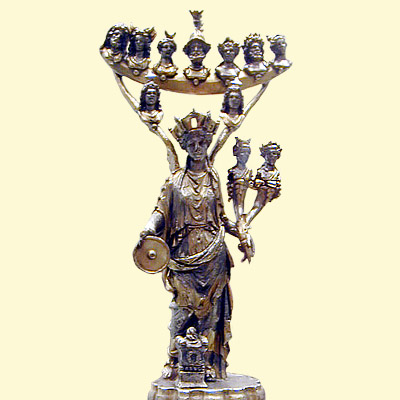
Continuing through the church, I came across a reliquary in the form of a bust: Saint Libérate. Hold on to your hats.
According to a note at Bouillac, Libérate, aka Livrade or Liberata, was a the daughter of Catillius, the King of Galicia. The King ordered his daughter marry a pagan and she fled to Aquitaine with her twin sisters (!) Quitterie and Gemine. In Aquitaine, they had a lot of success spreading the Christian faith. Eventually, they were denounced by their father, arrested and beheaded by a Roman official by the name of Moderius.
Libérate's remains were in Sigüenza, Spain by 1082. In 1114, the year Grandselve Abbey was founded, they were said to be at the abbey. A “notable” part of her remains are now found in Mazères.
The idea of twin sisters spreading the faith in their place of refuge echoes the Puelles and the legends associated with Saintes-Maries-de-la-Mer. The martyrdom resulting from rejecting a pagan spouse is a genre unto itself: recall if you will the Benedictine convent Sant Pere de les Puel•les in Barcelona, where legends have the young women, puelles [maidens], disfiguring themselves in order to escape being defiled by Moorish invaders. Alternate versions generalize self-mutilation as a means of escaping arranged marriages.
As we will see, this theme is repeated in several variations upon the Libérate legend originating in northern Portugal and Galicia. What we find emerging is a subset of the virgin martyr type--the precise emphasis abbé Rous placed on the legend of the Saintes Puelles (see part 2).
As it turns out, the cult of Libérate is rather secondary to that of her sister Quiteria (whose name, incidentally, comes from a title of Astarte meaning “the red one”). According to Wikipedia, Quiteria (Quitterie) was the daughter of a Galician prince. Rejecting an unwanted marriage she fled to Aire-sur-l’Adour in Gascony, where she was captured and beheaded in the Montus forest, along with her sister Liberata. Quiteria's remains are in Aire-sur-l'Adour and Libérate's are said to be contained in a 14th century sarcophagus in the church of St. Jean-Baptiste in Mazères.
English Wikipedia leaves something out. An alternate legend related in Catalan Viquipèdia states that she was the daughter of a Wisigoth king--Aeci--in Toulouse.
According to Portuguese tradition, there were nine sisters in total (nine muses?), born in Minho to the wife of a Roman military official. The mother was mortified at having so many children, like an animal, and ordered them drowned. The maid entrusted with this task secretly refused, instead bringing them to be raised by local women .
As adults, they, like Sernin, refused to worship local gods. They were brought before their father and ordered to marry. They refused and were imprisoned. They then escaped and went on to lead a guerrilla war against their father! (Shades of Jeanne d’Arc, aka la pucele....) In this version Quiteria was caught and beheaded.
Euphemia, or Eumelia, another sister, threw herself from a cliff to avoid capture. When she fell, the rock opened and swallowed her whole; a spring immediately appeared on the spot. This idea of being swallowed by rock and a subsequent spring echoes the Galician legends around St. Jacques and legends around Saint Fris, whose cult is centered in Gascony....where much of the 9-sisters action was said to have taken place.
Other Portuguese legends have it that these sisters came from Baiona, Pontevedra. In this version Eumelia is beheaded and thrown into the sea, from whence she emerged with her head in her hands, holding dogs at bay. The first festival honoring Eumelia took place at Tui, Pontevedra in 1688. Quiteria’s cult, centered in Aire-sur-l’Adour is on the St James Way; the cult could have easily traveled back and forth between Gascony and Galicia. Her cult is thus found France, Spain, Portugal and was brought by the latter to Brazil and India.
One of the nine sisters, mentioned by name at Bouillac along with Quitterie and Libérate, is Gema, also known as Marinha or Margarida.
She has been identified/conflated with Saint Marina of Aguas Santas (119-139 CE). The details of her legend should by now be familiar; she was one of nine sisters born Baiona to the wife of Lucius Castelius Severus, the Roman governor. The mother, Calsia, ordered them drowned in the Miñor River. The servant thus entrusted, Sila, was a secret Christian and left them with several families later to be baptized by Saint Ovidus. At age 20 they were brought before their father and ordered to renounce their faith. Refusing, they were imprisoned and escaped. Where they were beheaded, a spring appeared—the Aguas Santas.
So, obviously this is a variation upon the same legend, with differing details and adapted to another location. Marina died on January 18th but her feast day is exactly seven months later on July 18th. Libérate is celebrated on July 20th, the date her relics were brought from Sigüenza to Baiona by Bernard de Sedirac, a Benedictine.
Wikipedia also has a brief entry on Saint Liberata and Saint Faustina of Como, in Italy. These sisters, holy virgins, founded the convent of Saint Margarita and died c. 580 CE. Their feast day: January 18th. Interestingly, French Wikipedia states that when Saint Quitterie was decapitated in Aire-sur-l'Adour, a bishop named Faust converted the entire town to Christianity, aided by a miracle: the decapitated head fell to the ground and a spring appeared. The virgin then took her head in her hands and placed it on a hill in the town, where her sarcophagus rests today. Elements of this story are found in that of her sister, Saint Eumelia and that of another Saint, Saturnina, whose story is clearly another version of that of the nine sisters.
The patroness of Pizzone is a holy virgin by the name of Saint Liberata. In Pizzone her feast day is on June 10th and in the Chicago area on the 8th. Other celebrations include January 11th and July 20th. In Chicago, there is a special mass and a procession in her honor: she is usually portrayed crucified. Her parents names, as well as those of her 8 sisters, confirm she is one and the same as Libérate.
Margaret the Virgin (Margaret of Antioch) is yet another variation on the holy virgin, celebrated by Anglicans and Catholics on July 20th, just as Libérate. (Orthodox Christians celebrate her on the 17th). Margaret the Virgin was the daughter of a pagan priest who lived apart from her family because they scorned her faith. She was offered to Roman governor in marriage. Her refusal led to being tortured and beheaded in 304 CE. The Eastern Orthodox Church calls her San Marina and identifies her with Saint Pelagia. This holy virgin leaped from a rooftop rather than suffer dishonor from soldiers, much like the “puelles” of Barcelona and Saint Eumelia. Another Pelagia, of Tarsus, refused marriage to both Diocletian and his son and was thus burnt at the stake. Pelagia is sometimes conflated with Marina the Monk, who we will look at more closely in a minute.
Another curious conflation of the Libérate figure is Saint Wilgefortis. Her cult appeared in the 14th century. Her story begins like the others, often set in Portugal. A young noble, she was promised by her father to a pagan king. She took a vow of virginity and tried to stave off the wedding through prayer; she hoped to become repulsive and thus undesirable. Her prayers were answered in an odd way: she sprouted a beard! Her father, furious, had her crucified, like Saint Liberata of Pizzone.
Folk etymology has it that her name comes from “virgo fortis” but this is likely spurious. Her name in France and Italy is Liberata and in Sigüenza she is said to be "confused" with the sister of Saint Marina of Aguas Santas. However, her feast day of July 20th may indicate the “confusion” was widespread—her cult spanned Europe but was officially suppressed in 1969. Wilgefortis is invoked by women seeking to be liberated from abusive husbands or unhappy marriages. Not to say this isn’t a true today, but in the Middle Ages, this was undoubtedly a chronic problem.
Wilgefortis is a curious image, something like a crucified, bearded transvestite. But this theme of transvestism appears in another saint known as Marina, or Pelagia: Marina the Monk. Marina was the child of a wealthy Christian family in Lebanon. After the death of her mother, the young girl’s father wanted to enter a monastery. The girl wanted to go as well, so they came up with the idea that she should dress as a man. She spent her life as a monk, until a fateful incident at an inn. The night she and some brothers were staying at this inn, the innkeeper’s daughter and a soldier got jiggy and a few months later, her pregnancy was obvious. Confronted, the innkeeper’s daughter blamed Marina, who was expelled from the monastery and lived as a beggar at its gates. Eventually she was allowed back into the monastery, but was given all the shit work. Upon her death, it was discovered that she was in fact a woman; the innkeeper’s daughter and the soldier fessed up and the abbot was devastated by his unjust actions. Marina the monk died, incidentally on July 19th but is celebrated on February 12th.
If I may add just another variation upon the transvestite theme. You will recall that in some versions of the Quiteria/Liberata story, the sisters waged war against the pagans after escaping from captivity. Some versions of the story have the women escaping not from a Portuguese or Galician king, but a Wisigoth in Toulouse; in these, Quiteria fled to Gascony dressed as a cavalier. This may be a chicken or egg question but I find strong parallels to the story of Jeanne d'Arc. I've already noted she was called the "pucelle". As Wiktionary has it: "Old French pucele, from Late Latin pulicella ‘young girl’, a popular diminutive of puella ‘girl’."
Jeanne d'Arc, then, "la pucele" is known as a warrior, a "liberator" and much is made of both her virginity and her cross-dressing: "Joan of Arc wore men's clothes almost continually from her first attempts to reach the Dauphin, later crowned Charles VII, until her execution twenty-eight months later."
Another link is that chief among the Saints whose voices she heard was Margaret of Antioch. As we have seen, Margaret of Antioch, or the Virgin, has variously been identified at Saint Pelagia or the transvestite Margaret the Monk. Another one of her Saints was Catherine of Alexandria. Catherine was the daughter of a pagan governor and is revered as a virgin martyr. She refused to marry anyone beneath her station and eventually found one who met her standards: Christ. She was thus, as with many another example, a bride of Christ:
Saint Catherine also had a large female following, whose devotion was less likely to be expressed through pilgrimage. The importance of the virgin martyrs as the focus of devotion and models for proper feminine behavior increased during the late middle ages. Among these, St. Catherine in particular was used as an exemplar for women, a status which at times superseded her intercessory role. Both Christine de Pizan and Geoffrey de la Tour Landry point to Catherine as a paragon for young women, emphasizing her model of virginity and "wifely chastity."
 |
| St. Saturnina; Eglise de St. Saturnine, Sains-lès-Marquin (photo, echo62) |
 |
| St. Sernin; Eglise St. Sernin, Merville |
Finally, I came across another obscure saint by the name of Saint Saturnina, with a legend very much like what we have already seen. She was a king’s daughter and took a vow of celibacy at the age of 12. At twenty (the age if you recall, of the 9 sisters) she was forced into marriage. She escaped this unwanted marriage by fleeing to Arras in northern France. With her parent’s permission, the pagan lord chased her and upon catching up to her, attempted to rape her. She resisted and was beheaded.
Somehow, this offending noble miraculously drowned in a fountain. Saturnina then arose, carried her head in her hands (like Eumelia) to the church of St. Remi. An alternate take is that she placed her head upon a stone in Sains-lès- Marquion and declared she would be the last human sacrifice to be performed there. The tree planted on this spot allegedly still stands. Her relics were taken to Neuenheerse in Saxony and the Convent Church of St. Saturnina was built the between 1100 and 1130. Her feast day is June 4th.
Interestingly, images of Saint Saturnina have her flanked by a pair of what appear to be bulls, holding an object resembling the alabaster jar of Magdalene or even our Saintes Puelles. Her shrine contains a reliquary, flanked by two women, one of whom carries a book. These women, as far as I can figure, are Saints Saturnina and Fortunata. I don't know the latter's story, but Catholic Online describes her as a virgin martyr; killed in 303 CE in Ceasarea, now in modern Israel, along with three of her brothers. I've had a difficult time finding details about her in English, but this manuscript description says: "From Caesarea in Palestine, St. Fortunata was a virgin martyr [who] surrendered her soul to God after she enduring the rack, fire, wild beasts, and other tortures in the time of the persecution of Diocletian". It occurs to me that Diocletian reappears in many of our stories. The Church appears to bear a grudge.
 |
| Reliquaries of Saint Saturnina and Fortunata (rear), Church of St. Saturnina, Bad-Driburg-Neuenheerse (photo, Wikimedia Commons) |
Among the many questions this welter of information raises, I'd like to address but a few.
The first question is: what does all this have to do with the Saintes Puelles? First of all, the virgin martyr is a well-established type. Abbé Rous goes to great pains to establish that the very word "puelles" means in fact, just this. From the other holy virgins herein described there are important differences: there was no forced marriage and they were never executed, merely flogged and exiled.
Yet the fundamental pattern is the same. Even though the tale of the nine sisters revolves around the refusal to marry, there is another lesson in addition to preserved chastity; that is, the refusal to sully oneself by marrying a heathen. In some versions, the daughters refuse to acknowledge the pagan gods. And this is the precise "crime" of both Sernin and the Puelles. This was followed by punishment and then flight. In exile, the young women are very successful in spreading the faith.
The Saintes Pulles were also said in some cases to be sisters and some have even speculated that they were twins. Other legends have them as noblewoman and servant--from northern Spain.
If we examine the legends around the nine daughters, one is naturally inclined to wonder about the origin of these tales. Were they based on a pre-existing pagan story and then embroidered upon in order to serve as a Christian morality tale? Was there in fact a real event so poignant in its details that it spread far and wide in various permutations? It surely reflects the social dislocation as the pagan world evolved into the Christian one and serves to illustrate and condemn the former for its barbarity.
Of course, the tale may have simply bee invented out of whole cloth by some bored monk. Although the tale of the Puelles and the 9 sisters all take place in late antiquity, mostly between the late fourth and early sixth centuries, the legends themselves first appeared much later and were diffused throughout the Romanesque and Medieval periods. They would have served to illustrate a number of spiritual values: chastity, courage, strength; they may have been used to impress young women with the virtue of abandoning the world of marriage and the world in favor of the monastic life.
The diffusion of the cult may have been communicated between monasteries, a tale told for the edification of far-flung parishes. The Benedictines reoccur in our tale; were these legends part of Benedictine culture? Their concentration in the southwest of France, from Toulouse to northern Portugal and Galicia, may indicate that the stories were communicated up and down the St. James Way. The Way itself has pre-Christian origins; the terminus at Compostela has been a gathering place for pilgrims since time immemorial. You may be aware that the south of France and the north of Spain traditionally have more in common with each other than with that with the north of France. The Visigoths had a capital at Toulouse and then Toledo; their kingdom was demarcated against the northern Franks.
This division lasted well into the Middle Ages. The culture of Languedoc had a different regard for women. Whatever didactic function they may have served, the tales certainly must have resonated among woman, whose lot in life was definitely difficult. Used since pagan times as a commodity, to be traded in marriage in order to cement alliances or consolidate territorial claims. The woman at all social levels must have been able to relate to the horrors of the forced marriage.
It is not unlikely, given the geographic concentration of the tales, that they were spread by the troubadours. The tragic fate of a woman would have certainly been an attractive theme and there are parallels between the tales and the ideals of courtly love:
That sort of history which views the early Middle Ages dominated by a prudish and patriarchal theocracy, views courtly love as a "humanist" reaction to the puritanical views of the Catholic Church. In the language of the scholars who endorse this view, courtly love is cherished for its exaltation of femininity as an ennobling, spiritual, and moral force, in contrast to the ironclad chauvinism of the first and second estates. The condemnation of courtly love in the beginning of the 13th century by the church as heretical, is seen by these scholars as the Church's attempt to put down this "sexual rebellion."
However, other scholars note that courtly love was certainly tied to the Church's effort to civilize the crude Germanic feudal codes in the late 11th century. It has also been suggested that the prevalence of arranged marriages required other outlets for the expression of more personal occurrences of romantic love, and thus it was not in reaction to the prudery or patriarchy of the Church but to the nuptial customs of the era that courtly love arose.
In our stories, however, courtly love is like an expression of divine love; our women would be those who had symbolically "wedded themselves to Christ." They could serve as a condemnation of a barbaric social order, a valorization of chastity and a nifty bit of publicity for the nunneries.
That varieties of this tale appear throughout Europe and the Orthodox world may be a reflection of the kind of geographic mobility of the troubadours, crusaders and pilgrims along the routes to Jerusalem, Compostela and Rome. Unsurprisingly, the versions which differ the most are found farther away from the versions promulgated in Gascony and Galicia. Saturnine and Wilgefortis, for example, cults found mostly in northern France, Belgium and Germany, are clearly based upon the nine sisters, but the differences are evident in both names and in the case of Saturnine, the geographical setting. But the tale and the moral lessons are essentially the same.
It is said that a work of art is never finished, merely abandoned. At this point I'll concur with the caveat that the abandonment is temporary. We'll be back to this story soon enough.