Saturday, November 6, 2010

Les Saintes Puelles, Part 2: Where by reading books and visiting places we approximate something like research

The Saintes Puelles, Mas-Saintes-Puelles
For the following post to make sense, please first consult Les Saintes Puelles for background, context, etc.

When we last left the Puelles I mentioned that I had discovered a place in Asturias, Spain, named "Puelles" a few kilometers away from another called "San Saturnino"; in Asturianu these are alternately called "Pueyes" and "Sanzornin" (local signs use both appellations). Given their close proximity to the so-called "French Way" of the St. James Way, this is not surprising. Toulouse and the Basilica of San Sernin were an important stop for pilgrims on the way to Compostela; it is probable that as these pilgrims made their way towards the sacred destination, they brought the cult of both Sernin and the Puelles with them.

As it turns out, when I discovered these places I had already rented a house a mere twenty minutes away so I was thus able to visit them, snap some photos and make a few observations. Nothing particularly revelatory, but worth recounting nonetheless.

Before I made it to Spain, however, I stumbled across a reference to a book called Histoire des Saintes Puelles et de leur culte (History of the Saint Puelles and their cult) by the abbé Emile Rous, published in Perpignan in 1876. Fortunately, I was able to find this book in the Bibliotheque d'Etude et du Patrimoine in Toulouse.

So one afternoon I made my way to the reading room and consulted the book. A small and slender volume, the first half is a general examination on the origin of the cult of the saints. The second half deals with the Puelles specifically.

Rous' first objective is to clarify the meaning of the word "puelles". Citing Tertullian and St. Ambroise, he concludes that "puella" means "vierges consacrés à Dieu": virgins dedicated to God.

His next task is to recount the legend of St. Sernin (see previous post) and in this he adds a few details. Apparently, Émile Mabile, in his massive "Histoire générale de Languedoc" concludes that the antagonism which led to the martyrdom of Sernin was a conflict with worshipers of Cybele and I have elsewhere suggested Mithras. Rous disputes both. There is no concrete evidence to suggest either and so we are merely speculating based on the image of the bull. As we will see at the end of this post, one author makes a claim for Mithras with an interesting analysis, but one with which I am unequipped to concur, or refute.

Rous’ great contribution to my own understanding of the Puelles is not in recounting the legend of Sernin's martyrdom, however, but in what happened next. After caring for the body of Sernin, the Puelles were driven out of town, "ornéé" says Rous, " de la double auréole de la virginity et du martyr": "decorated with the double halo of virginity and of the martyr." They found refuge in a place called Recaudum where their faith and example made even the crops and orchards more fruitful:

"Arregant de un riu de flors
Las plantas infructuousas"

This is pretty simple: "arregar" is the Occitan verb for "to plant". My rough translation of this would be "Making a river of flowers from unfruitful plants" or words to that effect. This vegetal motif echoes many images of the Virgin Mary; there are numerous legends in which statues of Mary appear under rosebushes flowering in mid-Winter. Our Lady of Merixtell, patroness of Andorra, is one of these legends. Many other saints venerated in the Languedoc, such as Thérèse de Lisieux and Saint Germaine de Pibrac, are often pictured with flowers tumbling from their aprons. The apparition of La Virgen de Guadalupe, also involves a miracle of winter flowers.

Also worth noting is that Puelles and San Saturnino in Asturias are found in the commune of Villaviciosa, whose name implies a certain vice -- laziness -- on the part of its inhabitants; according to legend this is because the land is so productive the farmers do not need to work hard. The motif of abundant fertility rocking with the best of 'em.

In any event, much like legends of the two Marys who stayed in Saintes-Maries-de-la-Mer after the Magdalene left (again, see the previous Puelles post), the Puelles led such saintly and virtuous lives that they became an inspiration to those around, winning converts by their example. This is celebrated in a traditional Goig, or Catalan song:

"A l'Espos vos prestareu
Portant Coronas de flors

Como reynas victoriosas"

I'm not sure what the first line means but the rest is easy: "Wearing crowns of flowers like victorious queens". (Any help on the exact translation of the first line would be appreciated).

Upon their deaths, the Puelles were buried outside of the village in a field which was thereafter always covered in flowers. Their tomb is said to have been moved into the village now known as Mas Saintes Puelles as part of a sanctuary dedicated to St. Michael. This sanctuary was destroyed and their relics were then placed in the Parish church.

Outside of Mas Saintes Puelles, abbé Rous examines a few other places where their cult took root. The first of these is in Toulouse. Rous insists that the cult dates back to at least the 10th century, but he never actually offers any proof. His feeling is that given the antiquity of the cult of saints, it must reach back to before the written records. It is in fact a crucial question, but there is no documentary evidence prior to the 16th century.

There is a breviary in the Bibliothéque Nationale which belonged to a church official in Toulouse, dated 1553, containing liturgical rites dedicated to the Puelles. In 1537 we find the Sanctarum Puellarum, a votive mass which offers lessons for their feast day.

There is also evidence of their cult in Saint Sernin basilica dating from roughly the same period in the form of paintings and an enameled medal on Saint Sernin's reliquary.

My instinct here is that these two homages to the Puelles, so close in date, may reflect the cult of the ideal woman flourishing in Toulouse at the time, at the apex of the Tolousain Renaissance. Clémence Isaure, legendary patroness of the Floral Academy, was an invention of this period. The historical Belle Paule (1518-1610) was in the flower of her youth. The idea of Dame Tholose, the first non-religious allegorical sculpture in Toulouse since antiquity, brandishing a floral wreath, first appeared in print in 1534 and ten years later the sculpture itself was raised near the Capitole.

In the diocese of St. Papoul, evidence is even more recent. No documentary evidence exists until another Sanctarum Puellarum found in a missal from St. Papoul, a scant 17 km drive from Mas Saintes Puelles. This mass dates from 1774. Papoul, or Papulus, according to the legend, was assigned to help Sernin by none other than St. Peter himself (impossible, historically). The Benedictine abbey that bears his name dates to the 8th century, which may in fact support abbé Rous' insistence upon the antiquity of the Puelles cult. We have evidence of Romanesque sculptures of Sernin; if his disciple Papulus was honored with an abbey in his name, what then of the Puelles?

According to Rous, the name "Mas Saintes Puelles" dates from 960 CE in the testament of one Hugues de Toulouse. It is from this document learn that the burial field was covered in "white daisies" with never a weed to be found. In 1461 Archbishop of Toulouse Bernard de Rosier wrote of the reliquary of the Puelles (chasse en argent), now destroyed. According to Rous, fragments of this reliquary now rest at a place called Saint Saturnin de Caborriu. I have been unable to find this location; Caborriu is a Catalan place name, but even with the Catalan appellation "Sant Sadurni de Caborriu" I've found nothing. On the other hand, there is still a place near Mas Saintes Puelles which bears the original name of this village; Ricaud, meaning "refuge" or "shelter". Is this a later place named after the original appellation of Mas Saintes Puelles?

Near St. Papoul and Mas Saintes Puelles is the Diocese of Carcassonne; here we find another cult of the Puelles. Saint Hilaire Abbey is another Benedictine abbey founded in the 8th century, originally dedicated to Saint Sernin but changed later to honor Hilaire as the latter's cult developed.

In any event, there is a magnificent sarcophagus of the highest artistry located here, depicting the life of Saint Sernin (along with his companions, including Saint Papoul and Saint Honest, or Honestus, allegedly martyred at Pamplona and as some legends have it, baptizer of Saint Fermin). This tomb includes depictions of the Puelles and dates from c. 970.

There are other manifestations of a Puelles cult in the Diocese of Narbonne, Elne and Urgell from the late 14th and early 15th centuries: a missal from Elne dated 1511; a manuscript dated 1490-1492 of another Sanctarum Puellarum belonging to a painters guild from Narbonne. Scant findings indeed.

After Mas Saintes Puelles, the most concrete and continuous devotion to the Puelles is to be found at Tautavel. This town, whose name may mean "high spring" (as in water) has a long history. Prehistoric remains are abundant and it is home to the famous Tautavel Man. The Castle located here once held chapels dedicated to women; for all you Grail fans, one was dedicated the Mary Magdalene. Another, dedicated to the Holy Cross, prominently features an image of Saint Helen with the cross. Legend has it that the Puelles once stayed here for provisions and there is a mention of a "proedium romain" or Roman property where a sanctuary to them was founded, their cult brought by a Count of Barcelona who had been visiting his holdings in the Lauragais. References to this property are found as early as 1292 where it is called "Sentes Pudseles", but the sanctuary itself isn't referred to until 1392 and 1394, in a pair of wills. The chapel reappears in wills in both the 15th and 16th centuries.

These dioceses are the extent of Rous' discussion of the cult of the Puelles, but there may be references to them elsewhere; there are at least seven municipalities bearing his name in France as Saint Sernin. Given the variations on the name, there may be others. One of these can be found 10 k to the south of Mas Saintes Puelles.

A number of places in Catalonia are named for him as well and it is likely Puelles references are to be found.

One place Rous probably wasn't aware of is the aforementioned places in Villaviciosa. At Puelles, or Pueyes, we had little luck. A church close by was said to incorporate elements from the Church of San Sernin, but it was locked and we couldn't get a hold of anyone with keys.
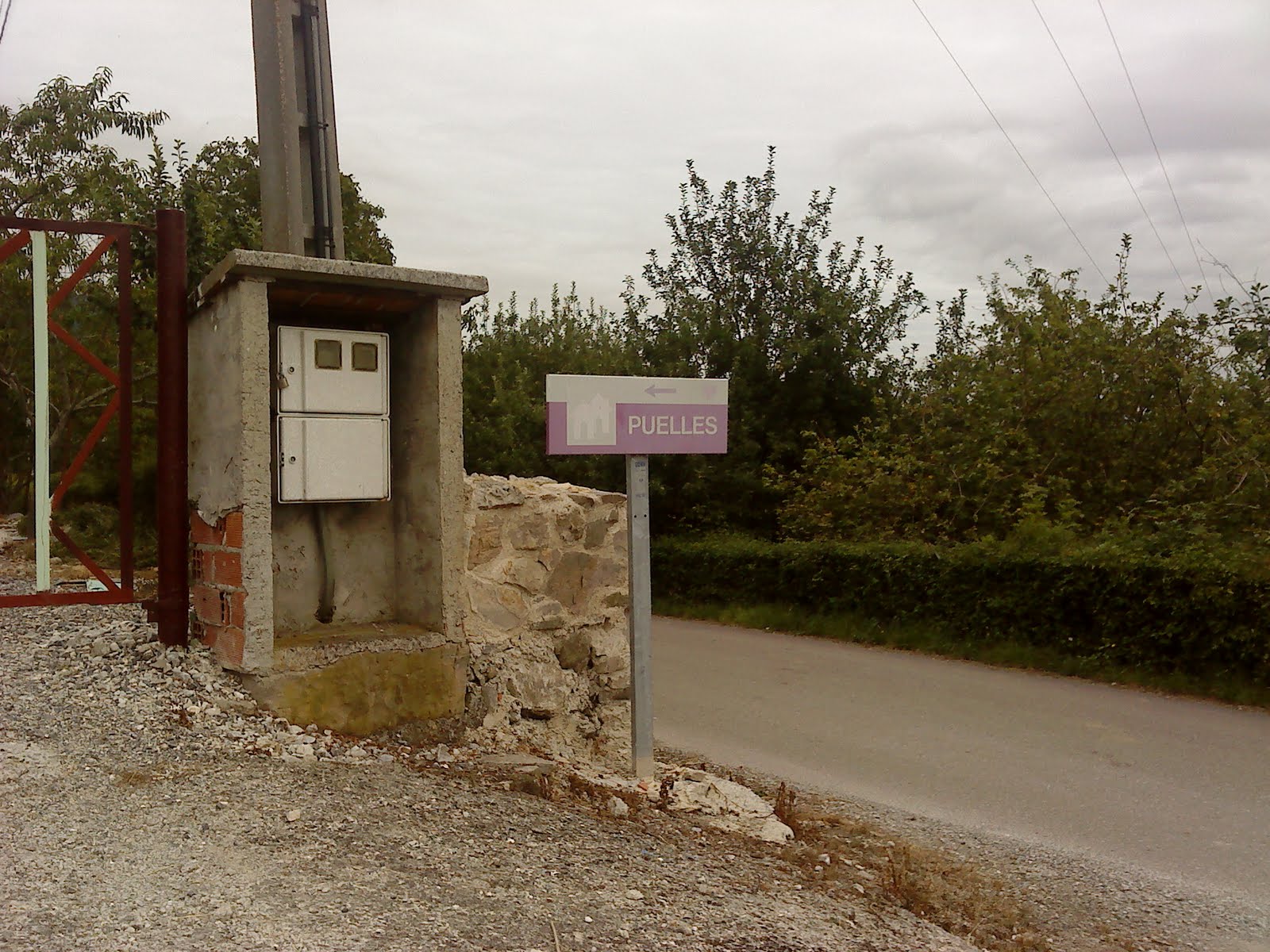
Puelles, aka Pueyes, Villaviciosa
At San Saturnino, or Sanzornin, we had more luck. There we found a small chapel dedicated to Our Lady of Mount Carmel. The chapel was not very ornate, but tucked away in a niche was a Romanesque sculpture of Saint Sernin, identified by his bishop's crozier. The statue was in fact headless, which may be due to its age, or perhaps a victim of the Spanish Civil War.

Headless statue of St. Sernin; chapel in San Saturnino, Villaviciosa
On a small porch was a sarcophagus (used as a play kitchen by local kids!), which we were informed was found at the village spring during renovation; a much older church was located there where this spring still flows with delicious, sweet water. Nourished by bones, perhaps.

Both these places are within 10 kilometers of the Monasterio de Santa María de Valdediós, founded in 1200 by Benedictines. On this site one can find a very early Romanesque Church of remarkable stature erected as early as 892 (San Salvador de Valdediós). I don't know if there's a connection between the cult of the Puelles and the Benedictines; the monasteries of Saints Papoul and Hilaire, as you'll recall, were also founded by Benedictines. Perhaps its was links between these monasteries which brought the cult here and not, as I said earlier, pilgrims....

Soon after reading abbé Rous I bought MaryAnge Tibot's "Saintes Puelles, ou la destinée deSaturne". It's priced way too high for such a slender volume (58 pages) and I read it in the blink of an eye. She does a good job of summarizing the Sernin legend and disputing some of the assertions made by Rous. She's familiar with all the primary sources (providing me with several leads) and has spoken to a number of academics who've already explored the topic. This is the bittwersweetness of having found this book, the double-edged sword. On one hand it confirmed a lot of my own observations and put me on to a lot of things worth looking into further. On the other hand, I can't help but feel all my further explorations will be made in the shadow of what she has already done in this book.

The book has two halves. The first is a rather straight look at the legend and sources. The second delves into the alchemical and astrological symbolism of the Puelles. Not being qualified to either confirm or dispute her findings and assertions, I find that I will have to educate myself further on the topics. Her arguments seem solid enough and not flying off into completely unfounded speculation, but like I said, I'm too uninformed to say much else. I am completely skeptical of her theory that the Puelles were literally Siamese twins, based on the unusual sculpture at Tautavel (more on this in a minute). This is especially so because she relates that according to some legends, the pair represented a noble daughter of Huesca and her servant.

I had read this but didn't actually mention it in my last post, which is a big oversight within the context of my developing thesis. I have linked their iconography to that of Saintes-Maries-de-la-Mer. According to this legend and again, I neglected this in my last post, Saint Sarah was a servant of one of the Marys, usually Mary Jacobe. Mary Jacobe, or Clopas, was held by some to be the daughter of one of Saint Anne's three husbands, making her the step-sister of the Virgin Mary.

My working theory is basically that the Puelles story and iconography derive from two traditions. The first is that of Mary Magdalene and the three Marys of Saintes-Maries-de-la-Mer, sometime known as the myrrh-bearers because of the myrrh they carried with which to anoint Jesus' body. I believe the Puelles have been cast in the image of these myrrh-bearers and that their iconography (unguent jar, book) derives from Mary Magdalene. The relationship of mistress and servant finds an echo in the Puelles. What I found next, completely by chance, leads me to believe that the conflation of this sort would be entirely in character with Gallo-Roman Christianity, especially with regard to the second tradition: that of the virgin martyr.

St. Anne; Eglise Notre Dame, Bouillac
Mary Magdalene; Eglise Notre Dame, Bouillac
Recently I visited the site where the Abbey of Grandselve once stood. This Abbey was originally Benedictine (them again), established in 1114, but was handed over to the Cistercians in 1144 or 45. Close to the ruin, in Bouillac, some of the abbey's treasures are preserved. Among these are fragments of sculptures, from the waist up, of Saints Magdalene and Anne. They obviously come from the same ensemble and date from the 17th century, much later than our legends but not so far in time from other representations of the Puelles. In these sculptures we see the usual attributes of the Saints: Magdalene is carrying a pot for the funerary oils and Anne is carrying a book. This is rather unremarkable but together, it is a striking similarity of representations of the Puelles (as in Tautavel) and the Ghent Altarpiece (1432) depicting Mary Magdalene and the Egyptian Maria (another conflation which led Magdalene to be considered as a whore).

Also contained in Bouillac are two reliquaries dedicated to Saint Liberate, or Livrade. The daughter of a Spanish King (like one of the Puelles), she was forced to flee to escape an imposed marriage with a pagan noble. With her twin sisters Quitterie and Gemene, she came to Aquitaine, where, like the Puelles and the Saints Mary after their respective flights, had great success Christianizing the land. Livrade, like the Puelles, is revered as a virgin martyr.

These are interesting similarities, but what also strikes me is the legend behind that monastery in Barcelona also bearing the name of the Puelles. These puelles were the nuns themselves, who either fled to this nunnery to escape imposed marriages or as one version has it, disfigured themselves to avoid being taken by Moorish invaders. Resistance to heathen or escape from unwanted marriage; these are themes shared by our female saints, lending credence to the idea that they represent different aspects of the same medieval ideal. What I found out later is that MaryAnge Tibot has also written a book on....Saint Wilgefortis.

Wilgefortis is often conflated with the very same Saint Liberate; the essence of their legend is the same. What I found as I continued looking into these saints is that there are several virgin martyrs from various places which are quite obviously one and the same legend; places and details vary, but some many features overlap it's clear we are looking at the same legend.

My Puello-centric research at a standstill for the moment, I'll next present a brief survey of these virgin martyrs, beginning with Saint Livrade/Liberate and ending with a delightful coincidence: there is a virgin martyr called Saint Saturnina....

Thursday, October 28, 2010

Notre Dame d'Alet

Rose window; Notre Dame d'Alet, Montaigut-sur-Save
Let me begin by presenting you with the legend, translated from this page. This text originally appeared in the Almanach Catholique Français (1922).

The Legend of Our Lady of Alet

Around 1200 CE, not far from the Bouconne forest five leagues from Toulouse, an inhabitant of Montaigut named Raymond or, as they say in those parts, Ramounet, was busy plowing his fields to prepare them for the next sowing.

It was hot, the soil hard, the oxen heavy and the man himself a miscreant without fear of God or the Devil. His mouth was far quicker with a blasphemy than a prayer.

The oxen were loathe to obey and the blows Ramounet gave them with his goad did nothing to quicken their step. On the contrary; at one point they stopped and refused to budge. This was all that was needed for the laborer to lose his patience.

A blasphemy was forming on his lips but at the very moment when, to add some oomph to his imprecation, he lifted his eyes to Heaven, he saw the Holy Virgin holding the baby Jesus in her arms. The Mother of God spoke to him:

"Raymond," she said, "go on my behalf to the villagers of Montaigut and tell them I want them to build me a chapel."

Raymond, dazzled, replied fearfully:

"Madame, everyone in Montaigut knows me and if I tell them you appeared to me, they won't believe it."

"Plant your goad in the ground," replied the Virgin.

Raymond obeyed and planted his goad, which was instantly covered in flowers.

As you can imagine, Raymond left posthaste for the village, carrying his flowery goad. He performed the mission entrusted to him by the Virgin and the people believed him. But where to build the chapel? The Holy Virgin hadn't said.

After some deliberation it was decided to build the chapel in the very field where Raymond labored.

But another marvel followed. Despite all the hard work carried out in building the chapel during the day, the night found all the work demolished. Work was thus stopped during several days as no one wanted to waste their efforts. Finally, the exasperated master mason threw his trowel into the air saying:

Where my trowel falls
The chapel will be built

And the trowel seemed to take flight, falling to earth at the summit of a hill that dominates the rich valley of the Save River and overlooks the village of Montaigut.

There, the oratory still visible today was built, magnificently restored under the care of R.P. Caussette in 1867.

Numerous pilgrims come to this sanctuary, open year round for the devotion of the faithful. The principal celebration is on the 8th of September [Nativity of the Virgin].

Notre Dame d'Alet, Montaigut-sur-Save
Nigra sum sed formosa

Every detail of this legend corresponds to those surrounding Black Virgins: the strange behavior of oxen while plowing; the demand for a chapel to be built; lack of success in executing this order until the Virgin herself points out where it should be built; the miracle of flowers. Black Virgins often have special chapels located on hills overlooking towns....

Other details conform perfectly to the characteristics of the Black Virgins, though not mentioned in this article. The chapel dedicated to Notre Dame d'Alet sits on a hill, but the spot where she originally appeared was in a field below. According to the nun who takes care of the chapel, that place is marked by a spring. No need to recapitulate that this is typical of Marial apparitions, black or otherwise.

Unlike run-of-the-mill Virgins, a Black Virgin usually has a fervent cult. Indeed, again according to our learned nun, this chapel was the pilgrimage destination for Toulousains during the entirety of the Middle Ages and the Renaissance. It remained the most important destination in the region until it was eclipsed by the cult of Saint Germaine of Pibrac (1579-1601). Private veneration of Saint Germaine dates from 1644, when her body was exhumed and found to be incorrupt, but her cult seems to have taken wing in the 19th century. (I maintain Saint Germaine is just another, more approachable manifestation, not simply of a virgin, but the Virgin).

But Pibrac had barely taken the number one spot when it was eclipsed by Lourdes, which was attacting thousands of visitors by the mid-nineteenth century. The Virgin abides. In any event, the cult of Notre Dame d'Alet remains active and a procession and pilgrimage are held every year on the day of her Nativity. (Pictures here).

So, we've got oxen, miracles, a spring, an active cult and we've even got the color: Notre Dame d'Alet. The statue presented to me was definitely dusky in hue as a result of the material in which she is made. Like many BV chapels, there are various light-skinned depictions, but the painted ex-votos have been placed around the darker pietà.

All of which leads me to several interesting thoughts. First of all, Notre dame d'Alet is not considered a Black Virgin site, despite all the shared characteristics with this typology. Secondly, recall that the Marial apparition at Montaigut was with the baby Jesus. In fact, such statues are represented here. But it's interesting that the ex-votos and special chapel within the chapel are grouped around a dusky pietà, despite the disparity with the legend.

Ex-voto painting; Notre Dame d'Alet, Montaigut-sur-Save
Is this a sign that on some level, the darkness of this sculpture speaks to the faithful more forcefully than the light-skinned sculptures, despite the fact that the latter are more in tune with the legend?

At the same time, the pietà here is not considered a "Black Virgin." Which leads us back to a point worth pondering. Most popular works about Black Virgins focus on the origin and meaning of the figures. Which is as it should be perhaps, even though it's perhaps a speculative and potentially futile exercise. Theories as to the origins abound; "meaning" is in the mind of the beholder.

What be more easily documented, however, is when the Black Virgins began to be perceived as black. That is to say, when was it that commentators felt it necessary to mention a dark color at all. Moreover, when did this perceived blackness began to take on importance? For there's the rub. Black Virgins, as we've said, have fervent cults; among the faithful this blackness is of critical importance. Indeed, the "restoration" of some Black Virgns have revealed they were originally polychrome....much to the distress of her faithful.

In any event, Notre dame d'Alet is perhaps a valuable case study to test the thesis of Monique Scheer, who for me has written to most useful article on the phenomenon I've read to date. her influence on my thinking is evident in this passage from From Majesty to Mystery:

A positivistic approach toward ascertaining the ontological status of their blackness is most likely futile and in any case tells us nothing of how the color was perceived and interpreted among believers. That is why, in this essay, I will approach the question of when and why the madonnas became black in terms of a history of perception. What patterns of interpretation would have been available and relevant to viewers to make sense of the skin color? How do these change over time? And can the explanation for the existence of this coloring be sought in these meanings?

A few dollars more

I don't have much to say on the following point, but I would like to add that I find in this story a rather obvious sexual component. The laborer, preparing the fields for planting his seed, is stymied by recalcitrant beasts. Lo! A shining woman appears and commands him to plant his goad, or long stick, into the earth. Instantly, flowers appear on his staff. The sexual metaphor may only be apparent to the post-Freudian mind; who knows if such an interpretation would have been considered pre-Freud?

But this sexual metaphor is, to me, just that; the interaction of the brutinsh Raymond and the Virgin not only gives birth to flowers, but presumably sparks a spiritual transformation as well. Tellingly, the Wikipedia article on the goad speaks more about spiritual metaphors than practical concerns. Quoting An Encyclopedia of the Biblical World:

The image of prodding the reluctant or lazy creature made this a useful metaphor for sharp urging, such as the prick of conscience, the nagging of a mate, or the "words of the wise," which are "firmly embedded nails" in human minds (Eccles. 12:11-12).

And quoting The Kabbalah Tree: A Journey of Balance & Growth:

Lamed means 'goad' and in particular an ox-goad, as if we use the power of Gevurah to goad that Aleph ox, the silent letter, into a more tangible physical existence in the heart of the tree [of life]. Lamed begins the Hebrew words for both "learn" and "teach," and so encompasses the most Kabbalist of activities, study. Kabbalah has never been a path of pure sensation, but always has used study to goad us into higher consciousness. Lamed, alone of the Hebrew alphabet, reaches above the height of all the other letters. Through learning we extend ourselves above ordinary awareness.

The goad also is linked to the crosier, or staff carried by high-ranking church officials:

The traditional explanation for the form of Western crosiers, beyond the obvious reference to the bishop as a shepherd to his flock, is this: the pointed ferrule at the base symbolizes the obligation of the prelate to goad the spiritually lazy; the crook at the top, his obligation to draw back those who stray from the faith; and the staff itself his obligation to stand as a firm support for the faithful. It is considered to be both a rod and a staff (Psalm 23:4): a rod for punishing the recalcitrant, and a staff for leading the faithful.

Other symbolism, though perhaps less germane to this legend, will certainly strike a chord with anyone who has followed our posts on serpents and rods:

The Eastern Orthodox and Eastern Rite Catholic crosier, is found in two common forms. One is tau-shaped, with curved arms, surmounted by a small cross. The other has a top comprising a pair of sculptured serpents or dragons curled back to face each other, with a small cross between them. The symbolism in the latter case is of the bronze serpent made by Moses in Numbers 21:8-9. It is also reminiscent of the caduceus or the rod of the ancient Greek god Asclepius whose worship was centered around the Aegean, including Asia Minor, indicating the role of the bishop as healer of spiritual diseases.

How 'bout them apples?

This legend dates from the time when the cult of the Virgin was becoming wildly popular and when the Virgin became an important intercessor in the Catholic mind. The goad, a slightly sexual symbol at the very least, also evokes spiritual flowering, discipline, punishment and leadership....

Throwing down the donny

Finally, it would be remiss not to mention that there is another Notre Dame d'Alet....or was. In Alet-les-Bains there was once a powerful Benedictine monastery, the seat of a bishopric and a cathedral dedicated to Notre Dame. Thus it was often referred to as Notre Dame d'Alet, or Aleth. This word is a Frenchification of a much older Celtic word: Alekhta. The town is obviously very old, founded by Celts upon the Aude River, perhaps due to the thermal springs found there. These were, and still are, considered as healing waters and tradition has it that temple to Diana or Cybele was erected there under Roman influence; this Roman presence there leads one to wonder what kind of syncretization went down.

Although a fascinating story unto itself, I haven't found any indication that this Alet is linked to Notre Dame d'Alet of Montaigut, which also bears traces of Roman presence. Another Aleth in Brittany, like Montaigut, has roots in pre-history, a later Celtic presence and was even later occupied by Romans, but it's hard to say if there is a toponymical relation.

Still on the hunt for the connection....

Wednesday, October 27, 2010

In Which Major Potter Encounters A Swine Driver, And Trades With Him For An Intelligent Pig


Way back when, the Gid and I collaborated with two chums--Sven and Undule--on a Wiki called Plastic Tub, "a repository of lore and history regarding Accidental Associationalist movement."

As far as I know, it's the first and perhaps only Wiki of its kind. Among its 623 pages one can look up the secret meaning of the sausage or the mysterious Hand Pants--the Tub has an extensive glossary--or look into the life of such luminaries as AA editor and BBQ wizard Mazzistow Carrington. Interested in learning more about the story behind the ill-fated Wee-Wee? The Tub's got you covered.

Well, perhaps the Tub ain't dead, as someone once said about Surrealism, merely sleeping....but the grand collaboration of past years, at one point a true "flurry", has slackened into sporadic blips and beeps. An edit may be made here and there, but other projects loom. Gid and I are on LoS. I'm not sure what Sven is up to. But Undule, aka .sWineDriveR., is rockin' the house with his photographic experimentation.

.sWineDriveR. was actually the heart and soul of the Tub; the energy which made it all happen can be seen in his prolific output. Basically, all this Tub talk was a prelude to a plug. When a friend does something we like, we broadcast it. In this case it's not merely one hand washing the other; his stuff really is worth checking out.

The photo that illustrates this post was put up as a sort of vanity cuz I, Daurade, am pictured. (I'll let you guess which one of these two criminals on the run is me). But seriously, check out the photo at his photostream and go in the direction of "newer' or "older" and you'll find something which strikes you.

Or, take a gander at his flickr homepage and/or the collections. And, if you can, leave a comment or an encouraging word, damn it. A lot of work went into these photos. Let 'im know if you appreciate it!

Update 29/12
This massive page of photos "popular-interesting" is not to be missed.

Wednesday, October 13, 2010

Aucamville Project 8: Saint-Pierre de Merdans

So far in the Aucamville Project we've examined some chapels which all have a connection to water.
  • Notre Dame des Aubets is associated with a sacred spring.
  • Saint Jean-Baptiste de Margestaud was also the site of a sacred spring said to cure various ailments. In addition, it is a stone's throw away from the Margestaud, one of the two streams that traverse the commune of Aucamville.
  • Notre Dame de Boisville overlooks the confluence of these two streams at the point just before they flow into the Garonne.

The second stream is called Saint Pierre de Merdans and here too, a chapel once stood. Now there is nothing but some foundations and a socle adorned with a cross, but this site contains the remains from Aucamville's long history, from Roman times to the present....

According to some sources, the last chapel here was destroyed during the Revolution. But this was just the last in a series of chapels....


As far as I have been told, the site began as a cemetery. According to a guy living near the site, one can still dig up bones without too much trouble at a depth of 10 centimeters; some of these bones were collected into an ossuary at the beginning of the eighties.

A small, square (pagan) temple was at one point located on the spot, traces of which are still visible. Several Gallo-Romain villas were once located around the site; bricks and Roman coins found in the area confirm the antiquity of the place.

The site was Christianized during the Romanesque period and the first chapel was erected. The foundations are still visible. Another neighbor believes this Romanesque structure was destroyed during the 100 Years War.

Within these foundation walls are a smaller set. These apparently belong to a Medieval chapel erected within the ruins of the Romanesque. The current socle and cross seem to sit in what was once the apse of this chapel. Behind this there are other remnants which appear to be circular. I don't know the age of these; one neighbor says they are from the Romanesque church, but the place is so overgrown with brambles it's difficult to get a precise layout of the place. This second chapel, according to the second neighbor, was destroyed during the Wars of Religion. If this is correct, then the chapel destroyed in the Revolution was the third incarnation, at least. The timeline is fuzzy and I'm wondering where to go next for more precise archeological information. How many chapels were there? When were they built? When were they destroyed? Several permutations seem possible.

Internet references are sparse. There's the blurb I've linked to above. I also came across an excerpt from a letter by our old pal abbé Firmin Galabert (Aucacamville Project 5) parish priest and historian of Aucamville.

From the Bulletin archéologique et historique de la Société archéologique de Tarn-et-Garonne, Tome IX:

M. l'abbé Galabert envoi sa lettre mensuelle, datée d'Aucamville:

Le lièvre n'ayant pas autre chose à faire en son gîte qu'à songer j'ai réfléchi souvent pour trouver la destination de cette cuve carrée, de béton, que la Société archéologique visita sur ma paroisse, tout près des ruines de l'église de Saint-Pierre de Merdans, et il me semble qu'on pourrait facilement y voir une cuve ayant servi au baptême par immersion, mode pratiqué jusqu'au XIIIe siècle, et le trou ou piscine pratiqué dans le fond serait le point d'où partait le canal d'écoulement.

Like a hare having nothing other to do in his cottage but muse, I have often thought about the purpose of this square, concrete cistern that the archeological society visited in my parish, just next to the ruins of the church of Saint-Pierre de Merdans; it seems to me that one can easily see in it a cistern used for baptism by immersion, a mode practiced until the 8th century, and the hole or pool in the bottom would be the opening of the drain.

Si on objecte que la profondeur de la cuve qui est d'environ 40 centimètres ne permettait pas de couvrir entièrement d'eau les adultes, je répondrai que à l'époque où remonte cette cuve baptismale, il n'y avait plus d'adultes à baptiser, et que, du reste, alors on aurait ajouté à l'immersion le baptême par infusion.

If one objects that the depth of the cistern, which is about 40 centimeters, would not have entirely covered an adult in water, I would reply that at the time from when this baptismal font dates, there were no longer adults to baptise and that, moreover, in such a case we would have added baptism by infusion to that by immersion.

Je ne suppose pas, en donnant cette antiquité à ladite cuve je ne suppose pas que les ruines de la chapelle actuelle remontent aussi haut dans l'histoire, mais on peut croire qu'une autre église avait déjà précédé celle-là, car je puis dire avec Horace:

Multa renascentur quae jam cecidere
Cadentque quae nunc sunt in honore...

I do not assume, in giving said cistern such antiquity, I do not assume that the ruins of the current chapel go back as far in history, but we can imagine that another church preceded it; to quote Horace:

Multa renascentur quae jam cecidere
Cadentque quae nunc sunt in honore...

(Many things will be reborn that have already fallen, and many will fall that are now honored)

Que si l'on refuse de voir dans ce béton en briques une cuvè baptismale, on peut aussi y voir des restés de bains: romains ou gallo-romains, et l'orifice du fond aurait également débouché dans un tuyau d'apport ou de retour des eaux.

If we refuse to see a baptismal font in this concrete and bricks, we can also see the remains of baths: Roman or Gallo-Roman, and the hole in the bottom would have also flowed into an intake pipe or water return.

Du reste, aux alentours de la chapelle, surtout de l'autre côté du ruisseau, le sous-sol renferme bien des ruines que la charrue soulève quelquefois.

Otherwise, around the chapel, especially on the other side of the stream, the ground covers many ruins sometimes brought to the surface by the plow.

----

This quote, though sparse and very small in scope, evokes two themes I find fascinating about this place. The first is it's survival over a long period of time as a place of burial and worship; however Christianized, it's origins are surely pagan.

The second is theme of water. Not only is it located near a stream, but Galabert here muses about the Baptismal rite. I cannot help but recall that Aucamville was a Wisigothic village and that the Wisigoths had an important reverence for water; one wonders if there could be some relation between this and the fact that Aucamville's other chapels are associated with water and date from much farther back in time than the current structures.

Sunday, October 3, 2010

The Nutty Professor

1. From an article entitled Glenn Beck is obsessed with Hitler and Woodrow Wilson. (I'm just saying.):

Once you liken your opponent to the Nazis, any form of rational discussion becomes impossible. But Beck, it seems, has a Nazi fetish. In his first 18 months on Fox News, from early 2009 through the middle of this year, he and his guests invoked Hitler 147 times. Nazis, an additional 202 times. Fascism or fascists, 193 times. The Holocaust got 76 mentions, and Joseph Goebbels got 24.

The lady doth protest too much, methinks....? Blackboard Jungle!

2. "....any form of rational discussion becomes impossible."

You may remember we pretty much said the same thing back in Februrary (Two for Two: American Years of Lead).

3. Next up: Sabrina the Teenage Witch. "I am not a crook witch!" Waggle jowls, flash victory sign.

4. Followed by: Hogan's Heroes, guest starring Tea Party favorite Rich Iott as the lovable Reinhard Pferdmann of the 5th SS Panzer Division Wiking....

5. Saw a thing on the Washington Post where some guy from Slate talked with Todd Gitlin and whined about the Right attacking Christ Coons for his article entitled "The Making of a Bearded Marxist." He's got a point. Coons never called himself a Marxist--it was joke by friends remarking on the future divinity school student's humanitarian outlook upon his return from-- gasp--conspiracy alert--Kenya!! Maybe Beck is on to something....

Anyway, what a pussy. The Right is making hay with this because they know nobody will actually read the article and it helps them develop their narrative that America is being eaten alive from within by Socialists. Or Nazis. Catholics, Freemasons, Jews, Muslims. Whatever works.

Same reason why the Left is hammering Iott for dressing up as a member of the SS and mocking Christine O'Donnell for her confession that she had a first date on a blood-spattered Satanic altar. One spouting off about a love of freedom and the other the evils of having a wank.

Hey, one good slander deserves another!

6. Holy shit, politicians exploiting an opponent's gaffes, indiscretions and "weird" hobbies! Political partisans attacking other people with the same means they decry in their political adversaries. Hypocrisy! Distortions! Half-truths! Outright lies! Say it ain't so!