I was struck by how this photo frames Putin. It at once emphasizes Russia's current isolation and the much-theorized insulation of Putin from anybody but the yes-men who might be leading him to believe that he a) made a sound decision invading Ukraine and b) that the people are with him.
Or is the big white area akin to a blank canvas upon which Putin can create something from nothing, imposing his will onto a white void?
Oddly, if the photo represented Russia, Putin's head would be approximately in the right position if it were to represent Moscow....roughly.
The double-headed eagle we see on the flag has long been a symbol imperial Russia. Indeed, the double-headed eagle is described as a heraldic representation of the very concept of Empire. As the single (Aquila) eagle represented The Roman Empire, when doubled it represented the division of The Empire into the Western (ie Rome) and Eastern (ie Byzantium) Empires in 285 CE.
The way Vlad's head sits squarely in it's center is a perfect metaphor for the man and his war. It's as if his head is literally swathed in dreams of restoring Russia's old imperial glory
After the fall of Constantinople, the use of two-headed eagle symbols spread to the Grand Duchy of Moscow after Ivan III's second marriage (1472) to Zoe Palaiologina (a niece of the last Byzantine emperor Constantine XI Palaiologos)....
In effect its use links Russia back to the Roman Empire, as if Russia is its legitimate heir. The double-headed Eagle was the principal element of the Russian Empire's coat of arms until the Revolution of 1917. During the Soviet period, it was abandoned, but was restored in 1993, this time in gold rather than the imperial black of the last Czars.
It was first used by the Scottish Rite of Freemasonry as the emblem of the Kadosh Degree and was adopted as the emblem of the Rite itself in 1758 as the "Double Headed Eagle of Lagash." I think. Masonic history is complicated as it is, made more so by it's early secrecy.
Originally, in French usage, Knight Kadosh was the 24th of 25 degrees under the jurisdiction of the "Council of Emperors of the East and West."
In 1801, the first of today's Supreme Councils was created with a system of 32 degrees; in this system Kadosh became the 30th degree. In the US Southern Jurisdiction anyway. In the Northern Jurisdiction the 30th degree is called "Grand Inspector."
But back to the photo, Putin doesn't seem all that happy....
I'm not sure if Putin is standing before the flag of the Russian Federation or the Presidential standard. As far as I can tell they are pretty much the same, the difference being the Federation flag is rectangular and the President's is square. (Anyone out there with a better grip on this than I?)
It's worth noting the following two images. The first is the 17th C. Flag of the Czar of Muscovia. The second is today's Russian Presidential standard. Not such a great leap to say the Russian President is in effect, a Czar. Judging by the current war, a Czar which hasn't given up on Imperial ambitions. Oh, the irony. The ex-Soviet KGB-man takes up the symbol of the Soviets' nemesis....and those guys used to call the Americans "Imperialists"....
Your paltry and simplistic output has lasted for years....years!! And you have, what? Resigned yourself to splotchy blurbs with nary a Neanderthal pun in which to find something, anything, that is, shall we say, intelligent, or at the very least, "sharp?"
Get with it, shysters. Faith is gonna move ya. Brothers gonna work it out. God Save the Queen!
You runt-nuts!! Dare I say: Russian warship, go fuck yourself! Get, with it, "blog!!" Do some ding-a-ling à la a no-bling, flava flav, 'larm clock: Wake up, bitches!!! Wake the fuck up!!!"
And so on. Word to the wise, shit-heels: Stop phoning it in. At least have the balls and realpolitik 'nuff to know ya gotta make some bank, yo.
And, oh yeah, at the top of this page there's this weird, looped image of what appears to be a so-called "Border Collie" sneezing, with a demeanor that betrays a feeling somewhere between cute chagrin and total terror. The striated B+W, 1970's TV-like image could come from 1957, 2047, or today, but it's a transmission, baby, and it was beamed into my head by the pedophile "coronavirus cabal" that has infiltrated the world: the G-7, NATO, the Bilderbergs, the CIA, FBI, KGB, Star Fleet, the Deep State, the Scottish Rite, the Order of the Arrow, the Rotarians, the UN, etc. et. al. ad nauseum.
Remember, I love you. But these other chain-yankers do not. By any means necessary, one way or the other, you must survive this war, and well, so far, you have been getting your asses kicked six ways to Sunday by the brutal boot-heel of everyday living. Simple shit.
Like I said: You suck. Your blog sucks. Your life sucks. Close up shop. STFU. Give it up, wusses.
A substance said to be excreted by mediums during trances; a slime-like substance said to be associated with hauntings.
Signature
Said to be white/gray/transparent or any other colour, viscous;
resembling mucus. Said to ooze from solid objects or from mediums'
bodies involving mucous membranes (nose, eyes, mouth), and to take form
as a misty substance.
The text above (minus "Source: Wikipedia") was electronically cut-up four times, re-formatted, the punctuation eliminated, and given an aleatory title (on the ectoplasm page, the words "with the" were typed into "find" and, when found, the next two words were selected). I wish I could say that this geste had no particular purpose and wish even more I didn't have to say that the result has no particular value. The cut-up tool has merely repeated only a few of the words several times and eliminated several others. The secrets liberated from inside this prison of words thus do not shed any light on my question (forthcoming). Cybernetic bibliomancy has led nowhere, so fate has forced you upon me.
"Le Miro"
with be
nose, from said
any said be
take said viscous
nose, said to nose
trances, be to trances
by said said
other said take to said
take
any be said associated
nose, other said take
to nose
to said
trances
viscous
said to to be white/gray/transparent
by trances
take nose, associated to be
colour,
colour,
bodies
So the point, the question, is this. You fellows obviously think of yourselves as what Tzara's vulgar herd would consider clever men; whereas this opinion is debatable, it is undeniable fact that you both have noses. Tell us, then, pray: Is Caspar indeed the ghost of Richie Rich?
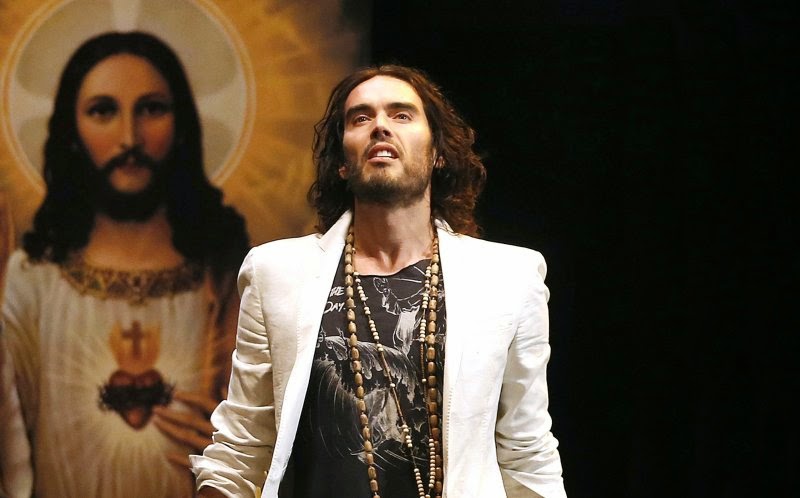
Russell Brand has been taking a beating from all corners over his most recent book, Revolution. Critics have called it naive, muddled, hypocritical, filled with factual errors and -- worst of all -- not funny. I haven't read the book and probably won't, so I can neither confirm nor deny the accuracy of these criticisms. Except for the factual errors. That is both demonstrable and pretty inexcusable. It happens: I once claimed Josemaría Escrivá was buried in Torreciudad and was corrected in a comment -- he's buried in Rome. While to my discredit, hell, it happens. We've written a lot on this blog; stands to reason mistakes will be made. But a major publishing firm should be better-equipped with editors and fact-checkers and someone who's plunged head-long into attacking basically everything the West stands for -- capitalism and democracy -- should come well-armed with a good grasp of the facts. Because if the facts are wrong, no one's gonna really listen to your opinions.
I kind of like Brand, and I'm sure he means what he says and just because the guy has "made it", it doesn't mean he's lost his right to critique the culture he's a part of. That said, he's clearly pissing in the wind and in the clips I've seen of him....well, let's just say he's not doing us any favors. (Which is a pity, because articles I've read by him are pretty engaging). A suspicious mind might even think that "they" have chosen the most likely candidate to bring discredit upon the large global phenomenon of "occupy"-style discontent....what reasonable person will be swayed by this hyper-kinetic ex-junkie?
I think the photo above doesn't require being an art critic in order to "get". Brand's beard, flowing hair, beads as vague spiritual accoutrement, his upward, somewhat beatific gaze....ok, ok, we get it. Just in case we missed it, we've got Jesus over to the left to hammer the point home.
So, Brand is out to save the world, he's got a messiah complex. Any message except for that he may in fact have something reasonable to say.
We've discussed the juxtaposition of public figures with Jesus or Christian symbolism quite a bit on LoS. The list and links at the end of America's Half-Blood Prince of Darknesscontains the best summary of these articles; I will avoid repeating myself refer you to that article. You'll find that this kind of photo is fairly common.
I saw a post from Juxtapozon Facebook the other day about Spanish photographer Ángela Burón and the following photograph caught my breast, er, I mean eye:
Mírame a los ojos cuando te hablo, 2014
A striking bit of photoshoppery; take a fine female form in what would otherwise be sexy as hell and Blam! You wanted to look at what is being revealed, taking a delicious pleasure in admiring such a form....but you find it's staring right back at you. Busted, fella.
Qu’est-ce que le Surréalisme? (What is Surrealism
Generally, a regular guy scoping out a woman is gonna try to steal a sideways glance or ogle from afar; unseen, you can get away with it. But what happens when you're caught in the act? Uncomfortable, to say the least. A bit embarrassed, maybe even ashamed. A sort of visual violation has been thwarted. And what if rape is, as is said, a crime not of sex, but of power?
But why this talk of violation and rape? Juxtapoz refers to Buron's work as "sneaky surrealism" and that's the trigger. LoS has dealt with the conflation of the breast and the eye in a number of posts; the Gid's introduction to the subject featured Magritte's Le Viol from 1934, in which the replacement of the nipples with eyes is reversed. Le Viol means "The Rape."
In the painting, a woman's face has become transformed into a nude female body. Her mouth is a vagina, her eyes have become breasts. The organs of sight and speech have been rendered into the principal objects of male lust. Blind and mute, Magritte's feminine form is rendered powerless. Thus, the rape. His interest in the concept was such that he painted other versions in 1945 in 1948, both also entitled Le Viol. He also drew it for André Breton's Qu’est-ce que le Surréalisme? in 1934 and a second drawing from 1945 was discovered relatively recently. Though the head is "facing" slightly left as opposed to right, the drawings most closely resemble the 1934 version. This page includes a more thorough interpretation of the image.
Qu’est-ce que le Surréalisme? (What is Surrealism
Le Viol, 1934
Contrast Magritte's painting with Burón's photo, which reverses the metamorphosis; Burón imbues the female form with power by turning the breasts into the watchful guardians of her image; interesting too that the lower part of the torso is revealed to such a point that her sex must lie but a millimeter south of where the frame ends. The gateway is out of sight. After all, it's self-evident: the photographer controls what we see....and what we don't.
In at least two posts (The Eyes Have It and There and Back Again), we've looked at the iconography of two Sicilian saints: Agatha carries her breasts on a plate and Lucia carries her eyes. In this Medieval Catholic context, the women are victims, martyred for refusing the advances of an unwanted pagan suitor. In a time when women were the pawns of men, who used marriage to create alliances and in all cases to consolidate their power, the breasts and eyes are inert, disembodied. Sex between a royal couple might have little to do with love or desire but everything to do with providing an heir or to consummate a marriage -- a deal brokered by others. In either case, for reasons of power. Is it such that we can call this rape?
Gid's initial post also features an 18th-century engraving of a woman with an eye in glory representing Reason in the place where her breast should be. Perhaps there's a pun involved, the areola being the circle of flesh around the nipple proper and the aureola a radiant cloud of light around a sacred personage. Not so odd when you consider Delacroix's Liberty Leading the People (1830), in which Marianne rallies the troops, leading with a prominent exposed breast. Then there's Honoré Daumier's 1848 sketch entitled The Republic, in which Marianne nurses two children. This is the state and it's values, foremost among them Reason, which nurtures and elevates the people. The breast leads, the breast nurses, the breast is generous. A controversial re-boot of Marianne in a local Mairie as recent as 2011 had to be replaced because her prominent set was causing a bit of a ruckus in the village. "I made the breasts prominent to symbolize the generosity of the Republic" said the artist. In this case, the breast symbolizes a form of power.
In our previous posts, we talk a little about why the eyes and breasts are conflated, but we suggest reading our source, N. Hilton's Before the Milk of the Word: Nipple-Eyes, for a more thorough treatment of the topic. He deals with Magritte and our Revolution-era engraving. The association is not really as outlandish as it seems. Imagine a kid's drawing with a circle and a dot in the middle; basically the same simple pictograph one would use to represent an eye or a breast. But it is much more than a visual metaphor. A nursing baby gets a windshield full of tit....before gazing up into its mother's eyes and letting out a satisfied belch, fed and secure. Primordial images, an association all breast-fed kidlets make from day one. Also makes me think of the time I was talking to a colleague and must have been staring chestward, because she said, "Hey, my eyes are up here!" And lo and behold, during my second run through this text I discovered that Burón's photos is called Mírame a los ojos cuando te hablo: "Look me in the eyes when I talk to you." When I talk to you. Not you talk to me. When I (eye?) talk to you....
But I'm just being lazy; read the Hilton article; he or she gives a good overview of the subject.
Then there's Ken Russell's Gothic. Required viewing for the budding bohemian/AP English film geek. One of the more disturbing hallucinations brought to the screen include the following; Percy Shelley is licking lips lustily over Claire Claremont's breasts and Blam! They're staring back, bub:
I seem to recall Claire is acting out Shelley's fantasy, "baring her breast and entreating him to look into her eyes", but when her nipples blink he turns away in terror. Those haggard peepers would set anyone off a bit of nipple play for a while I'd wager, but it's worth stating the obvious: the transformation of the nipples into eyes re-calibrates the balance of power.
Then there's this image I scanned from an article in a French magazine about sexual predators on the Internet. I uploaded this before in an article about Little Red Riding Hood but didn't include it in the original article. The eyes are rather wolf-like, which could indicate that women need to become like hunters themselves, in order to root out and destroy those who might otherwise prey on them. That this is all represented by the eyes is perhaps tied to the natural fact that the hunter always tries to see everything while remaining unseen to its prey. It's much more likely that the hunter will be successful if its prey isn't aware that it's being stalked. In this image the usually oblivious mammary becomes something vigilant, determined, if not a tad menacing.
.
Anyway, I don't have anything more to say on these images with regard to eye-nipple iconography than I've already said. Burón's photo struck a chord with me and since she was gracious enough to let me use it, I wanted to share it in terms of this question of power, that hadn't really occurred to me before.
I'm not much of an art critic, but I find her work to be at turns playful, sultry and erotic. She often reassembles the female form in a way that brings to mind the dolls of another Surrealist, Hans Bellmer, but without the undercurrent of violence and sadism his work emanates. On the contrary, her work is serene and not self-exploitative, she always remains in control of her image. She often looks the viewer right in the eye; in some, her camera is turned towards you. This is especially effective in a shot where she lies naked, her back to the viewer. But while she is out of focus, the camera in the foreground, trained upon the viewer, is not. Her camera, her eye, thus serves, in a manner we've already evoked, as a kind of protection. She is vulnerably naked, she can't even see you. But her camera can. You might ogle, but will probably turn your head when you realize you've been caught in the act. The viewed voyeur vanishes.
On a final note, a post script if you will, this makes me think of an organization based NYC called Hollaback!, whose goal is to end street harassment by, among other means, filming or photographing people who catcall, leer or make unwelcome advances, then putting it on the net. (Full disclosure, I'm an old friend of their Deputy Director's partner). In Burón's photos, she reminds us that shedecides how and when she can be approached; she is in control of her image and thus, her physical body. A scene often used in cinema is that of the underling squirming uncomfortably under the silent gaze of another character; it's a perfect representation of both character's perception of the power relationship between the two. The women in Hollaback! want to be the ones doing the looking. Looking someone in the eye can be discomfiting and that, in the end, is powerful.
Recent parliamentary elections in Bangladesh have resulted in violence, as these things are wont to do, claiming at least 21 lives as of January 6th. (Bharat Press). This photo was snapped on January 5th in Rajshahi by a Reuters photog:
I know nothing about Bangladeshi politics and am not sure if that violence is being played out today. No lack of respect intended but this shot seems so archetypal, kind of familiar. To the point, it reminded me of the following Tarot card, the 5 of Wands from the Rider-Waite Tarot deck:
The Rider-Waite deck was first published in 1909, illustrated by Pamela Colman (1878-1951) under instructions from mystic A.E. Waite (1857-1942), himself influenced by master occultist Eliphas Levi (1810-1875) and the Sola-Busca Tarot (ca. 1491).
Colman Smith, ca. 1912
Colman had been initiated in the Golden Dawn in 1901, putting her into contact with Waite. This commission is certainly her most widely known work; the deck itself is arguably the most widely-recognized. I think they're beautiful and after almost thirty years I'm still struck with a sense of wonder as I remove the cards from their hand-carved box with inlaid flower on the lid I bought for them. It's Indian, I believe (wouldn't it be more full-circlish if it had been made in Bangladesh). This box is a perfect size, as if it had been made to the deck's dimensions. This was an inexpensive item from Pier 1 Imports. My high school style relied upon Pier 1, my blue Mao cap (no red star) and Chinese slipper-type shoes were part of my daily attire. New Waver, dude. Strangely, these shoes were known among other people I knew as Jap Flats or even Pol Pots. Something along the line of the "they all look the same" branch of genetic research.
Those shoes cost about three bucks and at the beginning had woven cloth soles. Basically, they were a kind of espadrille; you could see them a lot in Kung Fu films, another 80's staple hungover from the 70's. Those Mao caps were also de riguer for the budding young bohemian back in the day.
Back when I was a pup, this was the only deck easily found...I think I bought mine in a B. Dalton's or Waldenbooks down the road from my parents' place--for 8 dollars even--in a strip mall near the entrance to Northdale, one of the way-too-numerous unincorporated collections of subdivisions in North Tampa with the usual insipid names, evoking rural tranquility and the genteel life. I often heard a snippet from Penelope Spheeris's Suburbiain my mind, a "sample" from the film found on the soundtrack: "Slums of the future...." Mainstream bookstores were much more limited in those days but you could still pick out some spine-tingling titles. How many times did I look at those glossy black paperbacks until my meagre allowance or hoarded lunch money accumulated into enough coin to acquire them? The Necronomicon, The Satanic Bible, orThe Magic Power of Witchcraft. I not only had to collect my money, but gather up my courage. I was a D&D kid and these books were powerful for me, exuding a kind of danger. I kept them discretely placed on my bookshelf behind such innocuous tomes as Singing Wheels or Little House in the Big Woods. Not because I'd get in parent trouble or have them confiscated, but I wanted to avoid a concerned talking to; plus, these were my private interests. A book of shadows should stay in the shadows.
The bookstore where I bought the cards might have even been the same place I plunked down a few dollars for Eden Grey's (Priscilla Pardridge, 1901-1999)influentialA Complete Guide to the Tarot, published by Bantam in 1970. I still refer to it from time to time on those rare occasions when I pull out the deck and have a go. When I read, I don't usually have the book meanings in my head, but I do like to sometimes take a peek in order to stimulate my thoughts. It was written with the Waite-Rider in mind and these cards illustrate Grey's text.
For a while in High School I ran with a group of self-styled Wiccans and that influenced my readings. Why not, I suppose, but I would have been much-better served if I'd dug more into the Bible, the Kabbalah and the Golden Dawn, which spawned both Wicca and the O.T.O. Wicca founder Gerald Gardner (1884-1964) and O.T.O. founder Aleister Crowley (1875-1947) had cut their teeth on its teachings and rituals. Crowley even designed his own Thoth Tarot deck, but in my opinion they compare poorly to Colman's graceful lines and the deceptive simplicity of their composition and symbolic content. Waite and Colman do less with more and her work has aged more gracefully; Crowley's additions just seem kitschy, crowded and contrived to be menacing.
Tarot for me is not about fortune telling, but it is a useful way to place some random data into a structure and contemplate the correlations: numbers, suits, reoccurring images, Major vs. Minor arcana. Hell, if we can use Rorschach inkblots to measure the psyche, why not Tarot cards? I run loose with the cards and stick to the so-called "Keltic" cross layout or sometimes (rarely) a simpler three card technique for a quicker way to inquire about relatively simple concerns; I think less about traditional meanings than I do at developing my own series of impressions based upon the internal correspondences and little details that might catch my eye. The meaning of a card, none of it inherent, changes anyway in terms of where it appears and in the relationship each card has with those around it.
I rarely look at the cards unless my wife mentions it and someone presses for a reading. Sometimes I'm half-lit by this point, which is not the best state to be in when working with systems more complex than a bottle opener. But some of these readings have turned out really well. I elicit commentary from the querent: "What do you see? What does this bring to mind?" I'm still excited when I begin to formulate a narrative while the querent is still throwing darts blindfolded (not literally!) The querent's wide-eyed recognition can be delightful. Not so much if the brow over the wide eyes is darkened.
Anyway, apart from the fact that I have a strange tendency to sleep in a position like the Hanged Man (XII in the Major Arcana), I have nothing here to add.
This was not intended to be a reminiscence or a "Tarot" post, merely a juxtaposition of two images. In the first we see men fighting in a field using staves over the results of a disputed election. In the second, we don't know the cause, but the strife and weaponry are the same. The sky is blue and the day seems lovely.
The Waite-Rider deck is simple, yet not devoid of complex symbolism derived from Waite's extensive mystical knowledge; in addition to the Golden Dawn he was a Freemason and Rosicrucian who'd later write extensively on ceremonial magick, the Kabbalah, alchemy and other Western esoteric traditions. I still refer to his New Encyclopedia of Freemasonry (1921) whenever I write about Freemasonry or related topics.
All that knowledge is distilled into a series of 78 clean-lined and finely composed images of a Goldilocks just-rightness.
I love coming back to an old flame from something so (superficially) unrelated. Time folds and the threads that keep the past and future bound together become visible. Tie up the fraying ends or tear through them, let it all drift apart. Apparently the ghost of someone, I can feel it overlooking my shoulder, is urging me on. But that could be something else entirely.
"Our most recent post about the phenomenon of photographers photographing politicians and popes so that a conveniently placed light or other applicable circle appears to form a halo around their heads also conveniently recapitulates LoS' collection of said photos, along with a small barrel, a tin honestly, of related images witch toy about with the air of human sanctity. Or devilry."
--J. Jonah Jameson
You can see some other examples here on LoS, or you can see how this photo actually niftily relates to the content of an article (Like Pope Francis? You’ll love Jesus.) in today's WaPo about the liberal love affair with our Lateran lad.
It doesn't take a particularly astute media observer to point out that Barack Obama has generated some extreme responses from the American public. It's tempting to say Americans either love him or hate him, but the former option seems to be dwindling....you'd be hard-pressed these days to find people who still say they "love" him. On the contrary, there's no shortage of hatred out there.
The kind of rhetoric in which we've been most interested here on LoS uses the language of religion. In the giddy days following his election we began to hear of supporters speaking as if Obama were the Savior. The Messiah in the form of a skinny lawyer from Chicago. While this was partly conservative satire of liberal response to his election, there were grounds for the criticism. For example, a 2008 cover story about Obama's popularity in the German magazine Der Spiegel was entitled Der Messias Faktor(The Messiah Factor).Newsweek's January, 2013 cover on Obama's reelection was entitled The Second Coming.
Perhaps even more widespread, however, has been the notion that Obama is a false Messiah, the Beast, the Antichrist. Searching for "Obama is the Messiah" or "Obama is the Antichrist" in Google images will confirm that I'm not simply making this up.
It occurs to me that both identifications serve to arouse the ire of religious conservatives; on the one had there are the people who genuinely believe that Obama is the harbinger of the End Times. On the other hand there are those who are offended that the media would make a comparison between Jesus and any secular figure, let alone one with whom they disagree politically. And then there are those who doubt his nationality and religious allegiances or feel a vague if not explicit uneasiness about what a mixed race President means for the future of the country; it becomes easier to understand why intimations of saintliness provoke--at a minimum--a hostile response. In an atmosphere as polarized as America today, where concession becomes a kind of treason, the rhetoric will become even more uncompromising; Obama not only isn't saintly, he's downright demonic. This is also why people will overlook their doubts about a baffling health care plan full of flaws and unanswered questions and proclaim their unreserved support for something so obviously "good" and why others would prefer to shut the government down than accept something which is so obviously "evil".
In this context, which is not a historical abstraction but a reality of the here and now, the image above will generate a certain Internet buzz or at the very least a ripple of murmurs.
Drudge asks: are those a devil's horns or the wings of an angel? Are we are seeing Obama portrayed as a modern-day Hermes? For some a welcome messenger and guide, for others a presumptuous conductor of souls trying to assume the role reserved for He of whom Obama is but a pale pretender?
Should we take note of the olive branch of peace or the sheaf of arrows? 13 leaves or 13 arrowheads. Forget the symbolism of of the original 13 colonies, we all know what the number really means, right? War and peace, black and white, give and take. Not much of this last dynamic happening on the tiled floors of Congress.
This photo was shot by AFP photographer Saul Loeb as Obama spoke about hurricane preparedness in the context of the budget debate and, as the captions says, on the 7th day of the government shutdown. Not so effective as an "Obama as God" portrait; to be accurate Obama would have to be resting....
But the wings or horns? photo gets at the heart of the social polarity in America today, which is not only being played out physically in Washington D.C., but in the mind of the country, where the war is being fought with symbols. And if this is happening in the halls of Congress and in the American Mind, it would, at least for millions of Americans, indicate a spiritual war as well. We can see the shadows on the wall engaged in furious struggle; it stands to reason there's something important going on outside the cave.
Somewhere out there, Jesus and Satan are locked hand in hand over the chessboard, tiled black and white, no give, no take.
Angel or Demon? Antichrist or Messiah? Choose your own adventure!
----
For further reading, here's a list of some other posts where we looked at odd photos of Obama, along with a few additional remarks in light of what I've mulled over today. In some cases, I linked to online reactions to them and in others I've only now sought it out. For the rest I don't know how people reacted....
In this odd picture, an academically-robed Obama is shot in such a way that he appears to be holding a glowing ball of light while giving a speech about health care. I think the photo was intentionally imitating a crystal ball, symbolizing that nobody knows exactly what the future would bring with regards to Obamacare. At the time, the photo elicited mostly bemused reactions, but there were some half-serious comments out there to the effect that the liberal media were suggesting that Obama is some kind of magician. Which of course has the additional capacity to offend as a celebration of the occult.
In another health care-related image, the Huffington Post placed a photo of Obama holding his hands in the air, hand in hand with his colleagues, next to one of a Byzantine mosaic of Jesus in a similar pose. The image was used to illustrate an article about Notre Dame (the university) suing the Obama administration because his plan mandated that birth control be covered. Is HuffPo taking a swipe at Notre Dame, comparing Obama and Jesus as two men who would advocate taking care of the poor? Or does is symbolize a face-off between secular and religious belief? I didn't read any comments on this photo, but I can only imagine that for many people there would be nothing innocuous about its rhetorical or symbolic intentions.
In this shot the Obama family is seen from below, Rio's Christ the Redeemer glowing in the background. This photo generated significant online commentary by many who saw it as crude propaganda that associates the Obama family with holiness; the nimbus of white light, the protecting arms of Christ looming in the background, the angle of the shot which is as if the viewer gazes up at the family....
In this shot Obama has a weird haughty look to him, his up-tilted head framed in such a way at to form a kind of circle within a black triangle I didn't see any comments about this one, but I wondered then if Drudge used it to a) suggest the Eye of Providence to recall the Illuminati, a kind of guilt-by-association tactic or b) suggest a black KKK hood, evoking the reverse racism the man is accused of harboring not so deeply within. (A quick search of the image does reveal that in a few instances people associated with the NWO, the Eye in the Pyramid or a pyramid with detached capstone.)
This is a series of shots where both Democrats and Republicans are framed so that they appear to have halos or appear at the center of the cross. I think these are certainly intentional and probably satirical comments on how politicians frame their political discourse in moral terms. This set does not include Obama.
This was also a controversial shot, which generated a firestorm, or a least a fire-shower, of online comments. Obama appears to have both halo and nimbus and a white cross hovers in the background. Like the Rio pic, it is shot from below so we are looking up at him on high. In this case, the cross was not part of the shot but was photoshopped into the image. Conservative commentators saw an example of liberal bias, the deification of Obama. This shot was used to illustrate an article about health care, which is why, according to some, a cross was an appropriate backdrop.
----
I first saw this current AFP photo with the question about "wings or horns" on Drudge at about 12 PM in France on 8 October but by 3 PM it was no longer there. Fortunate The Blazeincludes a brief quip about Drudge's editorial choice, including a screen shot. Quick work! The Blaze wrote about it yesterday, so the image was apparently online for a while. Odd is that Drudge called it a "shock" image, and asked the "horns or wings?" question, but he wasn't linking to an article; he linked to Yahoo news which merely carried the photo and named the photographer, date and event. Apparently, Drudge is unaware of the long history of religiously-charged photos of Obama, or merely looking for another small way, like I think he did with the "eye in the triangle" photo, to feed anti-Obama resentment. Which is his right, of course. He's hardly secretive about his political orientation nor subtle with the articles he chooses and the titles he gives his links.
Makes me think of another photo someone sent me and which I put onto my website long ago, not too long after 9-11. I don't recall where it came from, and I've never seen it elsewhere, except where someone has either hotlinked it or downloaded it and uploaded to their own site. I guess we can add the horned President genre to world leaders giving dubious "Masonic" handshakes or flashing the famous "sign of the horns" collections so plentiful on the Web. Just for kicks I did a Google images search on the following image it has been reproduced by quite a few sites around the world. You can see that all its current online uses ultimately derive from that single source, because they all have the telltale signs of having been scanned from newsprint. That means a proper digital original hasn't been made public. So it's kind of cool that I let this thing out into the world years ago and it's still alive. It'd be interesting to know who took it first and how it spread after that. But viral standards these days, it's still pretty limited, but I still have that tattered bit of newsprint somewhere.
So, here it is, SHOCK photo of George W. Bush. Definitely horns.
Please check them out and then go onto the other brilliant photo sets.
Pictured are:
the doors of the Zavala State Archives and Library Building, Austin
statues of Sam Houston and Anson Jones in front of theZavala Building
a Masonic Temple in Dallas
Scottish Rite mosaic and sculpture of the double-headed eagle
a window in the General Land Office with a pair of six-pointed stars
a Ten Commandments monument which led to a Supreme Court Case, decorated with an All-Seeing Eye
This last monument has an interesting history. Presented to the city in 1961 as a kind of weird tie-in to Cecil B. DeMille's The Ten Commandments, it led in 2005 to
a United States Supreme Court case involving whether a display of the Ten Commandments on a monument given to the government at the Texas State Capitol in Austin violated the Establishment Clause of the First Amendment.
The court ruled it didn't. What intrigued me about the monument is that the tablets have another image of the tablets contained within them, in a strange lettering.Looking into this I came across the following post. The Ten Commandment Tablets actually pictured in the DeMille film used a classic Reformed Christian Church version of Ten Commandments divided into four and six. The chiseled lettering was "early Canaanite type".
Of course, those pictured in the DeMille film are those pictured in miniature on this monument. The writer of the first post I ran across is Avrahaum Segol, a Jewish activist who sees the monolith and the film as an attempt to Christianize the Ten Commandments and promote Christianity. He may have a point. I've actually written about Segol before. He was the guy who
claims the swastika shape of Wesley Acres in Decatur pays homage
to the German scientists who came to nearby Huntsville after World War
II and designed the rockets that put Americans on the moon.
Segol's got a hard graft ahead of him:
Between 1955 and 1985, more than 150 monoliths were dedicated in 34 states and Canada. (here)
In any event, a less shrill history of the FOE monuments can be found here:
Fraternal Order of Eagles stated mission is to unite fraternally
for mutual benefit, protection, improvement, social enjoyment
and association, all persons of good moral character who believe
in a Supreme Being to inculcate the principles of liberty,
truth, justice and equality, to perpetuate itself as a fraternal
organization and to provide for its government as it's Constitution,
Laws, Rituals, by-laws or other rules and regulations may from
time to time provide, and to promote the general welfare, the
Fraternal Order of Eagles ordains this constitution.
The officers of a Fraternal Order of Eagles Aerie are:
Worthy President, Worthy Vice President, Junior Past Worthy
President, Secretary, Treasurer, Worthy Chaplain, Worthy Conductor,
Trustees, Inside Guard, and Outside Guard.
The mission and officers listed here lead me to believe the FOE was influenced a great deal by Freemasonry. Phoenix Masonry furnishes an initiation ritual. If you're familiar with Masonic ritual, you can decide for yourself if it influenced the FOE, or not.
Strange thing is that Kindle says "You may notice that the photo I took of this Black Madonna is NOT the same statue as the Black Madonna in the blog where I’d found her first. Similar, but not the same. Another mystery never to be solved."
I say "strange" because I think it is the same statue, merely a different angle! I left a comment to clear up the mystery, but it's true that the lips in my shot seem to be redder. Also, the niche behind her in my photo is decorated with war medals, whereas Kindle's is not. This doesn't seem too mysterious to me, these things change depending on the season, but Kindle's right, it is kind of curious.
What do you think?
My initial photo of Notre Dame de Bonne Délivrance.
Kindle's photo.
A previously unpublished shot at a similar angle to that of Kindle's.
I think that the different angles distort the appearance of the statue and that the color differences are due to a different quality of camera. Mine being a pretty cheap model that I'd given up for dead after my son tried to use it underwater....and obviously started working again. Maybe it just brings out the colors in a wonky fashion as a result of its mishap, as one can see in the background color and the architectural elements.
I'd say the medals were ex-votos on temporary display (or had been permanent and then removed for some reason by the time Kindle took her photo). Unless it's merely a camera issue, is it possible that the nuns she watches over had applied some makeup for the occasion? I actually doubt that explanation, but I know that some Marian statues get a change of clothes according to the liturgical season, as a Google images search for Notre Dame de la Daurade demonstrates.
"Clothes were cut for all kinds of statues – from great icons in sanctuaries and the mannequins used in religious processions, down to the tiny statues of Mary worshiped in convents and household chapels," said Maximilien Durand, the show's curator and director of the Lyon Fabric Museum. "They were dressed like real women, like fashion icons, with real hair, wigs, even make-up."
So while I still doubt Mary's got lipstick on, it wouldn't be entirely without precedent.
Of course, judging by reactions to a 2012 incident in Brooklyn, this old practice probably didn't include making up the Mother and Child to look like members of KISS....
Gene "The Virgin" Simmons and Paul "Baby Jesus" Stanley
My friend Pinto and I are going to present some of our work -- collages, photography and assemblages -- at Les Pavillons Sauvages. The opening is on March 16 at about 8 o'clock and will be soundtracked by our friends Habsyll, before morphing into a full-fledged set as the night grows later. Habsyll describe themselves as "Anti-humanistic, experimental Drone/Noise Doom". Hey hey!
Beer and wine and rum shall flow, the "art" full of blood and piss and bones. Come one, come all for a good evening of art and music and booze.
Pavillon Sauvages: 35 Avenue Jean Dagnaux, 31200 Toulouse (Map)
Gid, who is agog, thanks Daurade and author/poet Jon Frankel for their research assistance and editorial input. In our previous post, we exposed a long-rumored picture, possibly of Thomas Pynchon, that was hiding out in plain site (hyuk hyuk) on the Internet. We also dropped (an admittedly small) "bombshell": "we founda reference to another heretofore unknown photo of Pynchon!" Now we're back with follow up, as promised.
I'd like to start by framing this article in a way that's not stalker-ish: "This is a search for better perspective on events that feel pivotal to '60s student movements as well as Pynchon and Farina's artistic concerns and themes; and we actually hope to dig up juvenalia by Pynchon or Farina!" In fact, those previous statements *are* entirely true ... about our previous post. But the truth is, in this case, we were just plain old curious about an apparently unknown reference to an unrecognized yet allegedly publicly availablephotograph of Pynchon. Gid sniffed something that grabbed him, and off he went blood-hounding.
But be fair to us: As with our previous post, everything we've presented is all quite public, and we're amazed no one else has presented it yet. Furthermore, Pynchon himself once reportedly said, "Not bad. Keep trying" in response to a story postulating that he was Salinger, so what's wrong with trying to locate a public photo? Finally, we think that Pynchon has a sense of humor about this stuff; he did, after all, voice his own character on the Simpsons in a small skit that clearly poked fun at his aversion to being photographed.
"Pynchon on the Simpsons" is a tongue twister!
So...here we go.
The Source of the New Rumor The reference we found was from from a 2010 questionnaire for Cornell alumni. The answers were, oddly, posted online. One of the responses was:
Outstanding Cornell memory: President Deane Waldo Malott was burned in effigy, and a photo of Tom Pynchon, Kirk Sale, Richard Farina and Todd Perry made the front page of the NY Daily News under the Headline “Coeds Riot for Sex.”
This is not, as far as we know, something that has been mentioned in any rumor of Pynchon photos, much less something that has been "found" or discussed. Given the paucity of Pynchon pics and the interest among Pynchon fans have shown in this topic over the years, this silence was too tempting to gloss over.
The recollection is from Julia Werner '61; there are numerous mentions in the Sun suggesting that she would have personally known the people she mentions. In 1958,the Sun reported that Werner won a short story competition sponsored by the Writer. The upperclassman prize went to Fariña. One year later, in 1959, the Sun reported that she was elected prose editor of the Writer. In January, 1960, the Sun carried her book review of an anthology of student work; it's well-written and absolutely brutal (let's hope she doesn't review this blog). One of few pieces she praises was written by Fariña. Just beneath this review is a letter by Hadley S. DuPuy, whom you may recall from our previous post. DePuy's letter is written to recruit students to join a team participating in a college bowl quiz. Interestingly, Werner ended up joining the team. In December, 1960, the Sun reported that Werner had three stories published in the first edition of the Trojan Horse; others in the edition included Curtis, Fariña, and Baxter Hathaway--all of whom we discussed in our last post. A review in the Sun two days later called one of Werner's inclusions, which was the lead piece, the "finest" story in the publication.
At a time when Cornell's English department was chock-full of highly talented students, including Pynchon and Fariña, these are remarkable accomplishments--and bear in mind that we only highlighted Werner's achievements that were somehow related with the people she mentioned in her recollection.
Before We Start, What's This About a "Riot for Sex"? Starting on May 23, 1958, thousands of Cornell students protested against the school's in loco parentis policy.
The protest was started by Kirk Sale, a good friend of Thomas Pynchon. The demonstration began peacefully enough, but it soon took a nasty turn. After burning an effigy of Cornell's President, the students marched to the President's house, despite Sale's pleas for them to stay put. Students hit the President with eggs, and by some reports, a smoke bomb was tossed into his house.
The story was picked up in the national news, with coverage lasting for several days. What were the student's concerns? Speaking about the cause of the protest, Sale stated:
We feel that the Administration, during the past eight years, has consistently hampered the rights of both the students and the faculty ... The Administration of Cornell has so often ignored the student's voice and so regularly refused to establish any effective channels of communication that a public demonstration was our only recourse.
Other articles cast the net wider, addressing issues related to fraternity vs. non-fraternity disputes; facility scholars vs. facility creative writers; and academic freedom vs. censorship pressures from the Postmaster General (that last point seems relevant to The Crying of Lot 49). See our "Annotated Bibliography of the Protest Coverage" at the bottom of this post for some recommended discussions, responses and analyses of these events, if you're interested in learning more.
This litany of student grievances was, however, mostly ignored by the press. Even The Harvard Crimson, which one would suspect of being sympathetic to the Cornell students' point of view, wrote only of the immediate events and ignored the larger context, stating, "The students were protesting a proposed ruling that co-eds no longer be permitted to attend unchaperoned parties in off-campus rooming-houses." They focused on the last straw, and not the hay bale which preceded it.
So it's easy to leap to the conclusion that this was a riot for sex--but it still takes a salacious liberty, which newspapers, quite frankly, ought not to do.
The Hunt for the Daily News Enough with the background; it's time to chase the New York Daily News! Unfortunately, despite its large readership, the paper has not been indexed and it's electronic archives do not go back to 1958. Fortunately, Gid lives near a big university, so one evening he went into the university library and down into the basement where microfilms are stored. (Not to air our dirty laundry, but Daurade noted that "Cornell's Olin Library also stores microfilm in the basement--surely a practical consideration given the need for rear-projected light to read them--theaters don't have windows, after all". The Gid counters that, like Gilligan watching bicycle-powered TV, he read the Daily News' microfilmed archives on a computer screen, this being 2013, though he suspects that Daurade's correctly peeled back a layer on the palimpsest.) [Gid, this may be 2013, but I read this in 2000 and even now they still use those back-lit machines!]
Anyhow, the Cornell protest was on May 23, 1958, and other newspapers (e.g., New York Times) stopped discussing it after a couple of days, so Gid scanned through the microfilm from May 24 - 31, 1958. And there it was!
Protest at President's House, President Circled (AP Photo in the Daily News)
Or maybe not. (Sorry, but the AP photo had a circle around President Malott. Couldn't resist yanking your chain.) The Daily News' coverage had a different title: "Cornell Boots 4 in Egg Tossing" (May 25, 1958). The title we wanted, "Coeds Riot for Sex", sounds like it's going for yucks and offering editorial interpretation of facts. The article we found, however, sticks to facts, even if a few details were later challenged and the presentation lacked balance insofar as it seemed to down-play the concerns of the students. The picture is pretty blurry, but it's clear enough to see that the same picture appeared in the The Cornell Daily Sun in a "SUN Staff Photo Feature" which credits all images to Sun staff photographers (Volume LXXIV, Number 14, 26 May 1958, "Students Protest Administration", p. 7, various Sun staff photographers listed).
Protest at President's House (Staff Photo in the Sun)
We took a pretty careful look at these photos, and we did not see anyone who looked like Pynchon or
Fariña, although we're less sure about Sale or Perry. These are grainy photos with lots of people, though, so we may have missed something. What do you think? Did we overlook something? (By the way, President Malott is circled in this picture, too; it's just harder to tell.)
Another Clue! Overall, something wasn't adding up. We certainly understand that 52-year-old recollections won't be impeccable; besides, Werner wasn't listing out facts for a court or newspaper; she was just reminiscing. Still, the title and tone of the article didn't feel right, and the photo didn't look right.
What next?
While poking about that May 26, 1958, edition of the Sun, Gid noticed a little article on page 3 called "Press Views on Mass Action"; this article listed several other papers' coverage of the protest, including, "Four Suspended by Cornell After 2-Day Riot Over Girls" in the New York Journal American.
Now that sounded an awful lot like Werner's recollection of a "Riot Over Sex" article!
So, Gid and Jon tried to find the New York Journal American [NYJA]. It was not, however, available at any institutions they could access. It looks like 1958 was never archived electronically. Very few places seem to have it on microfilm, and when Gid searched the catalogs of libraries with the microfilm who might be willing to offer an inter-library-loan ... he kept finding spotty coverage that missed the desired time frame (May 1958). Gid checked with a large number of librarians across the country (LIBRARIANS ROCK!!!), but at the time this post was posted, Gid was still searching for a library with the correct microfilm, waiting to hear back, for example, from the Library of Congress and the New York Public Library periodical reference services. (That's not criticism; these two institutions are still well within a reasonable window to reply.)
It was starting to feel like a Pynchonesque quest, kind of like Crying of Lot 49 or V..
There's More Than One Way To Skin a Cat
It was time for another approach. According to the Sun's "Press Views on Mass Action", the NYJA's article is from the AP, and the same AP article was run in the Binghamton Sunday Press and the Buffalo Courier-Express. With the help of a kind librarian, Gid found two articles in the Binghamton Sunday Press' coverage of the events. Both had differenttitles than the NYJA, but papers are allowed to change the text/title of AP articles. One of the Binghamton articles also had a picture, the first in this montage:
From left to right: Sale from Binghamton Sunday Press; Sale from the Sun; Sale showing sling (Sun); Sale from '72 sketch
This photo, however, is only of Sale. Do papers alter the photo(s) that they include with AP articles? "Yes, Matilda, they do", sez Daurade. In other words, we still don't know what photo was in the article that Werner referenced--the reference that started this chase.
By the way, does anyone know why Sale's right arm is in a sling? It's a little tough to see in the Binghamton's copy of the image. You can see it a little better on p. 8 of the May 26, 1958 Sun and even more clearly in a different picture of Sale on the preceding page (see images 2 and 3 in our Kirk's sling montage). It is also clearly reproduced in a drawing on p. 12 of the June 1972 Cornell Alumni News(large PDF warning!) which we included as image 4 in the preceding group of photos.
We noted that this photo, like the previous photo, was credited to AP but also appeared in the Sun as credited to Sun staff photographers. The exact same picture appears in the Utica NYObserver (big PDF) credited to the AP.
Which got us to thinking...
As Planets Orbit the Sun As far we can recall, every photo that we've found of the event also appeared in the Sun, so, Gid proposed a theory: perhaps the Sun was the only paper with photographers on hand; the Sun turned over their photos to the AP; and other newspapers got them from the AP. Was this why Pynchon praised the The Cornell Daily Sun so highly, calling it "the Sun, an observation point on high"?*
Seriously though, that would explain why the Sun credits the photos to Sun staff photographers while other sources credit the exact same photos to the AP. (By the way, May 26, 1958, Sun, p. 7, credits seven staff photographers; one of them was Bob Wegryn, who also shot the photos for the dueling article we wrote about in our previous post.)
Ironically, as the Sun didn't print on the weekend, they ended up running these photos a day or two after they had already appeared in other sources, which makes the record look wonky. For example, the photo we included with Cornell's president circled is from the Daily News, May 24, 1958, credited to the AP -- but the same photo appeared in the Sun two days later credited to Sun staff photographers.
Our friend Jon tried to poke a hole in this theory (which is what I expect friends to do; moreover, Daurade reports that Jon has a deeply ingrained poke fetish) by asking if we'd checked the Ithaca Journal, which could have presumably gotten photographers to the scene quickly. Gid's cursory check turned up no photos of the event in the Ithaca Journal, but this is something worth a follow up by any enterprising researchers (none being found on our staff). If Gid's theory is correct, then whatever photo is in the NYJA is one that we've already seen in the Sun, none of which appear to include Pynchon -- but we'd like to know for sure; we'd also like to see which photo prompted Werner to make the comment.
Finally, we'd like to know your thoughts on the pictures in the May 26, 1958, Cornell Sun! To the extent that all leads seem to trace back to this one edition of a small paper, we feel like we're investigating the universe in a grain of sand. It's entirely possible that we are, as a previous commentator suggested, stirring a tempest in a tea cup; hell, our previous post now comprises about 3% of the hits that this entire blog has received in the past five years, but, as Daurade has previously mentioned, "we feel there's value in looking at the little things".
* Mason & Dixon, p. 707, but we're totally kidding. We dragged this quote completely of context; it has nothing to do with newspapers.
1. We found a reference to "a photo of Tom Pynchon, Kirk Sale, Richard Farina and Todd Perry [that] made the front page of the NY Daily News under the headline "Coeds Riot for Sex.'"
2. The Daily News didn't have an article with that headline, but it did run "Cornell Boots 4 in Egg Tossing" (May 25, 1958). We don't think that article's photo (see above, with President circled) includes Pynchon or Fariña. Do you?
3. The New York Journal American (NYJA) did have an article called "Four Suspended by Cornell After 2-Day Riot Over Girls", but we couldn't find a copy. Can you?
4. The NYJA article was from the AP. The Binghamton Sunday Press and the Buffalo Courier-Express ran the same AP article. Does this mean they included the same photo? The Binghamton Sunday Press' article has a photo, but it's only of Kirk Sale. (If you want to see it, scroll back up and rtfa.) 5. We think that the Sun was the only paper with photographers on hand; that the Sun turned over their pics to the AP; and that all photos of the event stem from the Sun. Can you prove me wrong? If we're correct, then whatever photo Werner was recalling is probably in the May 26, 1958, Sun. Do any of the pictures there look like the right one to you?
The Cornell Daily Sun, Volume LXXIV, Number 147, 26 May 1958.This was the first edition of the Sun to come out after the protest. Many (all?) of the key students in the protest were English Lit majors and many were involved with the Sun, so the coverage is extensive and high quality. Numerous photos. We believe the Sun staff photographers may be the sole source of photographs printed in the state and national media of the event.
Cornell Alumni News, Volume 60, Number 18, 15 June 1958, "Students Protest University Relations; President Promises Conference Group", author unknown, p. 621-623 - Strange pagination; actually starts on p. 7 of the scan. Good coverage of the protest (but a large PDF). Cornell Alumni News, Volume LXXV, Number 141, 15 May 1959, "WEEKEND OF SIN! Halfway Down The Gorge--In SLIME and FILTH!" p. 2, by Hermione Dopkit as told to Stan Werbul (both presumably pseudonyms) - Not coverage per se, but a good example of satirical commentary by the students. As we noted in our previous post, The Cornell Daily Sunused joke articles like this to poke at the administration. This was one of the more extreme examples; others, like the dueling article we highlighted last time, took more subtle, well, jabs. Been Down So Long It Looks Like Up to Me, Richard Fariña, 1966. Fariña, who was eventually charged as a result of his leading role in the events, wrote an entire novel built around the protest.
Cornell Alumni News, June 1972, "Writers &; Teachers", by Geof Hewitt '66, p. 10 - 15. Large PDF! The protest coverage doesn't start until p. 13 (top of second column), but be sure to check out the drawing on p. 12. The Cornell Daily Sun, 5 May 1978, "Hathaway Recalls Cornell Writers of the 50s", p. 31 and 38 - Unfortunately, this specific issue hadn't made it into the online archives at the time we published this article, but if you'd like a copy, drop us a note. Good coverage of the protest, especially of some of the key players. Traces sources of discontent back many years to a censorship event related to the postmaster general. Also looks at some divisions within the English department over the same time span.